

Adding a New Dimension to Spiritual Direction Training

Introduction

Spiritual Direction, also known as Spiritual Companioning, explores various practices that develop and deepen a relationship with God, the Divine, or a Higher Power, in accordance with what is most resonant with the directee. It involves a combination of holy listening and asking questions that assist the individual in noticing and discerning the movement of Spirit. Previous scholars have shown that adding Emotional Intelligence and Spiritual Emotional Intelligence to training for religious leaders is a helpful adjunct to the more typical focus on spiritual formation.

Background Story

While many programs train Spiritual Directors in a broad overview of modalities, most do not include Emotional Intelligence (EQ) and Spiritual Emotional Intelligence (SEQ) as part of their curriculum. As her project for her Doctor of Ministry degree, Lynette Vaive used a combination of the two with Spiritual Directors in training at the Haden Institute in Hendersonville, NC. As a graduate of the program at Haden, Lynette was curious to learn if EQ and SEQ would assist the individuation and personal development of students preparing for practice as Spiritual Directors.

Process

Lynette and Jim Vaive worked with volunteers from three different groups of Spiritual Direction students at Haden: a low residential group, a virtual group, and a control group. For both the low residential and virtual groups, students completed a single assessment to measure their EQ and SEQ near the beginning of their two-year training at Haden. For those groups, a personal debrief and workshops were followed by weekly emails for 10-12 weeks to reinforce the learning. The EQ work prepared the foundation early in their training and was followed then by the SEQ work approximately 3 months later, following the same pattern. The control group completed the assessment but did not receive their reports, the personal debrief, workshops or weekly emails. Approximately 14-16 months into the Spiritual Direction training, the students took the assessment again for post-intervention measurement, and pre-intervention and post-intervention results were compared.

Outcomes and Data

The data comparing the pre- and post-intervention EQ and SEQ scores showed several significant outcomes:

  • Students who engaged in the learning showed more significant changes than those that did not have capacity to take advantage of the suggested ways to practice both EQ and SEQ. This reinforces the need for continued practice for further development of EQ and SEQ.
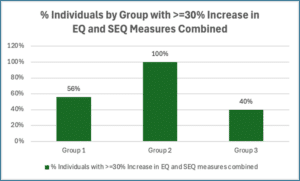
  • While the EQ and SEQ interventions separately showed mixed results, the combination showed the most powerful results: a 56% increase for low residential group 1 and a 100% increase for virtual group 2, as compared with a 40% increase for the control group.
  • The nine SEQ tiles, as actionable ways to put SEQ into action, showed increases across all groups, including the control group. This shows the natural alignment between the SEQ framework and spiritual direction training.

Conclusion

While the number of participants in this study was too low to establish statistical significance ( Group 1 N=9; Group 2 N=6; Group 3 N=10 at project completion), the data indicates that when participants were fully able to engage with the learning, there was often very significant gain in their EQ and SEQ scores. Further study is indicated to see if these findings would be replicated at a different Spiritual Direction program and with different groups of students. Overall,  This is best summed up in these comments from project participants:

  • Seeing the connection between emotional awareness and spiritual growth was a game changer for me. I would like to continue to learn more.
  • I think learning about EQ and SEQ will help me to be a responsible and helpful spiritual director.
  • I found value in this. Period. And I’m looking forward to drawing upon what I’ve learned—not just with my clients but in my own loved life.