Posts

I Damaged Someone & The Truth It Taught Me

There is a picture my mother drew of my father in his studio. He is standing at the canvas with a brush in his hand, but he is not painting. He is looking. Just looking. My mother told me once that the hardest thing about being an artist is not the making — it is the seeing. Seeing what is there, not what you hoped would be there. Seeing clearly enough to know when something is wrong, even when the wrong thing is something you made.
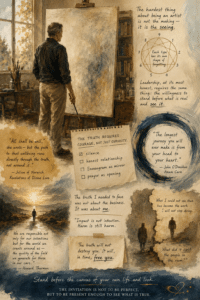
I have thought about that picture a lot over the years. Especially in relation to leadership. Because leadership, at its most honest, requires the same thing my father was doing in that studio: the willingness to stand before what is real and see it — not manage it, not spin it, not quietly maneuver around it — but see it. And the hardest version of that seeing is always the one that turns inward.

When Lynette and I were building the spirit of EQ framework, we kept returning to a question that came up repeatedly in our coaching and spiritual direction work: why do so many gifted leaders struggle with self-awareness? Not because they lack intelligence. Not because they are unkind or unserious. But because the very qualities that made them effective — decisiveness, energy, forward momentum, the ability to hold a vision and drive toward it — can become the walls of a room they eventually cannot see out of.

The Enneagram has a word for this. It calls them fixations — the grooved, automatic patterns we operate from when we are running on autopilot rather than on presence. Each type has its own shape of forgetting. And the forgetting is not dramatic. It is quiet. It accumulates. It happens in the ordinary press of days, under the ordinary pressure of responsibility, until one morning you look up and realize the wake you have been leaving behind is wider and more damaging than you ever intended.

I know this from my own life. When I co-founded Varment Guard, my business partners were good people — steady, quiet, deeply competent in their domains. But one stands out for me, he did not move fast. He did not think fast. He processed carefully, methodically, and he was almost always right. I am a classic Enneagram Eight. I move fast. I decide fast. I push hard. I burned through rooms in those early years the way a locomotive burns through a tunnel — arriving on the other side with energy to spare, rarely pausing to consider what the air felt like for everyone else inside.

In the beginning, this particular partner and I worked well together. His steadiness balanced my fire. My drive opened doors his caution would have approached more slowly. But as the business grew and the pressure intensified, I lost access to that balance. I stopped seeing my partner clearly. I started seeing only the pace I needed us to keep, and I began — unconsciously, relentlessly — forcing this gentle soul into a shape that was not his. I pushed him beyond the edges of who he was. I did not mean to damage him. But I did. And eventually, he left. Not loudly. Not in conflict. He simply found a way out, and the relationship went with him. It was a wound I have carried for a long time.

What I could not see then — and what took years of coaching, spiritual direction, and a lot of sitting still to begin to understand — was that the truth I needed to face was not about the business. It was about me. The Eight’s deep gift is strength. The Eight’s deep shadow is the refusal to acknowledge the harm that strength can do. I had confused impact with intention. I believed that because I did not mean harm, I had not caused it. That is not how it works. That is not how it has ever worked.

The contemplative tradition is clear about this. Howard Thurman wrote that we are responsible not only for our intentions but for the world we create around us — the quality of the field we generate for those in our care. Julian of Norwich, writing from her anchorite cell in fourteenth-century Norwich, described the interior life as a dwelling place — something that requires tending, requires honest inspection, requires the willingness to see what is there rather than what we prefer to believe is there. “All shall be well,” she wrote — but the path to that wellbeing runs directly through the truth, not around it (Julian of Norwich, Revelations of Divine Love).

The research on emotional intelligence affirms what the mystics knew intuitively. Six Seconds, the global EQ nonprofit where Lynette and I served for many years, identifies self-awareness as foundational to every other capacity in the emotional intelligence model. You cannot regulate what you cannot see. You cannot choose your response when you are unconscious of your pattern. You cannot lead others toward wholeness from a place of unexamined wounding. The data bears this out across industries, cultures, and leadership contexts. Self-awareness is not a soft skill. It is the load-bearing wall.

But here is the thing about truth: it requires courage, not just curiosity. Many leaders are curious about themselves in a managed way — they take the assessments, they read the books, they sit in the leadership retreats. What is rarer is the willingness to let the truth land. To let it cost something. To sit with it long enough that it changes not just your language but your behavior, your relationships, the shape of the wake you leave. The contemplative teacher Thomas Keating called this the dismantling of the false self — the slow, sometimes painful process of releasing the persona we have constructed to protect ourselves and facing what is underneath (Thomas Keating, Open Mind, Open Heart). Most of us will do almost anything to avoid that process. Leaders perhaps most of all, because the stakes feel so high and the exposure feels so total.

John O’Donohue, the Irish poet and philosopher, wrote that “the longest journey you will ever make is from your head to your heart” (John O’Donohue, Anam Cara). I think of that line often when I am sitting with a leader in a coaching session, watching them circle a truth they cannot quite bring themselves to name. The truth is right there. They can feel it. But the distance between knowing it in the mind and letting it descend into the heart — into lived acknowledgment, into genuine accountability — can feel enormous. That journey is the work. And no amount of strategy, no quarterly planning cycle, no leadership competency framework can do it for you.

What helps? In our experience at spirit of EQ, several things. The practice of silence — not productivity, not journaling as output, but genuine quiet that creates the interior space for truth to surface. The practice of honest relationship — at least one person in your life who is not dependent on you, not intimidated by you, and will tell you what they see. The Enneagram, used not as a typology to explain yourself but as a mirror to face yourself. And prayer — whatever form that takes for you — as an act of opening, of consenting to be seen more fully than you can see yourself.

I did not get a chance to repair things with my partner. That is a grief I live with. But what his departure gave me — painfully, slowly, over years — was the beginning of something more honest in myself. A willingness to slow down long enough to feel the field I was generating. A willingness to ask not just “Did we hit the goal?” but “What did it cost the people in the room?” That shift did not diminish my leadership. It deepened it. It made me someone I am still, imperfectly, trying to become.

The Truth Leaders Don’t Want to Face

My father’s picture still lives in my mind. The brush in his hand. The stillness of his looking. The courage required to see clearly enough to know what is true and what is wish. That is the invitation for every leader who is willing — not to be perfect, not to have it all resolved, but to stand before the canvas of your own life and look.

The truth will not destroy you. It will, in time, free you.

If this reflection stirred something in you, we’d love to have you join us at mysticalseeker.substack.com — where we explore the inner journey of leadership, EQ, and spiritual formation.

Peace and every good.

mystical seeker.substack.com

Desert Wisdom: Context is Everything

Reflecting on where we stand in life and the decisions, we make is not a luxury reserved for philosophers or the privileged; it is a practical necessity for anyone who shoulders responsibility—whether as a leader, a parent, a partner, or a friend. Every choice we make ripples outward: policies we endorse shape communities, the tone we set in our family’s shapes children’s emotional landscapes, and the way we respond to friends in crisis models what compassion looks like. When the pace of life accelerates and the noise of competing opinions grows louder, pausing to reflect helps us separate what is urgent from what is important. Reflection is the practice of stepping back long enough to see patterns, notice motivations, and weigh consequences. It gives us the mental and moral space to act with intention rather than reactivity, to lead with clarity rather than impulse, and to love with presence rather than distraction.

This capacity for reflective life is under strain in times of social, political, or spiritual disruption. Anxiety narrows our attention; polarization simplifies complex choices into binary demands; and scarcity—of resources, attention, or trust—pushes us toward short-term fixes instead of sustainable care. Yet precisely in such moments, reflection becomes more valuable. Leaders who cultivate a reflective habit are less prone to adopt popular but harmful policies; parents who slow down can respond rather than punish; friends who listen deeply become anchors when networks fray. Reflection is not passivity; it is a form of preparedness: an inner readiness that allows us to respond to external turbulence with steadiness, wisdom, and, crucially, hope.

There is deep, practical help available if we look to the contemplative practices of earlier generations. The desert mothers and fathers—Christian ascetics who retreated into the deserts of fourth- and fifth-century Egypt, Palestine, and Syria—faced their own forms of upheaval. Their world was marked by the collapse of old political certainties, shifting religious allegiances, economic insecurity, and the daily challenge of survival in a harsh landscape. Communities and institutions that once felt permanently secure were in flux. In that context, these seekers turned inward, developing practices designed to anchor the heart and clarify the mind: silence, disciplined prayer or attention, fasting, communal counsel, and a rigorous form of discernment aimed at identifying the motives behind action.

It’s easy to caricature the desert fathers and mothers as isolated oddities, but their practices emerged from and responded to real social stress. Solitude was a tool to remove the cacophony of public life and to make the inner life audible; silence and repetitive prayer shaped attention and broke cycles of reactivity; accountability to a spiritual community protected against spiritual pride and isolation. Their teachings were practical: notice the impulse before you act, name the fear or desire energizing you, seek counsel, and cultivate a steady interior ground that is not won by control but by clarity. In other words, their wisdom was not about withdrawing from the world out of despair but about preparing oneself to engage the world more faithfully.

Why should these ancient practices matter to us now? Because the human heart and the social dynamics that shape it have not changed as much as our technologies have. Fear, greed, ambition, envy, compassion, and love still govern behavior. Practices that train attention and regulate emotion speak to perennial human conditions. Integrating contemplative habits into modern life can provide two immediate benefits: First, they reduce reactivity and promote clearer decision-making. When leaders or family members cultivate habits of silence and discernment—simple practices such as pausing before responding, taking structured times for quiet reflection, or keeping a short journal of motivations—their choices are more likely to reflect long-term values than immediate pressure. This leads to steadier policies, more thoughtful parenting, and deeper friendships.

Second, these practices cultivate an inner reservoir of hope. Hope is not the same as optimism; it is a stable belief in the possibility of good action and transformation even when outcomes are uncertain. The desert wisdom teaches that hope is best sustained not by constant positive thinking but by disciplined attention to what is true and actionable in the present moment. Regular practices that calm the nervous system and sharpen moral perception—breath-focused attention, brief daily silence, or communal sharing of struggles—create psychological space where hope can grow. When we know how to listen to ourselves and to each other, despair loses its hold and the imagination for constructive possibility widens.

Translating these practices into contemporary contexts does not require cloistering oneself in a cave. Two specific, accessible ways to integrate ancient practices into modern life are particularly practical. First, establish micro-practices of silence and reflection embedded in daily routines. This could be a three- to five-minute pause at the start or end of the day, a brief breath-counting exercise before meetings, or a ritual of asking two questions before important decisions: “What am I afraid of right now?” and “What good do I most want to preserve or bring about?” These small practices act like cognitive reset buttons, allowing emotions to settle and values to guide choices.

Second, create structures of communal discernment. The desert tradition emphasized accountability and counsel: individuals would bring their struggles to experienced guides and to a community for testing and correction. In the modern setting, this might look like regular peer check-ins among leaders, family councils where major decisions are discussed slowly and with listening rules, or small groups of friends committed to honest feedback. Such structures slow decision-making constructively, expose hidden biases or blind spots, and distribute responsibility in ways that reduce burnout and improve wisdom. They also restore a sense of shared purpose and mutual support that counters the isolating effects of crisis.

Context matters: the desert mothers and fathers were responding to a world in transition—political empires shifting, communities redefining themselves, and everyday life marked by scarcity and vulnerability. Their practices were adaptive responses to conditions of uncertainty. They learned to live with less reliance on external securities and more on cultivated internal resources: discernment that distinguished helpful counsel from harmful flattery, silence that tempered projection and rumor, and community that corrected extremes of pride or despair. In short, their practices were designed to produce people who could act faithfully and resiliently when the external world was unreliable.

When we tie that ancient context to our own, the hopefulness becomes practical rather than sentimental. The same practices that helped people withstand the dislocations of their time can be adapted to ours, not by mimicking every ancient behavior but by translating the underlying principles: create space for reflection, practice disciplined attention, seek accountable community, and orient actions toward the common good rather than narrow expediency. By doing so we develop inner resources that make us less dependent on the immediate approval of the crowd and more able to pursue long-term flourishing.

If you are reading this and feeling the strain of present uncertainties, know that hope can be cultivated. Start small: choose one micro-practice of silence or reflection to try daily for two weeks. Invite one or two trusted people into a monthly conversation where you ask each other honest questions and hold one another accountable for decisions. Notice how these practices change not only your inner tone but the quality of your actions—decisions made with care, responses delivered with compassion, and leadership grounded in discernment rather than fear. Over time, these habits compound. They rebuild trust inwardly and outwardly, making it possible to navigate disruption with steadiness rather than fracture.

Ancient wisdom and present-day insight are not opposed; they are complementary. The desert mothers and fathers offer tested methods for cultivating inner freedom and clarity; contemporary psychology and organizational practices provide ways to embed those methods in modern life effectively. Together they offer a path not of retreat from the world, but of preparation for loving and courageous engagement with it. In a time that tempts us toward panic or paralysis, disciplined reflection, communal discernment, and small faithful practices can sustain hope and enable action that lasts.