Posts

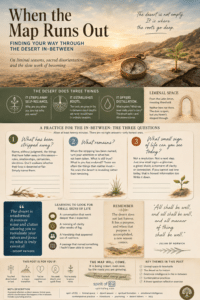
When the Map Runs Out: Finding Your Way Through the Desert In-Between

When the Map Runs Out: Finding Your Way Through the Desert In-Between

On liminal seasons, sacred disorientation, and the slow work of becoming

There is a moment — if you have ever been truly lost — when the map in your hand stops making sense. The road it promises isn’t there. The landmarks don’t match. And you realize, with a strange mix of dread and something almost like relief, that you have entered unmapped territory.

That is the desert. Not necessarily sand and scorching heat, though those images carry real weight across ancient wisdom traditions. The desert is any season where the familiar landmarks disappear — where the identity you carried into a transition no longer fits, and the one you will carry out has not yet taken shape. Theologians and contemplatives have long called it the wilderness. Anthropologist Arnold van Gennep named it liminality, from the Latin limen, meaning threshold. You are on the threshold. Neither here nor there. The door is open, but you haven’t stepped through.

I have lived in that doorway. In different seasons, I found myself between jobs, between marriages, and navigating the slow aftermath of a health crisis — like pancreatitis, which has a way of stripping everything to bare essentials with very little ceremony. Each loss arrived not as a single blow but as a kind of systemic unraveling. What I thought I knew about myself, about my direction, about what I was building — all of it came into question at once.

What I did not expect was that the desert would become a teacher.

The Threshold Has a Name

Liminal space is the technical name for the in-between — the transitional zone that exists between what was and what will be. Van Gennep first mapped it in his study of rites of passage: every significant human transition, he observed, moves through three phases. There is separation from the old identity, a liminal period of disorientation and becoming, and eventually reincorporation into a new form.

The middle phase — the liminal — is not a waiting room. It is a crucible.

 

Ancient traditions knew this. The Hebrew Bible is full of desert wandering — forty years for a people who needed to become something they were not yet. Moses on Sinai. Elijah under the broom tree. Jesus in the wilderness before the beginning of his public ministry. The desert, in these stories, is never incidental. It is the point. Something essential is being formed that could not have been formed any other way.

The desert fathers and mothers — those early Christian monastics who literally fled to the Egyptian wilderness in the third and fourth centuries — went to the desert on purpose. They understood that the stripping of comfort was not punishment but preparation. What could not be heard in the noise of ordinary life could sometimes be heard in the silence of the barren places.

“The desert is unadorned. It removes noise and clutter allowing you to reevaluate your values and focus on what is truly essential.”

I did not choose my desert. Most of us don’t. But I did, eventually, choose how to inhabit it.

What the Desert Actually Does

There is a temptation, when you are in a liminal season, to treat it as a problem to be solved. To scramble for the next thing, the next role, the next relationship — anything to end the suspension. I understand that impulse deeply. The in-between is uncomfortable in ways that are hard to articulate to people who are not in it.


But the desert has purposes that cannot be rushed.

It strips away self-reliance. When the external scaffolding of identity falls away — the job title, the relationship, the health you assumed — you are brought into contact with something deeper. Who are you when you are not who you were? That question, honestly held, is one of the most spiritually generative questions a person can carry.

It establishes roots. A plant in the desert sends its root system down far deeper than plants in well-watered soil. It must, to survive. Liminal seasons do something similar in us. The roots we grow in the in-between often reach depths we would never have explored in ordinary seasons.

It offers distillation. The desert is ruthlessly clarifying. What matters to you? What were you carrying that was never really yours to carry? What were you building toward that came from someone else’s vision for your life? The desert asks these questions quietly and persistently, and if you are still enough to hear them, the answers begin to come.

During my own desert season, I found myself returning again and again to contemplative practices — extended periods of silence, long walks without destination. Not as escape, but as a form of listening. I was learning to let the quiet do its work.

The emotional intelligence framework Lynette and I work with at spirit of EQ has a concept that became very real to me during this time: the difference between reaction and response. In a liminal season, there is enormous pressure to react — to fill the silence, to fix the disorientation, to manufacture certainty. Learning to pause, to stay present to what is really happening rather than what you fear might happen, is one of the deepest EQ practices I know. And the desert is where I learned it at a cellular level.

Learning to Look for Small Signs of Life

One of the most important practices I developed in those seasons was what I can only describe as desert botany — the discipline of looking for small signs of life in apparently barren ground.

The desert is never as empty as it first appears. It is full of life that has adapted to scarcity, that blooms in small and unexpected ways, that knows how to wait. When I stopped looking for the dramatic turnaround — the moment when everything would resolve — and started looking for the small green shoots, something shifted.

A conversation that went deeper than I expected. A morning of clarity after weeks of fog. A friendship that appeared out of nowhere and offered exactly what was needed. A passage from a desert father that named something I hadn’t been able to name.

Julian of Norwich, writing from her own experience of suffering and disorientation, offered words I returned to often: that all shall be well, and all shall be well, and all manner of thing shall be well. Not as denial of the present difficulty, but as an orientation toward a goodness that exists beyond the current view. The desert does not last forever. It has a purpose, and when that purpose is accomplished, a new season comes.

But the new season is shaped by how we inhabit the desert. Those who fight it or flee it arrive depleted. Those who learn to dwell in it — not comfortably, but honestly — often arrive at the other side with something they could not have acquired any other way.

Desert Journal Worksheet Link

A Practice for the In-Between: The Three Questions

This exercise is best done slowly, with a journal or open space for reflection. Allow at least twenty minutes. There are no right answers — only honest ones.

The desert fathers practiced a form of structured self-inquiry they called examen — a slow, honest review of what was present, what was absent, and what was stirring beneath the surface. This exercise draws on that tradition.

Settle first. Before you begin, take three slow breaths. Release the urgency of solving anything. You are here to notice, not to fix.

Question One: What has been stripped away?

Name, without judgment, the things that have fallen away in this season — roles, relationships, certainties, identities. Don’t evaluate whether their loss is deserved or fair. Simply name them.

Question Two: What remains?

When the stripping has been named, turn your attention to what has not been taken. What is still true? What in you has endured? These are often the things that matter most — the ones the desert is revealing rather than removing.

Question Three: What small sign of life can you see today?

Not a resolution. Not a next step. Just one small sign — a glimmer, a green shoot, a moment of clarity or connection. If you cannot see one today, that is honest information too. Write it down.

The Map Will Come

I am on the other side of that desert for now — or perhaps more accurately, I am in a different landscape, carrying what I learned in the in-between. The job that came after that season shaped Lynette and me into what we now call spirit of EQ. The health crisis that stripped my certainty about my physical resilience also deepened my empathy for people navigating their own fragility. The relational losses became — slowly, painfully, eventually — the soil from which something more honest grew.
I don’t want to romanticize the desert. It was hard. There were stretches of genuine desolation. But I also don’t want to minimize what it gave me — a set of roots that go deeper than anything I had before, a clarity about what matters, and a capacity to sit with others in their own liminal seasons without needing to rush them out the door.

If you are in the in-between right now — between who you were and who you are becoming, in a season of dryness, disorientation, or loss — I want you to know two things. First: you are not lost. You are in unmapped territory, which is a different thing entirely. And second: the map will come. It is being drawn, even now, by the roots you are growing.

The threshold is not the end of the journey. It is the most important part of it.

Peace and every good.


Small Habits That Turn Self-Knowledge to Practice!

There were times when I felt utterly out of control, a realization that didn’t come with a map—only the uneasy knowledge that thinking harder wouldn’t change how I reacted. What helped was an ongoing practice of curiosity and embodiment: tiny experiments like three daily check-ins, a weekly trigger log, or a 30-day journal that forced me out of intellectual comfort and into the messy, tender territory of felt experience. Anchoring these practices in relationships—people who could notice with me, hold me accountable, or simply listen—turned isolated attempts into lasting habits. Those small, repeated actions gradually closed the gap between knowing and being, softening reactions and aligning choices so emotional intelligence shifted from a trendy idea to the steady, humane way I move through life—exactly the gentle, persistent work this blog’s conclusion urges you to begin.

Why “know yourself” matters Without a clear sense of what’s inside you—your triggers, values, habitual reactions, energy patterns, and underlying stories—you can’t intentionally choose how to respond. You’re more likely to react on autopilot: snap when stressed, avoid hard conversations, or keep burning the candle for approval. Knowing yourself gives you options. It gives you the ability to pause in that gap between stimulus and response and choose rather than default.

Instead of just writing narrative today I wanted to give you some tips and practice.

This post has 9 or 10 things you can do to improve knowing yourself. Lynette and I taught this when we were with Six Seconds and use it now in our coaching. We have seen results from these practices because it is not merely a cognitive exercise.

True self-knowledge is embodied. It combines accurate assessment with felt reflection and repeated practice. Here are practical ways to deepen the practice, plus examples you can start using today.

Let’s start with three daily check-ins and practice one:

One of the simplest, most powerful habits is to pause and name what you feel three times a day. Stop, breathe, and say aloud or in a journal: “I feel anxious,” “I feel tired,” “I feel excited.” Use plain language. Don’t argue with the emotion; label it.

Why it works:

Naming an emotion moves it from automatic reactivity into conscious awareness. Once named, it’s easier to examine the cause, notice bodily sensations, and choose an appropriate response.

Practice one:

  • Morning: Right after waking, notice and name one feeling (e.g., “I feel hopeful”).
  • Midday: Pause after lunch; name what’s present (e.g., “I feel irritated”).
  • Evening: Before bed, note the headline emotion of your day and one bodily sensation that accompanied it.

Use a body scan to root awareness Intellectual awareness without bodily feeling tends to stay theoretical. A short body scan links mind and body. Sit quietly for two minutes and scan from head to toe. Notice tightness, temperature, weight, or movement without judgment.

Why it works:

 Emotions show up in the body—tight chest, clenched jaw, shallow breath. Bringing attention to those sensations grounds your experience and makes emotional information actionable.

Practice two:

  • When you notice a strong emotion, pause and ask: Where do I feel this in my body? Describe it (e.g., “a knot in my stomach,” “heat in my face”). Breathe into that area for three breaths and note any change.

Run a 30-day reflection journal. Short daily entries over a month reveal patterns that a single insight won’t show. Spend 10–15 minutes each day with a prompt and at the end of each week, scan for themes.

Why it works:

Repetition uncovers recurring triggers, times of day when you’re drained or energized, and stories you tell yourself.

Prompts to use across 30 days:

  • What felt most alive for me today? What drained me?
  • When did I feel proud or competent? When did I feel ashamed or small?
  • What did I avoid and why? Whose approval did I seek today? At the end of each week, summarize the top three themes you see. Over four weeks, patterns start to feel like a map you can navigate rather than random events.

Map your triggers. Trigger mapping makes visible the situations that reliably produce strong reactions. For one week, log moments when you feel a spike of emotion: the situation, what was said or done, your immediate thought, and your bodily reaction.

Why it works:

You’re often reacting to old narratives or unmet needs, not the present reality. Mapping reveals those hidden drivers and creates space for choice.

Practice three:

  • At the first sign of irritation or panic, jot down: setting, other person’s words, your first thought (“I’m not good enough”), and the physical sensations. After a week, look for clusters—maybe criticism activates shame, or ambiguity triggers control anxiety.

Clarify values with trade-offs. Values become meaningful when placed in tension. Choose five candidate values (e.g., autonomy, family, security, creativity, community) then simulate scenarios that force trade-offs.

Why it works:

It exposes the values you will prioritize under pressure—not the ones you’d like to have.

Practice 4:

  • Scenario A: A secure well-paid job with predictable hours but limited creative freedom.
  • Scenario B: A lower-paid, uncertain job that gives time to create. Which do you choose and why? Try multiple trade-offs (family time vs. career advancement; stability vs. adventure) and notice where your real priorities lie.

Design tiny experiments:

The brain changes when it collects evidence that a new response works. Design small, low-risk experiments to test alternatives to habitual reactions.

Why it works:

Small wins build expectancy that you can act differently, and expectancy shifts behavior.

Practices:

  • If you snap when stressed, commit to a 30-second breath before responding to criticism for one week.
  • If you avoid difficult conversations, set a goal to raise one small concern in the next team meeting, keeping it under two minutes.

Practice with others—anchor learning in relationships Emotional intelligence is relational. Practice intentions with a trusted colleague, friend, or partner. Share a commitment (“I’m practicing listening without giving advice”) and ask for gentle feedback.

Why it works: \

Real relationships give safety, accountability, and real-time coaching. They also mirror blind spots in ways solitary practice can’t.

Practice five:

  • Pair up with someone for a weekly check-in. One person practices a chosen skill during the week and then debriefs—what happened, what felt hard, what changed.

Move from insight to embodied practice. Use role-plays, walking meetings, or breathwork to translate cognitive insight into felt experience. Embodiment helps the heart remember what the mind discovers.

Why it works:

The body stores patterns. Repeating new behaviors in a sensory-rich way helps make them automatic.

Practice six:

  • In a role-play, rehearse a difficult conversation multiple times, noticing voice tone, posture, and breath. After a few tries, the physical cues make the new behavior feel more natural.

Cultivate self-compassion rituals

 Knowing yourself also means treating yourself kindly when you fail to live up to your intentions. Create a short self-forgiveness script to use after missteps.

Why it works:

Compassion keeps you experimenting; shame makes you retreat. Self-kindness sustains practice.

Practice seven:

  • After a misstep, say: “I’m learning. What can I try differently next time?” Repeat a two-minute compassion practice in the morning—wish someone well, then extend the same wish to yourself.

Tell a new story about who you are Identity matters. Shift the story from “I get triggered” to “I notice when I’m triggered and pause.” Act in ways that confirm the new story; identity and behavior reinforce each other.

Why it works:

When action aligns with a coherent identity, change is easier and more sustainable.

Practice eight:

  • Write and repeat one identity sentence each morning for two weeks: “I am someone who pauses before responding when I feel triggered.” Notice situations where the sentence helps you choose differently.

Measure wisely. Measurement can support growth when used for learning rather than judgment. Track only whether you did the practice—did you pause, name, or experiment? Celebrate the attempts.

Why it works:

Simple metrics build momentum without turning practice into a performance.

Practice nine:

  • Keep a checklist of the week’s small practices (three check-ins, one breath-before-response experiment, one compassionate reflection). Note completion, not perfection.

 Knowing yourself is not the endpoint.

Begin with gentleness: change rarely arrives in a single, dramatic moment but in the small, deliberate acts that teach your body and heart new habits. By practicing curiosity, checking in with yourself a few times a day, keeping a trigger log, or committing to a short daily journal, you move from intellectual understanding to lived experience. Those tiny experiments—grounded in relationships that hold you accountable and compassionate—shrink the gap between knowing and being. Over time your reactions soften, your choices align with your values, and emotional intelligence becomes less a buzzword and more the quietly steady pulse that guides how you show up for yourself and others.