
Posts

The Garden He Grew from Honest Contradiction

Post One:   The Garden He Grew From

Formation, the village of mentors, and the name given by a king

Post Two:   A Man Who Stands in the Room

Teaching, spiritual direction, EQ practice, and the soul-centered integrated life

Post Three:  When the Whisper Is Louder Than the Fear

Racial injustice, the cost of speaking, grief, and the word for those at the edge of the room


A CONVERSATION WITH DR. DON AJENÉ WILCOXSON · PART ONE OF THREE

The Garden He Grew From

What hard soil and an unlikely village made of one remarkable man
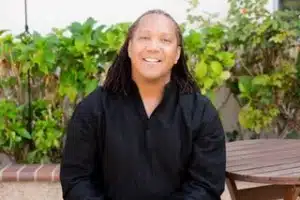
There is a photograph I keep returning to in my mind — not a real one, but the kind your imagination makes when someone tells you a story about a boy walking to school alone, afraid, and arriving anyway. I have known Dr. Don Ajené Wilcoxson for years. I know the man he became. But it was only when we sat down together for a long conversation that I began to understand the terrain that formed him.

He described his childhood plainly, without self-pity, in the way that people speak about hard things they have long since made peace with. Physical abuse. A biological father he never met. The daily threat of being beaten walking to school. He called it “really challenging.” What stayed with me was not the weight of those words but the steadiness with which he carried them — the way a man speaks about weather he has already walked through.

“I was blessed,” he said, and meant it. Because running alongside those hardships was something else: a community of people who saw him and chose to stay.

His adoptive father became, in his words, “the best thing that could ever happen” to his life — a man who taught him about all cultures, all music, all the beautiful width of what it means to be human.

There was also Dell Roberts, a friend who showed him what it looks like for a young Black man to move through the world with dignity. His mother, who helped him find stillness. His godmother, who taught him ethics — not as rules, but as a way of being. And his nana, who pressed into him the twin practices of listening and caring. He didn’t point to a single turning point the way we often hope people will. He pointed instead to a village.

There is a concept in the Enneagram — and Ajené is a deeply self-aware Nine — about the way the Peacemaker absorbs the world around them, becoming, in some sense, an amalgam of the people they love. What he described from his childhood is not just biography. It is the formation of a man who would go on to hold space for people from every tradition, every background, every wound — and do it with the naturalness of someone who learned to navigate difference before he could name it.

He was the darkest member of his family. Extended family and outsiders noticed. He noticed. And rather than letting that experience narrow him, it became a doorway. “It taught me to navigate that difference,” he said, “and that helped me work across cultures and faiths later.” What looked, from the outside, like a wound had quietly become a gift.

This is the movement that the Six Seconds emotional intelligence framework calls “exercising optimism” — not the naive insistence that things are fine, but the practiced discipline of asking what is generative alongside what is broken. Ajené did not learn this from a book. He learned it the way most lasting things are learned: by living through something hard and refusing to let it be the last word.

The name Ajené arrived later. He was in his mid-twenties, teaching, when an African king whose daughter had been moved by his work gave him the name. It means, roughly, “a businessman who truths” — which Ajené himself acknowledged is something of an oxymoron, a contradiction held together by purpose. He carries that name now not as an identity to perform but as a reminder. Something higher, he said, is always calling him in everything he does.

“The name is a constant reminder that I have something higher that is calling me in everything I do.”

That sense of calling runs through everything that follows: the classroom, the sanctuary, the spiritual direction session, the emotional intelligence coaching circle. But it began here, in the soil of a childhood that was genuinely difficult and genuinely held — held by a father who taught him wonder, a friend who modeled dignity, a grandmother who modeled listening, a godmother who modeled integrity.

There is a phrase from the Celtic tradition that has long moved me: the idea that what we are is not something we construct alone, but something we receive — from the land, from the ancestors, from the people who pray over us before we know we need praying over. Ajené did not use that language, but he described that reality. He is, in a deep sense, a man made by his village.

And the village made something extraordinary. A man who enters rooms prepared to meet whoever is already inside. A man who learned, before he had words for it, that difference is not a problem to be solved but a garden to be tended. A man who was given a name that named him more truly than he could have named himself — and who has spent the decades since trying to live worthy of it.

On Wednesday and Thursday, we will follow Ajené into the classroom and the sanctuary, into his work at the intersection of emotional intelligence and spiritual formation, and into the harder places — the grief he carries about racial injustice, the cost of speaking when silence would be easier, and what keeps the pilot light lit even now. But this is where we begin: with the boy, and the village, and the soil that made him.

The boy walked to school afraid and arrived anyway. That was, perhaps, the first lesson.

To get in touch with Ajene use this link.ajene@donajene.com

If this reflection stirred something in you, we invite you to explore the work of emotional intelligence and spiritual formation at spiritofeq.com and mystical seeker.substack.com

Peace and every good.

Presence Over Pressure: Rethinking Adulthood at 32

I have started todays blog with a paraphrased story to illustrate this important study for coaching and spiritual direction.

When my friend Lila brought her twenty-four–year–old nephew, Jonah, to the small group at our church last spring, I expected the usual restless energy of someone caught between college and a first job. Jonah sat quietly through the opening prayer, his hands folded, eyes darting now and then to his phone. Then he listened as a woman in her fifties talked about grief; he asked a thoughtful question about responsibility. By the time the meeting ended he admitted, with a nervous laugh, that he sometimes felt like he was “pretending to be an adult.” He wasn’t sure whether that was a confession or a relief.

This part is dense reading but worth the time if you are a coach or spiritual director. The conversation Jonah sparked has stayed with me, (Jim) because it maps a striking piece of science that demands we rethink how we guide young people in coaching and spiritual formation. IN the latest issue of “Presence” a Spiritual Directors International publication it states this study from 2025 that neuroscientists from Cambridge University published in Nature Communications (Mousley et al.) that compared diffusion MRI scans from nearly four thousand human brains ranging from infancy to ninety years old. Rather than finding a smooth, linear path of maturation, they reported discrete shifts at roughly ages nine, thirty-two, sixty-six, and eighty-three. One of the most provocative takeaways: adolescence, in neurological terms, appears to stretch well beyond what most social norms call “adulthood” — actual adulthood, the study suggests, may not begin until around age thirty-two.

This finding upends a lot of assumptions we make in churches, coaching programs, and spiritual direction. If brains remain in a significant developmental flux into the late twenties and early thirties, how should mentors, pastors, and spiritual directors show up for people like Jonah — or for us — in ways that match their neurodevelopment reality?

What the study suggests….

Mousley and colleagues used diffusion MRI to map patterns of white matter — the brain’s communication highways — across the lifespan. Prior to age thirty-two, the brain is still reorganizing: white matter is growing, neural pathways are becoming more efficient, and connectivity patterns are shifting. After roughly thirty-two, the researchers found a more stabilized architecture that often persists for about three decades, followed by later-life shifts around sixty-six and eighty-three. These aren’t just trivia about neurons; they have implications for how people form identity, sustain relationships, and engage with meaning and purpose.

A short story: the mentor, the millennial, the map When I met Jonah months later for coffee, he’d switched jobs twice and was enrolled in a night course on ethics. He confessed he dreaded the “adult checkboxes” — house, marriage, stable job — yet felt impatient with peers who seemed to have them. We talked about mentors: he wanted guidance but bristled at being told what to do. I told him about the Cambridge study — he laughed, then listened.

“Maybe being older isn’t the only way to be wise,” he said. “Maybe people can help me without trying to make me into something I’m not yet.”

That line captures the pastoral (presence) pivot we need: to offer presence without premature pressure, to accompany without imposing finished forms. The neuroscientific finding invites humility and patience. It asks us to honor the ongoing developmental work young adults are doing — neurologically, emotionally, spiritually — while providing steady practices and relational spaces that support maturation without rushing it.

Two ways for us to be present

  1. Practice steady attunement through embodied listening What it is: Embodied listening means attending to the whole person — voice, posture, affect, silence — and not just the words. It requires slowing down, modulating one’s own responses, and noticing shifts in emotion and cognitive framing without immediately correcting or advising.

How to do it:

  • Create predictable space and rhythm: offer recurring meetings that give the person time to try on insights between sessions. Stability matters to a brain still organizing its networks.
  • Use nonverbal check-ins: begin with a single question — “Where is your attention?” — allow a minute of silence, then reflect what you notice about tone and posture before asking probing questions.
  • Resist the fix: when you sense the urge to “solve” identity questions, mirror instead. “I hear uncertainty about responsibility and a desire for meaning.” This models a mind that can hold complexity without collapsing into premade answers.

Why it helps:

For a brain in flux, steady attunement supports the integration of new patterns. It offers a relational scaffold where the young adult can test emerging values and neural pathways safely.

  1. Offer scaffolded practices that combine exploration with ritual What it is: Scaffolded practices are simple, repeatable spiritual exercises that invite both experimentation and the formation of habit. They recognize that neurodevelopment thrives on both novelty (to build new connections) and repetition (to consolidate them).

How to do it:

  • Introduce three-month “experiment” cycles: choose one spiritual practice (e.g., contemplative journaling, short daily silence, or service with reflection) to try for 90 days. Check in weekly for the first month, then biweekly.
  • Combine short, diverse practices with a consistent ritual frame: begin and end with a five-minute centering practice (breath or scripture reading), then introduce a varied middle (creative reflection, dialogue, or action).
  • Encourage meta-reflection: every month, ask: “What patterns do you notice in your responses? What feels alive? What drains you?” This helps the maturing brain integrate experience into identity.

Why it helps: This approach respects the brain’s dual needs: novelty for growth and repetition for stability. Ritual gives a predictable platform for experimentation, reducing anxiety while encouraging exploration.

Why this matters to coaching and spiritual direction

  1. Developmentally informed accompaniment improves outcomes coaching and spiritual direction aim to catalyze growth: in habits, vocation, moral discernment, and interior integration. If the brain continues to rewire well into the late twenties and early thirties, then coaching strategies that treat early adulthood as a finished stage may be ineffective or even harmful. A developmental lens encourages coaches and directors to calibrate expectations, scaffold change plans over longer timelines, and attend to the neurobiological rhythms of consolidation and plasticity.
  2. It reframes maturity as a process, not a milestone spiritual direction, at its best, is about guiding people into deeper coherence — integrating emotions, beliefs, and actions. The Cambridge study reminds us that coherence can be emergent and slow. Rather than treating a thirty-year-old’s doubts as failures, we can see them as part of ongoing integration. This reduces shame and normalizes the nonlinear trajectory of faith and identity formation.
  3. It demands relational humility and patience Both coaching and spiritual direction rely on relationship. Neuroscience underscores that relationship is not merely a context but a mechanism for change: safe, attuned relationships shape neural development. Coaches and directors who cultivate attunement, ritual, and scaffolded experimentation are not just providing tools — they are offering the relational conditions in which the brain can reconfigure toward more adaptive patterns.
  4. It broadens the role of community If individual neurodevelopment unfolds across decades, community becomes a crucial resource — not merely a backdrop. Churches, peer groups, mentorship networks, and coaching cohorts can offer the recurring, low-stakes opportunities to practice new moral habits, relationships, and vocational identities. Programs that build long-term relational continuity will likely be more aligned with how brains mature.

A closing note to mentors and leaders:

When you sit across from someone like Jonah, remember you are not simply transferring information. You’re participating in a slow, relational craft of formation. The Cambridge findings do not strip away responsibility; they expand it. We must give space for the messy apprenticeship of being an adult, provide practices that balance novelty with ritual, and be present in ways that allow the nervous system and the soul to settle into new patterns of coherence.

Jonah eventually stopped checking his phone during our meetings. He still questions, still wanders in and out of certainty. But he’s started keeping a short weekly journal and meets once a month with an older mentor who listens without solving. Watching him, I’m learning to be less anxious about boxes checked and more attentive to the small, steady shifts that mark maturation. That’s the work neuroscience is asking us to honor: presence over pressure, accompaniment over answers, and the patient trust that growing up is a journey that may take longer — and be more sacred — than we thought.

Thank you for reading this study and helpful guide for professionals who coach and do spiritual direction.

Mousley, A., et al. (2025). (2025). Nature Communications. [Mousley et al., 2025, Nature Communications — diffusion MRI lifespan study]

https://pubmed.ncbi.nlm.nih.gov/41290675/