
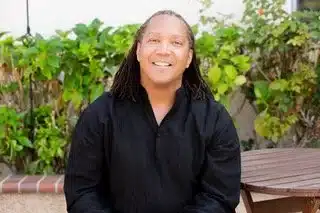
The Garden He Grew from Honest Contradiction
Post One: The Garden He Grew From
Formation, the village of mentors, and the name given by a king
Post Two: A Man Who Stands in the Room
Teaching, spiritual direction, EQ practice, and the soul-centered integrated life
Post Three: When the Whisper Is Louder Than the Fear
Racial injustice, the cost of speaking, grief, and the word for those at the edge of the room
A CONVERSATION WITH DR. DON AJENÉ WILCOXSON · PART ONE OF THREE
The Garden He Grew From
What hard soil and an unlikely village made of one remarkable man
There is a photograph I keep returning to in my mind — not a real one, but the kind your imagination makes when someone tells you a story about a boy walking to school alone, afraid, and arriving anyway. I have known Dr. Don Ajené Wilcoxson for years. I know the man he became. But it was only when we sat down together for a long conversation that I began to understand the terrain that formed him.
He described his childhood plainly, without self-pity, in the way that people speak about hard things they have long since made peace with. Physical abuse. A biological father he never met. The daily threat of being beaten walking to school. He called it “really challenging.” What stayed with me was not the weight of those words but the steadiness with which he carried them — the way a man speaks about weather he has already walked through.
“I was blessed,” he said, and meant it. Because running alongside those hardships was something else: a community of people who saw him and chose to stay.
His adoptive father became, in his words, “the best thing that could ever happen” to his life — a man who taught him about all cultures, all music, all the beautiful width of what it means to be human.
There was also Dell Roberts, a friend who showed him what it looks like for a young Black man to move through the world with dignity. His mother, who helped him find stillness. His godmother, who taught him ethics — not as rules, but as a way of being. And his nana, who pressed into him the twin practices of listening and caring. He didn’t point to a single turning point the way we often hope people will. He pointed instead to a village.
There is a concept in the Enneagram — and Ajené is a deeply self-aware Nine — about the way the Peacemaker absorbs the world around them, becoming, in some sense, an amalgam of the people they love. What he described from his childhood is not just biography. It is the formation of a man who would go on to hold space for people from every tradition, every background, every wound — and do it with the naturalness of someone who learned to navigate difference before he could name it.
He was the darkest member of his family. Extended family and outsiders noticed. He noticed. And rather than letting that experience narrow him, it became a doorway. “It taught me to navigate that difference,” he said, “and that helped me work across cultures and faiths later.” What looked, from the outside, like a wound had quietly become a gift.
This is the movement that the Six Seconds emotional intelligence framework calls “exercising optimism” — not the naive insistence that things are fine, but the practiced discipline of asking what is generative alongside what is broken. Ajené did not learn this from a book. He learned it the way most lasting things are learned: by living through something hard and refusing to let it be the last word.
The name Ajené arrived later. He was in his mid-twenties, teaching, when an African king whose daughter had been moved by his work gave him the name. It means, roughly, “a businessman who truths” — which Ajené himself acknowledged is something of an oxymoron, a contradiction held together by purpose. He carries that name now not as an identity to perform but as a reminder. Something higher, he said, is always calling him in everything he does.
“The name is a constant reminder that I have something higher that is calling me in everything I do.”
That sense of calling runs through everything that follows: the classroom, the sanctuary, the spiritual direction session, the emotional intelligence coaching circle. But it began here, in the soil of a childhood that was genuinely difficult and genuinely held — held by a father who taught him wonder, a friend who modeled dignity, a grandmother who modeled listening, a godmother who modeled integrity.
There is a phrase from the Celtic tradition that has long moved me: the idea that what we are is not something we construct alone, but something we receive — from the land, from the ancestors, from the people who pray over us before we know we need praying over. Ajené did not use that language, but he described that reality. He is, in a deep sense, a man made by his village.
And the village made something extraordinary. A man who enters rooms prepared to meet whoever is already inside. A man who learned, before he had words for it, that difference is not a problem to be solved but a garden to be tended. A man who was given a name that named him more truly than he could have named himself — and who has spent the decades since trying to live worthy of it.
On Wednesday and Thursday, we will follow Ajené into the classroom and the sanctuary, into his work at the intersection of emotional intelligence and spiritual formation, and into the harder places — the grief he carries about racial injustice, the cost of speaking when silence would be easier, and what keeps the pilot light lit even now. But this is where we begin: with the boy, and the village, and the soil that made him.
The boy walked to school afraid and arrived anyway. That was, perhaps, the first lesson.
To get in touch with Ajene use this link.ajene@donajene.com
If this reflection stirred something in you, we invite you to explore the work of emotional intelligence and spiritual formation at spiritofeq.com and mystical seeker.substack.com
Peace and every good.


