
Today Is Hard. Tomorrow Is Worse. Why I Kept Going
The Day After Tomorrow
There is a photograph I keep in my mind from the early days of Varment Guard — not an actual photograph, just the image burned in from living it. It’s a door. A plain commercial door, nothing fancy about it, with a small wooden frame above it. And inside that frame, four words someone had taken the time to put there deliberately: Failure was not an option.
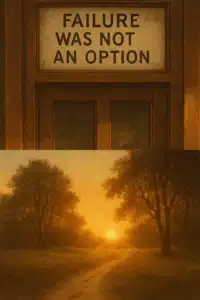
Mike M. and I had been meeting for eight months before we ever turned a key in a lock. Eight months of yellow legal pads and bad coffee and spreadsheets that kept being wrong and late-night conversations that neither of us was willing to end because ending felt like quitting. We were two people trying to think of everything — preparing the way you prepare for something that matters — and when we finally opened those doors, we discovered we hadn’t thought of even half of what was coming for us.
THE FOUNDERS HONEST LOOK WORKBOOK
That’s when Jack Ma’s words would have hit differently. “Today is hard and tomorrow will be worse, but the day after tomorrow will be sunshine.” — Jack Ma, Founder, Alibaba Group.
Hold that sentence for a moment. It isn’t a motivational poster. It’s a map.
WHAT’S BEHIND THE WORDS
Jack Ma didn’t build Alibaba from a position of ease or advantage. He was rejected by Harvard ten times. When KFC came to his city and hired 23 of 24 applicants, he was the one they passed on. China’s first public internet company turned him away. When he finally pitched the idea of an online marketplace for Chinese small businesses in 1999, he did it in his apartment, to a handful of friends who weren’t completely sure they believed him. He knew today is hard the way you only know something you’ve actually lived.
The history of business is, at its marrow, a history of stubborn people who refused to let a bad today become a permanent condition. Henry Ford failed twice before building the company that changed manufacturing forever. Milton Hershey lost everything in New York and again in Chicago before returning home to Pennsylvania with nothing but a process he still believed in. Walt Disney was told he lacked imagination by the very newspaper that had hired him. The pattern is so consistent it might seem like a cliché — except for the people living it. For them, it never feels like a pattern. It feels personal. It feels like an exception. It feels like it might be permanent.
What the ones who make it through seem to understand — sometimes while it’s happening, sometimes only years later — is that the difficulty is not a detour from the path. It is the path. The hard is not a sign you’ve chosen wrong. More often, it’s a sign you’ve chosen something real.
WHAT WE KNEW AND WHAT WE DIDN’T
When Mike and I opened Varment Guard, we believed we were ready for the hard. What we hadn’t prepared for was the texture of it. Not the spreadsheet problems — those were almost welcome, because spreadsheets have answers. It was everything else. The family dinners missed, and then just stopped being expected. The friendships that didn’t end loudly — they just went quiet because you weren’t available and eventually people found their rhythm without you. The money questions that didn’t arrive as dramatic crises but as a low, grinding background hum that followed you everywhere, even into sleep.
Nobody writes that part down. Not honestly. Because the real story of building something is longer and more irregular than any narrative shape can hold, and no one wants to tell you how much it costs before you’ve decided to pay it — because if they did, maybe fewer people would start.
So why did we do it?
Why does anyone?
The easy answers are all true: we believed in the idea, we wanted to build something that was ours, we wanted to see if we could. But the real answer lives underneath all of those. It has to do with identity. With the recognition that there was a version of life available — something that matched what was inside you — and that settling for something smaller would be a slow erosion you weren’t willing to live with. We did it because the alternative was becoming someone we didn’t recognize. And that felt worse than everything that came with the doing.
WHAT WE GAINED AND WHAT WE LOST
What did we gain? That part comes easier now than it did in the middle of it. We built something real — a company with a culture, a reputation, a set of values that held through hard seasons. Over the years, Varment Guard employed hundreds of people. Families were fed. Skills were developed. Careers were built that might not have existed otherwise. There is no dollar figure for any of that. And there is something else, quieter but just as real: you find out what you are actually made of. You discover your own capacity. You learn what you can carry. You don’t find that out any other way. No shortcut delivers it. Only the going does.
What did we lose? That one is easier in the dark than in the daylight. Sleep, certainly — and the kind of easy rest that comes when you’re not carrying something large. Margin, regularly. Time with people we loved, which you cannot really reclaim even if the relationships survived. Parts of yourself that were softer and more patient that got traded, over time, for something harder and faster and more efficient. I won’t call all of it loss, exactly. But I notice the absence of some of it. I think that’s worth naming honestly.
HOW TO KEEP GOING WHEN YOU FEEL ALONE
DAY AFTER TOMORROW WORKBOOK
Here is the part no one tells you about keeping going when you feel like you’re carrying it entirely by yourself: you are. You actually are. And that’s not a crisis — that’s the position.
Every person who has built anything real has sat in a room where no one else fully grasped what they were holding. Not the advisors. Not the investors. Not even the partners — because it’s your specific weight, shaped to your specific frame, and no one else quite feels it the same way. You can resent that solitude or you can learn to read it as information.
What it’s telling you is simple: the decision to continue is yours. Which means it cannot be taken from you. The market can’t take it. A bad quarter can’t take it. A difficult competitor can’t take it. A hard year can’t take it. Only you can put it down.
Jack Ma is telling you something real when he promises sunshine on the third day. But he’s also telling you something harder: you have to make it through the first two. Not around them. Not above them. Through them.
The frame above that door at Varment Guard wasn’t decoration. It was a daily instruction — renewed every morning when someone walked under it. Failure is not an option doesn’t mean failure is impossible. It means you’ve decided in advance that however bad today gets, and however much worse tomorrow is, you are not stopping here. The sunshine isn’t guaranteed. But it’s only available to the ones who are still there when it arrives.
Mike and I didn’t think of half the things that would come for us. But we had made a decision. And on the hardest days, honestly, the decision was the only thing.
Make the decision. Keep making it. The day after tomorrow is real.
Peace and every good.
