
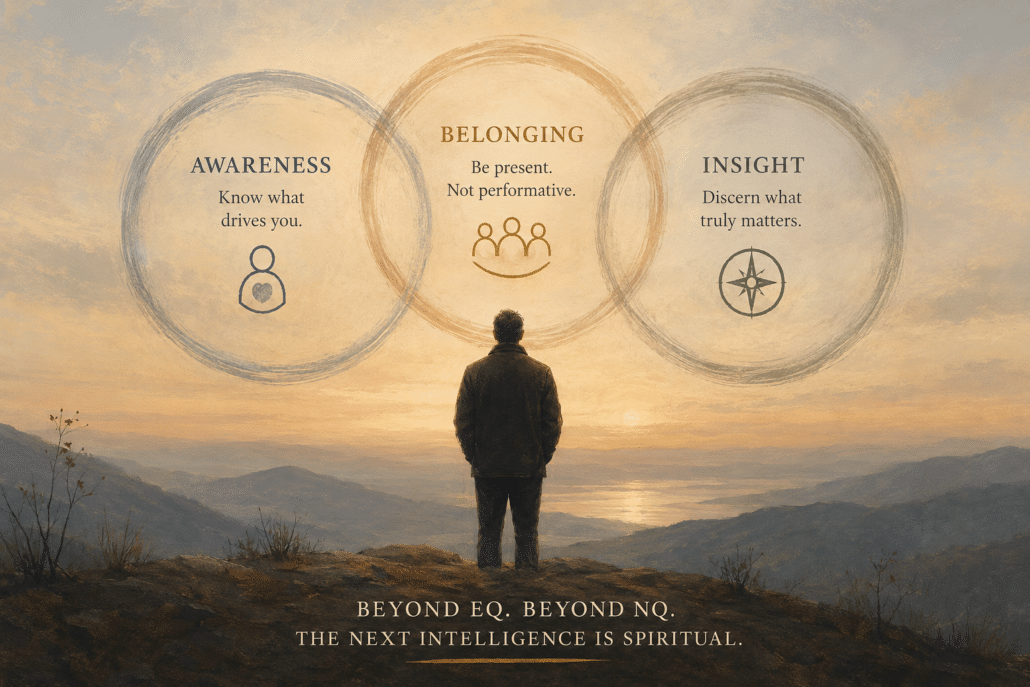
Beyond EQ, Beyond NQ — What’s Next?
What Fortune got right about emotional intelligence — and the layer it still missed
In May of this year, Fortune published a piece that stopped a lot of leadership development professionals in their tracks. Written by David Rock, neuroscientist and co-founder of the NeuroLeadership Institute, the headline made the argument plainly: EQ training is failing leaders in the AI era. Rock didn’t dispute that emotional intelligence matters. He argued that it no longer goes far enough — that what leaders actually need now is what he called neurointelligence, or NQ: the capacity to think about their own thinking, to understand how their brains process information, to build what he called “brain health” as a leadership discipline. (David Rock, “EQ training is failing leaders in the AI era. Here’s the brain science concept that can replace it,” Fortune, May 6, 2026.) He made a compelling case. He also stopped one layer short of where the real problem lives.
The Fortune piece is right that something is missing. Leaders who can name their emotions, regulate their reactions, and demonstrate empathy in a boardroom are increasingly common — and organizations are still in crisis. Gallup puts the cost of global employee disengagement at $8.8 trillion annually (Gallup State of the Global Workplace Report, 2026), and the 2026 Edelman Trust Barometer shows that 70% of people worldwide are now unwilling to trust someone with different values (Edelman Trust Barometer, 2026). These are not numbers that reflect a deficit of emotional skill. They reflect a deficit of something deeper: meaning, belonging, and the kind of self-knowledge that goes all the way down rather than stopping at the surface of emotion management.

EQ, at its best, asks: what am I feeling, and what do I do with that? NQ, at its best, asks: how is my brain processing this situation, and can I think about that process more clearly? Both are genuinely useful questions. But there is a third question that neither framework is designed to reach: who am I at the center, and is that person actually driving my decisions — or is something else?
That is the question every serious contemplative tradition in history has asked, and it is the question that Spiritual Emotional Intelligence, or SEQ, is built around. SEQ is not a religious framework. It does not require a particular faith or practice. It is the recognition that beneath emotional intelligence and cognitive agility there is an interior life — a set of deep patterns, values, wounds, and longings that shape how a person leads long before they ever name an emotion or notice a cognitive bias. Without access to that interior layer, EQ becomes technique and NQ becomes optimization. Both can be performed without any genuine self-knowledge at all. And in a world where AI can perform an increasing amount of what used to require human skill, performance without substance is exactly the wrong answer.
I had a client come to me about eight months ago who had been doing something I’ve been seeing more of — bringing their emotional struggles to an AI program. Not casually, but seriously, the way you might bring them to a therapist or a spiritual director. They were articulate about their feelings, had good language for what they were experiencing, and could describe their inner life in some detail. What they couldn’t do was locate themselves. The AI had been helpful in a narrow way — it reflected back what they said, organized their thoughts, offered frameworks for understanding their emotions. What it could not do was ask the question that actually mattered: who is the person having these feelings, and what does that person believe about themselves at the deepest level? There was no conversation about the self beneath the emotions — the place where thoughts, feelings, and spiritual convictions intersect and either hold together or quietly collapse under pressure. The AI had been working at the level of content. What my client needed was work at the level of formation. They had been processing their feelings without ever being asked about the foundation those feelings were resting on — the beliefs about worth, the theological assumptions about suffering, the spiritual story they were living inside without knowing it. EQ without that foundation is accurate but incomplete. NQ without it is optimized but unanchored. The self that has to show up and lead, love, and decide is not a collection of emotions to be managed or cognitive processes to be monitored. It is a person with a history, a wound, a longing, and a particular way of being in the world that no AI program is designed to find its way down to. My client wasn’t failing at emotional intelligence. They were missing the deeper self that emotional intelligence is supposed to serve.
SEQ works across three domains, and each one goes a level deeper than EQ or NQ reaches. Awareness in the EQ sense is the ability to notice and name what you’re feeling. Awareness in the SEQ sense is the practice of knowing what is actually driving you — the patterns so deep they feel like personality, the fears so familiar they feel like wisdom, the desires so old they feel like calling. Getting honest about those things requires not just emotional literacy or metacognitive skill but a willingness to sit with uncomfortable truths about yourself that no amount of brain health optimization is going to surface.
Belonging in the NQ framework doesn’t really exist as a category — it’s a human need, not a cognitive skill. EQ approaches belonging through empathy and social awareness. SEQ asks the harder question: are you actually present with the people you lead, or are you managing them? Presence isn’t a technique. It’s what’s left when you’ve stopped performing. The leaders who generate the deepest trust are the ones whose inner life and outer behavior are aligned — not because they’ve learned to project alignment, but because they’ve done enough interior work that there’s nothing significant to hide.
AI/NI Workbook
Insight in the NQ framework is about better thinking. Insight in the SEQ framework is about discernment — the capacity to distinguish between what is urgent and what is important, between what you want and what is actually yours to do, between the voice of genuine conviction and the voice of unexamined fear. That kind of discernment doesn’t come from thinking about your thinking. It comes from the long, slow, unglamorous work of knowing yourself at a level that most leadership development programs never reach.
David Rock is right that the future of leadership requires something beyond EQ. The something beyond it isn’t neural. It’s the interior life — examined, cultivated, and brought into alignment with how a person actually leads. That’s not a new idea. It’s the oldest one in the room, dressed in new language for a moment that has finally run out of surface-level answers.
There’s more on the SEQ framework at spiritofeq.com — and more of this conversation at The Mystical Seeker.
Peace and every good.
Jim Vaive (Master Certified Coach, Certified Spiritual Director, Certified Narrative Enneagram Teacher) and Lynette Vaive (Doctor of Ministry, Certified SEQ Practitioner) are co-founders of spirit of EQ and co-authors of The Mystical Seeker on Substack. Together they help individuals, teams, and organizations grow from the inside out — at the intersection of emotional intelligence, the Enneagram, and contemplative spirituality. Learn more at spiritofeq.com.


Leave a Reply
Want to join the discussion?Feel free to contribute!