
Two Wounded Hands and the Gap We Still Must Close
The Divine Touch of Connection: How a Single Image Holds a History, a Story, and a Call
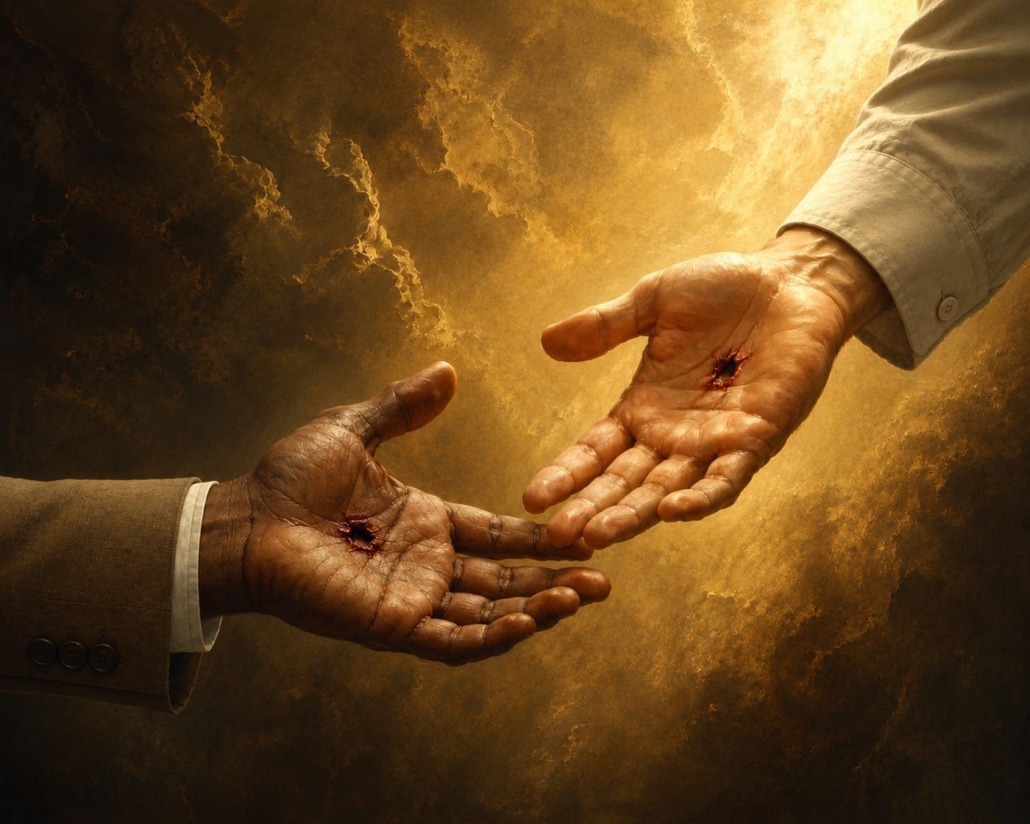
My father was an artist of some renown. He drew an image like this during the turmoil of the 1960s to tell us something — and it was lost to history. I have tried to recreate it for us today. Make no mistake: this is quite a bit more than a religious statement.
There are images that simply depict an idea — and then there are images that enter the viewer’s life, carrying history, memory, and longing inside their composition. This picture, which my father called the divine touch of connection, does the latter. It shows only what matters most: two reaching hands, marked by wounds, suspended in a beam of golden light. Between them is a gap — small, tense, and full of meaning — like the moment just before forgiveness becomes real.
What makes this image so powerful is that it doesn’t ask you to choose one interpretation. It layers spiritual symbolism, human vulnerability, and historical resonance into one quiet act of reaching. And by dressing the hands in 20th-century clothing, it refuses to stay in the past. It insists that what the wounds and the light signify is not only ancient scripture. It is also modern life.
A History Written into Hands
Hands are among the oldest symbols humans have used to communicate — offering help, taking responsibility, giving blessing, or showing harm. In the world of Christian art, wounded hands are deeply recognizable. Nail marks call to mind crucifixion imagery, but artists traditionally place those images in a broader scene: the whole body, the cross, the crowd, the sky.
This image reduces the scene to hands only. That reduction is not an artistic limitation — it is a deliberate spiritual strategy. By isolating the hands and making the wounds central, the image suggests that suffering and redemption are not peripheral details. They are the core language of connection itself. The wounds are displayed as proof that love can survive pain.
But the image doesn’t stop at religious history. The hands wear 20th-century clothing — not the robes of antiquity. That single choice pulls the meaning forward into the modern era. It tells us: this is not a distant story. The image becomes a mirror for contemporary wounds, whether those wounds are racial, social, political, or personal. The sacred is not only in ancient narratives. It shows up in modern suffering and in modern attempts to heal.
The Story Within the Gap
The heart of the image is its almost-touching moment. Neither hand grips the other. Neither dominates. Both reach. The open posture communicates invitation rather than force, reconciliation rather than conquest. That matters, because many of the world’s conflicts — religious, political, racial — begin when one side grips and the other recoils.
Here the hands approach each other in suspended space. The scene is not contact already achieved. It is connection about to happen but not yet completed. That tension is emotionally accurate. Healing rarely arrives all at once. Reconciliation is a series of near moments, the apology that is almost spoken, the conversation that almost happens, the decision to see someone fully that almost follows through.
The golden light makes this suspension feel sacred. Darkness surrounds the hands, but the light concentrates on the space where connection is possible — hope emerging not because suffering is good, but because something holy can be born from it. The light suggests that mercy is not only a feeling. It is an action. Something that can be reached for.
Shared Suffering, Shared Grace
The wounds are more than reminders of an old story. When both hands carry nail marks, the image conveys a radical idea: suffering is not isolated.
In many traditional depictions, the wounds belong to one figure — Christ alone. Here, the image implies shared vulnerability. The pain is carried on both sides, so the scene becomes less about hierarchy and more about solidarity,suffering is shared, therefore compassion is shared.
That shift changes everything. If suffering belonged only to one person, viewers might feel safe distance. But when wounds appear on both sides, the image draws us into mutual recognition: we are not as separate as we pretend. Redemption begins inside the act of reaching — not after pain is resolved, but inside the willingness to remain present with wounds without hiding them, denying them, or wielding them as weapons.
True connection happens through vulnerability, not perfection.
Unity Across the Lines History Built
One of the most striking layers is the contrast between darker and lighter skin tones. Because the hands are visibly different, the image refuses to keep its meaning safely vague. It insists on unity across difference — across racial boundaries, across histories of separation, across the long American wound that my father watched bleed openly in the 1960s and that has never fully closed.
The visual contrast says: shared humanity exists despite different bodies, stories, and experiences. The wounds look similar in their meaning — proof that everyone understands pain. The sacred is not reserved for one group. Mercy is offered across every line that society polices.
This is where the image becomes socially resonant. The nail wounds point toward biblical crucifixion. The racial contrast points toward reconciliation that is still unfinished. Even viewers who never connect the image to specific political events can feel its moral insistence: compassion must cross the lines that history creates.
Why the Clothes Matter
If the hands were dressed like ancient figures, viewers might treat this as museum spirituality — something reverent but unreachable. The 20th-century clothing changes that. It says the wounds belong to our world. The work of reconciliation is not reserved for saints or scripture. It happens through ordinary conversations and ordinary choices: whether to see another person as fully human, whether to hold accountability, whether to respond to harm with truth and mercy rather than retaliation.
The modern clothing also transforms the golden light. It can still be read as divine presence — but it can also be read as the clarity that sometimes arrives when someone chooses to break a cycle of hostility. It becomes conscience illuminated: the moment a person sees the other not as an enemy but as a neighbor.
What My Father Knew — and What We Must Face
My father was deeply troubled by what he saw around him. He watched a nation fracture along lines of race and power. He watched people choose sides over choosing each other. He made this image because he believed something: that the gap between human hands was closeable — but only if people were willing to reach, willing to be seen in their wounds, and willing to stay in the difficult suspended space where healing lives.
I look at our world today and I see the same fractures. The same refusals. The same turning away. The same wounds being hidden or weaponized instead of brought into the light. My father’s image is not nostalgic. It is prophetic.
The Call for Us Might Be………
So here is the invitation — and I mean this with everything I have: do not sleepwalk through this moment.
The gap in this image is not decorative. It is the gap you live in every day — between what you believe about human dignity and what you do to protect it. Between the reconciliation you say you want and the conversation you keep postponing. Between the world you inherited and the world you are choosing, right now, by what you do and what you refuse to do.
The divine touch of connection is not something we observe. It is something we perform — with our actual hands, our actual voices, our actual choices about who we see and who we ignore.
Reach. Even when it costs something. Especially then.
Because the light in this image does not belong to the past. It belongs to whoever is willing, today, to close the gap.
Peace and Every Good.


