
Posts

Two Wounded Hands and the Gap We Still Must Close

The Divine Touch of Connection: How a Single Image Holds a History, a Story, and a Call

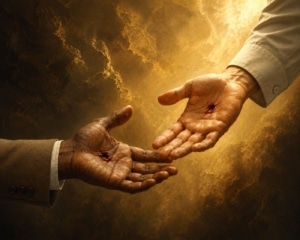
My father was an artist of some renown. He drew an image like this during the turmoil of the 1960s to tell us something — and it was lost to history. I have tried to recreate it for us today. Make no mistake: this is quite a bit more than a religious statement.

There are images that simply depict an idea — and then there are images that enter the viewer’s life, carrying history, memory, and longing inside their composition. This picture, which my father called the divine touch of connection, does the latter. It shows only what matters most: two reaching hands, marked by wounds, suspended in a beam of golden light. Between them is a gap — small, tense, and full of meaning — like the moment just before forgiveness becomes real.

What makes this image so powerful is that it doesn’t ask you to choose one interpretation. It layers spiritual symbolism, human vulnerability, and historical resonance into one quiet act of reaching. And by dressing the hands in 20th-century clothing, it refuses to stay in the past. It insists that what the wounds and the light signify is not only ancient scripture. It is also modern life.

A History Written into Hands

Hands are among the oldest symbols humans have used to communicate — offering help, taking responsibility, giving blessing, or showing harm. In the world of Christian art, wounded hands are deeply recognizable. Nail marks call to mind crucifixion imagery, but artists traditionally place those images in a broader scene: the whole body, the cross, the crowd, the sky.

This image reduces the scene to hands only. That reduction is not an artistic limitation — it is a deliberate spiritual strategy. By isolating the hands and making the wounds central, the image suggests that suffering and redemption are not peripheral details. They are the core language of connection itself. The wounds are displayed as proof that love can survive pain.

But the image doesn’t stop at religious history. The hands wear 20th-century clothing — not the robes of antiquity. That single choice pulls the meaning forward into the modern era. It tells us: this is not a distant story. The image becomes a mirror for contemporary wounds, whether those wounds are racial, social, political, or personal. The sacred is not only in ancient narratives. It shows up in modern suffering and in modern attempts to heal.

The Story Within the Gap

The heart of the image is its almost-touching moment. Neither hand grips the other. Neither dominates. Both reach. The open posture communicates invitation rather than force, reconciliation rather than conquest. That matters, because many of the world’s conflicts — religious, political, racial — begin when one side grips and the other recoils.

Here the hands approach each other in suspended space. The scene is not contact already achieved. It is connection about to happen but not yet completed. That tension is emotionally accurate. Healing rarely arrives all at once. Reconciliation is a series of near moments, the apology that is almost spoken, the conversation that almost happens, the decision to see someone fully that almost follows through.

The golden light makes this suspension feel sacred. Darkness surrounds the hands, but the light concentrates on the space where connection is possible — hope emerging not because suffering is good, but because something holy can be born from it. The light suggests that mercy is not only a feeling. It is an action. Something that can be reached for.

Shared Suffering, Shared Grace

The wounds are more than reminders of an old story. When both hands carry nail marks, the image conveys a radical idea: suffering is not isolated.

In many traditional depictions, the wounds belong to one figure — Christ alone. Here, the image implies shared vulnerability. The pain is carried on both sides, so the scene becomes less about hierarchy and more about solidarity,suffering is shared, therefore compassion is shared.

That shift changes everything. If suffering belonged only to one person, viewers might feel safe distance. But when wounds appear on both sides, the image draws us into mutual recognition: we are not as separate as we pretend. Redemption begins inside the act of reaching — not after pain is resolved, but inside the willingness to remain present with wounds without hiding them, denying them, or wielding them as weapons.

True connection happens through vulnerability, not perfection.
Unity Across the Lines History Built

One of the most striking layers is the contrast between darker and lighter skin tones. Because the hands are visibly different, the image refuses to keep its meaning safely vague. It insists on unity across difference — across racial boundaries, across histories of separation, across the long American wound that my father watched bleed openly in the 1960s and that has never fully closed.

The visual contrast says: shared humanity exists despite different bodies, stories, and experiences. The wounds look similar in their meaning — proof that everyone understands pain. The sacred is not reserved for one group. Mercy is offered across every line that society polices.

This is where the image becomes socially resonant. The nail wounds point toward biblical crucifixion. The racial contrast points toward reconciliation that is still unfinished. Even viewers who never connect the image to specific political events can feel its moral insistence: compassion must cross the lines that history creates.

Why the Clothes Matter

If the hands were dressed like ancient figures, viewers might treat this as museum spirituality — something reverent but unreachable. The 20th-century clothing changes that. It says the wounds belong to our world. The work of reconciliation is not reserved for saints or scripture. It happens through ordinary conversations and ordinary choices: whether to see another person as fully human, whether to hold accountability, whether to respond to harm with truth and mercy rather than retaliation.

The modern clothing also transforms the golden light. It can still be read as divine presence — but it can also be read as the clarity that sometimes arrives when someone chooses to break a cycle of hostility. It becomes conscience illuminated: the moment a person sees the other not as an enemy but as a neighbor.

What My Father Knew — and What We Must Face

My father was deeply troubled by what he saw around him. He watched a nation fracture along lines of race and power. He watched people choose sides over choosing each other. He made this image because he believed something: that the gap between human hands was closeable — but only if people were willing to reach, willing to be seen in their wounds, and willing to stay in the difficult suspended space where healing lives.

I look at our world today and I see the same fractures. The same refusals. The same turning away. The same wounds being hidden or weaponized instead of brought into the light. My father’s image is not nostalgic. It is prophetic.

The Call for Us Might Be………

So here is the invitation — and I mean this with everything I have: do not sleepwalk through this moment.

The gap in this image is not decorative. It is the gap you live in every day — between what you believe about human dignity and what you do to protect it. Between the reconciliation you say you want and the conversation you keep postponing. Between the world you inherited and the world you are choosing, right now, by what you do and what you refuse to do.

The divine touch of connection is not something we observe. It is something we perform — with our actual hands, our actual voices, our actual choices about who we see and who we ignore.

Reach. Even when it costs something. Especially then.

Because the light in this image does not belong to the past. It belongs to whoever is willing, today, to close the gap.

Peace and Every Good.
“The Gap Between Good Intentions and Real Justice”

Dr. King, “Sincere Ignorance,” and the Work of Becoming Intelligent

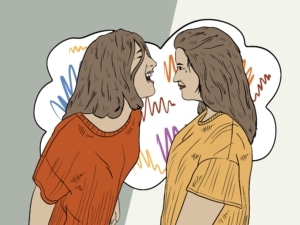
There’s a moment I keep returning to—quiet, ordinary, and surprisingly revealing. A conversation starts with goodwill. People want fairness. They want safety. They want to be decent. Then the same pattern appears facts arrive without their context, a few details get trimmed, and the outcome starts to feel inevitable. What stays with me afterward isn’t only the disagreement. It’s the question: Who is willing to look closer?

Growing up in Detroit in the ’60s, I learned early that social justice isn’t abstract—it’s something you watch unfold in real time. July 1967 lives in me like a knot that never fully unties. I was playing ball at Palmer Park when I looked east and saw smoke rising from the direction of my house. My body understood something was wrong before my mind could name it. I ran home through smoke and fire, searching for friends and neighbors—and finding some of them too late.

The unrest of not looking closer had finally exploded in riot.

I also lived next door to neighbors who looked different than me but carried the same human needs: fear when things worsened, hope when someone promised change, love for family, and a dignity they never asked anyone to grant—only to recognize.

That’s why Dr. King’s words land so gently and so powerfully—not as condemnation, but as an invitation to wake up.

“Nothing in the world is more dangerous than sincere ignorance and conscientious stupidity. We have a responsibility to be intelligent.”

Dr. King wasn’t only warning about cruelty. He was naming something subtler: sincerity that feels honest, and conscience that grows numb—not because people lack intelligence, but because they avoid the work required to use it. This isn’t merely about knowing. It’s about becoming the kind of person who refuses to let comfort masquerade as truth—even when the truth costs you something.

An Invitation into Three Kinds of Becoming

If we approach Dr. King with humility, his warning opens into an invitation:

  1. Becoming the kind of person who can learn without self-protection.
  2. Becoming the kind of person who can keep loving while seeking clarity.
  3. Becoming the kind of person who treats truth as a responsibility—not something to be avoided.

So, let’s take Dr. King’s phrase “sincere ignorance” seriously, not as a label to throw at others, but as a mirror—one that helps us notice where we may be missing something, and where we can grow.

Sincere Ignorance: When Not Knowing Feels Like Innocence

Sincere ignorance can happen even with the best intentions. It often begins quietly—with being handed only a portion of the story. We learn in fragments: family traditions, school lessons, community conversations, headlines. When that information is offered as complete, it can feel natural to accept it as reality. Over time, a partial account can solidify into a belief system—not because someone has thought deeply, but because they were never given a reason to question it.

“Ignorance” here doesn’t mean wrongdoing. It often means you simply didn’t have access to the full record—you weren’t trained to doubt yourself in healthy ways, and you weren’t offered the better questions.

And yet—here is the invitation—staying in that ignorance can still carry harm, even without intent.

Sincere ignorance disguises itself as innocence. Confirmation bias works quietly: we notice what aligns with our assumptions and overlook what doesn’t. We confuse “no doubt” with “truth.” In Detroit, I remember how hard it was to make meaning fast enough—how emotions demanded answers, but language didn’t arrive in time. I carried confusion that never became clarity. Dr. King’s phrase invites us to notice that gap: between what we feel, what we assume, and what we know.

Here’s the layer that makes this personal rather than merely intellectual: sometimes sincere ignorance causes harm through kindness. You respond with genuine empathy to someone who needs help—but the facts you’re relying on are trimmed. You’re responding to a portrayal rather than to the full context. Your compassion, guided by incomplete knowledge, may strengthen the very harm you hoped to prevent.

The invitation is not to shame people for what they didn’t know. It’s to learn how to stay compassionate without becoming careless. Becoming intelligent, in this sense, is how we protect love from becoming blind.

Conscientious Stupidity: When We Could Know and Choose Not To

Dr. King’s second phrase carries more weight, because it points to choice. Learning is possible. Clarity is available. Evidence exists. But discomfort protects comfort.

In daily life, this can look like postponing that never ends—asking for proof indefinitely while the pattern stays visible; insisting everything is too complicated until responsibility disappears; debating endlessly while inaction becomes normal.

Conscientious stupidity shifts the emphasis from not knowing to defending not knowing. It can look like demanding receipts while refusing to examine the receipts already within reach—or choosing abstraction over action, talking about nuance while ignoring what harm looks like on the ground.

It often sounds reasonable. It can wear the mask of “I’m just being cautious,” while quietly avoiding the steps that would test the belief.

But I want to keep this an invitation, not a threat. Dr. King isn’t asking, “Are you bad?” He’s asking, “Are you willing to wake up?”

A Spiritual Lens: What Fruit Are You Producing?

Howard Thurman’s approach to scripture offers a grounding question I find spiritually honest: What fruit is this teaching producing? Does it deepen love in action? Or does it produce obedience without transformation?

That question matters here because becoming intelligent is not only cognitive—it’s spiritual. Faith that cannot bear evidence will eventually become a shelter for denial. But faith that can bear evidence becomes a doorway to courage.

The invitation is to let your theology, your spiritual commitments, and your daily habits be tested by fruit. Are you becoming more loving and more accountable? Or more defended and less open?

What “Be Intelligent” Looks Like in Practice

Becoming intelligent isn’t cold or superior. It’s love with clarity.

  1. Pause before repeating a claim. Ask: Where did this come from? What context might be missing?
  2. Seek the full record. Look for credible evidence—not only persuasive stories. If a claim matters, the sources should matter too.
  3. Read teachings by their fruit. Ask: What does this lens train me to do? Compassion with courage, or comfort without accountability?
  4. Turn learning into one next right action. Share what you learn respectfully. Support local justice work. Join conversations that welcome both evidence and humanity.

Don’t Stop at Agreement

If this resonates with you, don’t stop there. Dr. King’s warning is an invitation to become awake—to let truth shape conscience, and to move from confusion to action, so love doesn’t stay trapped in good intentions but becomes something people can feel in the world.

Pick one claim you’ve heard often—something you’ve repeated without fully checking. Don’t choose something to debunk. Choose something to understand responsibly. Research it thoroughly, then name one specific change you will make: how you will speak, what you will support, what you will no longer excuse.

Then invite someone else—gently—into the same work. Not by humiliating them, but by modeling what humility looks like: the courage to say, “I might be missing something,” and the willingness to learn anyway.

Sincerity is not enough. Intelligence, in Dr. King’s sense, is responsibility: the courage to look again, to learn, and to act as though what’s true matters—and as though what happens next matters too.

Dr. King’s warning is not a verdict of you doing something wrong. It is a doorway for truth and love to abound.

Peace and every good.