
“The Work of Art at the Center of Every Person”
There were two easels in our house growing up, set at angles in the same room so neither parent blocked the other’s light. My mother worked in oils, slow and layered, sometimes returning to the same canvas for weeks until a shadow finally sat right. My father moved faster, looser, more willing to ruin a piece chasing something better. I grew up in the smell of turpentine and the quiet of two people absorbed in work that had no deadline attached to it, only a standard only they could see. I didn’t understand, as a kid, that I was watching two different theologies of creation. I just knew that in our house, “finished” was a word my parents used carefully, almost reluctantly, the way some families talk about money.
I tell you this because I’ve spent the better part of three decades since then assuming the lesson I took from that house was about art itself — about craft, attention, the discipline of starting over. It took my friend and colleague Jeff to show me I’d had it slightly wrong the whole time.
Jeff and I go back further than spirit of EQ. Long before either of us thought about emotional intelligence as a vocation, Jeff was part of the Varment Guard years — one of the people who helped build something out of almost nothing, back when “failure was not an option” was a motto we meant literally because the alternative wasn’t survivable. He’s the kind of person you want next to you in a startup’s early days: steady under pressure, unbothered by long hours, the sort of teammate who shows up and does the unglamorous work without needing credit for it. He was a member of New Albany UMC for years, and he still gives his weekends — actual weekends, the kind most people guard fiercely — to Kairos Prison Ministry, sitting in rooms with incarcerated men who have no platform, no audience, and in many cases no expectation that anyone outside those walls is thinking about them at all. Ask him about it and he doesn’t describe it as a sacrifice; he lights up. Being of service is, by his own account, what energizes him most.
When Jeff talks about coaching now, he uses a phrase that stopped me the first time I heard it. His own way of putting it: “I believe that each person has a unique and amazing work of art at their core. Not art like painting, but their essence.” Not a metaphor for potential, exactly — closer to a literal claim. Somewhere underneath the job title, the defense mechanisms, the years of doing what was expected instead of what was true, there is something formed and specific and already complete, waiting less to be built than to be uncovered. His own Noble Goal, the thing he organizes his working life around, is to help people find that art in themselves.
I used to think that was a generous overstatement — the kind of thing you say to encourage someone, true in spirit more than in fact. Then I watched what Jeff does with men inside a prison who have nothing left to perform for, no résumé to protect, no boss to impress. There’s no career upside to a Kairos weekend. No referral pipeline, no testimonial, no audience beyond the man across the table. Jeff describes what he brings into that room plainly: “These men have been beaten down for so much of their life that no one has told them that they have worth or value. I believe that is the most important thing that I take into the prison.” That’s the same claim as the work of art, said in a different register — not a creative impulse waiting to be unlocked, but a worth that was never actually in question, only buried under years of being told otherwise. And it’s precisely there, where every external reason to fake it has been stripped away, that Jeff says he sees people most clearly — not the art they wish they’d made, but the art that was always there, scarred over, hidden, waiting on someone steady enough to notice it without flinching.
This reframes the question I’d been asking wrong for years. I’d absorbed from my parents’ easels that art was something you produced — a discipline you practiced, a skill you built, a thing that either existed on the canvas or didn’t exist at all. So, when people tell me, in coaching sessions or over coffee, that they don’t have a creative bone in their body, that the art conversation isn’t for them, I understand exactly what they mean, because I used to measure it the same way. But Jeff’s version of the Noble Goal isn’t asking anyone to make more. It’s suggesting that most of us are sitting on something we’ve already made — a way of loving people, a particular kind of patience, a capacity to stay present in rooms other people flee — and we’ve spent so long hiding it, smoothing it over, calling it ordinary, that we’ve forgotten it was art at all.
This is where emotional intelligence stops being a corporate competency and starts being something closer to excavation. The tools Jeff uses — the same EQ frameworks we teach leaders and teams — aren’t really about performance optimization when you trace them back far enough. They’re instruments for noticing: what someone feels underneath what they’re saying, what’s been buried so long it reads as personality rather than choice, what got hidden because revealing it once cost too much. Jeff’s years in prison ministry didn’t happen alongside his coaching work by coincidence. They’re the same practice in two different rooms — one with stakes most people will never know, one with a quarterly review attached, both asking the identical question: what is the work of art this person has been hiding, and what would it take for them to trust it back into the light.
The Art You’ve Been Hiding Reflection Sheet
I think about those two easels differently now. My parents weren’t only teaching me about craft. They were teaching me, without either of them saying it outright, that the thing worth making was never separate from the person making it — that the canvas was just where it became visible. Jeff would say the canvas isn’t required at all. The art is already there. The work, his work, our work, is helping people stop believing they have to make something new before they’re allowed to call what’s already inside them by its true name.
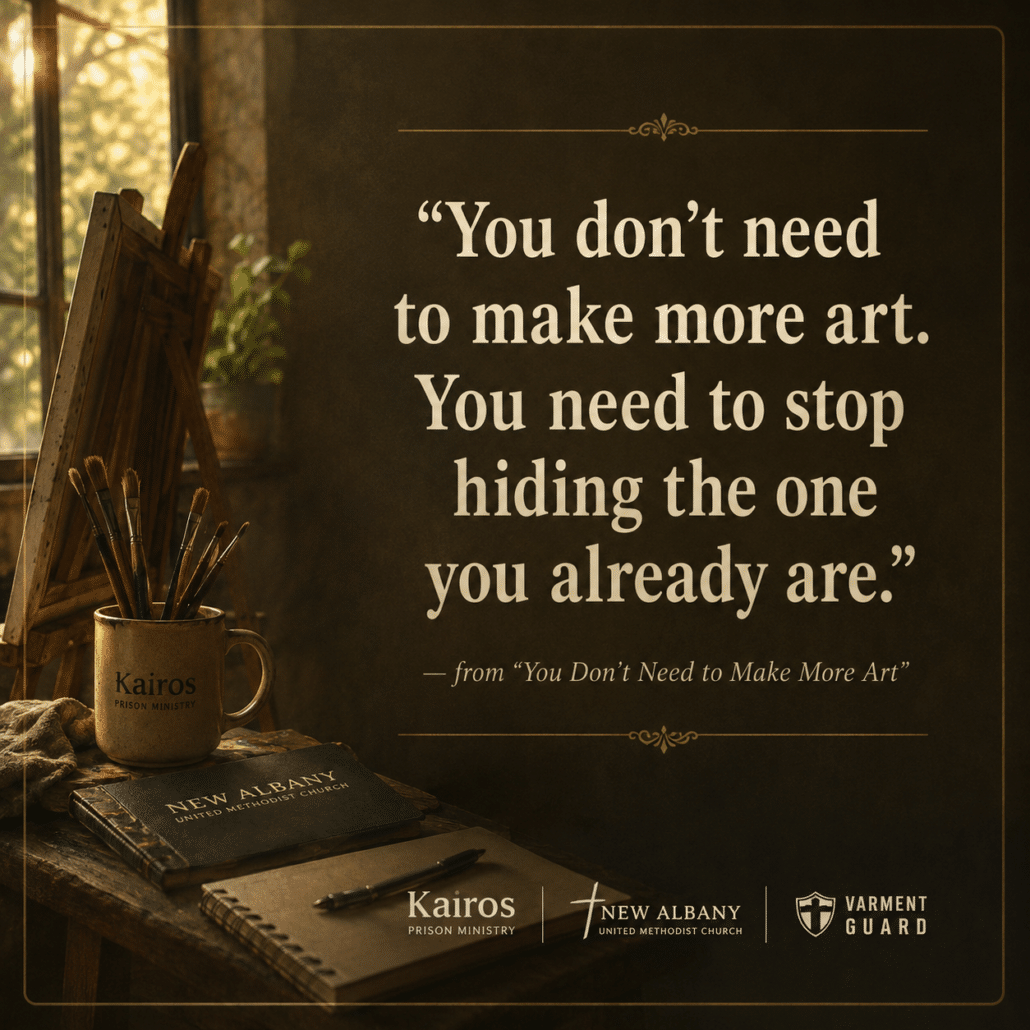
You don’t need to make more art. You need to stop hiding the one you already are.
Peace and Every Good
If this stirred something, you can find more reflections like it on The Mystical Seeker.
mysticalseeker.substack.com & spiritofeq.com/blog
About the Author
Jim Vaive is co-founder of spirit of EQ, where he and his wife Lynette help individuals, leaders, and teams grow through emotional intelligence, the Enneagram, and contemplative spiritual formation. He writes at The Mystical Seeker on the inward life that makes the outward work possible.


