
The Fish Don’t Talk About the Water
The Fish Don’t Talk About the Water
In 2005, David Foster Wallace stood in front of a graduating class at Kenyon College and told a small parable. Two young fish are swimming along, and an older fish passes the other way and says, “Morning, boys. How’s the water?” The two young fish swim on for a bit, and then one of them turns to the other and says, “What the hell is water?”
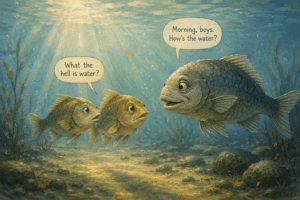
Wallace’s point wasn’t really about fish. It was about the obvious, ever-present realities that shape our lives so completely that we stop being able to see them at all. The water we swim in is the last thing we notice, precisely because it’s everywhere.
I thought about that fish story recently on a trip to a city I don’t call home. Our guide walked us past arena after arena, his voice rising with real pride — this stadium, that stadium, the new one going up next year. You could hear how much he loved his city in the way he talked about those buildings.
I looked past him at the sidewalks. Tents. Bedrolls. People folded into doorways in the middle of the afternoon. It wasn’t hidden. It wasn’t subtle. It was just — there, the way water is there.
So I asked him: “What about your homeless?”
He got quiet. Almost flinched. “We can’t really talk about that,” he said, and moved on to the next stadium.
We can’t really talk about that.
I’ve turned that sentence over many times since. It wasn’t cruelty in his voice — it was something closer to reflex, like a fish that’s been trained not to notice it’s wet. His city loves its stadiums out loud. Its people sleeping in the cold, it has agreed, silently and collectively, not to see.
And it’s not just his city. Homelessness in this country has climbed toward levels not seen since the Great Depression, and mostly we manage not to talk about it either — except to complain about a tent on a sidewalk we’d rather not look at on our way somewhere else. We build the water. Then we swim in it and call it normal.
Here is the part that should unsettle us, if we let it. This is not a new test, and we are not the first generation to fail parts of it. Ancient Israel’s prophets — Amos, Isaiah, Micah — spent their careers hammering a wealthy, temple-proud nation for the exact same blindness: elaborate worship on one hand, the poor ground into the dust on the other. Rome built magnificent coliseums while its underclass starved outside the gates, and centuries later we tour the ruins and marvel at the architecture without asking who slept in its shadow. Every era gets its stadiums — its games, its monuments, its things to be proud of out loud — and every era has, in its own doorways, a version of what its guides would rather not discuss. The particulars change. The reflex does not.
There are people who’ve given their whole careers to this fight, and right now many of them are losing ground. In 1992, a psychologist named Dr. Sam Tsemberis started a small experiment in New York called Pathways to Housing: give a person an apartment first — before therapy, before sobriety, before anything else is asked of them. It worked. Housing First, as the model came to be known, spread nationwide over the next three decades and became the backbone of federal homelessness policy, credited by researchers as the most effective tool built yet against chronic homelessness.
In 2026, the same federal agency that once championed it moved to gut its funding in favor of “treatment first” programs instead, a shift advocates warned could put more than 170,000 people back on the street. A judge has since blocked part of the rollback, but the funding remains fragile, and shelters are folding while they wait. In one Maryland county, a permanent-housing program lost its federal grant in January; a small Episcopal church down the road gave its entire Christmas offering — about $15,000 — just to cover eleven families’ rent for one more month. That’s the fight up close: careful work built over three decades, surviving month to month on a church’s collection plate.
Wallace saw a version of this same blindness, from a different angle entirely — not policy, but attention. Near the end of that commencement address, he circled back to his fish and told the graduates plainly: “This is water. This is water.” He wasn’t talking about homelessness. He was talking about all of it — every obvious, unbearable thing that hides in plain sight until someone insists on naming it.
Francis of Assisi understood something about this reflex that still cuts. He didn’t organize a committee to study poverty from a comfortable distance. He walked toward the leper on the road — the person his whole city had agreed to look past — and embraced him. Not as a strategy. As a correction to his own blindness. He had to become willing to see the water before he could do anything about it at all.
Fish Don’t Talk About Water Workbook
Awareness is the first domain of Spiritual Emotional Intelligence for exactly this reason. You cannot repent of what you cannot see. You cannot love your neighbor if your neighbor has quietly become part of the scenery — background, infrastructure, something you’ve stopped registering as human. The tour guide’s embarrassment wasn’t a character flaw. It was a diagnosis, and it’s one most of us carry in some form, about some doorway in some city we’ve decided not to look at too closely.
Every tradition I’ve spent my life inside says some version of the same hard thing: a society is judged, in the end, not by its monuments but by how it treats the ones with no power to demand better treatment. Not by its stadiums. By its doorways. History keeps handing down that report card, generation after generation, and we keep being surprised that it’s still being graded.
Where This Meets You:
Somewhere in your own city, there’s a version of that tour guide’s silence — a thing everyone has quietly agreed not to mention. You already know what it is. The only question Wallace’s parable really leaves us with isn’t whether the water is there. It’s whether we’re willing to notice we’re wet.
Peace and every good.
Jim Vaive is co-founder of spirit of EQ and author of The Mystical Seeker, writing at the intersection of emotional intelligence, the Enneagram, and contemplative spirituality. He and his wife Lynette help individuals and organizations grow from the inside out.”