Posts

The Exquisite Risk of Letting the Dark Do Its Work

There is a photograph I have carried in my memory for decades — not one taken on film, but one pressed into the body the way cold presses into bone. It is a winter morning in Detroit, still dark at six a.m., and I am standing at the kitchen window watching my mother mix paint in the silence before the house woke up. She wasn’t sad. She wasn’t lost. She was in that rare place artists sometimes go — a place that looks like emptiness from the outside but is, from the inside, a particular kind of waiting. A necessary hollow. I didn’t have words for it then. I do now.

The mystics called it la noche oscura — the dark night of the soul.

When the Ground Falls Away

Most of us arrive at the dark night not by choice but by collapse. Something that once held meaning — a career, a faith practice, a sense of self, a relationship — gives way beneath us. The fall is disorienting precisely because we didn’t see it coming, and because the things we reach for on the way down don’t hold.

This is not ordinary sadness. It is not burnout, though it can look like it. It is not clinical depression, though it can travel alongside it, and if it is significantly impairing your daily life or generating thoughts of self-harm, please reach out to a licensed professional — that is not weakness, it is wisdom.

What distinguishes the dark night is its spiritual texture: the loss isn’t just of energy or motivation but of meaning itself. Things that once lit you up feel hollow. Your spiritual practices go silent. You withdraw. You wonder, quietly or loudly, whether you have lost God, or whether God was ever there at all.

St. John of the Cross — a sixteenth-century Spanish mystic who wrote from inside a prison cell no larger than a closet, where he had been confined by the very religious order he was trying to reform — would say: you are exactly where you need to be.

That is hard to hear in the dark. It was for me.


The Poem That Knows the Way

What John wrote in that cell was not a lament. It was, against all reason, a love poem.

“Dark Night of the Soul” — in Mirabai Starr’s luminous translation opens not in despair but in secret motion. The soul slips out of the house while everything is still. She travels in darkness, not despite the darkness but through it, guided not by any external lamp but by something burning in her own chest.

No other light, no other guide Than the one burning in my heart. — St. John of the Cross, trans. Mirabai Starr

This is the paradox the dark night holds: what feels like abandonment is, in John’s vision, a form of being led. The stripping away of every consolation — every spiritual feeling, every certainty, every framework that once made sense — is not punishment. It is preparation. The soul is being emptied so that something truer can fill it.

The poem ends not in the darkness but in a garden. In rest. In transformation. Lover transformed in Beloved.

John doesn’t promise the journey will be short. He doesn’t promise it won’t hurt. He promises it goes somewhere.

What Emotional Intelligence Has to Do with It

Here is where the contemplative tradition and emotional intelligence meet in a way I find profound: both ask us to stay present with what is, rather than immediately managing it away.

One of the core competencies in the Six Seconds model of EQ is what we call Feel Your Feelings — the capacity to move toward your inner experience rather than away from it. Not to be consumed by it. Not to perform it. But to let it be what it is, without premature resolution.

The dark night, spiritually understood, asks for the same posture. It resists the fixes we reach for — the productivity systems, the five-step frameworks, the urgent need to locate the lesson and extract it. Those impulses are understandable. They are also, in the dark night, exactly what is being dismantled.

What the dark night wants from you is not your solutions. It wants your surrender.

And surrender — in the contemplative sense — is not passivity. It is a particular kind of courage: the willingness to stop managing the mystery and begin inhabiting it.


Five Things to Do When You Are in the Dark

I want to offer not a ladder out but a way of being in. These are not performance targets. They are invitations.

Stay close to your body.  The dark night is disorienting in the mind, but the body often knows more than we credit it with. Walk. Sit with your back against something solid. Pay attention to what you can smell, hear, feel. The Incarnation — God taking on a body — is itself a theological argument that matter matters. You are allowed to be a creature.

Release the spiritual performance.  If your prayer feels empty, don’t force it into the shape it used to have. John wrote from inside a prison cell with nothing but scraps of cloth and the words forming in him in the dark. The form of devotion may need to change entirely. Let it.

Find one trustworthy companion.  Not someone who will rush you to resolution, but someone who can sit in the not-knowing with you. A spiritual director. A therapist. A friend formed in contemplative patience. The dark night is not meant to be survived alone, even when it demands solitude.

Practice lectio divina with the darkness itself.  What if you read the darkness the way monastics read scripture — slowly, with openness, asking not what does this mean but what is this forming in me? The dark night, John insists, is doing something. You may not be able to name it yet. That is alright.

Trust the heart that burns inside.  Even when you cannot feel it. Even when the candle seems to have gone out. John’s soul travels the whole dark journey guided by what is burning inside her chest — not what she can see, not what makes rational sense, but what is alive in her. There is something in you that has not gone out. It may be very quiet. Tend it like an ember.

What the Darkness Already Knows Reflection Guide


What the Darkness Already Knows

My mother would finish her mixing before the sun came up, and then she would begin. I used to think the dark hours were the waiting. I understand now they were the work.

The dark night of the soul is not a detour from the spiritual life. For John of the Cross, for Meister Eckhart, for Howard Thurman writing from the underside of suffering, for Julian of Norwich holding her visions in the midst of plague — the darkness has always been the passage. Not the destination. But not the obstacle either.

It is, to borrow Mirabai Starr’s phrase, an exquisite risk.

And if you are in it right now — if the house has gone still and everything you reached for is no longer where you left it — you are not broken. You are, perhaps, being made.

The night that joins the lover with the Beloved does not announce itself. It simply comes. And it leads.

St. John of the Cross, Dark Night of the Soul, translated by Mirabai Starr, Riverhead Books, 2002 —

If this found you in a threshold season, we’d be honored to walk alongside you — explore spirit of EQ’s community on Substack or join us in our Mighty Networks space for ongoing conversation.

Peace and every good.

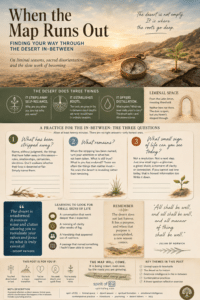
When the Map Runs Out: Finding Your Way Through the Desert In-Between

When the Map Runs Out: Finding Your Way Through the Desert In-Between

On liminal seasons, sacred disorientation, and the slow work of becoming

There is a moment — if you have ever been truly lost — when the map in your hand stops making sense. The road it promises isn’t there. The landmarks don’t match. And you realize, with a strange mix of dread and something almost like relief, that you have entered unmapped territory.

That is the desert. Not necessarily sand and scorching heat, though those images carry real weight across ancient wisdom traditions. The desert is any season where the familiar landmarks disappear — where the identity you carried into a transition no longer fits, and the one you will carry out has not yet taken shape. Theologians and contemplatives have long called it the wilderness. Anthropologist Arnold van Gennep named it liminality, from the Latin limen, meaning threshold. You are on the threshold. Neither here nor there. The door is open, but you haven’t stepped through.

I have lived in that doorway. In different seasons, I found myself between jobs, between marriages, and navigating the slow aftermath of a health crisis — like pancreatitis, which has a way of stripping everything to bare essentials with very little ceremony. Each loss arrived not as a single blow but as a kind of systemic unraveling. What I thought I knew about myself, about my direction, about what I was building — all of it came into question at once.

What I did not expect was that the desert would become a teacher.

The Threshold Has a Name

Liminal space is the technical name for the in-between — the transitional zone that exists between what was and what will be. Van Gennep first mapped it in his study of rites of passage: every significant human transition, he observed, moves through three phases. There is separation from the old identity, a liminal period of disorientation and becoming, and eventually reincorporation into a new form.

The middle phase — the liminal — is not a waiting room. It is a crucible.


Ancient traditions knew this. The Hebrew Bible is full of desert wandering — forty years for a people who needed to become something they were not yet. Moses on Sinai. Elijah under the broom tree. Jesus in the wilderness before the beginning of his public ministry. The desert, in these stories, is never incidental. It is the point. Something essential is being formed that could not have been formed any other way.

The desert fathers and mothers — those early Christian monastics who literally fled to the Egyptian wilderness in the third and fourth centuries — went to the desert on purpose. They understood that the stripping of comfort was not punishment but preparation. What could not be heard in the noise of ordinary life could sometimes be heard in the silence of the barren places.

“The desert is unadorned. It removes noise and clutter allowing you to reevaluate your values and focus on what is truly essential.”

I did not choose my desert. Most of us don’t. But I did, eventually, choose how to inhabit it.

What the Desert Actually Does

There is a temptation, when you are in a liminal season, to treat it as a problem to be solved. To scramble for the next thing, the next role, the next relationship — anything to end the suspension. I understand that impulse deeply. The in-between is uncomfortable in ways that are hard to articulate to people who are not in it.


But the desert has purposes that cannot be rushed.

It strips away self-reliance. When the external scaffolding of identity falls away — the job title, the relationship, the health you assumed — you are brought into contact with something deeper. Who are you when you are not who you were? That question, honestly held, is one of the most spiritually generative questions a person can carry.

It establishes roots. A plant in the desert sends its root system down far deeper than plants in well-watered soil. It must, to survive. Liminal seasons do something similar in us. The roots we grow in the in-between often reach depths we would never have explored in ordinary seasons.

It offers distillation. The desert is ruthlessly clarifying. What matters to you? What were you carrying that was never really yours to carry? What were you building toward that came from someone else’s vision for your life? The desert asks these questions quietly and persistently, and if you are still enough to hear them, the answers begin to come.

During my own desert season, I found myself returning again and again to contemplative practices — extended periods of silence, long walks without destination. Not as escape, but as a form of listening. I was learning to let the quiet do its work.

The emotional intelligence framework Lynette and I work with at spirit of EQ has a concept that became very real to me during this time: the difference between reaction and response. In a liminal season, there is enormous pressure to react — to fill the silence, to fix the disorientation, to manufacture certainty. Learning to pause, to stay present to what is really happening rather than what you fear might happen, is one of the deepest EQ practices I know. And the desert is where I learned it at a cellular level.

Learning to Look for Small Signs of Life

One of the most important practices I developed in those seasons was what I can only describe as desert botany — the discipline of looking for small signs of life in apparently barren ground.

The desert is never as empty as it first appears. It is full of life that has adapted to scarcity, that blooms in small and unexpected ways, that knows how to wait. When I stopped looking for the dramatic turnaround — the moment when everything would resolve — and started looking for the small green shoots, something shifted.

A conversation that went deeper than I expected. A morning of clarity after weeks of fog. A friendship that appeared out of nowhere and offered exactly what was needed. A passage from a desert father that named something I hadn’t been able to name.

Julian of Norwich, writing from her own experience of suffering and disorientation, offered words I returned to often: that all shall be well, and all shall be well, and all manner of thing shall be well. Not as denial of the present difficulty, but as an orientation toward a goodness that exists beyond the current view. The desert does not last forever. It has a purpose, and when that purpose is accomplished, a new season comes.

But the new season is shaped by how we inhabit the desert. Those who fight it or flee it arrive depleted. Those who learn to dwell in it — not comfortably, but honestly — often arrive at the other side with something they could not have acquired any other way.

Desert Journal Worksheet Link

A Practice for the In-Between: The Three Questions

This exercise is best done slowly, with a journal or open space for reflection. Allow at least twenty minutes. There are no right answers — only honest ones.

The desert fathers practiced a form of structured self-inquiry they called examen — a slow, honest review of what was present, what was absent, and what was stirring beneath the surface. This exercise draws on that tradition.

Settle first. Before you begin, take three slow breaths. Release the urgency of solving anything. You are here to notice, not to fix.

Question One: What has been stripped away?

Name, without judgment, the things that have fallen away in this season — roles, relationships, certainties, identities. Don’t evaluate whether their loss is deserved or fair. Simply name them.

Question Two: What remains?

When the stripping has been named, turn your attention to what has not been taken. What is still true? What in you has endured? These are often the things that matter most — the ones the desert is revealing rather than removing.

Question Three: What small sign of life can you see today?

Not a resolution. Not a next step. Just one small sign — a glimmer, a green shoot, a moment of clarity or connection. If you cannot see one today, that is honest information too. Write it down.

The Map Will Come

I am on the other side of that desert for now — or perhaps more accurately, I am in a different landscape, carrying what I learned in the in-between. The job that came after that season shaped Lynette and me into what we now call spirit of EQ. The health crisis that stripped my certainty about my physical resilience also deepened my empathy for people navigating their own fragility. The relational losses became — slowly, painfully, eventually — the soil from which something more honest grew.

I don’t want to romanticize the desert. It was hard. There were stretches of genuine desolation. But I also don’t want to minimize what it gave me — a set of roots that go deeper than anything I had before, a clarity about what matters, and a capacity to sit with others in their own liminal seasons without needing to rush them out the door.

If you are in the in-between right now — between who you were and who you are becoming, in a season of dryness, disorientation, or loss — I want you to know two things. First: you are not lost. You are in unmapped territory, which is a different thing entirely. And second: the map will come. It is being drawn, even now, by the roots you are growing.

The threshold is not the end of the journey. It is the most important part of it.

Peace and every good.