Posts

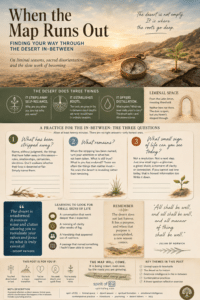
When the Map Runs Out: Finding Your Way Through the Desert In-Between

When the Map Runs Out: Finding Your Way Through the Desert In-Between

On liminal seasons, sacred disorientation, and the slow work of becoming

There is a moment — if you have ever been truly lost — when the map in your hand stops making sense. The road it promises isn’t there. The landmarks don’t match. And you realize, with a strange mix of dread and something almost like relief, that you have entered unmapped territory.

That is the desert. Not necessarily sand and scorching heat, though those images carry real weight across ancient wisdom traditions. The desert is any season where the familiar landmarks disappear — where the identity you carried into a transition no longer fits, and the one you will carry out has not yet taken shape. Theologians and contemplatives have long called it the wilderness. Anthropologist Arnold van Gennep named it liminality, from the Latin limen, meaning threshold. You are on the threshold. Neither here nor there. The door is open, but you haven’t stepped through.

I have lived in that doorway. In different seasons, I found myself between jobs, between marriages, and navigating the slow aftermath of a health crisis — like pancreatitis, which has a way of stripping everything to bare essentials with very little ceremony. Each loss arrived not as a single blow but as a kind of systemic unraveling. What I thought I knew about myself, about my direction, about what I was building — all of it came into question at once.

What I did not expect was that the desert would become a teacher.

The Threshold Has a Name

Liminal space is the technical name for the in-between — the transitional zone that exists between what was and what will be. Van Gennep first mapped it in his study of rites of passage: every significant human transition, he observed, moves through three phases. There is separation from the old identity, a liminal period of disorientation and becoming, and eventually reincorporation into a new form.

The middle phase — the liminal — is not a waiting room. It is a crucible.


Ancient traditions knew this. The Hebrew Bible is full of desert wandering — forty years for a people who needed to become something they were not yet. Moses on Sinai. Elijah under the broom tree. Jesus in the wilderness before the beginning of his public ministry. The desert, in these stories, is never incidental. It is the point. Something essential is being formed that could not have been formed any other way.

The desert fathers and mothers — those early Christian monastics who literally fled to the Egyptian wilderness in the third and fourth centuries — went to the desert on purpose. They understood that the stripping of comfort was not punishment but preparation. What could not be heard in the noise of ordinary life could sometimes be heard in the silence of the barren places.

“The desert is unadorned. It removes noise and clutter allowing you to reevaluate your values and focus on what is truly essential.”

I did not choose my desert. Most of us don’t. But I did, eventually, choose how to inhabit it.

What the Desert Actually Does

There is a temptation, when you are in a liminal season, to treat it as a problem to be solved. To scramble for the next thing, the next role, the next relationship — anything to end the suspension. I understand that impulse deeply. The in-between is uncomfortable in ways that are hard to articulate to people who are not in it.


But the desert has purposes that cannot be rushed.

It strips away self-reliance. When the external scaffolding of identity falls away — the job title, the relationship, the health you assumed — you are brought into contact with something deeper. Who are you when you are not who you were? That question, honestly held, is one of the most spiritually generative questions a person can carry.

It establishes roots. A plant in the desert sends its root system down far deeper than plants in well-watered soil. It must, to survive. Liminal seasons do something similar in us. The roots we grow in the in-between often reach depths we would never have explored in ordinary seasons.

It offers distillation. The desert is ruthlessly clarifying. What matters to you? What were you carrying that was never really yours to carry? What were you building toward that came from someone else’s vision for your life? The desert asks these questions quietly and persistently, and if you are still enough to hear them, the answers begin to come.

During my own desert season, I found myself returning again and again to contemplative practices — extended periods of silence, long walks without destination. Not as escape, but as a form of listening. I was learning to let the quiet do its work.

The emotional intelligence framework Lynette and I work with at spirit of EQ has a concept that became very real to me during this time: the difference between reaction and response. In a liminal season, there is enormous pressure to react — to fill the silence, to fix the disorientation, to manufacture certainty. Learning to pause, to stay present to what is really happening rather than what you fear might happen, is one of the deepest EQ practices I know. And the desert is where I learned it at a cellular level.

Learning to Look for Small Signs of Life

One of the most important practices I developed in those seasons was what I can only describe as desert botany — the discipline of looking for small signs of life in apparently barren ground.

The desert is never as empty as it first appears. It is full of life that has adapted to scarcity, that blooms in small and unexpected ways, that knows how to wait. When I stopped looking for the dramatic turnaround — the moment when everything would resolve — and started looking for the small green shoots, something shifted.

A conversation that went deeper than I expected. A morning of clarity after weeks of fog. A friendship that appeared out of nowhere and offered exactly what was needed. A passage from a desert father that named something I hadn’t been able to name.

Julian of Norwich, writing from her own experience of suffering and disorientation, offered words I returned to often: that all shall be well, and all shall be well, and all manner of thing shall be well. Not as denial of the present difficulty, but as an orientation toward a goodness that exists beyond the current view. The desert does not last forever. It has a purpose, and when that purpose is accomplished, a new season comes.

But the new season is shaped by how we inhabit the desert. Those who fight it or flee it arrive depleted. Those who learn to dwell in it — not comfortably, but honestly — often arrive at the other side with something they could not have acquired any other way.

Desert Journal Worksheet Link

A Practice for the In-Between: The Three Questions

This exercise is best done slowly, with a journal or open space for reflection. Allow at least twenty minutes. There are no right answers — only honest ones.

The desert fathers practiced a form of structured self-inquiry they called examen — a slow, honest review of what was present, what was absent, and what was stirring beneath the surface. This exercise draws on that tradition.

Settle first. Before you begin, take three slow breaths. Release the urgency of solving anything. You are here to notice, not to fix.

Question One: What has been stripped away?

Name, without judgment, the things that have fallen away in this season — roles, relationships, certainties, identities. Don’t evaluate whether their loss is deserved or fair. Simply name them.

Question Two: What remains?

When the stripping has been named, turn your attention to what has not been taken. What is still true? What in you has endured? These are often the things that matter most — the ones the desert is revealing rather than removing.

Question Three: What small sign of life can you see today?

Not a resolution. Not a next step. Just one small sign — a glimmer, a green shoot, a moment of clarity or connection. If you cannot see one today, that is honest information too. Write it down.

The Map Will Come

I am on the other side of that desert for now — or perhaps more accurately, I am in a different landscape, carrying what I learned in the in-between. The job that came after that season shaped Lynette and me into what we now call spirit of EQ. The health crisis that stripped my certainty about my physical resilience also deepened my empathy for people navigating their own fragility. The relational losses became — slowly, painfully, eventually — the soil from which something more honest grew.

I don’t want to romanticize the desert. It was hard. There were stretches of genuine desolation. But I also don’t want to minimize what it gave me — a set of roots that go deeper than anything I had before, a clarity about what matters, and a capacity to sit with others in their own liminal seasons without needing to rush them out the door.

If you are in the in-between right now — between who you were and who you are becoming, in a season of dryness, disorientation, or loss — I want you to know two things. First: you are not lost. You are in unmapped territory, which is a different thing entirely. And second: the map will come. It is being drawn, even now, by the roots you are growing.

The threshold is not the end of the journey. It is the most important part of it.

Peace and every good.


Seasons of Life: Plant, Cultivate, Harvest, Rest

Spring, Summer, Fall, Winter—four words that map to the weather outside, but also to the arc of a human life. About twenty years ago I developed a simple process to explain the changing seasons of our lives, and since then I’ve used it with people at many mile markers: teenagers, young professionals, midlife leaders, retirees. The metaphor is simple and intuitive, and it helps to name where we are and what work is appropriate for that season. Below I walk through each life-season—Spring, Summer, Fall, Winter—describe its character and give concrete examples of how people typically move through them. Wherever you are, the seasons remind you that change is natural, purposeful, and cyclical. Assuming we live to an average age of 80 please follow along below.


Spring: Ages 0–20 — Planting the seeds of who we might become then Spring is newness. The air smells of possibility. In this life-season we are discovering tastes, talents, and identity. Curiosity rules: children test boundaries, adolescents try on personas, young adults experiment with careers and relationships. Spring is the time for exploration, learning, and making mistakes—because mistakes are how seeds learn to grow.

Examples:

  • The student who tries math club, drama, and robotics before settling on engineering: each trial is a seed of interest, some blossoming later, some composting into wisdom.
  • A teen who travels abroad for the first time and finds an unexpected love for language and culture: that spark becomes the basis for a major in international studies.
  • The young parent who reads every book on infant sleep and nutrition, building a foundation of practical knowledge that will shape family rhythms for years.

What Spring asks of us

  • Curiosity over certainty. Try things without needing to commit forever.
  • Permission to be imperfect. Early experiments are meant to be rough drafts.
  • Support and scaffolding. Mentors, teachers, and family are the gardeners who provide guidance, not commands.

Summer: Ages 20–40 — Cultivation, hard work, and tending to what was planted then Summer is warm and busy. The seeds and seedlings from Spring now require persistent care: long days of watering projects, pruning distractions, fertilizing relationships. This is the period of craft, career-building, relationship consolidation, and parenting young children. The emphasis shifts from exploration to cultivation—turning possibility into reliable growth

Examples:

  • The professional who chooses a job, enrolls in targeted training, and spends years building expertise: through daily grind and focused practice, they develop the competence that makes them indispensable.
  • A couple who buys a first home, balances bills, and learns to co-manage household stress: their relationship grows through negotiation and shared responsibility.
  • An artist who organizes a schedule to write, paint, or rehearse every morning before work: discipline leads to a body of work.

What Summer asks of us

  • Patience and consistency. Growth is the product of repeated action, not one-off inspiration.
  • Discipline and sacrifice. Summer frequently requires saying no to immediate pleasure to protect long-term gain.
  • Adaptability. Heat brings pests and droughts; similarly, setbacks will require recalibration—not abandoning the whole garden.

Fall: Ages 40–60 — Harvest, reaping what you’ve sown then Fall is abundant and reflective. The work of Spring and Summer begins to yield measurable returns. Careers reach plateaus of influence, children launch into their own lives, investments and relationships show fruit. Fall is both a celebration and a reckoning: we gather the harvest and take stock of what was gained—and what might be missing.

Examples:

  • The entrepreneur who sells a company, realizing both financial reward and a sense of accomplishment: the sale is the harvest of years of risk and toil.
  • The parent sitting in an empty nest for the first time: there’s pride in grown children, and space to rediscover self.
  • The teacher who earns tenure and sees former students’ career-success: the lifetime of small moments culminates in visible impact.

What Fall asks of us

  • Gratitude and stewardship. Harvest is a time to enjoy results and wisely distribute them.
  • Honest assessment. Some crops may not have produced as expected—this is an opportunity for learning and for pruning future commitments.
  • Planning for transition. The abundance of Fall can fund new projects, mentorship roles, or simpler living in the seasons ahead.

Winter: Ages 60+ — Rest, reflection, and sharing the wisdom of a fallow ground then Winter is quieter and slower, but not empty. After decades of sowing, tending, and harvesting, the ground becomes fallow and the pace softens. This is a season for reflection, synthesis, and giving. Wisdom rises to the surface. People in Winter often become mentors, grandparents, community elders, or artists of subtlety. They ask new questions about meaning, legacy, and contribution.

Examples:

  • The retired engineer who volunteers to coach a robotics team, passing on practical knowledge and the ethic of craftsmanship.
  • The grandparent who tells family stories, preserving heritage and values for younger generations.
  • An older person who takes up painting later in life, using decades of observation to create work with depth and patience.

What Winter asks of us

  • Acceptance of limits. Winter invites us to appreciate what remains possible rather than mourn what’s past.
  • Generosity. Sharing accumulated knowledge, time, and resources can be among the most fruitful acts in Winter.
  • Curiosity reignited. Although the pace is slower, curiosity can still lead to deep learning—reading, community work, or spiritual exploration.

Seasonal transitions: fluid, non-linear, and deeply personal and one useful feature of the seasons model is that it’s not rigid. People don’t all move in lockstep with their birth year. Life events—immigration, illness, career changes, late parenthood—can shift us into a different season. An entrepreneur in their fifties may still be in a Summer of building, while a young person who experiences early loss may enter a reflective Fall earlier than peers. The model’s strength is in naming patterns: the energy you need to cultivate, the harvest you can expect, and the rest that’s owed.

Examples of non-linear journeys:

  • A 55-year-old who starts a new company after selling their previous one: their season is an energetic Summer nested within a chronological Fall.
  • A 30-year-old who becomes a caregiver for an aging parent: their Summer includes intense caretaking that often resembles Fall’s harvesting responsibilities.
  • A person who experiences a major spiritual awakening in their forties and shifts priorities from accumulation to meaning: their internal season moves toward Winter even as biological age sits in Summer.

Practical ways to honor your season

  • If you’re in Spring: cultivate curiosity. Try internships, travel, and varied learning. Build habits more than plans.
  • If you’re in Summer: protect your daily rituals. Keep a balance that allows for growth without burnout. Prioritize long-term commitments over short-term applause.
  • If you’re in Fall: catalog your achievements and gaps. Delegate, mentor, and think strategically about legacy and impact.
  • If you’re in Winter: simplify. Share stories, mentor, and focus on relationships. Consider how your resources—time, money, knowledge—can serve the next generation.

A final note on beauty and dignity in every season Each life-season has beauty and challenge. Spring’s zeal can be naïve; Summer’s busyness can be myopic; Fall’s harvest can bring unexpected loss; Winter’s quiet can feel lonely. Yet every season also brings opportunities uniquely its own—a first discovery in Spring, a mastery in Summer, a tangible harvest in Fall, and distilled wisdom in Winter. None is superior; all are necessary.

So, as you read this, consider what season you’re in. Name it. Ask what work that season requests of you. Tend your life with the attention appropriate to the season—plant with curiosity, cultivate with discipline, harvest with gratitude, and rest with generosity. When you treat life as a cycle of seasons rather than a single, linear race, you give yourself both grace and a roadmap: the right action at the right time, and the confidence that change is not failure but natural rhythm.