
ICF Mentor Coaching: What Changes on January 1, 2027
The ten hours have not changed. Who is allowed to give them has — and if you are starting now, the new rule already applies to you.
If you are working toward an ICF credential, or renewing one, a rule takes effect on January 1, 2027 that changes who your mentor coach can be.
The requirement itself is unchanged. ICF still asks for ten hours of mentor coaching, at least three of them one-to-one, completed over a minimum of three months. What changes is the qualification of the person delivering them. From January 1, every new mentor coaching hour that counts toward an ACC, PCC, or MCC credential must come from a mentor who holds ICF’s Mentor Coach Specialization — the MCS — at the level you are pursuing.
Until that date, any appropriately credentialed coach can mentor you. After it, the specialization is the requirement.
What the MCS is
ICF announced the Mentor Coach Specialization in April 2026. It is a separate qualification a mentor coach earns on top of their own credential, and it comes in three levels that map to the credential their clients are pursuing: MCS-ACC, MCS-PCC, and MCS-MCC.
To earn one, a coach holds an active credential in good standing and completes at least 41 hours of mentor coaching education aligned with the ICF Mentor Coaching Competencies. That education has to include specific training on the assessment framework for the level — the ACC BARS, the PCC Markers, or the MCC BARS.
The short version: mentoring a coach is now treated as its own discipline, with its own training and its own credential, rather than something any experienced coach is assumed to be able to do.
Which level you need
The level your mentor holds has to match the credential you are going for.
| You are pursuing | Through Dec 31, 2026 your mentor needs | From Jan 1, 2027 your mentor needs |
| ACC (application or renewal) | PCC or MCC, or a renewed ACC, in good standing | MCS-ACC or MCS-PCC |
| PCC (application) | An active PCC or MCC | MCS-PCC |
| MCC (application or renewal) | An MCC in good standing | MCS-MCC |
The MCC line is the strictest and always has been. An MCC candidate has to be mentored by an MCC, and from January that MCC also needs the MCC-level specialization.
The part most people are about to miss
ICF requires the ten hours to span at least three months. In practice that means twelve full weeks between your first session and your last.
Do the arithmetic against the calendar. Twelve weeks from the middle of November lands in the second week of February. Which means that if you have not already started, you cannot finish your hours before the cutover — and any hour delivered on or after January 1 by a mentor without the MCS will not count toward your application.
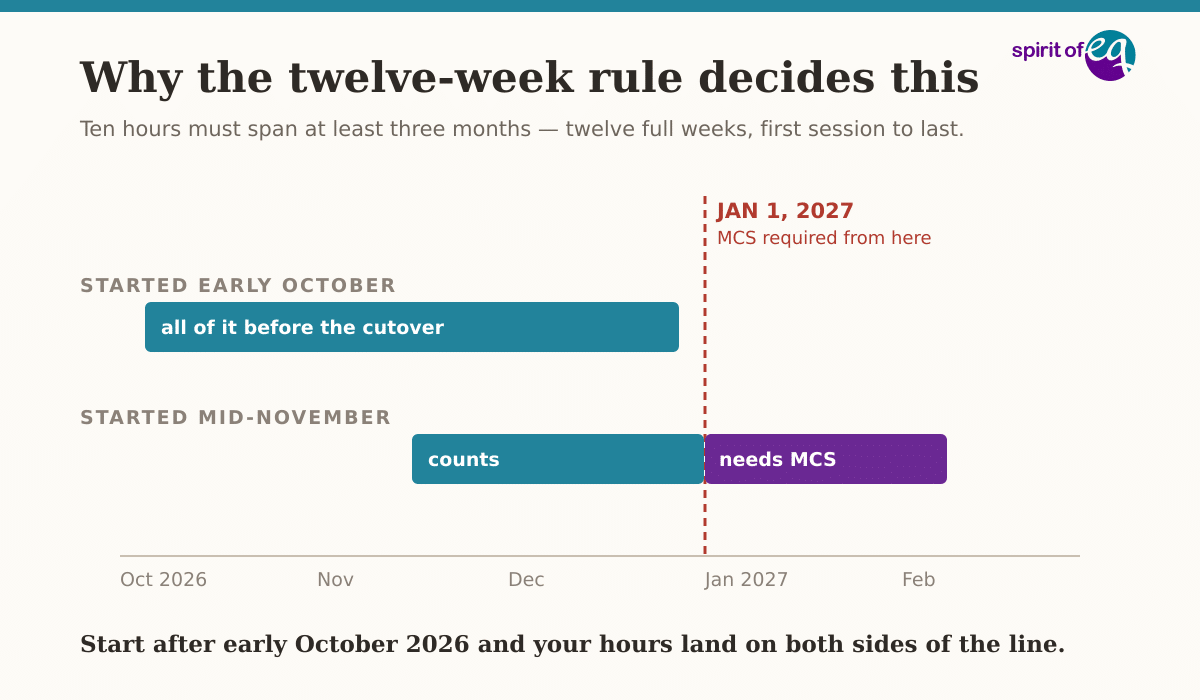
The window to do this under the old rules did not close on December 31. For anyone starting fresh, it closed sometime in early October, and most people have not noticed.
This is not a reason to panic. It is a reason to choose your mentor on one specific criterion: if you are beginning now, begin with someone who already holds the MCS at your level, so that every hour counts on both sides of the line rather than half of them.
If you have already done some of your hours
They are safe. Hours completed before January 1, 2027 with a mentor who was properly qualified under the rules in force at the time remain valid, and you do not need to redo them.
The dividing line is the date the hour was delivered, not the date you submit your application. Hours banked in 2026 with a qualified mentor count. New hours from January 1 need an MCS mentor.
If your engagement straddles the two years, that is worth a direct conversation with your mentor now rather than a discovery at submission.
What counts as an hour
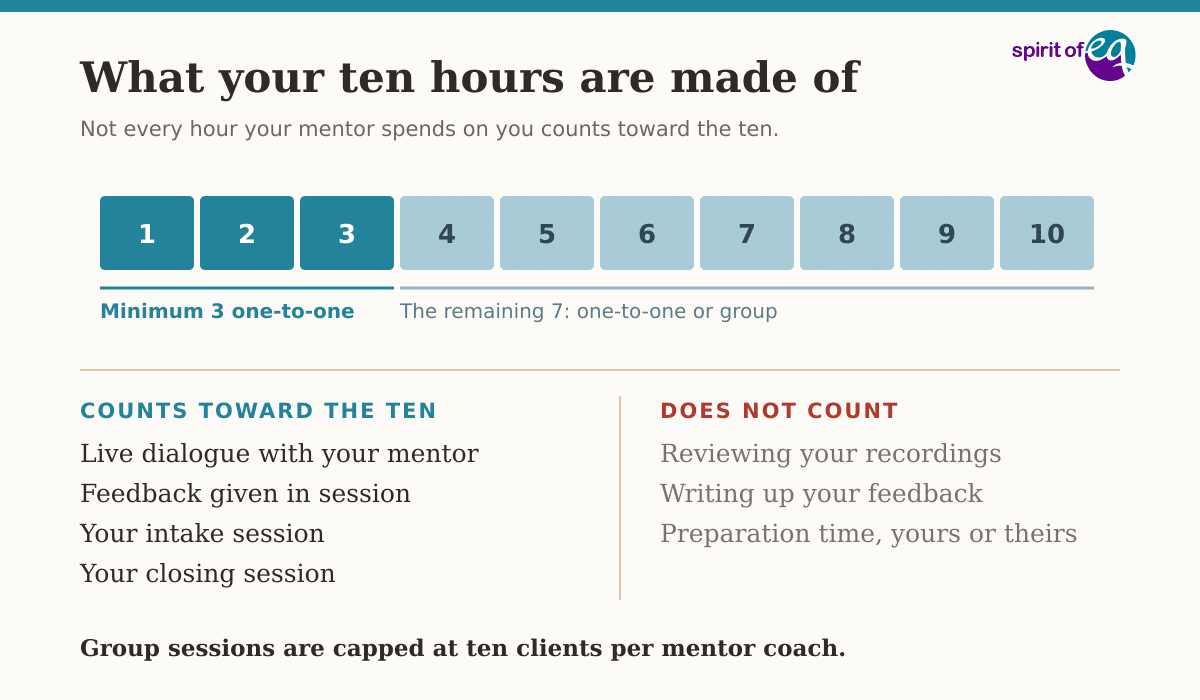
Worth restating, because it catches people out. Only the interactive time counts — the dialogue and the feedback. The hours your mentor spends listening to your recordings and preparing their notes do not count toward the ten, however much work that is. Your intake session and your closing session do count.
If some of your hours are in a group, ICF caps the group at ten clients per mentor coach. At least three of your ten hours must be one-to-one regardless.
If you are renewing rather than applying
Mentor coaching is part of ACC renewal, and the same January 1 rule applies to those hours.
For PCC renewal, mentor coaching is not required, but up to ten hours of it can count toward the forty CCEs you do need. Those hours have to come from mentor coaching at the PCC or MCC level.
Three things to do before January
Find out whether your mentor will hold the MCS. Ask directly, ask which level, and ask them to confirm it in writing before you book hours that fall in 2027. A mentor who has worked with candidates for years is not automatically covered — the specialization is new, and holding a PCC or an MCC does not confer it.
Check the dates of every hour. Not the month you started. The specific dates.
Count backwards from your application. Twelve weeks minimum, and leave room — ICF’s own handbook suggests at least two weeks between sessions, which stretches ten hours out further than most people plan for.
Download: Your 2027 Mentor Coaching Checklist
Everything above, as a checklist you can work down in ten minutes — which level you need, how to audit the hours you have already completed, the calendar arithmetic, and the three questions to put to your mentor in writing. Download the PDF.
Where we sit
We are writing this because we went and got the specialization, and because the coaches asking us about their hours have mostly not heard of the rule yet.
Jim holds the MCS at the ACC and PCC levels, with the MCC level in progress. Lynette holds it at the ACC and PCC levels. Hours with either of us count for ACC and PCC candidates under the current rules and under the rule arriving in January — nothing to redo when the date passes, and no split engagement to explain on your application.
Here is what the ten hours look like with us. All ten one-to-one, across a minimum of three months. Recorded session review against the ICF Core Competencies and the PCC Markers. Written feedback after every session, so you have something to work from rather than a memory of a conversation. The documentation ICF asks for, issued at the end. Two thousand five hundred dollars for the ten hours, stated up front so you can decide whether it fits before you spend a call finding out.
If you would rather think it through first — which level you need, how your dates fall, whether what you have already done still counts — book a conversation and we will work through it with you. No charge for that, and no expectation attached. If we think someone else is a better fit for where you are, we will tell you.
Peace and every good.
Jim and Dr. Lynette Vaive are the co-founders of spirit of EQ and co-authors of The Mystical Seeker. Jim is a Master Certified Coach and Lynette a Professional Certified Coach; both are certified Narrative Enneagram teachers and Certified Spiritual Directors. Learn more at spiritofeq.com.
Sources
ICF Mentor Coach Specialization Handbook (April 2026), International Coaching Federation. ICF Mentor Coaching requirements, coachingfederation.org.