
The Elder Is the One Who Can Be Asked
For thirteen years Lynette and I have been going to the same spiritual director.
Two chairs. A drink set down beside each of us. That particular few seconds before anyone speaks, when you both know what you came to say and neither of you has started. We go there to say out loud the things that do not get said anywhere else — and I have noticed that nothing gets said out loud in that room until somebody asks.
It happened in that room. I could not tell you now what had just been said — only that somebody had said something true, and in the quiet afterwards the holy crap light came on.
Not a thought. A piece of information arriving from lower down than thinking: this has changed. You are not the one carrying it any more. You are the one it gets brought to.
And the part I did not expect, and still cannot entirely explain, is that it was all right.
Hero to Elder
Connie Zweig, a psychotherapist who spent a career in the work before writing The Inner Work of Age, has a name for this passage. She calls it the shift from role to soul, and underneath it the move from Hero to Elder. I reached for the words doing to being before I ever read her, which I take as evidence that the thing is real and she simply got there first with language.
The Hero’s unit of value is capacity — what he can carry, fix, build, protect. I ran on that for forty years, and I have written elsewhere about the bill. The drive was not fair to the people around me, and some are still paying for it. That is the Hero’s characteristic damage. Not malice. Force, applied to people who had not asked for it.
The Elder’s unit of value is availability. Not what he can carry. What he can be asked.
Why the Hero cannot answer the only question that matters
I have been circling one question: what is mine to do?
It took me an embarrassing while to see why it would not resolve. The question is unanswerable to a Hero, because the Hero’s answer is always all of it. I am an Eight on the Enneagram, and here is what an Eight does — sees something shiny in the sand, rushes over, picks it up, turns it into something. Each time the thing was real and worth doing. Each time the picking-up was automatic.
Discernment requires something to decline with. You cannot sort what is yours from what is merely available while your sense of yourself depends on being able to take all of it. The move from hero to elder is not a pleasant development in late life. It is the thing that makes the question answerable at all.
What stands in the way is not time
Zweig came to this from shadow work — she co-wrote Meeting the Shadow long before she wrote about age. What blocks the passage is not the calendar. It is unconscious material: the denial and resistance that erupt at the thresholds of later life, mostly out of sight of the person they are happening to.
Every type has a version. For an Eight the disowned thing is need — not weakness in general, but the state of requiring something from someone who might not give it. I spent decades building a life in which that state was impossible, and I called the result strength.
Which is why the afternoon in that car park outside Florence went the way it did. Our car had been emptied, my passport with it, and I had been competent at a robbery all day. Then two colleagues arrived and asked what I needed first, and the thing I had spent forty years keeping out of the room walked in, and I could not hold it.
That is shadow doing what shadow does, and it is why a Hero cannot decide to become an Elder on a Tuesday. The material has to be met, and it does not surface on request. It surfaces when something takes your passport.
Where I already made the move, and where I have not
Here is the part I did not expect to find when I started writing this.
I have been doing elderhood for twenty years, professionally, without noticing. In the chair with a client or a directee, the one thing I will not do is tell them what to do. The choice is theirs, the consequences are theirs, and the only thing I have worth anything is a question they had not thought to ask themselves. People tell me, in almost the same phrase, that I never tell them what to do. I used to hear that as a compliment about technique. I think now it is a description of the office.
So the transition is not ahead of me at work. It is unfinished everywhere else.
An Eight fights for the people he cares about. That is my line and I have said it proudly. But I can let a client have their own consequences all day long, and whether I can let the people I love have theirs is a different question. I do not like my answer. The Hero is still fully operational in exactly the places where I care most.
A word, not a plan
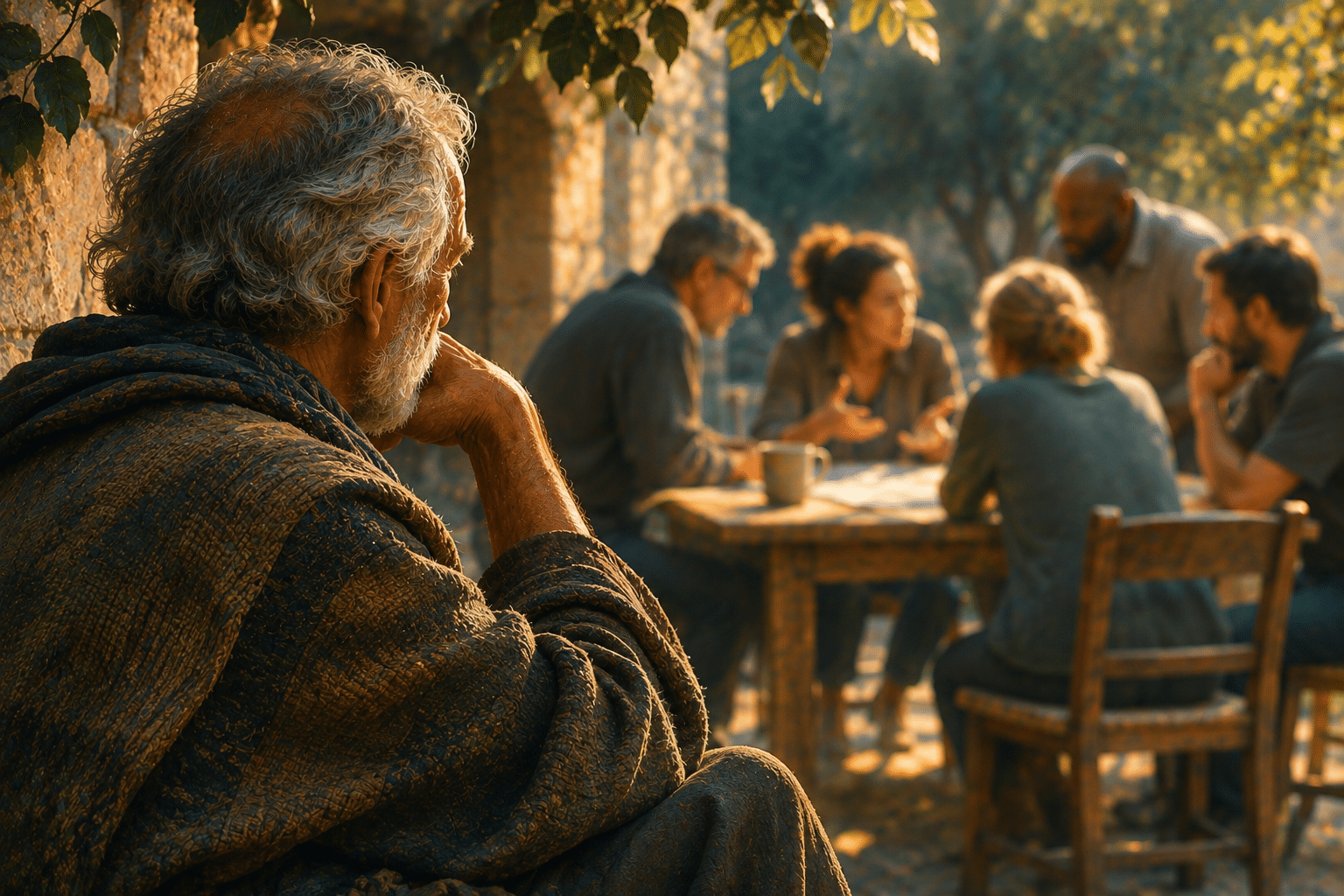
The monastics who went out into the Egyptian desert in the fourth century had no credentialing body — no application, no committee, no letters after anyone’s name. People walked out to where somebody was living, sat down, and said: abba, give me a word. Amma, if it was a woman. That was the whole transaction. Not a program, not a strategy — a word, something short and often strange, which the asker carried around for a year.
Notice who made the elder. The askers did. The office existed because people kept coming, and it would have ended the day they stopped. Which is the same shape as the thing I learned in Italy: an identity handed to you by other people, with no document in the transaction.
It also explains why advice is the Hero’s instrument and a word is the Elder’s. The Hero knows, and the knowing is proof of capacity. A word is offered and let go of, and whether anything comes of it is none of the giver’s business. You cannot give a word while you are still using your answers to prove something.
You cannot claim it. You can only become askable.
So what do you do, if you want the office and nobody is handing it out? Nothing that looks like applying. An elder who announces himself is seniority with a grievance. The only move available is to become the kind of person it makes sense to ask — reachable, honest about what you got wrong, done performing wisdom, and willing to be asked at an inconvenient hour by someone whose problem is not interesting.
Then the other half. The elder is not only the one who can be asked. The elder is the one who asks. Not let me know if you need anything, which hands the work back to the person already underwater. The four words two Italians used on me in a car park: what do you need first?
Anyone who asks that is doing the office, whatever their age.
What it costs, and the word I used
I will not pretend this is painless. It means being consulted less than you are capable of advising, with your influence running entirely on other people choosing to ask. After forty years of needing nobody’s permission to act, that is a real loss and I feel it.
What you get is larger and harder to name. The Hero is exhausting to be and exhausting to be near. People brace around a Hero. Nobody braces around an elder, which is exactly why they come.
Zweig was initiated as an Elder in a formal ceremony by a community that still performs them, and I am glad such things exist. But the ceremony did not make her one — it recognised something already underway. The rite ratifies; it cannot manufacture.
Which settles the question I have been circling since the passport. Everything else that proves me was issued by somebody and can be taken back in an afternoon — the title, the credentials, the body, the document in the drawer. This one is different, and not because it is more secure. It is different because it was never issued at all.
It is not a rank. It is a practice. And when I understood that, the word that came was not finally, and it was not at last. It was all right — the weight off the back arriving not as triumph but as permission.
Two chairs. A drink beside each of us. Somebody older than me has been doing this so quietly, for thirteen years, that it took me most of that time to notice it was a job.
A companion reflection sheet for this post: Who Comes to You (PDF).
About Jim & Dr. Lynette Vaive
Jim Vaive and Dr. Lynette Vaive are the co-founders of Spirit of EQ, where they work with leaders and seekers worldwide in coaching, training, and spiritual direction. Jim is a Master Certified Coach and Lynette a Professional Certified Coach; both are certified Narrative Enneagram teachers and Certified Spiritual Directors. Dr. Lynette Vaive’s doctoral research is the scholarly foundation of the Spiritual Emotional Intelligence (SEQ) framework. Together they write The Mystical Seeker on Substack and are co-authoring a book on SEQ. Reach them at jim@spiritofeq.com and lynette@spiritofeq.com.
Sources
Connie Zweig, The Inner Work of Age: Shifting from Role to Soul (Park Street Press, 2021), foreword by Harry R. Moody. Zweig is also co-author of Meeting the Shadow.
The form “give me a word” is from the sayings of the Desert Fathers and Mothers (the Apophthegmata Patrum), fourth-century Egypt.
Richard Rohr, “Our Life’s Call,” Daily Meditations, Center for Action and Contemplation, 13 November 2026.
© 2026 Spirit of EQ
