
The Circles You Didn’t Know You Were Drawing
Closeness has a shape, and most of us were never taught it.
There is a moment that happens in my work more often than any other, and it usually arrives early. Someone sits down, we exchange the ordinary opening courtesies, and then — twelve, fifteen minutes in — they hand me something enormous. A marriage that is failing. A diagnosis. A thing they did in 1987 they have never said out loud. It comes out in a rush, and when it is finished there is a particular silence while they wait to see what I am going to do with it.
In that room, it is the right thing. That is what the room is for.
What concerns me is what I hear next, which is that the same thing happened on Tuesday with someone at work.
People tell me this about themselves without quite hearing what they are telling me. They say it lightly: I’m an open book, I don’t really have a filter, I just say what I think. It is offered as a virtue, and in a sense it is one. These are not calculating people, and I would rather sit with them than with someone who has never let anything slip in their life. But then I ask how it tends to go, and the stories come out, and they are not good stories.
They go wrong in three ways, and it is worth separating them, because they are not the same problem.
The first is the one everyone braces for: someone takes what you gave them and uses it. Not always with malice — sometimes it is repeated in a meeting as context, or passed to a third person as concern — but the effect is that something you said in one register is now operating in another, where it can be held against you. This is the rarest of the three.
The second is more common and gets talked about less. The information is not weaponized; it is simply misread. You said you were struggling, and what got filed away was unstable. You said the marriage was hard, and what they carry now is she’s leaving him. Nothing was done with it. It sat in someone else’s head and finished itself in a shape you did not choose.
The third is the quietest and the most costly. You tell someone something large, and they hear it as an announcement of intimacy. You were overflowing. They understood it as being chosen. Now there is a closeness on the table that one of you believes in and the other does not, and that asymmetry has to go somewhere. Usually it becomes disappointment, and the disappointment lands on you, and you cannot work out what you did.
None of these are failures of honesty. Every one of them is a failure of proportion.
The contemplative tradition saw this early. John Cassian, writing in the fifth century about what he had learned from the desert monastics, called it discretio — discretion — and he did not mean keeping quiet. He meant the capacity to judge rightly what a particular moment asks for. He ranked it above the more dramatic virtues, above fasting and vigils, because those could all be practiced to excess and do harm, and discretion was the thing that knew how much. It is not a rule about secrets. It is a sense of measure.
What I could not find anywhere was a way to put that in front of someone in thirty seconds. So I built one. This is my own model, worked out over about twenty-five years — with clients, in direction, and on myself — and refined every time it turned out to be wrong.
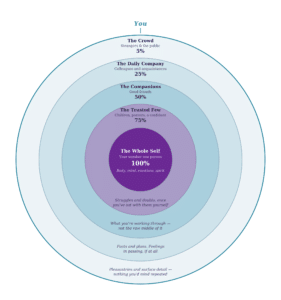
The Circles of Disclosure.
(NOTE–If you would like the Diagram, let me know.)
You are the whole field. Everyone in your life sits somewhere inside it, and how much of yourself you hand over changes with the distance from the center. The percentages are approximate; nobody is doing arithmetic in a hallway. They are there to give you something to feel for.
The Whole Self — 100%. At the center, your number one person. A spouse, a partner, whoever that one is. This is where you bring all of it: body, mind, emotions, spirit. Not a report on those things — the things themselves, including the parts you have not finished figuring out. You do not have to arrive at understanding before you speak. You can say it while it is still shapeless and be received anyway. I want to be plain about this, because it is the center of everything else on the page: you cannot do this with everyone, and attempting it will fail. Not might. Will. The whole self is more than any other circle is built to hold, and handing it to a circle that cannot carry it does not create closeness — it creates damage, usually to you. Most people have one such person. Some have none, and that is its own grief, worth naming rather than working around.
The Trusted Few — 75%. Children, parents, a confidant or two. Real struggles and doubts go here, with one difference that matters: once you have sat with them yourself. The distinction is not how much you say, it is whether you are talking with someone or at them. A grown child can carry the fact that you are frightened about something. They should not be the place where you first discover it.
And notice what has already happened by this ring. The whole self does not travel outward. It stops at the center. Everything from here on is a portion — a real portion, chosen and offered, but a portion — and that is not a loss or a compromise. It is what these relationships are for. The mistake people make is assuming that if they love someone enough, or trust them enough, the center should expand to include them. It does not work that way. The interior ring is interior because it is the only one built to hold all of you, and the moment you try to widen it, you have not made two people closer; you have only moved the weight somewhere it cannot be carried.
The Companions — 50%. People who know the shape of your life, who would recognize your handwriting and your worst habits. What you are working through goes here, but not the raw middle of it. Not the three-in-the-morning version. This is where you can be honest that something is hard without handing over the whole weight of it, and most real friendship lives at exactly this depth. It is not a lesser closeness. It is a different one.
The Daily Company — 25%. Colleagues, neighbors, the people you see constantly and know slightly. Facts and plans. Feelings in passing, if at all. You can say the week has been rough; you do not have to say why. There is a version of this that becomes armor, and that is not what I am describing — an office where nobody says anything real is its own kind of sick. But most of the damage I hear about here came from a mistaken register, not from excess warmth.
The Crowd — 5%. Strangers, anyone you have just met, and anything you post. Pleasantries and surface detail. Nothing you would mind being repeated, because it may be, and you will not be there when it is.
Circles of Disclosure Reflection Sheet
Here is what it looks like when the first circle’s contents land in the fourth.
Something has gone badly at home. You have not slept. On Monday a colleague you like well enough asks how your weekend was — a Daily Company question, asked in that register, expecting a Daily Company answer. And instead of rough, but fine, the true thing comes out: the marriage is in trouble, you are frightened, you do not know what happens next.
Watch what follows. They have nowhere to put it. They were making conversation and now they are holding something they did not ask for and cannot hand back. Whatever they say next will be inadequate, because the register they were standing in has no adequate response available — and you will feel that inadequacy as rejection, on top of everything else. Then they adjust. More careful around you, or more solicitous, either one a small distance where there wasn’t one. It travels a little, mentioned to one other person as genuine concern. And here is the part that costs the most: by Thursday you have come up for air. The information has not. It is still Monday morning in their head, and the version of you they are now working from is the worst hour of your year, frozen, with no way for you to go back and update it.
Nobody did anything wrong. The content was true. It was simply put in a circle not built to hold it.
Which brings me back to that room, and the silence after something has been set down.
What I listen for is not whether someone has told me too much; the room can hold it. I listen for whether the telling was aimed — whether this was said to me, here, for a reason, or whether it is simply what comes out of them now, in every room, to whoever is sitting there. Because if it is the second, the thing that looks like openness is doing something else. It is not connection. It is spillage. And spillage does not create intimacy; it only looks like it from the inside, for about an hour.
Most of the trouble comes from a mismatch — handing a Daily Company person something that belonged at the center, or holding back from the center what they had every right to hear. The first kind usually costs more, because what you said keeps travelling after you have stopped talking. Where the rings sit, and who belongs in each, is yours to work out.
Peace and every good.
——————————————————
About Jim & Lynette Vaive
Jim and Lynette Vaive are the co-founders of spirit of EQ and co-authors of The Mystical Seeker. They are Master Certified Coaches, certified Narrative Enneagram teachers, and Certified Spiritual Directors, and together they hold credentials in Spiritual Emotional Intelligence (SEQ) — a framework rooted in Lynette’s Doctor of Ministry research. Learn more at spiritofeq.com.
Sources
John Cassian on discretion as the governing virtue — Conferences, Conference II (“On Discretion”), c. 426. Cited as context for the problem, not as a source for the Circles of Disclosure model, which is the author’s own.