
Posts

Staying in the Boat: A Practice for Hard Seasons

Hope Takes Practice

The meeting room was quiet in a way that didn’t feel like reverence. It felt like dread. We’d borrowed the space from the church, a place to meet, nothing more, but everyone was there, all of us together in one room, and that fact alone told people something was coming before I said a word. Outside, the parking lot was full of company trucks and company cars parked in uneven rows, engines off, everyone already inside and waiting. It was early 2008. People sat there that morning the way you sit when you already suspect the news isn’t good — still, watchful, bracing.

They were right to brace. The housing bubble burst that winter, and in the space of three months, Varment Guard lost half its residential customer base. Half. We’d built the company on people buying houses, selling houses, refinancing houses, renovating houses, and on the ongoing maintenance that kept those houses sealed up and pest-free year-round — the kind of steady contract work that depends entirely on people owning and caring for property in the first place. When nobody’s buying or selling or refinancing or renovating anything, that maintenance work doesn’t slow down gradually. It disappears.
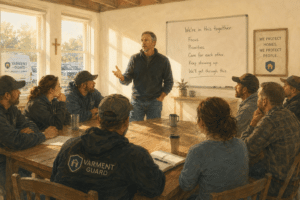
So we had the real conversation, right there in that room. Not the version where you reassure everyone and hope it blows over, but the one where you say out loud that benefits are getting reduced, paychecks might be late some weeks, every expense that isn’t keeping a truck on the road or a roof over someone’s head is getting cut, and the only way through is together. What I didn’t say out loud that day was that my wife at the time and I had already maxed out our personal credit cards and tapped our line of credit to keep things afloat — that part of the story was mine to carry, not theirs. We went through what could go and what couldn’t, who we’d call personally to try to win back, what it would take to make the phone ring again. It was painful, and it stayed painful longer than any of us wanted, mostly because none of it was business as usual. People who’d been with us for years were taking real hits, and I felt every one of those hits land. But something happened in that room I didn’t fully understand until years later: people stopped pulling against each other and started pulling toward one thing, which was survival, plain and simple. That shared pull carried more weight than any incentive plan ever had.

Here’s what I learned that week and have never unlearned. People don’t follow your plan first, they follow your face. Tell a room of frightened people that everything’s fine while your hands are shaking, and the room will be more frightened in five minutes than it was when you walked in. But stand up and say plainly, here’s where we’re going and we’re going there together, and mean it, and the people who trust you will get in the boat with you. There’s an old image about who reaches for the lifevest first when the ship is taking on water. If the leader grabs theirs before anyone else’s, the room reads that faster than it reads any memo, and panic spreads quicker than the actual bad news ever could. Hope, it turns out, is contagious in exactly the same way fear is. Somebody in the room has to carry it first, whether they feel ready for the job or not.

I found language for this just last week, reading the daily post from the Center for Action and Contemplation, where the Grammy-winning musician Jon Batiste was asked how we lean into joy as an act of resistance when the world around us feels dehumanizing. His answer has stayed with me. He talked about finding a rooting that’s true for you before anything else, because authentic joy doesn’t show up first — it comes from pain that’s already been transmuted into something that holds, even when the circumstances haven’t changed at all. He said the questions worth asking are who your hope is actually for, who’s in control of it, and what it’s rooted in, because hope that’s tied to outcomes you can’t control will collapse the moment the outcome looks uncertain. We were asking versions of those same questions in that room without knowing it: what are we actually hoping for here, is it the old normal coming back, or is it something we can hold onto either way. And then Batiste said the line that’s been sitting with me ever since — hope is like a contact sport. You work on it. You get better at it.

What Is My Hope Rooted In? Reflection Sheet

That’s exactly what happened in that room, except none of us knew it at the time. We thought we were cutting expenses and rebuilding a customer list. What we were really doing, underneath all of it, was practicing hope in the most unglamorous way possible — one hard conversation, one late paycheck, one returning customer at a time. By the time we came out the other side, the company had survived, but something more had shifted than the balance sheet. I’d started locating my faith somewhere other than the quarterly numbers. I’d watched grown men who fix raccoon problems for a living choose to keep showing up for each other when the easier thing would have been to walk. And I’d learned that hope, the kind that survives a flooded house and a roof on fire, isn’t something you wait around for. It’s something you build, the same way you build a muscle, under load, in rooms that don’t feel hopeful at all while you’re standing in them.

I think about that room often now, the borrowed space, the trucks and cars sitting still in the lot. None of us had any evidence yet that we’d make it. What we had was each other, and a decision, made out loud, to stay in the boat. That turned out to be enough.

If you’re in a season that doesn’t look hopeful right now, I’d love to hear where you’re finding your footing.

Peace and every good

Jim Vaive is co-founder of spirit of EQ alongside his wife and co-founder, Lynette Vaive. A Master Certified Coach (MCC), Certified Spiritual Director, and certified Narrative Enneagram teacher, Jim writes at The Mystical Seeker on contemplative practice, emotional intelligence, and the inward life. He and Lynette also co-host the spirit of EQ podcast.


Embracing Our Ancestors: A Living Legacy of Strength

In the confusion that many of us find ourselves in modern life, it’s easy to become disconnected from the past. We often find ourselves so focused on the present and the future that we forget to look back and appreciate the rich tapestry of history that has shaped us. Yet, as Steven Charleston, Choctaw elder and retired Episcopal bishop, points out, our ancestors are not just figures of the past; they are a living source of strength and wisdom that can guide us through the challenges we face today.

Charleston’s words remind us that the struggles we encounter are not unique to our time. Our ancestors faced their own battles—fear of illness, heartbreak, family conflicts, and the looming threat of war. They lived in a world where corrupt politicians held power and natural disasters struck without warning. Despite these challenges, they persevered, driven by love, faith, and an unwavering determination to carry on. You can know this to be true, as you are here now, smile.

This resilience is a testament to the human spirit. Our ancestors walked through life’s storms with courage and grace, refusing to succumb to despair. They found ways to navigate their grief and struggles, drawing strength from their communities and their beliefs. Their ability to endure and overcome is a powerful reminder that we, too, can rise above our difficulties. But, please make no mistake, they were not always happy, they had lives just like ours.

In many cultures, honoring the ancestors is not just a quaint tradition but a vital part of daily life. It is a way of acknowledging the sacrifices and achievements of those who came before us, recognizing that their experiences and wisdom continue to shape our lives. By connecting with our ancestral roots, we gain a deeper understanding of who we are and where we come from. Consider that many people are very interested in the genealogy websites that track your roots. What can we find out about those investigations?

I wanted to see where I came from so my brother and I with our families traveled to the upper peninsula of Michigan to a little mining town called Copper Harbor. We found graves from when the area was first settled after the copper ore was found. We stopped to see the frame homes that the boards which made up the outside skin of the home. It seemed to lack the ability to form a seal to keep the frigid wind out. With no insulation, and a small potbellied stove to warm that 3 room home. Snow from lake effect sometimes was 345 inches a year. We then went down into the mines where the copper was pulled out of the earth with little more than hand tools in the beginning. I had no idea of those roots of my heritage; I was stunned into silence. The air closed around me as I thought thinking, feeling, grateful for the heritage that was my past. I knew that those miners, and the women who supported them were all stronger than I ever understood and that strength was in my blood, yes, in my blood and I know now, without a doubt that I have the strength to live my life on my terms. Thank you, Ancestors!

The stories of our ancestors are woven into the fabric of our identities. They are the foundation upon which we build our lives, providing us with a sense of belonging and continuity. When we take the time to learn about their lives, we discover the values and lessons that have been passed down through generations. These stories offer us guidance and inspiration, helping us to navigate our own paths with confidence and purpose.

With this knowledge I am proud to talk about where I came from and what it means to be a Vaive.

In today’s fast-paced world, it can be challenging to find the time to reflect on our heritage. However, doing so can be incredibly rewarding. By exploring our family histories, we can uncover the rich tapestry of experiences that have shaped our families and communities. We can learn about the triumphs and trials of our ancestors, gaining insight into the resilience and strength that have been passed down to us.

One way to connect with our ancestors is through storytelling. Sharing stories about our family’s past can be a powerful way to keep their memories alive and to pass on their wisdom to future generations. These stories can be shared around the dinner table, at family gatherings, or through written accounts that can be preserved for posterity. By keeping these stories alive, we ensure that the legacy of our ancestors continues to inspire and guide us.

Did you know that most things we read from long ago were first passed along to each generation as a story told, most often around tables while eating? That narrative is the most engaging way to share information.

Another way to honor our ancestors is by participating in cultural traditions and rituals. Many cultures have specific practices that are designed to honor and remember those who have passed on. These rituals can provide a sense of connection and continuity, linking us to our past and reminding us of the enduring strength of our heritage. Whether it’s lighting a candle in memory of a loved one, participating in a traditional ceremony, or simply taking a moment to reflect on the lives of those who came before us, these practices can be a meaningful way to honor our ancestors.

In addition to personal reflection and storytelling, we can also draw inspiration from the broader historical context in which our ancestors lived. By studying history, we can gain a deeper understanding of the challenges and triumphs that shaped their lives. This knowledge can provide us with valuable insights into the resilience and determination that enabled them to overcome adversity. It can also help us to appreciate the progress that has been made over time and to recognize the ongoing struggles that we must continue to address.

As we reflect on the legacy of our ancestors, it’s important to remember that their strength and resilience are not just relics of the past. They are qualities that we can cultivate in our own lives. By embracing the lessons of our ancestors, we can find the courage and determination to face our own challenges with grace and resolve. We can draw on their wisdom to navigate the complexities of modern life, finding hope and inspiration in their enduring spirit.

Like my brother and I going up to Copper Harbor we found that our ancestors are a living source of strength and wisdom that can guide us through the challenges of today. By honoring their legacy, we were able to see a deeper understanding of ourselves and our place in the world. We can draw inspiration from their resilience and determination, finding the courage to face our own struggles with hope and faith. As we navigate the complexities of modern life, let us remember the enduring spirit of our ancestors and the lessons they have to offer. Together, we can carry their legacy forward, finding strength in their timeless wisdom.