
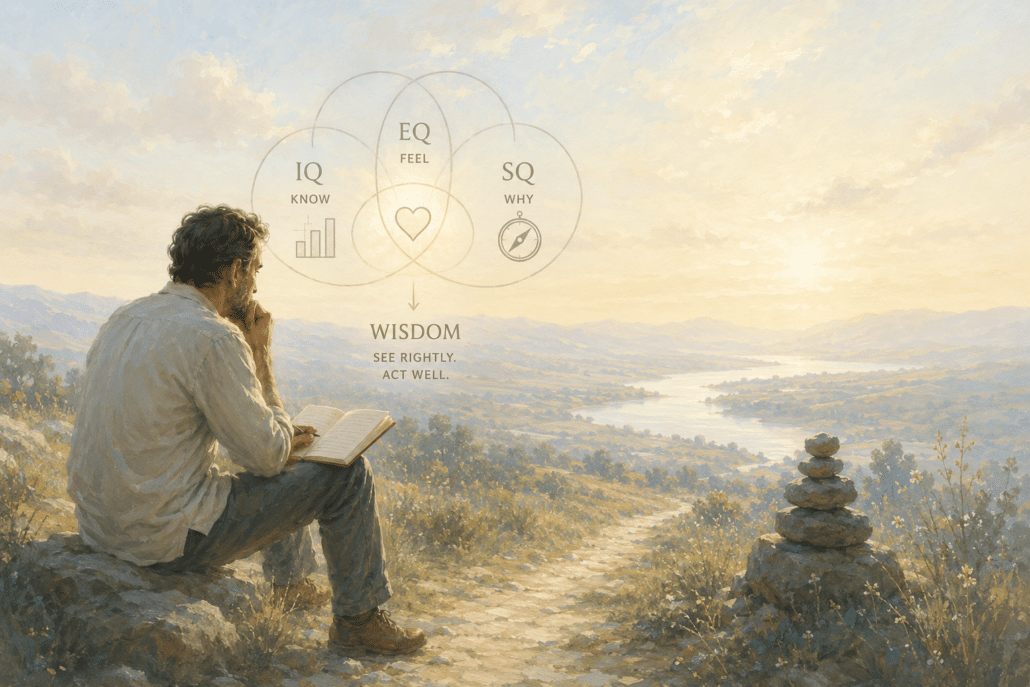
Intelligence Is Not Wisdom
Intelligence Is Not Wisdom
And confusing the two is one of the most expensive mistakes a leader can make
There was a problem at Varment Guard that the numbers made perfectly clear. The accounting was sound — the logic was right, the figures said what figures are supposed to say. What I missed entirely was what those numbers were doing to the people responsible for producing them. My employees were living inside a reality the spreadsheet had no column for: the pressure, the confusion, the quiet erosion of something that doesn’t show up on a P&L until it’s already gone. I had intelligence about the problem. I did not have wisdom about it. And by the time I understood the difference, the cost had already been paid by people who deserved better from me.
The desert fathers had a name for what I was missing. They called it nepsis — watchfulness, or sobriety of attention — the practice of seeing what is actually happening rather than what the available framework suggests should be happening. The Apophthegmata Patrum, the collected sayings of the desert elders, return to this again and again: the danger is not ignorance but the confident wrongness that comes from a trained mind that has stopped questioning its own frame. Abba Moses said it plainly: “A man who does not know himself cannot know his neighbor.” Knowing the numbers is not the same thing as knowing yourself. And a leader who has not done the second will regularly mistake the first for sufficient.

This is the distinction that philosophy has been circling for centuries and that psychology has finally found empirical language for. David Egan, philosopher and teacher at the World Community for Christian Meditation, puts it this way: intelligence involves a sharpness and quickness, working from problems toward solutions. Wisdom works in the opposite direction — not finding answers but calling the questions themselves into question, stepping back to see how a situation has been framed and asking whether there might be some other way of framing it altogether. (David Egan, “The Difference Between Wisdom and Intelligence,” WCCM, February 2024.) Intelligence is convergent. Wisdom is expansive. And everything in the attention economy — every dashboard, every metric, every well-formatted report — is working directly against the patient, expansive, slow thing that wisdom actually demands.
Psychologist Robert Sternberg, whose triarchic theory of intelligence remains one of the most careful treatments of the subject, has argued for years that wisdom may matter more than intelligence in leadership — and that our failure to cultivate it is a central problem of the age. He writes that when citizens and leaders fail in the pursuit of their duties, it is more likely for lack of wisdom than for lack of analytical intelligence. (Robert Sternberg, “Why Schools Should Teach for Wisdom,” Educational Psychologist, 2001.) We have no shortage of analytical intelligence. What we have a shortage of is the willingness to do the slow, patient, unglamorous interior work that wisdom actually requires.
This is precisely where Emotional Intelligence enters as something more than a skill set. Researchers have noted that the ancient Stoics anticipated what EQ research has spent decades documenting: that sound judgment requires emotional self-knowledge, and that practical wisdom is experience-dependent in ways that raw intelligence is not. (Neurolaunch, “Intelligence vs. Wisdom: Unraveling the Distinctions and Connections,” May 2026.) EQ brings a person closer to wisdom than IQ does because it asks not just what but who — who is in the room, what are they actually experiencing, what does this moment cost them that the data doesn’t capture. Standing in that Varment Guard office, reading a report that said one true thing about the situation, I had enough IQ to understand the numbers and not yet enough EQ to see the people behind them.
The next layer — Spiritual Intelligence, or SQ — goes further still. Cindy Wigglesworth, one of the primary researchers on the subject, defines it as the ability to act with wisdom and compassion while maintaining inner and outer peace regardless of the circumstances. (Cindy Wigglesworth, SQ21: The Twenty-One Skills of Spiritual Intelligence, 2012.) It is the capacity to orient yourself inside the largest possible frame — not just the frame of the immediate problem, the current quarter, or the next decision, but the frame of what this moment means, what it costs, and what it calls for. Where EQ asks what am I feeling and what do I do with that, SQ asks why does this matter and to whom am I ultimately accountable. The desert fathers understood SQ not as a category but as a way of being: the fruit of long interior practice, of years spent unlearning the confident wrong answers.
Neuroscientist Tara Swart, writing on this distinction, describes wisdom as the life lessons a person stores through experience — in the body, in the gut, in the accumulated residue of what it has cost to live and lead. Intelligence, she notes, is more about data and knowing. Wisdom is more of a felt sense that something is right or wrong. (Tara Swart, interviewed in Mindbodygreen, “Wisdom vs. Intelligence,” 2021.) What I was missing in that Varment Guard moment was precisely that felt sense — the capacity to stand in a room full of correct data and still ask: what is happening to the people in this? What is the human cost of the logic that makes perfect sense on paper? That question is not answerable by analysis. It requires a different kind of attention — slower, less efficient, more willing to be uncertain — the kind the desert elders spent their whole lives cultivating and the kind every good leader eventually discovers they cannot borrow from a report.
Intelligence is Not Wisdom Reflection Sheet
The word Aristotle used for the integrated thing was phronesis — practical wisdom, the capacity to see rightly and act well in the particular moment, all the way down to the ground of who you are and what you are for. IQ can help you read the room. EQ can help you feel it. SQ can help you understand why the room exists and what it is asking of you. Wisdom, the integration of all three seasoned by experience and honest self-examination, is what tells you that the numbers are correct and something is still wrong — and that the something still wrong is the thing that actually needs your attention.
There’s more of this conversation at The Mystical Seeker — and the SEQ framework at spiritofeq.com.
Peace and every good.
Jim Vaive (Master Certified Coach, Certified Spiritual Director, Certified Narrative Enneagram Teacher) and Lynette Vaive (Doctor of Ministry, Certified SEQ Practitioner) are co-founders of spirit of EQ and co-authors of The Mystical Seeker on Substack. Together they help individuals, teams, and organizations grow from the inside out — at the intersection of emotional intelligence, the Enneagram, and contemplative spirituality. Learn more at spiritofeq.com.


Leave a Reply
Want to join the discussion?Feel free to contribute!