Posts

What the Passport Couldn’t Prove

The car was empty when we came back to it. A village square an hour outside Florence, September light coming sideways across the stones, and the rental car standing open like something that had been hollowed out. Luggage gone. Backpacks gone. Computers, iPads, the chargers, the notes I had made on the plane. We were on our way from the airport to a castle in Tuscany, for a week of learning and facilitating. Lynette and I looked at each other over the roof of the car and laughed.

I have thought about that laugh for ten years. It arrived before anything else did — before the inventory, before the police report, before the slow understanding of what had left with the bags. Whatever I am, it laughed first.

What left with the bags was my passport.

What a Passport Is

It is worth looking at what a passport is, because it is a strange object to grieve. It is issued. Someone else certifies that you are who you say you are, and strangers accept the certification on that authority rather than yours. It only matters at borders; at home it lies in a drawer for years. And it says almost nothing true about you — a name, a date, a place of birth, a photograph taken under fluorescent light on a bad morning. It attests that you exist and where you are from. Nothing about what you love, what you have repented of, what you would weep over. The thinnest possible description of a person. And standing in that square, I understood that I had no way to prove who I was.

What Do You Need First?

Two Italian colleagues drove out to help us. I remember very little about the logistics and everything about one sentence. They asked, “What do you need first?”

And I cried.

Not when the car was emptied. Not when I understood the passport was gone. When two people who did not require any documentation asked me what I needed.

That question is addressed to a someone. It assumes there is a person standing there with needs, prior to any paperwork, and it was the first question in days I could not answer by producing something. I had nothing to hand anyone. And the strange grace of that week was that nothing was required. We spent days getting the language wrong and the customs wrong, and the Italians were gentle with us anyway — patient with our fumbling, warm without cause, entirely uninterested in whether we could establish our standing.

My identity that week was not recovered by looking inward. It was handed to me by other people, freely, with no document in the transaction.

A Stack of Passports
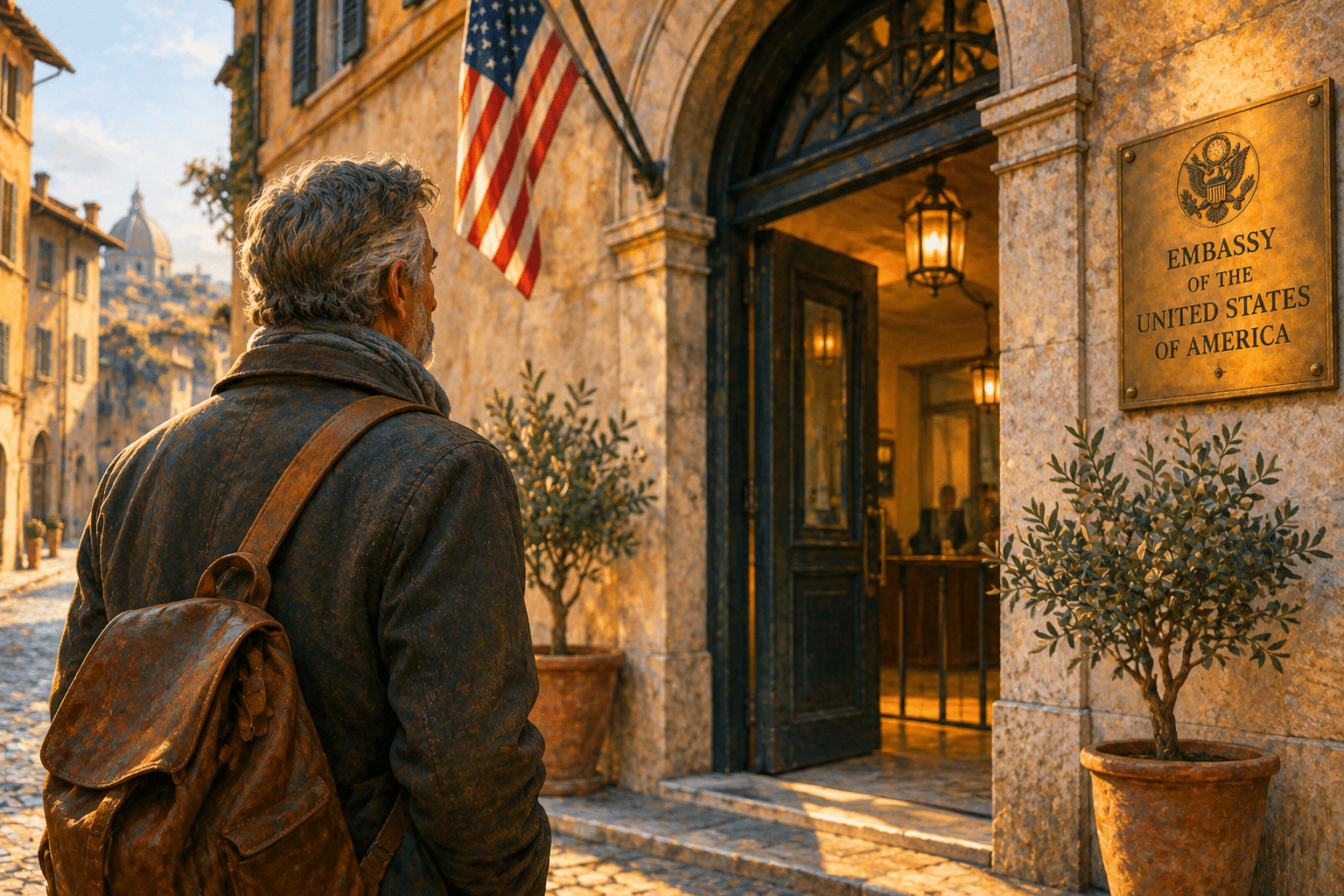
A man with a leather backpack seen from behind, standing before the arched entrance of the United States Embassy beneath an American flag.

I have been turning this over again lately because of a question I cannot put down: what is mine to do? Richard Rohr writes that “your life is not about you” — that we are an instance of something larger living itself through us (Center for Action and Contemplation). Parker Palmer, in Let Your Life Speak, says that before we tell our lives what we intend to do with them, we should “listen for what it intends to do with you.” Palmer was in his early thirties when that question woke him. I am seventy-four.

Which makes it a different question. Palmer’s version is a correction for willfulness — I have been chasing borrowed ideals, let me listen for the life that is already mine. Mine is narrower and more exacting: of the things that are genuinely mine, which ones do I still have the time and the strength for?

And underneath that one, a harder one. Who is the person who would do them?

I have no academic degrees. My whole public self is a stack of conferred identities — master certified coach, certified spiritual director, certified teacher of this, certified practitioner of that. Decades of accumulating documents that attest to who I am, each one real, each one earned in hours nobody saw. A stack of passports. And in a square outside Florence I learned how much of that I could carry across a border where none of it was recognized.

I do not think the credentials are false. That is the easy move and it is not honest. The letters describe what I have done, and the hours behind them are real. The passport was true. It just was not me.

Who Are We Without the Thing That Proves Us?

The question does not require a theft. It arrives on its own schedule, and it comes for everyone. Who are you when the title goes — when the business card no longer explains you at a party, when the organization you ran runs fine without you, when the role you filled for twenty years is filled by someone else and filled well? Who are you when the marriage ends, or when the person who knew you longest dies and takes with them the only remaining witness to your younger self? Who are you when the body stops cooperating — when the knee that carried you up mountains will not take the stairs, when the mind that held nine things at once holds four? Each of these is a passport. Each of them is issued by something outside you. Each of them can be taken in an afternoon.

There May Be No Then

Here I want to say something about the version of this question I am living with now, and you can skip the paragraph if you would rather.

I have an aorta that is enlarged. It could give way without warning. There is also a cyst on my pancreas that gets watched. This is not terminal illness, which hands you a prognosis and lets you plan a final act. It is not ordinary mortality either, the statistical fog the rest of us ignore successfully. It is mortality with a vivid mechanism and no timeline. I can neither plan around it nor forget it.

What that destroys is the sequenced life. The ordinary way we answer “what is mine to do” is in an order of operations — finish the book, then build the thing, then rest. An aorta like mine invalidates sequencing, because there may be no then. So the question changes shape in my hands. It stops being in what order? and becomes: what would I want to be in the middle of?

I would offer that one to you whether or not anything in your chest is enlarged. Sequencing is a fiction for all of us. Some of us have just been informed.

Smaller Than Anyone Promises

I would offer one correction to the thing we usually say about the end of a life — that the small things fall away and only the big ones remain, love and God and the people. It sounds right and I do not think it is true. What survived that week in Italy was not a revelation. It was Lynette’s face over the roof of a car. It was two people asking a practical question. It was a village being kind while we got everything wrong. What is left when you are stripped turns out to be smaller and more particular than anyone promises — not love but a specific face, not service but the one person you would still sit with on a Tuesday.

Taken In Without Papers

There is one more piece, and it is the one I would least like to say out loud. I am an Eight on the Enneagram. My whole life is organized around capacity — I can handle this, I can carry it, I will be the one who does not need help. An enlarged aorta is the one thing that cannot be handled, out-worked, or out-willed. And notice what undid me in that square. Not the loss. Being offered help. “What do you need first” is the most destabilizing question you can ask a person built like me, because it presumes need.

I think that is why the tears came then and not before. Something in me knew the paperwork was gone and that I was going to have to be received instead of verified.

Which is, as near as I can tell, what belonging is. Not being recognized. Being taken in without papers.

I got a new passport eventually. It sits in a drawer. Ten years on, the thing I remember from that week is not the document or the loss or the inconvenience of replacing a life’s worth of chargers. It is a laugh over the roof of an emptied car, and strangers in a language I was mangling, asking me what I needed first.

A companion reflection sheet for this post: What the Passport Couldn’t Prove (PDF).

About Jim & Dr. Lynette Vaive

Jim Vaive and Dr. Lynette Vaive are the co-founders of Spirit of EQ, where they work with leaders and seekers worldwide in coaching, training, and spiritual direction. Jim is a Master Certified Coach (ICF), a certified spiritual director, and a certified Narrative Enneagram teacher. Dr. Lynette Vaive is a Professional Certified Coach, a certified spiritual director, and a certified Narrative Enneagram teacher; her doctoral research is the scholarly foundation of the Spiritual Emotional Intelligence (SEQ) framework. Together they write The Mystical Seeker on Substack and are co-authoring a book on SEQ. Reach them at jim@spiritofeq.com and lynette@spiritofeq.com.

Sources

Parker J. Palmer, Let Your Life Speak: Listening for the Voice of Vocation (Jossey-Bass, 2000), 2–3.

Richard Rohr, “Our Life’s Call,” Daily Meditations, Center for Action and Contemplation, 13 November 2026, cac.org/daily-meditations/our-lifes-call. The closing passage quoted here is adapted from Rohr’s Adam’s Return: The Five Promises of Male Initiation (Crossroad, 2004), 60–61.

© 2026 Spirit of EQ

What Do You Need First?

In September of 2016 we landed in Florence with everything we owned for the next ten days in the back of a rental car.

We were there for a Six Seconds Master Class — emotional intelligence practitioners from around the world, at a castle in Tuscany about ninety minutes out of the city. At the airport we picked up a woman we had never met, a Six Seconds colleague working out of Dubai who needed a ride. Canadian originally. Talkative in a way I was in no condition for after six hours of time difference.

We stopped in a village to eat. Busy square, cars everywhere, a small restaurant up a flight of stairs where the owner greeted us in English and talked us into the local red.

A restaurant table set for dinner in warm lamplight, with a carafe of red wine, two glasses, white flowers and a lit candle.

When we came back, every other car in that square was gone, and Lynette’s jacket was hanging out of a broken rear window.

They had used it to cover the hole. Suitcases, backpacks, computers, iPads — all of it. We stood on opposite sides of the car, looked at each other over the roof, and started laughing.

And my passport

It took a while for that one to land.

The clothes were an inconvenience. The computers were expensive. The passport was something else, and I did not have words for it that afternoon.

In a foreign country, that document is not a travel convenience. It is the only thing you carry that says who you are. Without it I could not prove my name, my nationality, my right to be standing where I was standing, or my ability to go home. Every other claim I had on the world — the company I had built, the work I did, the people who knew me — was eleven hundred miles away and completely unavailable.

I had my wife and the clothes I was wearing. That was the whole of my identity for the rest of that week.

We were in a liminal space from that point on, and I do not use that phrase loosely. There was the navigation of the loss itself, in another language. And underneath it, something I had not had to think about in decades: we had to work out how to fit in, where to fit in, and how to do it without any of the usual equipment.

That is a different experience from going to Italy on holiday. On holiday you are a visitor with a return ticket, and the question of whether you fit never comes up, because you are not trying to.

We were trying to.

Three things happened, and only one of them was kind

A policeman. I tried to explain to a local officer, in sign language, that our car had been emptied. He understood enough to send us back to Florence to file a report. Procedural. No warmth required, and none given.

A document we could not read. At the station the shared language turned out to be bad French, between our friend from Dubai and the officer. Lynette signed a theft report in Italian with no idea what it said. Her words for it, in her chapter of our book, are that she was entirely at the mercy of two people she had met only that day.

Then I got lost looking for parking and had to text and ask where they were, which was my contribution to the afternoon.

And whoever broke the window. That square was full of people. Someone put the glass through on a parked car in daylight and nobody stopped them.

I want that third one in here, because the comfortable version of this story is people are good. People are various. Belonging is not a claim about human nature. It is about what particular people do when you can do nothing for them.

The question

Two colleagues from the Six Seconds community in Italy — Tomasso and Ilaria — heard what had happened and texted to find out where we were. We asked them to meet us at the rental place, where we were swapping a car with a hole in it and paying for the hole.

They arrived. And their first question was not how are you, and it was not let us know if you need anything.

It was: what do you need first?

And I cried.

I will leave that where it is rather than dress it up. I was in my sixties. I had built a company with several hundred people in it and the words failure is not an option painted above the door. I had spent the whole day being competent at a robbery — sign language with police, a report I could not read, a rental counter, a wife to get to a castle. I had not come close to losing it once.

Then two people I barely knew asked me a question I could answer, and I could not hold it.

I have had nine years to think about why, and the best I can do is this: for most of that day I had been a problem being processed. A case number, a damaged vehicle, a man gesturing at a policeman. What do you need first was the first moment anyone had treated me as a person who still had needs rather than a situation requiring management. It arrived about four hours after I had stopped being able to prove who I was.

Then they drove us to an electronics shop and spoke Italian while we stood and watched, and we came out with phone chargers and a hair dryer with the right voltage for Lynette. Then they took us to a restaurant, got us a table in a sheltered corner, and ordered for us — because they had worked out we did not have another round of language in us that day.

Why that question and not the other one

Let me know if you need anything sounds generous and does almost nothing, because it hands the work back to the person who is already carrying too much. They have to work out what they need, decide whether it is fair to ask, find the words, and risk the no. Most people, at their lowest, will simply say they are fine.

What do you need first does the opposite. It assumes there is a list. It assumes the list is long. It asks for one item. And it can be answered in four seconds by somebody standing in a car park with nothing.

That is not a warmer way of saying the same thing. It is a different thing, and the difference is who does the work.

If you lead people, this is the single most portable thing in this post. The next time someone on your team is underwater, do not offer to help. Ask them what they need first.

Gentle while we got it wrong

Here is what I remember most clearly, and it took me years to understand it.

We messed up the language. We messed up the customs. We turned up at the wrong hours, mispronounced everything, misread how things were done — and the Italians we met were gentle with us the entire time.

Not patient the way people are patient with a nuisance. Gentle. The restaurant owner who switched to English unasked. Tomasso and Ilaria ordering our dinner. The people at the training who told us where the shops were and then took us — three separate trips before we were dressed again. A waitress at the end of that week who kept her restaurant open past closing for our first wedding anniversary, put American music on, and made us a meal we still talk about. We ran into her in the square afterwards and met her son.

None of them were buying anything from us. We had nothing to trade, no standing, and in my case no document proving I was anyone at all — and we were welcomed anyway.

That is belonging, and it is worth being exact about why. Identity is what you can prove. Belonging is what happens when you cannot prove anything and are received regardless.

Most organizations never find out which one they are running on, because almost nobody in them is ever that exposed. What gets measured is contribution — so people quietly conclude that their standing is their usefulness. That holds up fine until the week they have nothing. Then they find out what they actually had.

The part I did not know at the time

Near the end of the week we asked Josh Freedman, who runs Six Seconds, about getting more involved. He told us he had been watching how we handled it.

That conversation is why the SEQ assessment exists. The framework this series is about came out of a week in which I had no passport, no luggage and no language, and was carried by people who owed me nothing.

I did not know I was being watched. Nobody does. Worth sitting with, if you lead anything: people are deciding whether you belong with them based on what you are like when it has gone wrong — and no one is going to tell you they are deciding.

Post 2 of 3 on the domains of spiritual emotional intelligence. Part 1: The Last One to Know — Awareness. Next: It Isn’t Confusion, It’s Exhaustion — Insight.

Peace and every good.

A companion workbook for this post: Who Gets to Arrive With Nothing (PDF).

About Jim & Dr. Lynette Vaive

Jim and Dr. Lynette Vaive are the co-founders of Spirit of EQ and co-authors of The Mystical Seeker. Jim is a Master Certified Coach and Lynette a Professional Certified Coach; both are certified Narrative Enneagram teachers and Certified Spiritual Directors. Together they hold credentials in Spiritual Emotional Intelligence (SEQ) — a framework rooted in Lynette’s Doctor of Ministry research — and serve individuals, small groups, and organizations across faith traditions. Learn more at spiritofeq.com.

Sources and credits

The events of September 2016 are told more fully in Dr. Lynette Vaive’s Chapter 1 of our forthcoming book on Spiritual Emotional Intelligence. Her account is the source for the sequence of that afternoon and for her own words about signing the theft report.

Tomasso and Ilaria are named with thanks, and with permission.

Jesus and the Gift of Music

Part One of a Three-Part Conversation with Eric Pennington

There’s a particular kind of loneliness in watching your own life happen to you. Eric Pennington knows it from the inside. As a boy, he remembers feeling almost outside himself — like he could watch young Eric move through his days, present in his own body but somehow also a few feet to the side of it, observing. Not constantly. Not dramatically. Just enough, and just often enough, that he noticed.

He doesn’t call it an out-of-body experience, exactly, though he understands why that’s the word people reach for. It’s closer to a kind of early vigilance — the watchfulness of a kid trying to make sense of a house that didn’t explain itself.


His parents, he suspects — though neither ever sat for a formal assessment — were both Nines on the Enneagram. The Peacemakers. Which meant, in practice, a house full of quiet. Not unkind quiet. Just unexplained quiet. “They’re just not talking,” he told me, “and you’re kind of left with — as a kid, I felt like I was left with question marks.” There was dysfunction underneath that silence, but a child doesn’t have the architecture yet to name it. He just keeps moving. Survives the day. Doesn’t ask why.

Then he turned twelve, then thirteen, and the questions he didn’t have language for started arriving anyway. Something cracked open in his family that year — the kind of rupture that becomes public in a way a kid never asked for, the kind that follows you into a new school year whether you’re ready or not. What matters for where we’re going today is what happened underneath it, at the same time, almost on top of it.

Eric gave his life to Christ in that window.

And within the same season — maybe eight months, maybe a year on either side — music became something more than background noise. “Jesus and the music was like a lifeline,” he told me. “The hope. The belief that I could navigate life in a way where I wouldn’t necessarily fall into the traps of a lot of my family — drugs, alcohol, prison. That’s kind of how I anchored myself. In those two things.”

Not one. Two. Faith and music, arriving together, doing something neither could have done alone.

I asked him about an archetype he’s mentioned to me more than once — Miles Davis. Not as a musician he simply admired, but as something closer to a mirror. His answer surprised me a little. “I really found Miles Davis’s music to be rather boring,” he said. It wasn’t the sound that hooked him. It was the shape of the career underneath it. Davis spent years doing it one way, then reinvented the whole thing and spent the next stretch doing it completely differently. A chameleon. Restless. Unwilling to stay put in a style just because it had worked.

“I think my attractiveness to that was just my hyper-creativity,” Eric said. “My desire to find things that were unique and different.” But there was something more functional happening too, something that only makes sense once you know what twelve-and-thirteen-year-old Eric was living through. “I think some of that connected to the trauma that was happening — like protection. If I could find something that set me apart, that would be sort of a protective barrier from just going along with the herd.” Because the herd, as he put it, was the thing pointing. Whispering. Making him the kid everyone already had a story about.

Difference, for Eric, wasn’t a personality trait he discovered later in a workshop. It was armor he built at thirteen, tuned to the rhythm of a man who refused to keep playing the same five years on repeat.

“Jesus and the Gift of Music”Reflection Sheet

I think about that often — how the things that save us early rarely look like salvation at the time. Music didn’t feel like a rescue plan to a thirteen-year-old. It felt like the only thing that made sense to do with his hands and his attention while everything else in his house was unreadable. Faith didn’t feel like doctrine. It felt like the only voice in the room that wasn’t asking him to pretend he understood something he didn’t.

What I find myself sitting with now, decades later, talking to the man that boy became, is how much of Eric’s whole posture toward emotional intelligence — the listening, the curiosity, the refusal to let people stay invisible to him — traces back to a kid who learned to watch closely because nobody was explaining anything out loud. He learned to read a room before he could read a textbook. He learned that silence isn’t the absence of information; it’s information you have to go looking for. And he learned, at thirteen, that you can be carried by two things showing up at once that have no business needing each other — a hope you can’t see and a sound you can hold in your hands.

He doesn’t watch himself from the outside anymore. Not the way he used to. But I’d guess some of that boy is still in there, still paying close attention, still listening for the note that doesn’t sound like everyone else’s.

Where this meets you: somewhere in your own story, two unlikely things probably arrived together and held you up when you couldn’t yet name what either one was doing.

Next time: how a bored afternoon in a corporate conference room turned into a company called Epic Living — and how emotional intelligence found Eric before he ever went looking for it.

Peace and every good.

About the Author

Jim Vaive is co-founder of spirit of EQ, where he and his wife Lynette help individuals, leaders, and teams grow through emotional intelligence, the Enneagram, and contemplative spiritual formation. He writes at The Mystical Seeker on the inward life that makes the outward work possible.