
Posts

It Isn’t Confusion. It’s Exhaustion.

In October of 2024 I set up a jeweller’s bench.

Not as a hobby. As a business — Jim’s Jewelry by Design. I made pieces people could hold while they were thinking: beads, knots, things with a weight to them. I bought the tools, learned the techniques, took the orders, did the books.

In May of this year I closed it.

I closed it because I did not have the time to do everything I needed to do. The writing and the coaching mattered more. They had to take center stage, and something had to go.

That is the tidy version. The honest one is less flattering. I am an Eight on the Enneagram, and here is what an Eight does: if I see something shiny lying in the sand, I rush over, pick it up, and turn it into a business. I have done it my whole life. A pest control company. A bread store. A jewellery bench. Each time the thing itself was real and worth doing. Each time the picking-up was automatic.

My focus is narrowing now, the way it does as you get older. And by the spring I was exhausted from keeping all the balls in the air.

That last word is what this post is about.

The thing we call confusion usually isn’t

I came across a piece recently by Cameron Trimble, a pastor and author, in Richard Rohr’s daily meditations from the Center for Action and Contemplation. She makes a distinction I have not stopped thinking about.

When people say they do not know what to do, they describe it as confusion. But confusion means you are missing information. Most of the time, she argues, what people are carrying is exhaustion — holding more than any one person should be holding.

Those two feel identical from the inside. They are not the same problem.

If it is confusion, more information helps. Get the numbers. Talk to someone who has done it.

If it is exhaustion, more information makes it worse. You are not short of input. You are overloaded, and every new consideration is one more thing to carry while you try to think.

I spent most of 2025 treating an exhaustion problem as a confusion problem. I read more, asked more people, made more lists about the bench — margins, time per piece, what it would take to make it work. I was very busy being thorough. None of it touched the actual thing, because the actual thing was that I had too much in my hands and no way to put any of it down.

The question was never is this a good business. It was how many things can one man in his seventies actually carry. No amount of research answers that one.

William James saw this in 1902

A brass compass resting on a rock in a field of tall grass at night, beneath a star-filled sky.

There is a passage in The Varieties of Religious Experience that I keep returning to, and it is not the one people usually quote.

James describes what he calls the field of consciousness — everything present to you at a given moment. It has a centre of interest, and around that centre the rest fades out to a margin “so faint that its limits are unassignable.” He compares it to a magnetic field, “inside of which our centre of energy turns like a compass-needle.”

Then he says this: “At other times, of drowsiness, illness, or fatigue, our fields may narrow almost to a point.”

Fatigue narrows the field. Not age, not weakness of character — fatigue. A tired person is not seeing less because they have become less; they are seeing less because the field itself has contracted, and from inside a contracted field there is no way to tell that anything is missing.

That is the whole trap. The exhausted person experiences their exhaustion as a failure of clarity, and reaches for more information — which requires more field, which they do not have.

Deciding and discerning are different jobs

Trimble’s second distinction is the one I had been circling for years without naming cleanly.

Deciding operates on a set of options. Someone has put three things on the table and your job is to pick the best one. Business is very good at this. There are frameworks, matrices, and people who will charge you a great deal to improve your hit rate.

Discerning happens before any of that. It asks whether the table is yours.

Here is why the difference costs money. A person who decides well clears options off the table quickly and confidently. That is a real strength. It is also exactly how you end up two years into something you never chose — because nobody asked whether they were the right options, and the speed of the deciding disguised the absence of the asking.

An Eight picking up something shiny from the sand is deciding, and deciding well. The business will probably work. The question nobody asks at that moment is whether it was his to pick up.

Trimble’s word for what people are actually after is attunement rather than certainty. Flatter version: most people chasing certainty want a guarantee about the outcome. What is available is a better read on what the situation is asking of you. Different purchases, and only one of them is for sale.

The in-between is not wasted time

One more thing from her piece — a reframe of a very old story.

A people leave one place and spend a long stretch in the desert before arriving anywhere. The usual reading of that stretch is dead time: a gap between the real chapters, to be endured.

The rabbinic reading she points to is the opposite. The time in between is not the delay before the thing happens. It is where they stopped being one kind of people and became another. They walked in carrying the habits of the place they had left — fear, scarcity, waiting to be told. Changing their location was the easy part. Changing that is what the years were for.

Out of the desert and into an ordinary working life: a transition is not the empty bit between two chapters. It is where you get re-made. Spend it entirely on getting out of it and you arrive as the same person who went in, which is generally how people make the same mistake in a new setting.

I have done that. Twice, at least.

And in that story nobody gets a map. They get a day’s food at a time — enough for today, nothing banked, no visibility past tomorrow. Her point, and mine: that is not a failure of provision. It is a description of how this works. You get enough for the next step, and the next step is enough.

For anyone who plans for a living that is uncomfortable. I ran a company for thirty-eight years on five-year horizons. But look at what the alternative demands: before you can act, you need a picture of an outcome several years out that nobody can honestly give you — and while you wait for it you do nothing, and call the nothing prudence.

What Insight actually is

This is the third domain of spiritual emotional intelligence, and the first two did the groundwork.

Awareness established that your own account of yourself is unreliable. Belonging asked who you are actually among, and whether a person can be among you with nothing to offer.

Insight is what becomes possible once those are in place. Not choose better between the things in front of me. Something narrower: work out which of them is mine.

Three questions, in order. Ten minutes.

One. Is this confusion or exhaustion? If you cannot name three specific facts you are missing, it is exhaustion. Stop researching. Your field has narrowed and no amount of reading will widen it.

Two. Who put these options on the table? If it is anyone but you, you are deciding rather than discerning, and the real work is upstream of the choice you think you are making.

Three. What is the next step, as against the plan? Not the strategy. The one thing you could do this week that you would not regret however the rest turns out.

That third question is most of it. Most people can answer it immediately and then refuse to act on it, because it feels too small to be the answer.

It is the answer. It is just small.

The bench

I still have it.

I have not decided what it is yet — whether it becomes a practice without being a business, or goes to someone who will use it better than I did. And for the first time in my life, not knowing by the end of the month does not feel like a failure of planning.

Enough for the next step turns out to be enough.

Post 3 of 3 on the domains of spiritual emotional intelligence. Part 1: The Last One to Know — Awareness. Part 2: What Do You Need First? — Belonging.

Peace and every good.

A companion workbook for this post: Is This Mine to Carry? (PDF).

About Jim & Dr. Lynette Vaive

Jim and Dr. Lynette Vaive are the co-founders of Spirit of EQ and co-authors of The Mystical Seeker. Jim is a Master Certified Coach and Lynette a Professional Certified Coach; both are certified Narrative Enneagram teachers and Certified Spiritual Directors. Together they hold credentials in Spiritual Emotional Intelligence (SEQ) — a framework rooted in Lynette’s Doctor of Ministry research — and serve individuals, small groups, and organizations across faith traditions. Learn more at spiritofeq.com.

Sources and credits

The distinctions between confusion and exhaustion, deciding and discerning, and the reading of the wilderness years are drawn from a piece by Cameron Trimble, pastor and author, published in the Center for Action and Contemplation’s Daily Meditations (Richard Rohr). The applications to business and to my own decisions are mine, not hers.

William James, The Varieties of Religious Experience (1902), Lecture X. The passage on the field of consciousness and its narrowing “at other times, of drowsiness, illness, or fatigue” is quoted from that lecture.
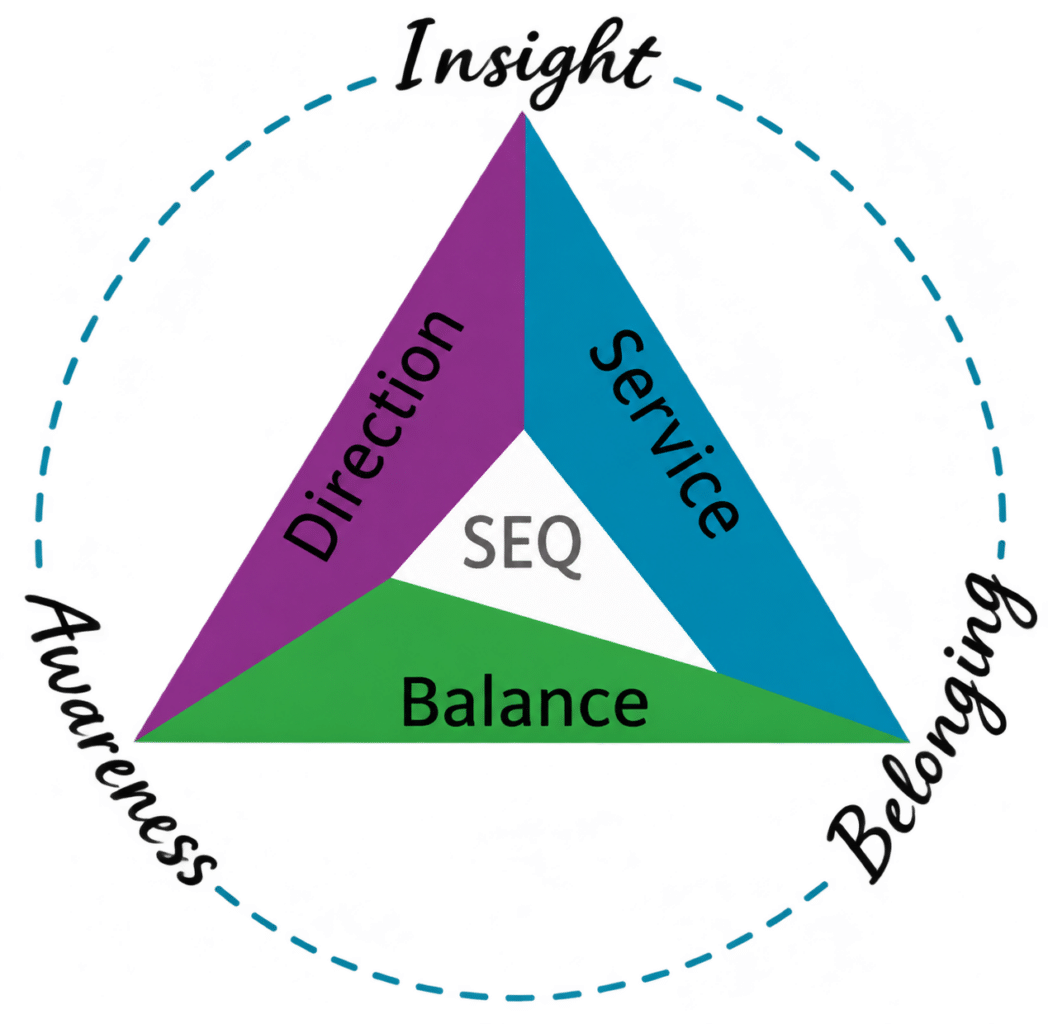

Summary of SEQ for Life and Peace

First written 29 January 2025.

Spiritual Emotional Intelligence is all about connection. Connection with ourselves as individuals in becoming all that each of us were created to be in this world and perhaps in the next. Connection with our close communities, those more vulnerable relationships where we may be invited to let our guard down and let those closest to us really see us—our hurts, our concerns, our mistakes, our gifts, our talents, and our joys. And lastly, connection with the world at large—people we may not even know or something larger than ourselves—our shared humanity, regardless of our country or culture of origin or station in life.

The SEQ model: a triangle with Insight at the top, Awareness at the lower left and Belonging at the lower right, and Direction, Service and Balance along its three sides, with SEQ at the center.
The three domains — Awareness, Belonging, Insight — with Direction, Service and Balance. Image: Spirit of EQ.

Considering connection as this three-fold model depicted above, each of these domains of connecting in our human lives play a key part in realizing the worth and dignity of each individual person and our shared humanity.

Awareness helps us make connection with ourselves, pay attention to our human physical, mental, emotional, and spiritual needs and desires and make them harmonious with the whole of our lives.

Belonging helps us realize that our close relationships require that we go beyond ourselves for those we love or befriend most closely. There is a necessary reciprocity in these relationships—we do not have them in any significant depth if we are unwilling to make ourselves vulnerable to the important others in our lives.

Insight is about connecting with something greater than ourselves—and this can include something larger than ourselves, whatever that means to each of us in our particular faith structure. It is Insight that allows us to go beyond ourselves, beyond our close communities, beyond what we believe or have come to understand to realize there may be something even greater in that space of shared humanity.

From this space of shared humanity, the themes of Life and Peace come through as a star that lights the way for each of us to move forward, individually and collectively. What is the higher vibration that each of us may emit when we are connected with something larger than ourselves? When we have cared for our own needs so that they are not clamoring for attention? When we support and are supported by those people we hold most dear in relationship? What is out beyond our small view of the world that may be possible through our collective connection with more than we may understand, more than we can see, and more than we can know with our logical minds?

While we are breathing on this planet, what is the most important work that we will do? What is life when we consider that we are only a part of the larger community? What is peace when we consider that we are only a part of the larger community?

Life and peace…What is the fullest and most meaningful life that you can imagine? How might you move closer to that ideal for our world together?

Direction helps us move toward our desired future, individually and all as one shared humanity. Service is the ultimate gift to another as we each share this life together—even with those we may never meet in person. Balance helps us not forget to tend our own needs and the needs of those we most love in this world and beyond, so that we never forget there is something larger than ourselves.

Rumi says it better than I can. His lines beginning “Out beyond ideas of wrongdoing and rightdoing” describe a field where the categories we argue over stop making sense. You can read the passage in full at the Poetry Society, in Coleman Barks’s translation.

In our shared humanity as the guiding light, there is life and peace. Spiritual Emotional Intelligence can be the lamp holder to illuminate our shared humanity.

The Intelligence You Weren’t Taught

She could name what she was feeling before most people in the room even knew they had feelings. She could read a tense conversation like a map, tracking the undercurrents, sensing what was unspoken. By every measure the research celebrates, her emotional intelligence was high. And yet, somewhere beneath all of that competence, something was restless. Something that didn’t have a name yet.

I think about her often. About the particular quality of her restlessness — not the kind that suggests incompleteness, but the kind that suggests there is more. A country just beyond the border of the map you’ve been given.

Emotional intelligence gave her a better map. What she was reaching for was a different kind of knowing altogether.

What EQ Gets Right — And Where It Stops

We have built our practice at spirit of EQ around the conviction that emotional intelligence changes lives. It changes how leaders show up, how teams hold conflict, how individuals navigate the interior terrain of their own experience. The research is clear, and decades of work with clients has confirmed it: people who develop their EQ are more self-aware, more empathic, more effective in their relationships, more resilient when the ground shifts beneath them.

But here is the honest edge of that map: emotional intelligence is a technology. A profound one. A necessary one. And yet a technology is only as generative as the spirit that animates it. You can have extraordinary self-awareness and still not know what your life is for. You can understand others deeply and still feel unmoored from any larger belonging. You can manage your emotions with great skill and still find, at the end of the day, that something essential is asking to be heard.

EQ maps the terrain. It does not always tell you why the terrain matters, or to what — or to whom — you ultimately belong.

That is where Lynette’s question begins.

Lynette’s Question — And the Research That Followed

Lynette Vaive has spent her career at the intersection of emotional intelligence, the Enneagram, and spiritual formation. Her doctoral research — a Doctor of Ministry focused on Spiritual Emotional Intelligence — grew from a question she kept encountering in the field: what happens when emotional intelligence is not enough? What is the deeper layer that some people access and others don’t? And can it be named, taught, practiced?

The framework she developed is called Spiritual Emotional Intelligence, or SEQ. It is not a replacement for EQ — it is a deepening of it, a third dimension that EQ by itself cannot fully reach. SEQ is organized around three domains: Awareness, Belonging, and Insight.

Awareness, in the SEQ framework, is more than self-knowledge. It is the capacity to be present to your own inner life with honesty and without flinching — to notice not just what you feel, but what your feelings are pointing toward. It is the kind of attention the contemplative traditions have always cultivated, and that modern life consistently works against.

Belonging is the recognition that we are not isolated selves navigating a competitive landscape. We are embedded — in community, in creation, in something that holds us whether we attend to it or not. SEQ invites us to notice that embeddedness, to feel it, to let it shape how we move through the world. This is the domain that changes how leaders relate to their teams, how partners relate to each other, how any of us relate to the stranger across the table.

Insight is the capacity to integrate what Awareness reveals and what Belonging grounds — to let that integration become wisdom that actually changes behavior, not just understanding. Insight, in the SEQ framework, is the difference between knowing and living differently because you know.

Within these three domains, Lynette’s research maps nine tiles — specific capacities that together describe what Spiritual Emotional Intelligence looks like in practice. But the framework breathes most fully not as a model to be mastered, but as a territory to be inhabited.

What Changes When You Go Deeper

I think of the woman at the beginning of this reflection. Her EQ gave her a map of her inner landscape. What SEQ names — what her restlessness was reaching toward — was the landscape itself. The felt sense that she belonged to something larger than her own competence. The capacity to let that belonging inform not just her behavior but her becoming.

Howard Thurman, the theologian and mystic who shaped the thinking of the civil rights movement and whose work has long been an anchor for me, wrote about the inner life with a clarity that few have matched. He understood that the most significant work any person does happens not on the stage of public action, but in the quiet interior where the self is formed and reformed in relationship to what is deepest and truest. He did not use the language of emotional intelligence. But he was describing its spiritual root.

SEQ is, in some ways, a contemporary articulation of what contemplatives have always known: that the quality of our presence to others depends on the quality of our presence to ourselves, and that the quality of our presence to ourselves depends on something we did not manufacture. A ground. A source. A belonging that precedes our effort.

In community and organizational settings, SEQ changes the texture of everything. Teams that develop Awareness together begin to notice the emotional undercurrents they used to ignore. Communities that practice Belonging begin to hold conflict differently — not as a threat to be managed but as an invitation to go deeper. Leaders who cultivate Insight find that their decisions come from a different place, quieter and more rooted than the reactive center most of us operate from by default.

Something shifts. Not dramatically, not all at once. But truly.

The Deeper Layer Is Not Out of Reach

She is still in the room, the woman from the beginning of this reflection. And now she has a name for what she was reaching toward. Not a label that fixes it, but a language that opens it — a way of attending to the Awareness, Belonging, and Insight that were always present in her, asking to be cultivated.

That is what the SEQ framework offers. Not a program, but a practice. Not mastery, but an orientation — a way of asking better questions of your own interior life and the lives you share with others.

Spiritual Emotional Intelligence  Reflection Guide— Three Domains, Three Questions

The map was never the territory. But there is a territory. And it is worth inhabiting.

If this stirred something in you, we would be glad to have you join the ongoing conversation at spirit of EQ — on Substack, in our Mighty Networks community, or through the work we do directly with individuals and organizations.

Peace and every good.