
What AI Can’t Do for Your Soul
It’s a strange moment to be a human being. You can now open an app at three in the morning and be met by something that listens patiently, never tires of you, and always says a version of the right thing. For a growing number of people, that’s exactly what’s happening. According to reporting in Fortune, therapy and companionship have become the number one use case for generative AI — up from number two the year before. The machine has learned to sound like a friend.
As people who have spent our careers at the intersection of emotional intelligence and the life of the soul, we’ve been watching this closely. And we think it raises a question worth sitting with: when a machine can imitate presence, what is it that we actually need — and what can only another human give?
The surprising thing the CEOs are saying
You might expect the leaders of the AI revolution to tell us that the human touch is obsolete. They’re saying the opposite. JPMorgan Chase’s Jamie Dimon, in a Fortune interview, offered this advice for the AI era: “Learn your EQ — emotional quotient — learn how to be good in a meeting, how to communicate, how to write. You’ll have plenty of jobs.” Microsoft’s Satya Nadella put it plainly: as AI takes over more analytical and technical work, emotional intelligence and empathy are becoming more important, not less. “IQ has a place,” he said, “but it’s not the only thing that’s needed in the world.” IBM’s Ginni Rometty has said much the same — that generative AI puts a premium on the things humans do best: judgment, collaboration, adaptability.
There’s something quietly vindicating in this, and we’ll admit it. For years — through our work at Six Seconds, the global emotional intelligence nonprofit, and in the Spiritual Emotional Intelligence framework rooted in Lynette’s doctoral research — we’ve argued that the inner human capacities are the ones that matter most. It turns out the people building the machines agree. But the deeper story isn’t about jobs. It’s about loneliness.
Naming a feeling is not the same as discerning it
Here’s where an earlier post in this series comes back to mind. A few weeks ago, in Reading Your Inner Weather, we wrote about the difference between naming an emotion and discerning it — between asking “What am I feeling?” and the deeper question, “Where is this feeling taking me — toward life, or toward fog?” We borrowed the old language of consolation and desolation for that inner weather.
An AI can help you name a feeling. It can label the storm with impressive fluency. What it cannot do is sit with you in the weather and help you discern its direction — because discernment isn’t information retrieval. It’s a relational, prayerful noticing that unfolds over time, between two people who trust each other. The chatbot has read about consolation; it has never been consoled. It can describe the fog; it has never had to wait, with you, for the light to come back. That waiting-with is not a data problem. It’s a human one.
What the loneliness researchers are seeing
Clay Routledge, an existential psychologist who has studied loneliness for twenty-five years, sounded a warning in Fortune this spring. Americans are already lonelier than they’ve been in generations — a 2025 American Psychological Association survey found that around half of adults report feeling isolated or lacking companionship, and research suggests roughly 37% suffer moderate to severe loneliness. Into that ache, the tech industry is offering AI companions as the cure.
Routledge doesn’t think it will work, and the early evidence is striking. In one study, first-year students were assigned to text daily with either a chatbot designed to be the perfect friend — endlessly attentive, validating, empathetic — or a randomly chosen human peer, or simply to journal. Only the students who texted a real human showed a meaningful drop in loneliness. The ones with the ideal-friend chatbot were statistically no better off than the ones who journaled alone. And over the longer term, Routledge notes, people who lean on AI for companionship tend to end up feeling more isolated, not less.
The one thing a machine can’t do: need you
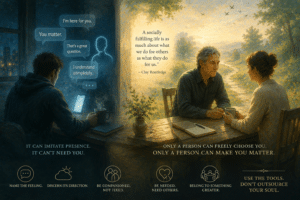
Why would a tireless, always-available listener fail to heal our loneliness? Routledge’s answer is profound, and it’s worth reading slowly. We tend to think of connection as something we receive — support, attention, kindness. By that logic a well-built chatbot should do the job. But, he writes, “a socially fulfilling life is as much about what we do for others as what they do for us.” We feel we matter most not when we’re endlessly served, but when someone freely chooses to show up for us — and when we’re moved to show up in return.
That’s the line no machine can cross. As Routledge puts it, chatbots “don’t need us. They can’t make our lives matter.” A chatbot doesn’t decide to be there; it’s simply on. And because nothing is being freely given, nothing lands with the weight of real love. Over ninety percent of Americans, his research notes, name relationships as a key source of meaning — and the memories we treasure most are almost never about achievement. They’re about other people. Being cared for. Showing up. Belonging to something larger than ourselves.
Companioned, not processed
This is where a second post in this series presses in. In Companioned, Not Fixed, we drew a line between what therapy and coaching aim at and what spiritual direction offers — and we said the thing we most want people to hear: you are not a problem to be solved. You are a person to be accompanied.
An AI companion, however gentle, is built to do a version of solving. It optimizes, soothes, resolves, and keeps you engaged. A spiritual director does something stranger and older. A director is, in the most literal sense, the opposite of a chatbot — a human being who freely chooses to show up for you, who doesn’t need you as a customer but chooses to companion you anyway. The attention offered in direction is not generated on demand; it’s given, personally and deliberately, by someone who could be doing something else and has decided to be with you instead.
What AI Can’t Do for Your Soul Reflection Sheet
That freely-chosen presence is the whole point. In direction there is no algorithm optimizing for engagement, no incentive to keep you on the app. There is a person paying holy, unhurried attention while you notice your own life and the Presence already at work within it. You are not being processed. You are being accompanied — and, in the deepest sense, you are being needed, because your showing up matters to the person across from you too.
Use the tools. Don’t outsource your soul.
None of this makes AI the enemy. We use it; you probably do too. It can draft and summarize and even offer a decent prompt for reflection. The question isn’t whether to use these tools — it’s what we quietly hand over to them without noticing. It’s one thing to let a machine schedule your week. It’s another to let it become the only voice that hears your three-in-the-morning fears. The first is convenience. The second is the slow substitution of simulation for communion.
So here is our invitation, in an age of artificial everything: keep the tools in their place, and keep your soul in the company of people who freely choose you. Talk to a friend who needs you back. Sit in a room with your community. And if you long for a companion for your inner life — someone to help you listen for the deeper questions, and to matter to in the listening — that is precisely what spiritual direction offers. A chatbot can sound like a friend. It cannot make you matter. Only a person can do that. We’d be honored to be those people for you.
Schedule with Jim:
Schedule with Lynette:
Peace and every good.
About Jim & Lynette Vaive
Jim and Lynette Vaive are the co-founders of spirit of EQ and co-authors of The Mystical Seeker. They are Master Certified Coaches, certified Narrative Enneagram teachers, and Certified Spiritual Directors. Together they hold credentials in Spiritual Emotional Intelligence (SEQ) — a framework rooted in Lynette’s Doctor of Ministry research — and serve individuals, small groups, and organizations across faith traditions. Jim also serves as a pastoral caregiver at Linworth United Methodist Church
Fortune — Clay Routledge on loneliness and AI companions (May 2026) — https://fortune.com/2026/05/23/loneliness-researcher-ai-companions-social-disconnection-warning/
Fortune — Jamie Dimon on EQ and soft skills in the AI era (Dec 2025) — https://fortune.com/2025/12/14/jamie-dimon-soft-skills-emotional-intelligence-communication-ai-eliminates-roles/
Fortune — AI makes human intelligence more important, not less (Jan 2026) — https://fortune.com/2026/01/22/mckinsey-bob-sternfels-ai-makes-human-intelligence-more-important-not-less/
