What the Passport Couldn’t Prove
The car was empty when we came back to it. A village square an hour outside Florence, September light coming sideways across the stones, and the rental car standing open like something that had been hollowed out. Luggage gone. Backpacks gone. Computers, iPads, the chargers, the notes I had made on the plane. We were on our way from the airport to a castle in Tuscany, for a week of learning and facilitating. Lynette and I looked at each other over the roof of the car and laughed.
I have thought about that laugh for ten years. It arrived before anything else did — before the inventory, before the police report, before the slow understanding of what had left with the bags. Whatever I am, it laughed first.
What left with the bags was my passport.
What a Passport Is
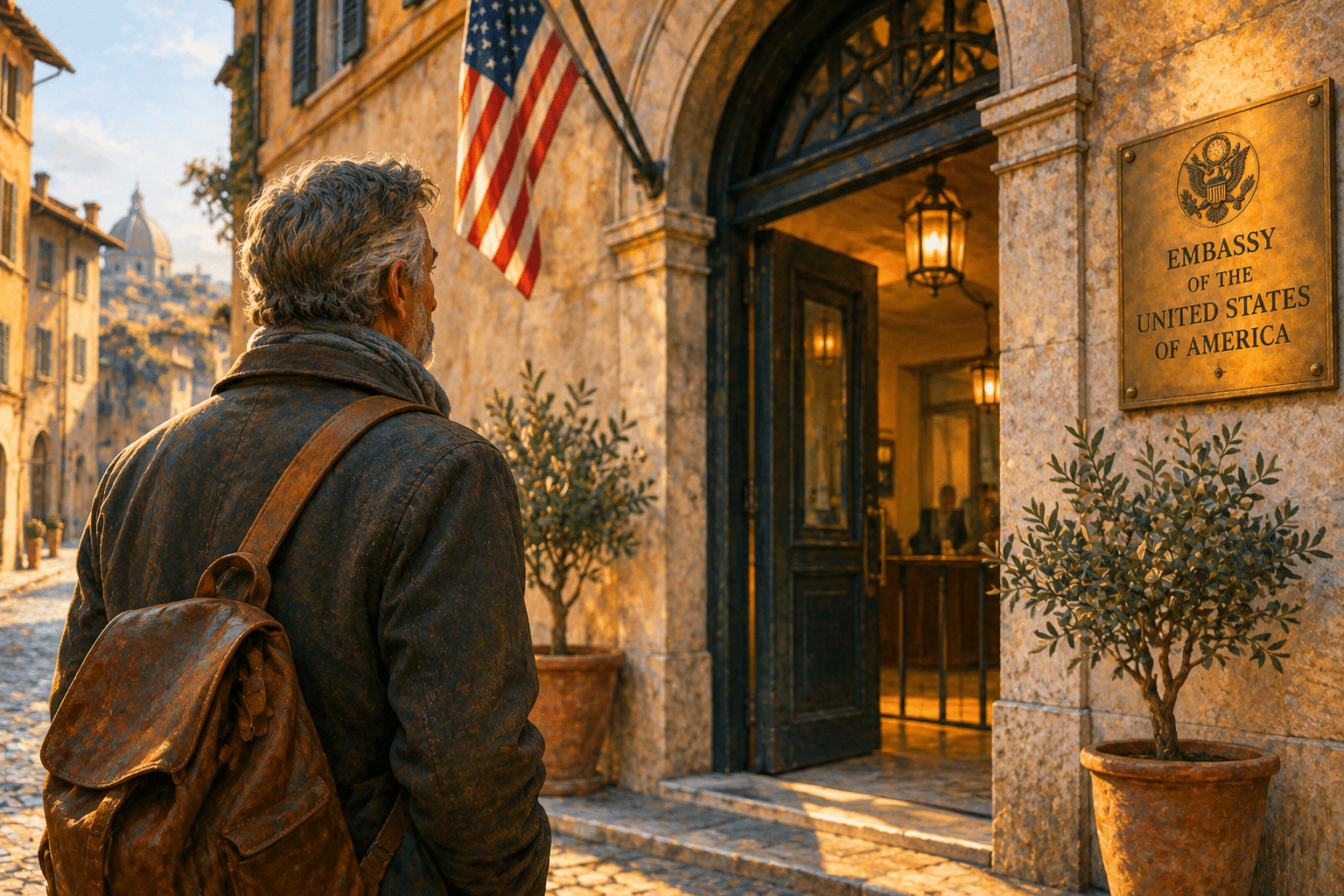
It is worth looking at what a passport is, because it is a strange object to grieve. It is issued. Someone else certifies that you are who you say you are, and strangers accept the certification on that authority rather than yours. It only matters at borders; at home it lies in a drawer for years. And it says almost nothing true about you — a name, a date, a place of birth, a photograph taken under fluorescent light on a bad morning. It attests that you exist and where you are from. Nothing about what you love, what you have repented of, what you would weep over. The thinnest possible description of a person. And standing in that square, I understood that I had no way to prove who I was.
What Do You Need First?
Two Italian colleagues drove out to help us. I remember very little about the logistics and everything about one sentence. They asked, “What do you need first?”
And I cried.
Not when the car was emptied. Not when I understood the passport was gone. When two people who did not require any documentation asked me what I needed.
That question is addressed to a someone. It assumes there is a person standing there with needs, prior to any paperwork, and it was the first question in days I could not answer by producing something. I had nothing to hand anyone. And the strange grace of that week was that nothing was required. We spent days getting the language wrong and the customs wrong, and the Italians were gentle with us anyway — patient with our fumbling, warm without cause, entirely uninterested in whether we could establish our standing.
My identity that week was not recovered by looking inward. It was handed to me by other people, freely, with no document in the transaction.
A Stack of Passports
I have been turning this over again lately because of a question I cannot put down: what is mine to do? Richard Rohr writes that “your life is not about you” — that we are an instance of something larger living itself through us (Center for Action and Contemplation). Parker Palmer, in Let Your Life Speak, says that before we tell our lives what we intend to do with them, we should “listen for what it intends to do with you.” Palmer was in his early thirties when that question woke him. I am seventy-four.
Which makes it a different question. Palmer’s version is a correction for willfulness — I have been chasing borrowed ideals, let me listen for the life that is already mine. Mine is narrower and more exacting: of the things that are genuinely mine, which ones do I still have the time and the strength for?
And underneath that one, a harder one. Who is the person who would do them?
I have no academic degrees. My whole public self is a stack of conferred identities — master certified coach, certified spiritual director, certified teacher of this, certified practitioner of that. Decades of accumulating documents that attest to who I am, each one real, each one earned in hours nobody saw. A stack of passports. And in a square outside Florence I learned how much of that I could carry across a border where none of it was recognized.
I do not think the credentials are false. That is the easy move and it is not honest. The letters describe what I have done, and the hours behind them are real. The passport was true. It just was not me.
Who Are We Without the Thing That Proves Us?
The question does not require a theft. It arrives on its own schedule, and it comes for everyone. Who are you when the title goes — when the business card no longer explains you at a party, when the organization you ran runs fine without you, when the role you filled for twenty years is filled by someone else and filled well? Who are you when the marriage ends, or when the person who knew you longest dies and takes with them the only remaining witness to your younger self? Who are you when the body stops cooperating — when the knee that carried you up mountains will not take the stairs, when the mind that held nine things at once holds four? Each of these is a passport. Each of them is issued by something outside you. Each of them can be taken in an afternoon.
There May Be No Then
Here I want to say something about the version of this question I am living with now, and you can skip the paragraph if you would rather.
I have an aorta that is enlarged. It could give way without warning. There is also a cyst on my pancreas that gets watched. This is not terminal illness, which hands you a prognosis and lets you plan a final act. It is not ordinary mortality either, the statistical fog the rest of us ignore successfully. It is mortality with a vivid mechanism and no timeline. I can neither plan around it nor forget it.
What that destroys is the sequenced life. The ordinary way we answer “what is mine to do” is in an order of operations — finish the book, then build the thing, then rest. An aorta like mine invalidates sequencing, because there may be no then. So the question changes shape in my hands. It stops being in what order? and becomes: what would I want to be in the middle of?
I would offer that one to you whether or not anything in your chest is enlarged. Sequencing is a fiction for all of us. Some of us have just been informed.
Smaller Than Anyone Promises
I would offer one correction to the thing we usually say about the end of a life — that the small things fall away and only the big ones remain, love and God and the people. It sounds right and I do not think it is true. What survived that week in Italy was not a revelation. It was Lynette’s face over the roof of a car. It was two people asking a practical question. It was a village being kind while we got everything wrong. What is left when you are stripped turns out to be smaller and more particular than anyone promises — not love but a specific face, not service but the one person you would still sit with on a Tuesday.
Taken In Without Papers
There is one more piece, and it is the one I would least like to say out loud. I am an Eight on the Enneagram. My whole life is organized around capacity — I can handle this, I can carry it, I will be the one who does not need help. An enlarged aorta is the one thing that cannot be handled, out-worked, or out-willed. And notice what undid me in that square. Not the loss. Being offered help. “What do you need first” is the most destabilizing question you can ask a person built like me, because it presumes need.
I think that is why the tears came then and not before. Something in me knew the paperwork was gone and that I was going to have to be received instead of verified.
Which is, as near as I can tell, what belonging is. Not being recognized. Being taken in without papers.
I got a new passport eventually. It sits in a drawer. Ten years on, the thing I remember from that week is not the document or the loss or the inconvenience of replacing a life’s worth of chargers. It is a laugh over the roof of an emptied car, and strangers in a language I was mangling, asking me what I needed first.
A companion reflection sheet for this post: What the Passport Couldn’t Prove (PDF).
About Jim & Dr. Lynette Vaive
Jim Vaive and Dr. Lynette Vaive are the co-founders of Spirit of EQ, where they work with leaders and seekers worldwide in coaching, training, and spiritual direction. Jim is a Master Certified Coach (ICF), a certified spiritual director, and a certified Narrative Enneagram teacher. Dr. Lynette Vaive is a Professional Certified Coach, a certified spiritual director, and a certified Narrative Enneagram teacher; her doctoral research is the scholarly foundation of the Spiritual Emotional Intelligence (SEQ) framework. Together they write The Mystical Seeker on Substack and are co-authoring a book on SEQ. Reach them at jim@spiritofeq.com and lynette@spiritofeq.com.
Sources
Parker J. Palmer, Let Your Life Speak: Listening for the Voice of Vocation (San Francisco: Jossey-Bass).
Richard Rohr, daily meditation on vocation, Center for Action and Contemplation (cac.org).
© 2026 Spirit of EQ
