
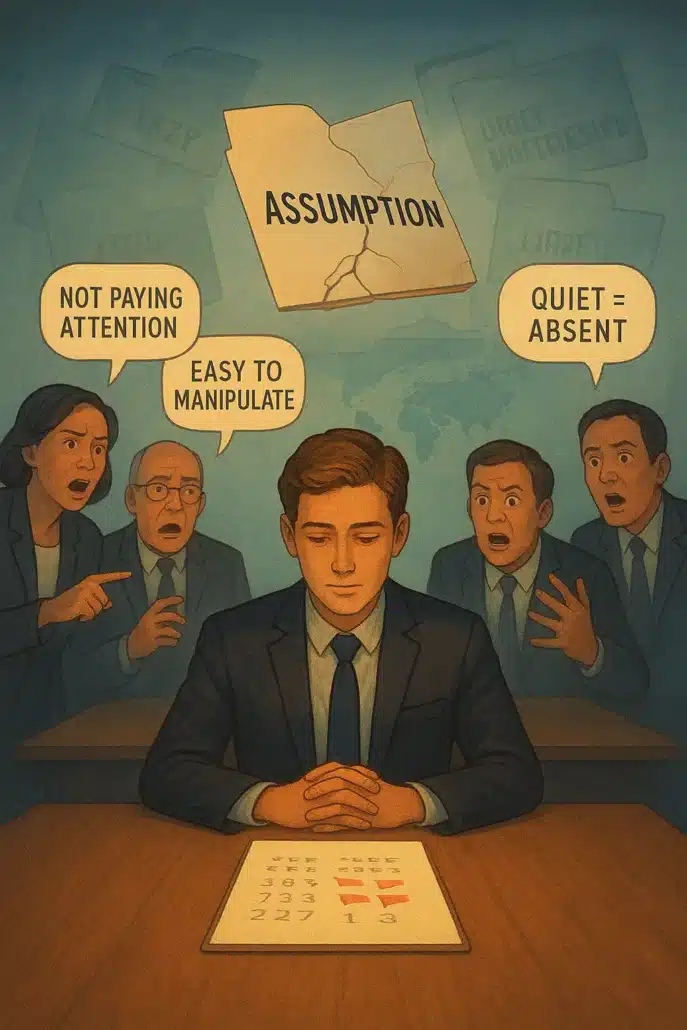
The Chairman Thought I Wasn’t Paying Attention
Picture a waiting room. You’ve been there five minutes, and without meaning to, you’ve already written a story about everyone in it — the man with the expensive watch who checks his phone every thirty seconds, the woman with paint on her jeans who hasn’t looked up from her book, the teenager in the corner with earbuds in like armor. You haven’t spoken to any of them. You may never speak to any of them. But somewhere in the architecture of your brain, a file has opened on each one, and it is filling itself in without your permission.
This is what we do. It is fast, it is mostly unconscious, and — here is the part that costs us — we tend to trust it.
Confirmation bias is the cognitive shortcut that turns a glance into a verdict. Once we’ve formed an impression, we filter everything through it, collecting evidence that confirms what we already believe and quietly discarding what doesn’t fit. The psychologist Leon Festinger spent decades helping us understand how fiercely the mind protects its working assumptions — not because it is lazy, but because uncertainty is expensive. The brain is a prediction machine, and prediction requires categories. The trouble is that people are not categories. They are houses you have never been inside, and the front door tells you almost nothing about what’s in the rooms.
It causes me to think about the ways I’ve been filed.
I was asked to lead a financial committee for an international organization. In the first meeting, I was the quietest person in the room. I tend to listen before I speak, to let the space fill before I take up any of it. I was watching. I was also reading — the numbers that weren’t adding up, the relationships between people that were bent in ways that take time to see, the kind of bent that looks like warmth from a distance but reads differently when you’re close and paying attention. Embezzlement. Alliances that were costing the organization more than they were protecting it. I could see it, and I called it out.
The room exploded.
What I learned later — from the chairman himself — was that he had watched me sit quietly when he asked me to be on “the committee” I wasn’t really present and could not tell what was going on. That my stillness read as absence. That I could be managed, even manipulated, and that bringing in someone so apparently passive had been, in his mind, a calculated move toward a controllable outcome.

He had filed me. Quickly, confidently, and very wrong.
I am not the first person this has happened to. You are not either.
Think about the moments you’ve been looked past — the job interview where someone’s eyes glazed before you finished your first sentence, the meeting where your idea was ignored until someone else said it twenty minutes later, the day you walked into a room in the wrong clothes for the assumptions people had already formed about you. Your hair too natural, your accent too layered, your stillness too unreadable, your energy too large. The label arrives before you do, and it does not ask for your input. It does not ask for your history, your interior life, your gifts, or your grief. It just lands, and it sticks, and quietly it shapes every interaction that follows.
The philosopher Martin Buber, my fav, spent much of his intellectual life writing about what he called I-Thou and I-It encounters — the difference between meeting someone as a full subject, irreducible and alive, and relating to them as an object, a role, a function, a category. Most of our daily encounters, Buber admitted honestly, are I-It. The world moves fast; we cannot hold everyone in full attention at every moment. But the cost is real. We move through life surrounded by people we have reduced to fit the size of our assumptions, and we call that knowing them.
The label is not the person. The label is a shortcut we mistake for a destination.
There is a practice I’ve come to think of as staying curious past the first sentence. Not the performance of curiosity — the enthusiastic head-tilt and the “Tell me more” — but the actual discipline of holding your impression lightly, the way you’d hold a rough draft: with interest, not authority. And this is what real coaches do. It tells you something. It does not tell you everything. The quiet person in the room is watching. The loud one is sometimes afraid. The polished one is held together with things you cannot see. The disheveled one has already solved a problem you haven’t noticed yet. Every label you apply is a door you close, and some of those doors open onto entire worlds.
What Josh Freeman of the emotional intelligence company Six Seconds has trained us to do here is not to have certainty but curiosity — not the confident read, but the open question. It asks us to notice what our brain wants to do with a stranger in the first thirty seconds and then, gently, invite it to wait. To ask a question we don’t already know the answer to. To sit with not-knowing long enough to find out who’s in the room.
The chairman’s assumption about me wasn’t malicious. It was human. But it was a choice — and choice is where practice lives.
When I left that boardroom after the explosion, I wasn’t angry. I was, in a strange way, grateful — because what had just happened was the clearest possible evidence that the quiet person had been paying the most attention. The label had failed. The person it was attached to had not. I walked out still whole, still present, still myself. And whatever the chairman thought he had managed had just become the thing that managed him.
That is always the risk when we label. The person inside the box tends to be larger than the box. And eventually — not always, not on our timeline, but eventually — they will show you.
Mystery Workbook Link Here
So the next time you sit across from someone, in a meeting, at a table, on a commute, in a waiting room, try this: let them be unknown a little longer. Let the file stay open. Notice what your brain wants to do and then invite it to wait. Ask a question you don’t already know the answer to.
The person across from you is always a mystery.
That is not a problem to solve. It is an invitation to pay attention.
Come continue the conversation in the community where these ideas live — [link here].
Peace and every good.
Leon Festinger, A Theory of Cognitive Dissonance (Stanford, CA: Stanford University Press, 1957)
Martin Buber, I and Thou (1923; trans. Walter Kaufmann, 1970)