When Is the Right Time for Spiritual Direction?

There’s a question that comes up almost every time someone expresses interest in spiritual direction, and it usually sounds something like this: Am I ready for something like that?

Jim has heard this question more times than he can count — in pastoral care conversations, in introductory sessions, in the quiet pause before someone finally picks up the phone to schedule. And his honest answer, every time, is some version of this: there is no ideal moment. But there are seasons that tend to open people to it. Recognizing yours might be the most useful thing this post can offer.

When something is ending or beginning

In 2008, Varment Guard — the pest control and wildlife management company Jim co-founded after eight months of preparation, the one with “Failure was not an option” painted above the door — hit the full force of the financial crisis. The company survived. But the season of navigating that uncertainty, of trying to discern what was worth holding and what needed releasing, was one of the most clarifying of Jim’s life. Not because it was easy — it wasn’t — but because it forced a quality of attention that ordinary times don’t require.

Transitions do that. A job ending. A relationship shifting. Children leaving home. A diagnosis. Even positive transitions carry loss inside them, and most of us don’t have a space specifically designed to hold that complexity. Spiritual direction and spiritual formation make room for the full texture of transitions — the grief and the hope, the relief and the fear — without trying to flatten any of it. If you’re in a between-space right now, that’s not a reason to wait. It’s often exactly the right time.
When you’re trying to discern something

Discernment — the practice of understanding what is truly yours to do, to choose, to release — is one of the oldest reasons people have sought spiritual companionship. Jim and Lynette’s years at Six Seconds, the global emotional intelligence nonprofit, were rich with this kind of work: helping leaders and organizations understand not just what they wanted to accomplish, but what was worth wanting in the first place. That distinction is at the heart of discernment. And it’s one of the things spiritual direction is extraordinarily well-suited to hold.

It doesn’t have to be a dramatic crossroads. Sometimes discernment looks like trying to understand why a particular relationship keeps surfacing in your thoughts. Why a certain path feels both right and frightening. Why you can’t shake a sense of call toward something you don’t have language for yet.

When your inner life feels flat or distant

This one surprises people. They assume spiritual direction is for moments of intensity — crisis, grief, breakthrough. But some of the most significant formation happens in the seasons that feel quiet to the point of emptiness. The plateau. The long stretch of ordinary days when nothing seems to be happening spiritually, and you’re not sure whether that’s rest or loss.

Howard Thurman — one of the contemplative voices that has most shaped Jim’s own formation — wrote about the soul’s need for intervals of quiet that aren’t actually empty, even when they feel that way. A skilled director knows how to be present with you in those stretches without rushing you out of them. Which is often exactly what they need.

When you’ve had an experience you don’t have words for

Sometimes something happens — in prayer, in nature, in a moment of unexpected stillness — and you find yourself thinking: what was that? Not with alarm, but with a kind of alert attention. Something shifted. Something landed.

Jim grew up in Detroit with two professional artist parents who taught him, without using these words, that what’s beneath the surface of things is worth your most careful attention. That instinct has shaped everything he does as a coach, a spiritual director, and a person of faith. Spiritual direction is one of the few spaces in most people’s lives where that kind of experience is taken seriously on its own terms — not explained away, not spiritualized into a tidy category, but listened to with genuine care.

When you’ve been carrying something alone for too long

This may be the simplest of all. Some things aren’t appropriate for therapy. Some things aren’t quite what a friend or spouse is equipped to hold. Some things belong to the inner life in a way that doesn’t translate easily into the ordinary rhythms of conversation.

Lynette and Jim have both sat with people carrying things for years that had never quite had a container — not because they lacked good relationships, but because what they were carrying required a particular kind of listening. The kind that doesn’t rush, doesn’t fix, doesn’t need you to arrive at a conclusion by the end of the hour.

You don’t need to be in crisis. You don’t need to be spiritually advanced. What you need is a sense that your inner life is worth this kind of attention — and the willingness to find out what it might surface if given the space.

If any of these seasons sound familiar, a free, no-obligation 15-minute conversation with Jim or Lynette is a gentle next step. Just a chance to talk about where you are and whether this is the right kind of company for the road.

Peace and every good.

Schedule with Jim: 

Schedule with Lynette: 


About Jim & Lynette Vaive

Jim and Lynette Vaive are the co-founders of spirit of EQ and co-authors of The Mystical Seeker. They are Master Certified Coaches, certified Narrative Enneagram teachers, and Certified Spiritual Directors. Together they hold credentials in Spiritual Emotional Intelligence (SEQ) — a framework rooted in Lynette’s Doctor of Ministry research — and serve individuals, small groups, and organizations across faith traditions. Jim & Lynette also serves as a pastoral caregivers in the United Methodist Church.


Beyond EQ, Beyond NQ — What’s Next?

What Fortune got right about emotional intelligence — and the layer it still missed

In May of this year, Fortune published a piece that stopped a lot of leadership development professionals in their tracks. Written by David Rock, neuroscientist and co-founder of the NeuroLeadership Institute, the headline made the argument plainly: EQ training is failing leaders in the AI era. Rock didn’t dispute that emotional intelligence matters. He argued that it no longer goes far enough — that what leaders actually need now is what he called neurointelligence, or NQ: the capacity to think about their own thinking, to understand how their brains process information, to build what he called “brain health” as a leadership discipline. (David Rock, “EQ training is failing leaders in the AI era. Here’s the brain science concept that can replace it,” Fortune, May 6, 2026.) He made a compelling case. He also stopped one layer short of where the real problem lives.

The Fortune piece is right that something is missing. Leaders who can name their emotions, regulate their reactions, and demonstrate empathy in a boardroom are increasingly common — and organizations are still in crisis. Gallup puts the cost of global employee disengagement at $8.8 trillion annually (Gallup State of the Global Workplace Report, 2026), and the 2026 Edelman Trust Barometer shows that 70% of people worldwide are now unwilling to trust someone with different values (Edelman Trust Barometer, 2026). These are not numbers that reflect a deficit of emotional skill. They reflect a deficit of something deeper: meaning, belonging, and the kind of self-knowledge that goes all the way down rather than stopping at the surface of emotion management.

EQ, at its best, asks: what am I feeling, and what do I do with that? NQ, at its best, asks: how is my brain processing this situation, and can I think about that process more clearly? Both are genuinely useful questions. But there is a third question that neither framework is designed to reach: who am I at the center, and is that person actually driving my decisions — or is something else?

That is the question every serious contemplative tradition in history has asked, and it is the question that Spiritual Emotional Intelligence, or SEQ, is built around. SEQ is not a religious framework. It does not require a particular faith or practice. It is the recognition that beneath emotional intelligence and cognitive agility there is an interior life — a set of deep patterns, values, wounds, and longings that shape how a person leads long before they ever name an emotion or notice a cognitive bias. Without access to that interior layer, EQ becomes technique and NQ becomes optimization. Both can be performed without any genuine self-knowledge at all. And in a world where AI can perform an increasing amount of what used to require human skill, performance without substance is exactly the wrong answer.

I had a client come to me about eight months ago who had been doing something I’ve been seeing more of — bringing their emotional struggles to an AI program. Not casually, but seriously, the way you might bring them to a therapist or a spiritual director. They were articulate about their feelings, had good language for what they were experiencing, and could describe their inner life in some detail. What they couldn’t do was locate themselves. The AI had been helpful in a narrow way — it reflected back what they said, organized their thoughts, offered frameworks for understanding their emotions. What it could not do was ask the question that actually mattered: who is the person having these feelings, and what does that person believe about themselves at the deepest level? There was no conversation about the self beneath the emotions — the place where thoughts, feelings, and spiritual convictions intersect and either hold together or quietly collapse under pressure. The AI had been working at the level of content. What my client needed was work at the level of formation. They had been processing their feelings without ever being asked about the foundation those feelings were resting on — the beliefs about worth, the theological assumptions about suffering, the spiritual story they were living inside without knowing it. EQ without that foundation is accurate but incomplete. NQ without it is optimized but unanchored. The self that has to show up and lead, love, and decide is not a collection of emotions to be managed or cognitive processes to be monitored. It is a person with a history, a wound, a longing, and a particular way of being in the world that no AI program is designed to find its way down to. My client wasn’t failing at emotional intelligence. They were missing the deeper self that emotional intelligence is supposed to serve.

SEQ works across three domains, and each one goes a level deeper than EQ or NQ reaches. Awareness in the EQ sense is the ability to notice and name what you’re feeling. Awareness in the SEQ sense is the practice of knowing what is actually driving you — the patterns so deep they feel like personality, the fears so familiar they feel like wisdom, the desires so old they feel like calling. Getting honest about those things requires not just emotional literacy or metacognitive skill but a willingness to sit with uncomfortable truths about yourself that no amount of brain health optimization is going to surface.

Belonging in the NQ framework doesn’t really exist as a category — it’s a human need, not a cognitive skill. EQ approaches belonging through empathy and social awareness. SEQ asks the harder question: are you actually present with the people you lead, or are you managing them? Presence isn’t a technique. It’s what’s left when you’ve stopped performing. The leaders who generate the deepest trust are the ones whose inner life and outer behavior are aligned — not because they’ve learned to project alignment, but because they’ve done enough interior work that there’s nothing significant to hide.

AI/NI Workbook

Insight in the NQ framework is about better thinking. Insight in the SEQ framework is about discernment — the capacity to distinguish between what is urgent and what is important, between what you want and what is actually yours to do, between the voice of genuine conviction and the voice of unexamined fear. That kind of discernment doesn’t come from thinking about your thinking. It comes from the long, slow, unglamorous work of knowing yourself at a level that most leadership development programs never reach.

David Rock is right that the future of leadership requires something beyond EQ. The something beyond it isn’t neural. It’s the interior life — examined, cultivated, and brought into alignment with how a person actually leads. That’s not a new idea. It’s the oldest one in the room, dressed in new language for a moment that has finally run out of surface-level answers.

There’s more on the SEQ framework at spiritofeq.com — and more of this conversation at The Mystical Seeker.

Peace and every good.

Jim Vaive (Master Certified Coach, Certified Spiritual Director, Certified Narrative Enneagram Teacher) and Lynette Vaive (Doctor of Ministry, Certified SEQ Practitioner) are co-founders of spirit of EQ and co-authors of The Mystical Seeker on Substack. Together they help individuals, teams, and organizations grow from the inside out — at the intersection of emotional intelligence, the Enneagram, and contemplative spirituality. Learn more at spiritofeq.com.

AI, Alignment, and the Examined Life

What artificial intelligence can’t do, and why that matters more than what it can

There is a question the ancient world already knew how to ask, and we keep pretending is new: who is actually making this decision?

The Socratic tradition called it the examined life. The desert fathers called it watchfulness. The Enneagram calls it self-awareness. Every contemplative tradition in history has circled back to the same insistence — that the quality of our choices depends almost entirely on the quality of our self-knowledge, and that self-knowledge requires a kind of honest, unglamorous looking inward that most of us will do almost anything to avoid. What’s new isn’t the question. What’s new is that for the first time in human history, we have a tool sophisticated enough that we can almost convince ourselves it’s doing the looking for us.

I’ll admit I came to this with some humor intact. I noticed early on that certain AI programs had a particular habit — every interaction seemed to begin with an assessment of how intelligent my question was, how thoughtful my framing, how perceptive my instincts. It took me a few exchanges to realize what was happening: the flattery wasn’t insight, it was optimization. The program wasn’t responding to me; it was responding to what keeps people engaged. Once I saw it I didn’t need it anymore, and I stopped needing the machine to tell me how smart I was before it helped me think. That’s a small thing, but it clarified something important: AI is a mirror, but it’s a mirror that can be angled to show you only what you want to see. The examined life requires a different kind of mirror — one that shows you what’s actually there, including the parts you’d rather not see. No algorithm is going to angle itself toward your blind spots. That work is still yours.

AI is extraordinary at a great many things. It processes information at speeds no human mind can match. It surfaces patterns across datasets too large for any individual to hold. It generates options, drafts, analyses, summaries — it can do in minutes what used to take days, and it does it without fatigue, without ego, without the emotional noise that makes human decision-making so expensive. If what you need is optimization across known variables, AI is genuinely remarkable. But there is a category of question it cannot touch, and it is precisely the category that the EQ and contemplative traditions have always considered most important: not what is the best available option, but who am I when I make this choice, and why.

The spirit of EQ podcast episode that prompted this post walked through four domains where AI intersects with how we lead and decide: awareness, alignment, responsibility, and decision-making. What struck me sitting with those four was how precisely they map onto what every serious inner-work tradition has always asked of us — and how differently AI and contemplative practice approach each one. AI can measure certain kinds of awareness: it can tell you what your calendar says, what your emails reveal, what patterns your behavior traces over time. But awareness in the EQ and contemplative sense isn’t data collection. It’s the capacity to be present to your own interior state right now, in this moment, with honesty — to notice what you’re feeling before you decide what to do with it. No algorithm can do that. The most sophisticated AI in the world cannot tell you that you’re about to send that email from a place of unprocessed anger rather than clear judgment. Only you can catch that, and only if you’ve developed the habit of looking.

Alignment is where it gets even more interesting. AI can align your choices with your stated goals. What it cannot do is ask whether your stated goals are actually yours — whether they came from genuine discernment or from fear, from external pressure, from a story about who you’re supposed to be that you’ve never examined closely. The Enneagram’s great gift is precisely this: it shows you the ways your type has organized its desires and fears in patterns so automatic they feel like personality rather than strategy. Becoming aware of that structure is alignment work of a kind no AI can perform, because it requires you to sit with discomfort long enough to see what’s actually driving you, and that sitting is irreducibly yours to do.

Responsibility is the domain where the limitations of AI become most consequential at a leadership level. AI can model the probable outcomes of a decision. It can weight options against criteria you’ve given it. What it cannot do is feel the weight of the choice — the actual moral gravity of deciding something that affects real people, real lives, real futures. There is something that happens in a human being who stays present to that weight rather than delegating it to a tool. Something gets asked of you. Something gets formed or deformed in the asking. Leaders who outsource the responsibility of decision-making — even partially, even to very good tools — are outsourcing a piece of what the examined life is supposed to develop in them.

AI Reflection Sheet

None of this is an argument against using AI. It is an argument for knowing what you’re using it for, and being honest about what it cannot do. The examined life has never been efficient. Socrates was notoriously slow. The desert fathers sat for years in cells working on single questions. The Enneagram will show you the same pattern in yourself thirty times before you fully see it. The examined life is slow, unglamorous, and frequently uncomfortable — and it is the only source of the kind of self-knowledge that produces trustworthy judgment, genuine compassion, and decisions you can actually stand behind.

The question AI raises, handled well, is not whether the machine is dangerous. It’s whether we’ll use its remarkable speed and capacity as an excuse to stop doing the harder, slower, more important work of looking inward — or whether we’ll use the time it saves us to go deeper into exactly the kind of examination no algorithm can perform. That’s not a technology question. It’s a spiritual one. And it’s one the ancient world already knew how to ask.

There’s more conversation on this at The Mystical Seeker — we’d love to have you there.

Peace and every good.

Jim Vaive is co-founder of spirit of EQ and author of The Mystical Seeker, writing at the intersection of emotional intelligence, the Enneagram, and contemplative spirituality. He and his wife Lynette help individuals and organizations grow from the inside out.


When Pushing Through Is the Wrong Answer

Why Canceling Plans Might Be the Healthiest Thing You Do

On self-awareness, honest limits, and why pushing through isn’t always the right answer

There is a particular kind of guilt that arrives about forty-five minutes before you’re supposed to be somewhere you no longer have the capacity to go. You made the commitment in good faith, probably a week ago, probably on a day when your energy was different and the calendar looked manageable and you genuinely meant it. Now the evening is here, and so is the truth: you are empty. Not tired exactly — empty. The kind of empty that has nothing left to offer a dinner table, a meeting, a gathering of people who deserve more than whatever hollowed-out version of you is going to walk through the door and perform presence for two hours.

Why Cancelling Plans is Healthy Workbook

Most of us, at that moment, go anyway.

We go because we said we would. We go because canceling feels like a character flaw, a social infraction, evidence of something soft or unreliable at the center of us. We go because the voice that says push through has been rehearsed so many times it arrives before we’ve even finished asking the question. And sometimes pushing through is exactly right — commitment matters, and showing up when it costs you something is part of what it means to be a person others can count on. But sometimes, not always, the most honest and emotionally intelligent thing you can do is pick up the phone and say: I can’t tonight.

That sentence is harder than it sounds. Not logistically — the text takes thirty seconds. Hard because it requires you to know something true about yourself in real time, and then to act on it, which is a two-step sequence that a surprising number of otherwise capable people never complete. The knowing is one skill. The acting on the knowing is another, and it’s the one that tends to get crowded out by obligation, by fear of disappointing someone, by the story we tell ourselves about what a cancellation says about who we are.

I had a Wednesday not long ago that had been stacked from morning — back to back appointments, the kind of day that requires you to be fully present in every room, hour after hour after hour. I was still recovering from pancreatitis. Not the dramatic early days of it, but the long, grinding middle part of recovery where you look functional from the outside and feel like a fraying rope on the inside. By late afternoon I had nothing left. Not a little less than usual — nothing. And there was one more appointment on the calendar, a person who mattered, a conversation I had committed to. I sat with it for a few minutes, which is its own kind of discipline — not the reflexive push-through, not the reflexive escape, but sitting with the honest question of what was true. What was true was that I could not do one more hour. Not because the person wasn’t worth it. Because I genuinely, physically, could not. So I told the truth. I said we would need to reschedule. It was hard to say, and it was the right call, and those two things were both true at the same time.

Emotional intelligence is often described in terms of what you bring to other people — your empathy, your listening, your regulation in a hard conversation. And it is those things. But underneath all of them is something more foundational: an accurate read on your own internal state, in real time, without flinching from what it tells you. That’s the beginning of the whole enterprise. Without it, empathy becomes performance. Regulation becomes suppression. You show up, you do the thing, you say the right words, and none of it is connected to anything happening inside you because you stopped checking a long time ago.

The EQ literature calls this self-awareness, and it’s technically the first domain, the thing everything else is built on. But the clinical language undersells what it asks of you: the willingness to be honest about your own condition even when honesty is inconvenient, even when the people around you would prefer a different answer. It’s easy to know your own state when the news is good — when you’re rested and clear and ready. It’s considerably harder when the news is that you’ve hit a wall, that you’re running on empty, that tonight you are genuinely not the person you want to show up as. That knowledge asks something of you. It asks you to say it out loud, to yourself first, and then sometimes to someone else.

What makes canceling feel like failure is that we’ve absorbed a set of assumptions about what it means to be dependable, productive, fully-functioning members of whatever worlds we inhabit — and those assumptions tend not to include “sometimes knows when to stop.” The cultures most of us work and live inside reward output, presence, availability. Canceling reads as a withdrawal from all of that, a small defection, proof that you couldn’t keep up. What it is, when done from honest self-knowledge rather than chronic avoidance, is an act of accurate self-management. You assessed your actual capacity, matched it against the demand, and made a call. That’s not weakness. That’s the whole skill set applied to yourself.

There’s a difference worth naming between canceling from honest self-knowledge and canceling from avoidance, because they can look identical from the outside but feel completely different from the inside. Avoidance is the slow accumulation of exits — the pattern of escape dressed up as self-care. Honest self-knowledge is a specific, present-tense read: not I don’t feel like it but I genuinely don’t have what this requires tonight, and showing up hollow serves no one. The question worth sitting with, before you send the text, is which one is true. Not as a trap or a guilt mechanism — as a genuine inquiry. You usually know the difference. The body knows before the mind finishes the sentence.

What you owe the people you’re canceling on is honesty, reasonable notice, and the genuine intention to reschedule. What you don’t owe them is a performance of yourself at a cost you can’t afford. The relationships worth having are sturdy enough to absorb an occasional cancellation made in good faith. The ones that can’t tolerate it are telling you something worth knowing.

And here is the thing that tends not to get said in conversations about self-care or any of the other words that have been handled so much they’ve gone a little soft: protecting your capacity isn’t only about you. The version of you that shows up rested, present, and genuinely available is a gift to everyone in the room. The version that pushed through out of obligation and is now moving through the evening on fumes — that person is there in body only, and everyone can feel it, including you. Honoring your actual limits isn’t withdrawal from community. It’s how you stay in it, over time, without burning down.

There will be commitments you keep even when it costs you, and you should — some things are worth the cost, and following through on hard promises is part of what integrity looks like in practice. But there will also be days like that Wednesday, when the honest answer is that you need to stop, and the most emotionally intelligent thing you can do is say so. Not every week. Not as a pattern. But when it’s true, said plainly, as an act of care — for yourself, and for the person on the other end of the call who deserves your real presence, not what’s left of it.

The guilt that arrives before you’re supposed to be somewhere you can’t reach — that’s worth paying attention to. It’s usually telling you something real. The question is whether you’re willing to hear it, and then willing to act on what you heard.

There’s more conversation happening over at The Mystical Seeker — we’d love to have you there.

Peace and every good.

Jim Vaive is co-founder of spirit of EQ and author of The Mystical Seeker, writing at the intersection of emotional intelligence, the Enneagram, and contemplative spirituality. He and his wife Lynette help individuals and organizations grow from the inside out.


The Fish Don’t Talk About the Water

The Fish Don’t Talk About the Water

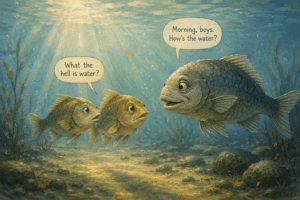
In 2005, David Foster Wallace stood in front of a graduating class at Kenyon College and told a small parable. Two young fish are swimming along, and an older fish passes the other way and says, “Morning, boys. How’s the water?” The two young fish swim on for a bit, and then one of them turns to the other and says, “What the hell is water?”

Wallace’s point wasn’t really about fish. It was about the obvious, ever-present realities that shape our lives so completely that we stop being able to see them at all. The water we swim in is the last thing we notice, precisely because it’s everywhere.

I thought about that fish story recently on a trip to a city I don’t call home. Our guide walked us past arena after arena, his voice rising with real pride — this stadium, that stadium, the new one going up next year. You could hear how much he loved his city in the way he talked about those buildings.

I looked past him at the sidewalks. Tents. Bedrolls. People folded into doorways in the middle of the afternoon. It wasn’t hidden. It wasn’t subtle. It was just — there, the way water is there.

So I asked him: “What about your homeless?”

He got quiet. Almost flinched. “We can’t really talk about that,” he said, and moved on to the next stadium.

We can’t really talk about that.

I’ve turned that sentence over many times since. It wasn’t cruelty in his voice — it was something closer to reflex, like a fish that’s been trained not to notice it’s wet. His city loves its stadiums out loud. Its people sleeping in the cold, it has agreed, silently and collectively, not to see.

And it’s not just his city. Homelessness in this country has climbed toward levels not seen since the Great Depression, and mostly we manage not to talk about it either — except to complain about a tent on a sidewalk we’d rather not look at on our way somewhere else. We build the water. Then we swim in it and call it normal.

Here is the part that should unsettle us, if we let it. This is not a new test, and we are not the first generation to fail parts of it. Ancient Israel’s prophets — Amos, Isaiah, Micah — spent their careers hammering a wealthy, temple-proud nation for the exact same blindness: elaborate worship on one hand, the poor ground into the dust on the other. Rome built magnificent coliseums while its underclass starved outside the gates, and centuries later we tour the ruins and marvel at the architecture without asking who slept in its shadow. Every era gets its stadiums — its games, its monuments, its things to be proud of out loud — and every era has, in its own doorways, a version of what its guides would rather not discuss. The particulars change. The reflex does not.

There are people who’ve given their whole careers to this fight, and right now many of them are losing ground. In 1992, a psychologist named Dr. Sam Tsemberis started a small experiment in New York called Pathways to Housing: give a person an apartment first — before therapy, before sobriety, before anything else is asked of them. It worked. Housing First, as the model came to be known, spread nationwide over the next three decades and became the backbone of federal homelessness policy, credited by researchers as the most effective tool built yet against chronic homelessness.

In 2026, the same federal agency that once championed it moved to gut its funding in favor of “treatment first” programs instead, a shift advocates warned could put more than 170,000 people back on the street. A judge has since blocked part of the rollback, but the funding remains fragile, and shelters are folding while they wait. In one Maryland county, a permanent-housing program lost its federal grant in January; a small Episcopal church down the road gave its entire Christmas offering — about $15,000 — just to cover eleven families’ rent for one more month. That’s the fight up close: careful work built over three decades, surviving month to month on a church’s collection plate.

Wallace saw a version of this same blindness, from a different angle entirely — not policy, but attention. Near the end of that commencement address, he circled back to his fish and told the graduates plainly: “This is water. This is water.” He wasn’t talking about homelessness. He was talking about all of it — every obvious, unbearable thing that hides in plain sight until someone insists on naming it.

Francis of Assisi understood something about this reflex that still cuts. He didn’t organize a committee to study poverty from a comfortable distance. He walked toward the leper on the road — the person his whole city had agreed to look past — and embraced him. Not as a strategy. As a correction to his own blindness. He had to become willing to see the water before he could do anything about it at all.

Fish Don’t Talk About Water Workbook

Awareness is the first domain of Spiritual Emotional Intelligence for exactly this reason. You cannot repent of what you cannot see. You cannot love your neighbor if your neighbor has quietly become part of the scenery — background, infrastructure, something you’ve stopped registering as human. The tour guide’s embarrassment wasn’t a character flaw. It was a diagnosis, and it’s one most of us carry in some form, about some doorway in some city we’ve decided not to look at too closely.

Every tradition I’ve spent my life inside says some version of the same hard thing: a society is judged, in the end, not by its monuments but by how it treats the ones with no power to demand better treatment. Not by its stadiums. By its doorways. History keeps handing down that report card, generation after generation, and we keep being surprised that it’s still being graded.

Where This Meets You:

Somewhere in your own city, there’s a version of that tour guide’s silence — a thing everyone has quietly agreed not to mention. You already know what it is. The only question Wallace’s parable really leaves us with isn’t whether the water is there. It’s whether we’re willing to notice we’re wet.

Peace and every good.


Jim Vaive is co-founder of spirit of EQ and author of The Mystical Seeker, writing at the intersection of emotional intelligence, the Enneagram, and contemplative spirituality. He and his wife Lynette help individuals and organizations grow from the inside out.”

The Desert and What Holds Weight

The Desert and What Holds Weight

Part Three of a Three-Part Conversation with Eric Pennington

There is a particular kind of man who can tell you, without flinching, exactly what a decade cost him — and then tell you, in the same breath, that he wouldn’t trade it. Eric Pennington is that man. I have known him for years now. I have watched him work rooms full of skeptical engineers and rooms full of grieving people and rooms full of executives who didn’t yet know they needed what he was offering. And nothing I have watched him do has prepared me for what it was like to sit across from him and ask him to open the desert back up, on camera, on purpose.

He calls it the desert. Sometimes the crucible — the older, harder word, the one that means the fire applied to ore until everything that isn’t the metal itself burns away. He doesn’t reach for that word for effect. He reaches for it because it’s accurate. The crucible doesn’t ask your permission. It doesn’t negotiate a timeline. It simply burns, for as long as burning is required, and you find out what you’re actually made of only after there’s nothing left to hide behind.

His began in 2006. It didn’t end, by his own accounting, until somewhere around 2017. Eleven years, give or take. I want you to sit with that number for a moment before we go further, because it would be easy to read past it. Eleven years is not a bad quarter. It is not a rough season. It is the better part of a man’s working life, spent not knowing, year after year, whether the ground would ever hold again.

“You can confidently say — yeah, I know I’m in the desert, but I’m sure probably next month we’ll be out of here,” he told me. “And then it’s not. And then you realize after a couple of years: yeah. You are in the desert.” He said it almost gently, the way people describe a wound long enough healed that they can finally hold it up to the light without flinching. But I watched his face while he said it, and I want to be honest with you: there was nothing easy underneath that gentleness. Eleven years of believing the end was near and being wrong, over and over, is not a small thing to survive with your faith intact. Most people don’t. Eric did.

I asked him what the desert took from him that he hadn’t expected to lose.

“A lot of that pride,” he said immediately. No hedging. No softening it into something more palatable. He traced it back through everything we’d uncovered in the two conversations before this one — a childhood where being right felt like the only available form of safety, a corporate career that rewarded the same instinct with money and promotions and the particular drug of applause, a company called Epic Living that he launched half out of genuine vision and half out of an old hunger still looking for its next hit. The desert went after all of it. “It birthed in me what I would say is authentic humility,” he said — and he meant the word authentic as a precise distinction, not a flourish. He has seen the performed version of humility up close. He knows it when he sees it, because he used to wear it himself. What the desert gave him instead was the kind you don’t get to choose. The kind that’s simply what’s left.

And then there were the mirages. I want to dwell on this, because I think it is one of the most honest things a person has ever said to me about suffering. A mirage in the desert isn’t an absence of hope — it’s hope, fully formed, arriving exactly when you need it, and then revealing itself as nothing. “You thought: I’m this close. There it is,” Eric said. “And then — gone. And another lesson to learn.” He didn’t say this with bitterness. He said it the way a man says something he has made an uneasy peace with, after enough years of practice, while still being honest that the peace was hard-won and is not the same thing as the pain having been small.

What grew in that soil, against every reasonable expectation, was something he attributes — without irony, in the middle of an interview about emotional intelligence — to Søren Kierkegaard. The idea of playing for an audience of one. Not performing for the room. Not measuring the work by who noticed it. Doing the work because the one true audience already knows the whole of your story, has already seen you at your most desperate and your most petty, and remains, somehow, still interested. I watched something settle in him when he said it. Like a man finally putting down something heavy he’d been carrying with both arms for over a decade.

This is the thing I most want you to understand about Eric Pennington: he refuses to simplify himself for your comfort or mine. In the span of a single answer he will move from Kierkegaard to the Enneagram to Miles Davis to a streaming television show, and somehow none of it is scattered. All of it is the same man, looking at the same wound from different angles, refusing to let any single lens claim the whole truth.

I asked him directly about the cost of being who he is — an empath, by his own naming, a self-preservation Four on the Enneagram, a man built to feel things at a depth this culture rarely makes room for, especially in men. His answer stopped me. “I’m an alien,” he said. “It feels like an alien.” Not with grief, though grief lives somewhere underneath it. With something closer to ownership. “I say that in recognition that I am here, and I’m here for a purpose.” He told me about a character on a television show he’d recently found himself drawn to — a figure who moves through the world differently than everyone around him, sees what others miss, is somehow both fully present and permanently a step outside. He used the word archetype without my prompting him toward it. He told me that the word “weird” used to land on him as wound, the way it landed on a boy who’d already survived more before age fourteen than most people survive in a lifetime. Now it lands as confirmation. “It added to my confidence and courage,” he said, “to continue to be who I know myself to be.”

I do not think most people get to that sentence. I think most people spend their whole lives running from the very thing Eric has learned to stand inside.

Then I asked him the question I had been most afraid to ask, because I suspected the answer would require more of him than any other question in three conversations: what is actually happening inside you, underneath, in the moment before you’ve found the words for something heavy?

He went quiet. Not an uncomfortable quiet — a deliberate one, the kind a musician takes before the next phrase. And then he gave me an answer I will be thinking about for a long time.

“It’s these notes,” he said. “If you’re familiar with music from a theory standpoint — you have quarter notes, you have half notes, you have whole notes, and then you have pauses that can be in between. That’s probably one of the gifts of music for me. It allowed me to process what’s happening underneath — that depth — and to be present with it. Because I can hold that note, and allow that liminal space to do what it does. And then play another note.” He brought Miles Davis back into it, the way he always eventually does — not the man’s sound, but his restraint. “It’s not how many notes. It’s what notes you choose. And the timing of them.” That, he told me, is the medicine. Not rushing toward resolution. Not explaining the ache before it’s finished teaching him something. Holding the note as long as the note needs to be held.

I have interviewed a great many people in my work. I have rarely heard anyone describe their own interior life with that much precision, or that much tenderness toward themselves.

We arrived, finally, at the question I had been saving across all three conversations — the one I think every other question had been quietly building toward. I reminded him of something he had told me himself: that his desire, underneath everything else, is to create things that will hold weight in eternity. And I asked him plainly: when you look back on this season of your life, what do you hope will have held that weight?

He answered slowly, on three levels, and I want to give you his words as close to whole as I can.

First — that he had been growing, across the whole of his life, into the person God intended him to be before he was ever formed in his mother’s womb.

Second — that his relationships would carry something real. That Jim, and Lynette, his wife, his children, the people he has walked closest to, would be able to say, without exaggeration: you did well there. We were helped. We were enriched by being near you.

Third — that the work itself, the podcasts and the articles and the coaching conversations no one ever sees the other side of, would have made a genuine difference in lives he will never personally know about. People who will never write him a message saying it mattered. He is not asking for the credit. He is asking that the giving was real, regardless of whether anyone ever tells him so.

The Desert And What Holds Weight Reflection Sheet

I have sat across from Eric Pennington enough times now to say this without exaggeration: I believe all three of those things will have been true. Not because he has learned to say the right words in the right order — he is far too honest a man for that kind of performance — but because eleven years in a desert burned away everything in him that wasn’t load-bearing, and what is left underneath is, simply, real. The boy who once watched his own life happen to him from a small distance, who found a lifeline in a hymn and a jazz record at thirteen, who carried a brother’s worst day into a school hallway where everyone already had a story about him, who chased the applause until it stopped feeding him, who walked eleven years of mirages and came out still able to play for an audience of one — that boy became, against very long odds, an extraordinary man. I am grateful to call him my friend. I think, by the time you finish reading this, you may understand why.

Where this meets you: what are you building right now that you hope will still mean something in a room you will never enter?

Peace and every good.

About the Author

Jim Vaive is co-founder of spirit of EQ, where he and his wife Lynette help individuals, leaders, and teams grow through emotional intelligence, the Enneagram, and contemplative spiritual formation. He writes at The Mystical Seeker on the inward life that makes the outward work possible.