
Getting It Right and Back To The Log
The work is not the writing. The work is going back to the log.
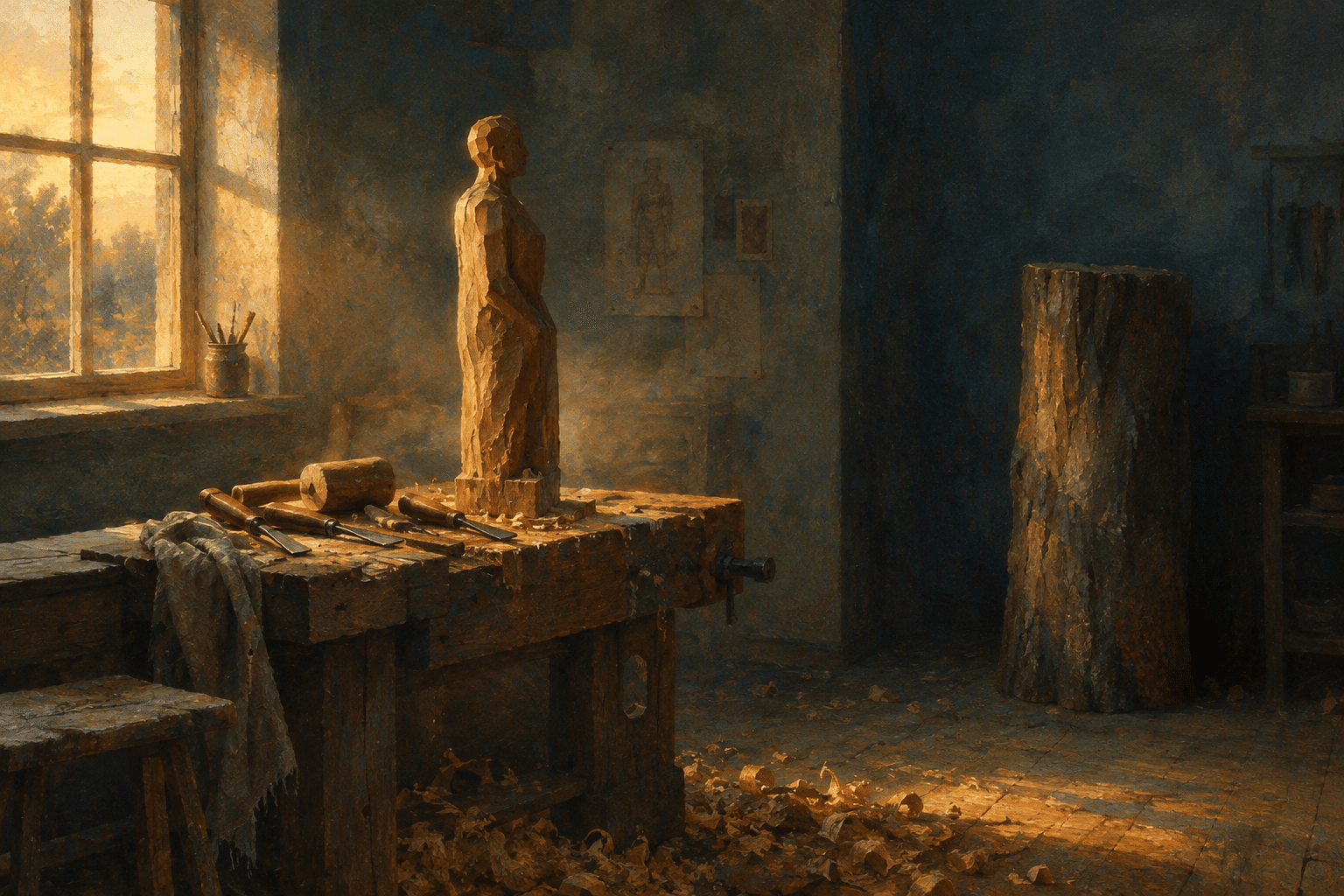
The smell I remember from my father’s studio in Detroit is sawdust and linseed oil, and under that the green, almost sweet smell of wood that hasn’t finished drying. He worked in walnut and cherry mostly, and he brought the material in himself — out to the forest, down a trunk, a log hauled back and set on end in the corner of the shop to wait its turn. Some of them waited years.
I was thirteen the year I started paying real attention, and what I kept sometimes was him starting over.
Not with failures. With work that was nearly done. A standing figure he had been at for weeks, and something in the slope of the cheek was wrong — a quarter inch, a plane that caught the light at an angle he hadn’t intended. There is no fixing that. You cannot paint over wood. He could cut deeper and let the whole head become something smaller than he had planned, or he could set it aside and go pick out another log. I watched him do both.
I questioned, the first time I understood what was happening. Not a child’s dismay — a thirteen-year-old’s wonderment which is curious, because I had reasons. Nobody would see it. It was weeks of work. He didn’t turn around. He said the figure had been telling him for some time that it wasn’t the figure, and he had finally gotten quiet enough to hear it. Hmmmm.
We had some version of that exchange a few times over the next few years. The foot placed a half inch off and the whole body going false above it. The shoulder that was technically correct and somehow dead. I always asked. He always said something close to the same thing, and I always heard it as a man talking about wood. Hmmmm. It took me five decades to understand he was describing a spiritual discipline, and I only understood it because I started writing — regularly, publicly, with my name on it — and found out that the work is not the writing. The work is going back to the log.
The process is not tidy. There is a list, sixty-some ideas now, growing, gathered from articles that snagged on something and sentences clients said in the middle of a session that opened a door I didn’t know was there. Some have been sitting a year and a half, like logs on end in the corner, not ready. Two have been drafted and set aside — not because they were bad but because they were not true yet. And every so often one comes up the moment I sit down, fully formed and insisting. Those are rarely the good ones. The urgency usually belongs to my ego rather than to the material.
Then comes the part nobody warns you about. You sit down intending to write one thing and the writing informs you, around the fourth paragraph, that you have been intending the wrong thing. Not a failure of planning. A kind of exposure. You cannot write honestly about patience while impatient and expect the sentences to hold; they go brittle, they start performing, and anyone reading carefully can hear it even if they couldn’t name what they’re hearing. The page is an unsentimental instrument. It registers what is in you with a precision I have found in only two other places: a good spiritual director, and silence.
Thomas Merton spent years convinced that the writing — and he wrote beautifully — was vanity dressed as vocation and discovered again and again that the page kept handing him back the very self he had come to the monastery to leave at the door. He could not get around himself by writing. Neither can I. Neither I suspect, can you, whatever your version of the page is — the report, the sermon, the hard email, the conversation you’ve rehearsed eleven times in the car.
So, writing has become a form of daily examen for me. Not something I perform at the end of a post, but what the post performs on me while I’m making it. Some sentences cost nothing. Others ask a question I would rather not answer, and I know which is which by a tightening at the base of the throat and a sudden interest in checking email.
The most expensive paragraph I ever wrote was in a post about what it means for a man to hear a woman say no. I was writing confidently, in the voice of the man who has it worked out, and the page stopped me. If I was going to write that, I had to admit I have not always heard it — not dramatically, but in the ordinary ways that are easier to excuse. Talking past a no. Softening it on someone’s behalf. Treating it as an opening position. I sat with it for a day and wanted to publish without it. Without the admission the post would have been competent and useless, one more man explaining a standard he exempts himself from. So I wrote it in, and then had to live with having written it, and the admission turned out to be the only part that earned the rest.
That is the half inch in the foot. The piece was fine. Fine was the problem. And there is no sanding your way out of it — you go back and start at the beginning or you publish something false and hope the light never catches it at the wrong angle.
Now I should tell you how this post got made, because leaving it out would make everything above a little bit of a lie.
There is an AI in my process, surprise! I bring the material — the studio, the list, the day I sat with that paragraph — and a draft comes back, cleaned up with sentence, spelling, etc and then I go to work on it. It is a real collaborator in that it asks me questions I hadn’t thought to ask myself, and not a collaborator at all in that it has no shop in its memory and nothing at stake in what I publish. Both are true at once. And it does not write the piece for me.
The danger is not the one people warn about. It is not going to replace me. Fluency is what it does best, and fluency is exactly what I described above as the signal that something is wrong. IT helps with an acceptable version. The surface you can no longer change. Every time it hands me that version I am standing where my father stood, except the piece arrived with questions before I had done any of the work that usually earns it, and a sanded surface is the hardest thing in the world to see a fault in.
That is the easy part — sentence structure, punctuation, the rhythm of a line.
But it cannot tell me which paragraph costs me something. It has no throat to tighten. When it drafted the section above it wrote well and wrote from the outside, because the admission underneath was mine and the having-to-live-with-it was mine. That does not transfer. An examen performed by someone else is not an examen; it is a performance review.
So: I let it start a draft. I let it argue with me. Then I go looking for the half inch myself, and I do not let it do that part. The day I hand over that part is the day this stops being a practice and becomes content, and I have enough content in my life. Don’t you?
Lynette reads most things after that, which is its own discipline, because she has known me for many years and can spot the sentence where I started hiding or it is not my words and it is the sentence a machine wrote. She doesn’t argue with it. She reads it back to me, and it falls apart on contact with her voice. No machine has done that to me yet, and I notice I don’t want one to. I do not want my writing to look like all the other AI generated material out there and face it, we can all tell when AI writes this stuff.
And then there is the reader I will never meet, who finds the post eight months late on a Tuesday night at an hour that tells you something about how the day went. I used to write to an imagined audience, which is to say nobody. Now I write to one person, usually someone who sat across from me and said a thing they had never told anyone. You lose reach that way. You gain the only thing that matters — the occasional note that says: this was me, how did you know. The honest answer is that I didn’t.
I have one of his pieces. It is in my house, where I see it every day without seeing it, the way you stop seeing anything you live with. It is wearing a wizard hat at the moment — a gift someone gave me that I had no use for and no heart to throw out, so I set it on his figure, and it has stayed there because it looks right. It looks like something he would have found funny. Every so often the light moves across it and I notice my dad again, and what I notice is not the skill. It is the dozen other versions of it that never existed, the ones that got set aside at the point where almost anyone else would have finished and signed it. That is what I am looking at. The restraint is the piece. And I smile. Hi, Dad.
I think about those afternoons every time a draft goes smooth and I can feel myself writing the acceptable version. Changing it is what brings the truth up — something underneath is asking for the room. Whatever I was proud of may have to go back to the woodpile. Sigh.
Then I sit in the quiet, where the sawdust was, and wait to hear what the figure has been telling me.
Peace and every good.
About Jim & Lynette Vaive
Jim and Lynette Vaive are the co-founders of spirit of EQ, where they work at the intersection of emotional intelligence, the Enneagram, and spiritual formation. Jim is a Master Certified Coach, a certified spiritual director, and a former CEO. Lynette’s doctoral research grounds their Spiritual Emotional Intelligence (SEQ) framework. Together they write The Mystical Seeker. spiritofeq.com · mysticalseeker.substack.com
Sources
Thomas Merton wrestled with writing as vocation and as vanity throughout his journals, most directly in The Sign of Jonas (1953).


Leave a Reply
Want to join the discussion?Feel free to contribute!