The Circles You Didn’t Know You Were Drawing

Closeness has a shape, and most of us were never taught it.

There is a moment that happens in my work more often than any other, and it usually arrives early. Someone sits down, we exchange the ordinary opening courtesies, and then — twelve, fifteen minutes in — they hand me something enormous. A marriage that is failing. A diagnosis. A thing they did in 1987 they have never said out loud. It comes out in a rush, and when it is finished there is a particular silence while they wait to see what I am going to do with it.

In that room, it is the right thing. That is what the room is for.

What concerns me is what I hear next, which is that the same thing happened on Tuesday with someone at work.

People tell me this about themselves without quite hearing what they are telling me. They say it lightly: I’m an open book, I don’t really have a filter, I just say what I think. It is offered as a virtue, and in a sense it is one. These are not calculating people, and I would rather sit with them than with someone who has never let anything slip in their life. But then I ask how it tends to go, and the stories come out, and they are not good stories.

They go wrong in three ways, and it is worth separating them, because they are not the same problem.

The first is the one everyone braces for: someone takes what you gave them and uses it. Not always with malice — sometimes it is repeated in a meeting as context, or passed to a third person as concern — but the effect is that something you said in one register is now operating in another, where it can be held against you. This is the rarest of the three.

The second is more common and gets talked about less. The information is not weaponized; it is simply misread. You said you were struggling, and what got filed away was unstable. You said the marriage was hard, and what they carry now is she’s leaving him. Nothing was done with it. It sat in someone else’s head and finished itself in a shape you did not choose.

The third is the quietest and the most costly. You tell someone something large, and they hear it as an announcement of intimacy. You were overflowing. They understood it as being chosen. Now there is a closeness on the table that one of you believes in and the other does not, and that asymmetry has to go somewhere. Usually it becomes disappointment, and the disappointment lands on you, and you cannot work out what you did.

None of these are failures of honesty. Every one of them is a failure of proportion.

The contemplative tradition saw this early. John Cassian, writing in the fifth century about what he had learned from the desert monastics, called it discretio — discretion — and he did not mean keeping quiet. He meant the capacity to judge rightly what a particular moment asks for. He ranked it above the more dramatic virtues, above fasting and vigils, because those could all be practiced to excess and do harm, and discretion was the thing that knew how much. It is not a rule about secrets. It is a sense of measure.

What I could not find anywhere was a way to put that in front of someone in thirty seconds. So I built one. This is my own model, worked out over about twenty-five years — with clients, in direction, and on myself — and refined every time it turned out to be wrong.

The Circles of Disclosure.
(NOTE–If you would like the Diagram, let me know.)

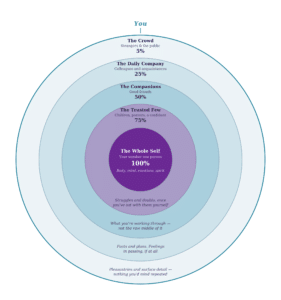
You are the whole field. Everyone in your life sits somewhere inside it, and how much of yourself you hand over changes with the distance from the center. The percentages are approximate; nobody is doing arithmetic in a hallway. They are there to give you something to feel for.

The Whole Self — 100%. At the center, your number one person. A spouse, a partner, whoever that one is. This is where you bring all of it: body, mind, emotions, spirit. Not a report on those things — the things themselves, including the parts you have not finished figuring out. You do not have to arrive at understanding before you speak. You can say it while it is still shapeless and be received anyway. I want to be plain about this, because it is the center of everything else on the page: you cannot do this with everyone, and attempting it will fail. Not might. Will. The whole self is more than any other circle is built to hold, and handing it to a circle that cannot carry it does not create closeness — it creates damage, usually to you. Most people have one such person. Some have none, and that is its own grief, worth naming rather than working around.

The Trusted Few — 75%. Children, parents, a confidant or two. Real struggles and doubts go here, with one difference that matters: once you have sat with them yourself. The distinction is not how much you say, it is whether you are talking with someone or at them. A grown child can carry the fact that you are frightened about something. They should not be the place where you first discover it.

And notice what has already happened by this ring. The whole self does not travel outward. It stops at the center. Everything from here on is a portion — a real portion, chosen and offered, but a portion — and that is not a loss or a compromise. It is what these relationships are for. The mistake people make is assuming that if they love someone enough, or trust them enough, the center should expand to include them. It does not work that way. The interior ring is interior because it is the only one built to hold all of you, and the moment you try to widen it, you have not made two people closer; you have only moved the weight somewhere it cannot be carried.

The Companions — 50%. People who know the shape of your life, who would recognize your handwriting and your worst habits. What you are working through goes here, but not the raw middle of it. Not the three-in-the-morning version. This is where you can be honest that something is hard without handing over the whole weight of it, and most real friendship lives at exactly this depth. It is not a lesser closeness. It is a different one.

The Daily Company — 25%. Colleagues, neighbors, the people you see constantly and know slightly. Facts and plans. Feelings in passing, if at all. You can say the week has been rough; you do not have to say why. There is a version of this that becomes armor, and that is not what I am describing — an office where nobody says anything real is its own kind of sick. But most of the damage I hear about here came from a mistaken register, not from excess warmth.

The Crowd — 5%. Strangers, anyone you have just met, and anything you post. Pleasantries and surface detail. Nothing you would mind being repeated, because it may be, and you will not be there when it is.

Circles of Disclosure Reflection Sheet

Here is what it looks like when the first circle’s contents land in the fourth.

Something has gone badly at home. You have not slept. On Monday a colleague you like well enough asks how your weekend was — a Daily Company question, asked in that register, expecting a Daily Company answer. And instead of rough, but fine, the true thing comes out: the marriage is in trouble, you are frightened, you do not know what happens next.

Watch what follows. They have nowhere to put it. They were making conversation and now they are holding something they did not ask for and cannot hand back. Whatever they say next will be inadequate, because the register they were standing in has no adequate response available — and you will feel that inadequacy as rejection, on top of everything else. Then they adjust. More careful around you, or more solicitous, either one a small distance where there wasn’t one. It travels a little, mentioned to one other person as genuine concern. And here is the part that costs the most: by Thursday you have come up for air. The information has not. It is still Monday morning in their head, and the version of you they are now working from is the worst hour of your year, frozen, with no way for you to go back and update it.

Nobody did anything wrong. The content was true. It was simply put in a circle not built to hold it.

Which brings me back to that room, and the silence after something has been set down.

What I listen for is not whether someone has told me too much; the room can hold it. I listen for whether the telling was aimed — whether this was said to me, here, for a reason, or whether it is simply what comes out of them now, in every room, to whoever is sitting there. Because if it is the second, the thing that looks like openness is doing something else. It is not connection. It is spillage. And spillage does not create intimacy; it only looks like it from the inside, for about an hour.

Most of the trouble comes from a mismatch — handing a Daily Company person something that belonged at the center, or holding back from the center what they had every right to hear. The first kind usually costs more, because what you said keeps travelling after you have stopped talking. Where the rings sit, and who belongs in each, is yours to work out.

Peace and every good.

——————————————————

About Jim & Lynette Vaive

Jim and Lynette Vaive are the co-founders of spirit of EQ and co-authors of The Mystical Seeker. They are Master Certified Coaches, certified Narrative Enneagram teachers, and Certified Spiritual Directors, and together they hold credentials in Spiritual Emotional Intelligence (SEQ) — a framework rooted in Lynette’s Doctor of Ministry research. Learn more at spiritofeq.com.

Sources

John Cassian on discretion as the governing virtue — Conferences, Conference II (“On Discretion”), c. 426. Cited as context for the problem, not as a source for the Circles of Disclosure model, which is the author’s own.


 

The Difference Between Spiritual Direction and Coaching

Two empty chairs turned slightly toward each other in a quiet room, warm lamplight between them, a window beyond showing early morning — the shared space of coaching and spiritual direction.

Two chairs, one conversation. What changes is the question you bring to it.

Coaching helps you move toward something. Spiritual direction helps you pay attention to something.

People ask Jim and Lynette this question more than almost any other. It’s a fair one — they offer both, they’ve been trained deeply in both, and from the outside the two practices can look similar. Both involve one-on-one conversation. Both involve careful listening. Both are oriented toward growth and clarity.

So what’s actually different? The honest answer is: quite a lot. And Jim and Lynette have lived that difference from both sides — as practitioners and as people who have needed both at different points in their own lives.

What coaching is for

Coaching is fundamentally future-oriented. It begins with the question: where do you want to go, and what’s getting in the way?

Jim and Lynette spent years as Regional Network Directors for North America at Six Seconds — Josh Freedman’s global emotional intelligence nonprofit — and together co-developed the SEQ (Spiritual Emotional Intelligence) assessment now used across many countries. That work deepened their understanding of what coaching can do at its best: help people understand how their emotions inform their choices, interrupt patterns that are limiting them, and move toward what they most want with more skill and intentionality.

The Six Seconds model takes the inner life seriously. But it does so in service of forward movement. Coaching tends to work well when you have a goal you’re working toward, a decision you want to make more effectively, or a pattern you want to interrupt. It’s good for people who know roughly where they want to go and need help getting there.

What spiritual direction and spiritual formation are for

Spiritual direction and spiritual formation are fundamentally present-oriented — and in some ways, gently suspicious of the rush toward the future that coaching is designed to support.

When Lynette completed her Doctor of Ministry research at the Haden Institute and Graduate Theological Foundation, the work that eventually became the SEQ framework, she was exploring something the coaching world often moves past too quickly: the inner life not as a resource to optimize, but as a landscape to inhabit. Spiritual direction begins not with where do you want to go but with where are you, and what is already stirring in you?

A spiritual director isn’t working toward a goal with you. They’re paying attention alongside you — to what’s alive, to what’s heavy, to what keeps surfacing without resolution, to where the sacred might already be moving in ways you haven’t fully recognized yet.

The overlap — and why it matters

The two practices share more than they might seem to. Both take the inner life seriously. Both involve listening of a particular quality. Both resist the impulse to fix or advise.

Jim often says that the person who comes to him for coaching and the person who comes for spiritual direction are sometimes carrying the same question — they just haven’t recognized it yet. The executive trying to decide whether to take the promotion might actually be trying to understand what his life is for. The woman discerning a major transition might need both the practical clarity of coaching and the contemplative spaciousness of spiritual direction.

These aren’t competing practices. In Jim and Lynette’s experience, they’re part of the same one.

Spiritual Direction or Coaching Reflection Sheet

So how do you choose?

A few questions worth sitting with: Do you have a clear goal, or are you still trying to understand where you are? Are you looking for help with change, or help with understanding? Is there something specific you want to accomplish in the next year, or something you’ve been carrying that doesn’t seem to be going anywhere?

And — do you sense that what’s happening in your life right now has a deeper dimension you haven’t been able to name yet? If so, spiritual direction and the spaciousness of spiritual formation might be exactly what you’ve been looking for.

If you’re still not sure, the best next step is a free 15-minute conversation. Jim and Lynette can talk through where you are and what kind of companionship makes the most sense for this season.

Schedule with Jim: https://calendly.com/jim-792/spiritual-direction-consultation

Schedule with Lynette: https://calendly.com/lynettespiritofeq/15min

Peace and every good.


About Jim & Lynette Vaive

Jim and Lynette Vaive are the co-founders of spirit of EQ and co-authors of The Mystical Seeker. They are Master Certified Coaches, certified Narrative Enneagram teachers, and Certified Spiritual Directors. Together they hold credentials in Spiritual Emotional Intelligence (SEQ) — a framework rooted in Lynette’s Doctor of Ministry research — and serve individuals, small groups, and organizations across faith traditions. Learn more at spiritofeq.com.

Series

Post 4 of 6 in the Spiritual Direction series.

Ninety Trucks, Ninety Driveways, Ninety People

The true sentence is usually the worse-sounding one.

There was a stretch of years when I would get to the Varment Guard yard before most of the crews, and what I remember is the sound more than the sight — twenty-odd trucks pulling in already running, warm from the drive, ready for the day and the hiss of a bay door going up. Most of the fleet never saw the yard in the morning. Ninety trucks and the men took them home, so at any hour of any night our trucks were scattered across Ohio in ninety driveways. Only the ones needing parts or a swap came in. But, standing there at six, what you saw was rows of black and gold, same logo, same ladder racks, same lettering on the door, men in the same uniform crossing between them with coffee.

I was proud of that lot. And, because of that pride it complicates everything I’m about to say.

We made them identical on purpose, and it cost money to keep them that way. Not for efficiency — for recognition( and maybe a little efficiency). Sending the trucks home every night was part of it. Ninety black and gold trucks sitting overnight in ninety neighborhoods is ninety people seeing us before they ever need us, so that a woman who noticed one in her neighbor’s driveway on Tuesday knew it on sight when it pulled into hers on Friday. She had already decided something about us before anyone knocked. That is how a stranger comes to trust you enough to let you into her crawlspace at ten at night. The sameness was a promise, of knowing that we had to be good enough, often enough, for the promise to be worth anything. Uniformity without a company behind it is just paint.

Which is why it took me a while to understand what bothers me about the internet now.

Because it looks like my back lot, and it shouldn’t. Scroll for ten minutes and you’ll see it — the same post, the same words, the same three-beat structure, the same gentle authority, the same closing invitation to reflect. Row after row of the same thing, parked, in the back lot. But our trucks were never supposed to be parked together. The whole design was to get them out and scattered, one to a street, each one sitting in front of a particular house belonging to particular people. What is filling the internet is the opposite: the livery piled up in one place where nobody lives, all the recognition with nothing behind it. No company. No crews. Nobody who answers the phone when it goes wrong at ten at night.

Nobody decided this, which is the strange part. At Varment Guard we chose the sameness and paid for it and could defend it in a room. What’s happening now is a lot that filled up by default, truck by truck, with no one ever choosing the colors.

I know how it happens, because I know how it almost happens to me. You sit down to write. Something comes back fluent and competent and nearly right. “Nearly right” has a gravitational pull that “wrong” never had. Wrong you fight. Nearly right you accept, because fixing it feels like fussiness, and because it already sounds like something that would do well. The median is seductive precisely because it is the shape of what has already worked for everyone else. Right?

The contemplative tradition has a name for this, and it is older than any of our tools. Thomas Merton spent his life circling what he called the false self — not a liar, not a villain, but the self we assemble out of what the room is known to approve of. It is competent. It is often admired. It is also, in his reading, not anyone. The desert monastics worried about the same thing in a different space. They were forever warning young monks against copying an elder’s practice instead of finding their own, because a borrowed discipline produces a borrowed man.

Here is the part that matters for anyone who isn’t writing anything. The parking lot is not primarily a content problem. It is an interior one, and it had a head start on the technology by several thousand years.

I sit with people for a living and what I hear, more often than anything else, is pre-owned language. Someone describes their marriage in the vocabulary of a podcast they heard. Someone names a career crisis in terms borrowed whole from an article they read. Someone tells me about their grief in the precise phrasing of the last condolence card they received. None of it is dishonest. All of it is context with nothing behind it yet. My work in that room is almost never to supply a better framework or give answers — it is to keep asking until something comes out that nobody handed them. You can hear it when it happens. The sentence gets worse. It gets halting and specific and a little embarrassing, and it is the first true thing said in forty minutes.

That is the whole discipline, as far as I can tell. The true sentence is usually the worse-sounding one.

I wrote in the last blog about my father in his studio, and how he would set aside a piece that was nearly finished because a quarter inch in the slope of a cheek had gone wrong. He could not paint over wood. He had to go back to the log and start again. It took me fifty years to understand he was describing the same thing I am describing here from the other end — that the fluent, finished, nearly right version is the most dangerous thing on the table, because it is the hardest one to see a fault in.

The Enneagram makes the same case from another direction. Each type is, among other things, a strategy for being acceptable — a reliable way of getting approval, safety, or distance that worked so well, so early, that it stopped feeling like a strategy and started feeling like a personality. Nine types, nine very sophisticated paint schemes. The work is not to trade your type for a better one. It is to notice the moment you reach for the familiar move and ask whether this situation is asking for it, or whether you are just driving the truck because it is the one in the lot.

Which brings me back to the yard, and to the thing I had wrong for years.

I thought the fleet was the achievement. It wasn’t. I knew those crews. I knew Steve and Brad and Harry — what each of them was carrying into the truck at six in the morning, what was waiting when they got home, which of them was in a season that was going to hold and which of them was in one that wasn’t. The trucks were identical. Steve and Brad and Harry were never identical, not for one morning, and every night those ninety identical trucks went home to ninety different lives. The black and gold only ever went as deep as the paint.

That is also what made the brand mean anything. The uniformity was never the product. It was a way of pointing at ninety particular people who showed up and did the work. Take them out and you still have the trucks, and the trucks are worth nothing.

So the question the internet raises isn’t really about sameness. The lot is going to fill up; it already has. The question is whether there is anyone in the cab?

Ninety Trucks, Ninety Driveways Reflection Sheet

What I have come to is unglamorous. Before I publish, before I say the thing in the meeting, before I offer the observation in a session that I can tell will land well, I try to ask one question. Is this mine, or did I pick it up in the lot? Not “is it true” — the median is usually true. True and borrowed are not opposites. The question is whether it came up out of a life or came in off a shelf, and I find I can tell, if I am willing to be slow about it for ten seconds.

Most mornings I don’t like the answer. The borrowed version is better written. It is always better written. That is the problem.

But I think about standing in that cold lot at six in the morning, looking at what I believed was uniformity, when what was in front of me was ninety people I would have had to ask, one at a time, to learn anything true about. The sameness was real. It was also, every single morning, the least interesting fact about what I was looking at.

Peace and every good.


About Jim & Lynette Vaive

Jim and Lynette Vaive are the co-founders of spirit of EQ and co-authors of The Mystical Seeker. They are Master Certified Coaches, certified Narrative Enneagram teachers, and Certified Spiritual Directors, and together they hold credentials in Spiritual Emotional Intelligence (SEQ) — a framework rooted in Lynette’s Doctor of Ministry research. Learn more at spiritofeq.com.

AI assisted, not written.

Sources

Thomas Merton on the false self — developed across his work, most directly in New Seeds of Contemplation (1961).

The sayings of the desert fathers and mothers on not imitating another’s practice: the Apophthegmata Patrum (Sayings of the Desert Fathers).

Getting It Right and Back To The Log

The work is not the writing. The work is going back to the log.

The smell I remember from my father’s studio in Detroit is sawdust and linseed oil, and under that the green, almost sweet smell of wood that hasn’t finished drying. He worked in walnut and cherry mostly, and he brought the material in himself — out to the forest, down a trunk, a log hauled back and set on end in the corner of the shop to wait its turn. Some of them waited years.

I was thirteen the year I started paying real attention, and what I kept sometimes was him starting over.

Not with failures. With work that was nearly done. A standing figure he had been at for weeks, and something in the slope of the cheek was wrong — a quarter inch, a plane that caught the light at an angle he hadn’t intended. There is no fixing that. You cannot paint over wood. He could cut deeper and let the whole head become something smaller than he had planned, or he could set it aside and go pick out another log. I watched him do both.

I questioned, the first time I understood what was happening. Not a child’s dismay — a thirteen-year-old’s wonderment which is curious, because I had reasons. Nobody would see it. It was weeks of work. He didn’t turn around. He said the figure had been telling him for some time that it wasn’t the figure, and he had finally gotten quiet enough to hear it. Hmmmm.

We had some version of that exchange a few times over the next few years. The foot placed a half inch off and the whole body going false above it. The shoulder that was technically correct and somehow dead. I always asked. He always said something close to the same thing, and I always heard it as a man talking about wood. Hmmmm. It took me five decades to understand he was describing a spiritual discipline, and I only understood it because I started writing — regularly, publicly, with my name on it — and found out that the work is not the writing. The work is going back to the log.

The process is not tidy. There is a list, sixty-some ideas now, growing, gathered from articles that snagged on something and sentences clients said in the middle of a session that opened a door I didn’t know was there. Some have been sitting a year and a half, like logs on end in the corner, not ready. Two have been drafted and set aside — not because they were bad but because they were not true yet. And every so often one comes up the moment I sit down, fully formed and insisting. Those are rarely the good ones. The urgency usually belongs to my ego rather than to the material.

Then comes the part nobody warns you about. You sit down intending to write one thing and the writing informs you, around the fourth paragraph, that you have been intending the wrong thing. Not a failure of planning. A kind of exposure. You cannot write honestly about patience while impatient and expect the sentences to hold; they go brittle, they start performing, and anyone reading carefully can hear it even if they couldn’t name what they’re hearing. The page is an unsentimental instrument. It registers what is in you with a precision I have found in only two other places: a good spiritual director, and silence.

Thomas Merton spent years convinced that the writing — and he wrote beautifully — was vanity dressed as vocation and discovered again and again that the page kept handing him back the very self he had come to the monastery to leave at the door. He could not get around himself by writing. Neither can I. Neither I suspect, can you, whatever your version of the page is — the report, the sermon, the hard email, the conversation you’ve rehearsed eleven times in the car.

So, writing has become a form of daily examen for me. Not something I perform at the end of a post, but what the post performs on me while I’m making it. Some sentences cost nothing. Others ask a question I would rather not answer, and I know which is which by a tightening at the base of the throat and a sudden interest in checking email.

The most expensive paragraph I ever wrote was in a post about what it means for a man to hear a woman say no. I was writing confidently, in the voice of the man who has it worked out, and the page stopped me. If I was going to write that, I had to admit I have not always heard it — not dramatically, but in the ordinary ways that are easier to excuse. Talking past a no. Softening it on someone’s behalf. Treating it as an opening position. I sat with it for a day and wanted to publish without it. Without the admission the post would have been competent and useless, one more man explaining a standard he exempts himself from. So I wrote it in, and then had to live with having written it, and the admission turned out to be the only part that earned the rest.

That is the half inch in the foot. The piece was fine. Fine was the problem. And there is no sanding your way out of it — you go back and start at the beginning or you publish something false and hope the light never catches it at the wrong angle.

Now I should tell you how this post got made, because leaving it out would make everything above a little bit of a lie.

There is an AI in my process, surprise! I bring the material — the studio, the list, the day I sat with that paragraph — and a draft comes back, cleaned up with sentence, spelling, etc and then I go to work on it. It is a real collaborator in that it asks me questions I hadn’t thought to ask myself, and not a collaborator at all in that it has no shop in its memory and nothing at stake in what I publish. Both are true at once. And it does not write the piece for me.

The danger is not the one people warn about. It is not going to replace me. Fluency is what it does best, and fluency is exactly what I described above as the signal that something is wrong. IT helps with an acceptable version. The surface you can no longer change. Every time it hands me that version I am standing where my father stood, except the piece arrived with questions before I had done any of the work that usually earns it, and a sanded surface is the hardest thing in the world to see a fault in.

That is the easy part — sentence structure, punctuation, the rhythm of a line.

But it cannot tell me which paragraph costs me something. It has no throat to tighten. When it drafted the section above it wrote well and wrote from the outside, because the admission underneath was mine and the having-to-live-with-it was mine. That does not transfer. An examen performed by someone else is not an examen; it is a performance review.

So: I let it start a draft. I let it argue with me. Then I go looking for the half inch myself, and I do not let it do that part. The day I hand over that part is the day this stops being a practice and becomes content, and I have enough content in my life. Don’t you?

Lynette reads most things after that, which is its own discipline, because she has known me for many years and can spot the sentence where I started hiding or it is not my words and it is the sentence a machine wrote. She doesn’t argue with it. She reads it back to me, and it falls apart on contact with her voice. No machine has done that to me yet, and I notice I don’t want one to. I do not want my writing to look like all the other AI generated material out there and face it, we can all tell when AI writes this stuff.

And then there is the reader I will never meet, who finds the post eight months late on a Tuesday night at an hour that tells you something about how the day went. I used to write to an imagined audience, which is to say nobody. Now I write to one person, usually someone who sat across from me and said a thing they had never told anyone. You lose reach that way. You gain the only thing that matters — the occasional note that says: this was me, how did you know. The honest answer is that I didn’t.

Back To The Log Reflection Sheet

I have one of his pieces. It is in my house, where I see it every day without seeing it, the way you stop seeing anything you live with. It is wearing a wizard hat at the moment — a gift someone gave me that I had no use for and no heart to throw out, so I set it on his figure, and it has stayed there because it looks right. It looks like something he would have found funny. Every so often the light moves across it and I notice my dad again, and what I notice is not the skill. It is the dozen other versions of it that never existed, the ones that got set aside at the point where almost anyone else would have finished and signed it. That is what I am looking at. The restraint is the piece. And I smile. Hi, Dad.

I think about those afternoons every time a draft goes smooth and I can feel myself writing the acceptable version. Changing it is what brings the truth up — something underneath is asking for the room. Whatever I was proud of may have to go back to the woodpile. Sigh.

Then I sit in the quiet, where the sawdust was, and wait to hear what the figure has been telling me.

Peace and every good.


About Jim & Lynette Vaive

Jim and Lynette Vaive are the co-founders of spirit of EQ, where they work at the intersection of emotional intelligence, the Enneagram, and spiritual formation. Jim is a Master Certified Coach, a certified spiritual director, and a former CEO. Lynette’s doctoral research grounds their Spiritual Emotional Intelligence (SEQ) framework. Together they write The Mystical Seeker. spiritofeq.com · mysticalseeker.substack.com

Sources

Thomas Merton wrestled with writing as vocation and as vanity throughout his journals, most directly in The Sign of Jonas (1953).

What Silence Does That Words Cannot

Some things will not arrive until we stop talking.

Watch what happens in almost any conversation when the talking stops. Three seconds go by. Then four. Somebody laughs a little, or changes the subject, or asks a question nobody needed answered. We are remarkably good at not letting a silence stand.

I have spent a lot of years now sitting with people in rooms where silence is the point — spiritual direction, retreats, bedsides. And the thing I keep learning is this: silence is not the absence of something. It is a presence with its own work to do. There are things it accomplishes that no amount of good language ever will.

Silence is an event, not a gap

The body seems to know this before we do. In a study at the University of Pavia, researchers tracked heart rate and blood pressure while people listened to a sequence of musical tracks, with two-minute silences inserted between them. Slower music was more relaxing than fast, which you would expect. But the deepest drop in heart rate and blood pressure did not come from any of the music. It came during the silent pauses in between (Bernardi et al., 2006). The silence was not a nothing between the somethings. Physiologically, it was the most restorative part of the whole sequence.

There is even a hint that silence builds something. A 2013 study found that mice given two hours a day of near-total quiet showed more new cells maturing into neurons in the hippocampus than mice exposed to music, white noise, or even their own pup calls (Kirste et al., 2013). It was mice, and it did not test memory or humans, so I would not lean on it too hard. But I notice that the one condition the researchers assumed was the control — the empty one, the nothing — turned out to be the one doing the most.

TRY THIS — Two minutes, nothing added

Set a timer for two minutes. Put the phone in another room. Do not put on music, not even the calm kind, and do not give yourself anything to accomplish.

Sit. Let the first wave of restlessness come, because it will, usually around forty seconds. Do not fix it. Just stay until the timer goes.

Afterward, notice one thing: what showed up in you once nothing else was being added?

The season I had no words

There was a season in my life when I had no words. Not fewer words — none.

I would sit and gaze off into the distance for long stretches. The people closest to me kept asking the same question: what is wrong? It was a fair question. But the honest answer was that nothing was wrong. I was simply not in a place to use words. Something in me had gone quiet, and it was not a malfunction. It was a passage.

I know now to call that a liminal space — one of those thresholds where the old way of being has ended and the new one has not arrived yet. At the time I only knew I had nothing to say and no desire to manufacture anything.

Here is what I did not expect. When I came out the other side, I did not go back to how I had talked before. My whole way of communicating had changed. I came out using about a third of the words I used to use.

Silence had not taken something from me. It had taken something out of me.

Why we fill it

We fill silence because it is uncomfortable, and because most of us were trained to believe that helping means saying something. When someone is in pain in front of us, speech feels like action and silence feels like abandonment. So we offer the reassurance, the reframe, the story about our cousin who went through the same thing. Almost always, we are managing our own discomfort and calling it care.

The desert monastics understood the cost of this. They had a word — hesychia, stillness — and they treated it as a discipline rather than a mood. When a young monk came looking for wisdom, Abba Moses did not give him a teaching. He said: go sit in your cell, and your cell will teach you everything. That is a strange kind of answer unless you have discovered that some truths will not be told to you. They have to surface on their own, in conditions quiet enough for them to come up.

The second sentence

Here is the most practical thing I know about silence, and it has changed more conversations for me than any technique. When a person finishes speaking and you do not rush in, they very often say something else. And the second sentence is frequently the true one.

The first sentence is the prepared one — the summary they brought with them, the version they have told before. The second one, the one that only comes if you leave room, is where the actual thing lives. I have watched it happen hundreds of times. People are not withholding. They simply have not reached it yet, and our hurry to respond keeps them from ever getting there.

TRY THIS — The count of three

In your next real conversation, when the other person stops talking, silently count three before you say anything. That is all.

It will feel much longer than three seconds. Resist the urge to nod it away or fill it with “mmm.”

Watch what happens. Often they will keep going — and what comes next will be the part that mattered.

What words could not hold

I have sat with a lot of people who had just lost someone.

Early on I thought my job in that room was to find the right thing to say. I would search for it the whole time I was sitting there — some sentence that would make the loss make sense, or at least make it lighter. I never found one. There is no such sentence. I have looked.

What I learned, slowly and mostly by failing at the other thing, is that words do not help in that room nearly as much as presence does. So now I sit. I do not explain the loss, or locate a meaning in it, or reach for anything about a better place. I sit, and I stay longer than is comfortable, and I let the silence be as large as the thing that happened.

Nobody has ever thanked me for what I said at a time like that. People have thanked me for staying.

Some things are too large for sentences

There is an old strand of theology called the apophatic way, and its claim is bracing: that the most important realities can be more truthfully approached by what we do not say about them than by what we do. Every word we put on something that large also puts a fence around it. Say God is light and you have said something true, and you have also quietly excluded everything light is not.

Grief works the same way. So does awe. So does love, past a certain depth. This is why the worst thing said at a funeral is almost always a sentence, and the best thing is almost always a presence — someone who came, and sat, and did not explain anything. Words divide and define, which is exactly what makes them useful and exactly what makes them too small for some rooms. Silence can hold what language has to cut into pieces.

What Silence Does That Words Cannot Reflection Sheet

An ordinary discipline

None of this requires a monastery. It requires a willingness to be, for a few seconds at a time, less useful than you would like to be. Two minutes with nothing added. Three seconds before you answer. A drive with the radio off. A meal where nobody narrates. These are small, and they are not easy, and they will show you things.

Because the question underneath all of it is not whether silence is pleasant. It is whether there is something trying to reach you that cannot get through the noise — including the noise you are making. There usually is. It has been waiting, patiently, for you to stop talking long enough to hear it.

Peace and every good.


About Jim & Lynette Vaive

Jim and Lynette Vaive are the co-founders of spirit of EQ and co-authors of The Mystical Seeker. They are Master Certified Coaches, certified Narrative Enneagram teachers, and Certified Spiritual Directors, and together they hold credentials in Spiritual Emotional Intelligence (SEQ) — a framework rooted in Lynette’s Doctor of Ministry research. Learn more at spiritofeq.com.

Sources

Bernardi, Porta & Sleight (2006) — cardiovascular and respiratory effects of music and silence: Circulation / Heart

Kirste et al. (2013) — “Is silence golden?” hippocampal neurogenesis in mice: PubMed

Abba Moses, The Sayings of the Desert Fathers; the apophatic tradition.

Intent Verses Impact and Its Causes

Impact vs. Intention

Why “I didn’t mean it that way” is almost always true — and almost never the point.

There is a sentence almost every one of us has said, usually with real feeling, usually while something in the room is going badly: I didn’t mean it that way. It is usually true. And it almost never helps.

The gap is built into us

This is something we have all experienced; it is standard human equipment. The actor–observer bias means I explain my own behavior by my circumstances — the pressure, the fatigue, the good intention I started with — while I explain yours by your character, even though I don’t know what is inside of you. (actor–observer bias). I am late because the meeting ran long. You are late because you are the kind of person who is late.

Layered on top of all of this is the illusion of transparency — we badly overestimate how clearly others can read what we are thinking (illusion of transparency). I know my short reply was a joke. I know my silence meant I was thinking, not disapproving. I know it so vividly that it feels broadcast. It is not broadcast. They received the words, or the tone, or the silence. They did not receive the intention behind it. They never do. Ever.

I want to say this part gently, Intention is not meaningless — it is the difference between a mistake and a cruelty. But intention is a fact about me, and impact is a fact about you. The error is offering a fact about myself as though it settled a question about someone else. Your foot still hurts.

The zinger I was proud of

I was co-leading a group of about twenty-five people with a friend. We were both sarcastic and both good at it — that was part of how we worked together. It had always been play.

She landed a zinger on me. I fired one right back, and I will be honest: I thought it was world class.

And she started to cry.

In that half second everything I had meant by it evaporated. It did not matter that it was a joke, or that she had gone first, or that this was how we always talked. What I intended never made it across the room. What landed was something else entirely, and I could see it on her face in front of twenty-five people.

So, I stopped the meeting and apologized to her out loud, in front of everyone who had just watched it happen. I have not done it since.

And I try very hard not to use sarcasm; you see sarcasm is a sharpened instrument. I had been telling myself I was using it well. I was just using it on people.

What repairs

Roy Lewicki and his colleagues at Ohio State tested the six components of an apology to see which ones truly land. The two most effective were acknowledgment of responsibility — this is my fault — and the offer of repair — here is what I will do about it. The least effective, in both studies, was the request for forgiveness (Ohio State, 2016).

That is worth sitting with, because the weakest element is the one most of us lean on hardest. “I’m so sorry. I really didn’t mean it. Are we okay?” Listen to the shape of what I just wrote, my feeling, my intention, and then a request that the person I hurt do something for me — reassure me, release me, restore me to being a good person. It is an apology organized around the comfort of the apologizer. What the injured person needs is simpler and harder: own it and fix it.

Restorative justice has been built on that shape for decades. Since I did Kairos prison ministry for decades, I know a little about this. Rather than asking what rule was broken and what the offender deserves, it asks: who was harmed, what do they need, and whose obligation is it to make it right — not one of which is a question about what anybody meant. And it is not soft. A 2025 meta-analysis finds restorative approaches produce modest but highly cost-effective reductions in reoffending, significantly higher satisfaction among those harmed, and greater accountability from those who caused it (Criminology & Criminal Justice). Centering impact is not merely kinder. It works better.

The repair that stayed with me

Years later I was on the other side of it. A man who I will call George W. came to me and apologized. A situation had gone badly because of choices George made, and those choices had landed on me.

What hurt was not only the outcome. It was that he had decided who I was — and decided wrong. George acted on a version of me that did not exist, and I had to live inside the consequences of a story about me that was not true.

When George apologized, he did not explain. He did not walk me through his reasoning or ask me to understand the pressure he had been under. He named what he had done, he named that it had hurt me, and he did not ask me to make him feel better about it.

It did not undo everything. We never got along well after that. But something in me softened that had been hard a long time. Being seen accurately at last, by the person who had gotten me wrong — that was the repair.

Intent Verses Impact Reflection Sheet

What love asks

In emotional intelligence terms this is a trainable skill, one that we in the west are so to acknowledge and it is not the same as being nice: the ability to hold what I meant and what landed at the same time, without collapsing either. Most of us can only hold the first, so the moment impact is raised we defend intention, and the conversation quietly becomes about whether I am a good person instead of what happened to you. The practice is small and genuinely hard. Do not explain yet. Ask — “tell me more about how that hit you” — and stay in it longer than is comfortable. Then own your part, with no but anywhere in the sentence, and ask what would help.

The contemplative tradition arrived here long before the research did. The first act of love, said Abba Poemen, is to leave the other person free — and part of what we must leave free is their account of their own experience. I do not get to tell you that what happened to you did not happen, simply because I would prefer to be the kind of person who did not cause it. That is why this is spiritual work and not a communication technique: centering impact means giving up the story in which I am the good guy, and that takes a true strength to survive being wrong.

I did not mean it that way. Almost none of us ever do. The question is what I do in the next thirty seconds, once I know.

Peace and every good.


About Jim & Lynette Vaive

Jim and Lynette Vaive are the co-founders of spirit of EQ and co-authors of The Mystical Seeker. They are Master Certified Coaches, certified Narrative Enneagram teachers, and Certified Spiritual Directors, and together they hold credentials in Spiritual Emotional Intelligence (SEQ) — a framework rooted in Lynette’s Doctor of Ministry research. Learn more at spiritofeq.com.

Sources

Ohio State University — the six elements of an effective apology (Lewicki et al., 2016): news.osu.edu

Actor–observer bias: EBSCO  ·  Illusion of transparency: overview

Meta-analysis of restorative justice outcomes (2025): Criminology & Criminal Justice

When Matter Becomes Prayer

When Matter Becomes Prayer

A companion to Thin Places — because the holy ground may be in your hands.

Last time I said the thinnest ground you will ever stand on is probably within a mile of your bed. Here is the next turn of that same screw: it may be closer than that. It may be in your hands.

Most of us were handed a quiet assumption somewhere along the way — that the spiritual life is the part of life that is not physical. Prayer happens with eyes closed. Holiness happens in sanctuaries, or at least in silence. Everything else — the dishes, the commute, the sanding of a board, the chopping of an onion — is the ordinary stuff you get through in order to arrive at the real thing. It is the life we have, right? It is also, according to nearly every contemplative who ever lived, exactly backwards.

The monk in the kitchen

In the 1600s a Carmelite lay brother named Lawrence, whom I love, was assigned to the monastery kitchen, work he did not particularly want. He spent decades there among the pots and pans, and what he discovered became one of the most beloved little books in Christian spirituality. He said he felt as close to God with his hands in the dishwater as he did kneeling at the altar. He put it with a kind of homely joy that still disarms people four hundred years later: “I turn my little omelet in the pan for the love of God” (The Practice of the Presence of God).

Notice what he is not saying. He is not saying he thought holy thoughts while cooking, using the omelet as background noise for a more important interior event. He is saying the turning of the omelet was the prayer. The egg, the pan, the wrist, the attention — all of it, offered. Matter became prayer in his hands, and he did not have to leave the kitchen to find God, because God had not left the kitchen either.

The most material faith there is

There is real theology under all of this, not just a nice sentiment. Christianity makes an almost scandalous claim about matter, that God took a body. “The Word became flesh” (John 1:14) — not became an idea, or a feeling, or a philosophy. Flesh. And ever since, the central rites of the faith have been stubbornly physical: bread, wine, water, oil, hands laid on a head. A sacrament, as the old definition has it, is an outward and visible sign of an inward and invisible grace. Which is to say the material world is not a distraction from the spiritual one. It is the way the spiritual one reaches us.

Teilhard de Chardin, the Jesuit who spent his life with his hands in actual dirt as a paleontologist, said it as plainly as anyone has: “By virtue of Creation, and still more the Incarnation, nothing here below is profane for those who know how to see” (The Divine Milieu). Nothing here below. Not the sink, not the garage, not the body, not the work.

Running in the grey mist

I used to run marathons. Really — I did. I was never a world-class runner, not close, but I did all right.

I would lace up in the dark and get out on the road while the grey mist still hung over the street in the early twilight. And there were mornings when I stood there stretching and thought, I am not in a place mentally to run today. Some days I went anyway, for no better reason than that one foot could go in front of the other.

And then something would happen. A mile or two in, a rhythm would find me — breath and stride and pavement all arriving at the same time — and I would smooth out. The effort did not disappear. It changed, simple.

And then, in that rhythm, came the moment. I touched something. You know what I mean, don’t you? All was right with the world, and I was not running anymore. I was communing. I had no language for it then. I would call it prayer now.

How we learned to split them

If this is true, why does it feel so unfamiliar? Two reasons, and they come from opposite directions.

The first is old. There has always been an impulse in religion to treat spirit as high and matter as low — to assume the body is a problem to be managed and the material world a waiting room for something better. It is an ancient instinct and the church has flirted with it for centuries, but the Incarnation keeps embarrassing it. You cannot build a faith around God taking on flesh and then quietly teach that flesh does not matter.

The second reason is new, and it is the machine I have written about before. A culture organized around output does not want your attention on the onion. It wants the onion chopped fast so you can get to the next thing, ideally while listening to something that makes you more productive. Hurry makes matter mute. Not because the dishes stopped being holy, but because nobody is home while they are being washed.

Who sweeps a room

The practical tradition here is wonderfully unglamorous. George Herbert, who wrote in 1633, put it in two lines that have outlived nearly everything else he said: “Who sweeps a room, as for thy laws, makes that and th’ action fine.” The Hebridean households I wrote about in the last piece blessed the kindling of the fire and the milking of the cow. Jewish practice has a blessing for bread, for wine, for the body working as it should. None of these are poetic decoration laid over ordinary life. They are claims about what ordinary life already is.

The book on my father’s kitchen island

My father died. And when my brother and I went to clean out the house, we found the book he had been reading at the end: Chop Wood, Carry Water.

My father was not a religious man. He had no use for church and did not talk about his soul. So why was he reading that? I never found out. There was no one left to ask, and I have made a kind of peace with never having the answer.

But I read the book, it changed my life. Its whole argument is that the spiritual path is not somewhere else — it is in the chopping and the carrying, in the office and the kitchen and the ordinary hours. Living here, now, is what matters most. The end of my life will take care of itself, won’t it?

I still do not know what my father found in those pages. I know what I found. And I know he handed it to me without ever meaning to.

There is one more thing I only learned later. That book, published in 1984, is sometimes credited with almost single-handedly creating the modern literature on finding the sacred in ordinary work. My father — who had no use for organized religion — died with the founding text of the thing I would spend the rest of my life trying to understand sitting on the kitchen island. I have never known what to do with that, except be grateful.

When Matter Becomes Prayer Reflection Sheet

Matter does not become prayer. We do.

I titled this blog “When Matter Becomes Prayer,” and now I want to take part of it back. Matter does not actually become prayer at some point, as though a bowl of soup were inert until the right thoughts were applied to it. In the last piece I wondered whether the veil is thin everywhere and we are the thick ones. The same correction belongs here. The onion was always the handiwork of God. The water was always water of baptism, in its way. What changes is not the matter. What changes is whether anyone is present to it.

Attention, then, is the thing we actually bring. Not belief, not feeling, not the right words — attention. Simone Weil said that absolutely unmixed attention is prayer, and anyone who has ever lost themselves in making something with their hands knows the truth of it from the inside, whether or not they would have called it prayer at the time.

Practices for hands

Do one thing at a time, with your whole self, and let that be enough. Make something with your hands this week — bread, a repair, a meal, a line of paint — and do not listen to anything while you do it. Eat one meal slowly enough to taste it. Bless the thing in front of you, out loud if you can stand it. And when words will not come, which happens to all of us eventually, let the body pray instead: walk, dig, cook, hold a hand. The body has been praying since long before you had language, and it has not forgotten how.

Brother Lawrence stayed in that kitchen the rest of his life. He is not remembered for a system or a doctrine. He is remembered because he discovered that the distance between the sink and the sanctuary was a distance he had invented, and once he stopped defending it, God was simply there — in the pan, in the water, in the hands.

Your hands are already in the water. That was never the obstacle. It was the invitation.

Peace and every good.


About Jim & Lynette Vaive

Jim and Lynette Vaive are the co-founders of spirit of EQ and co-authors of The Mystical Seeker. They are Master Certified Coaches, certified Narrative Enneagram teachers, and Certified Spiritual Directors, and together they hold credentials in Spiritual Emotional Intelligence (SEQ) — a framework rooted in Lynette’s Doctor of Ministry research. Learn more at spiritofeq.com.

Sources

Brother Lawrence — The Practice of the Presence of God: overview

Pierre Teilhard de Chardin — The Divine Milieu, “nothing here below is profane”: Center for Action and Contemplation

Rick Fields et al. — Chop Wood, Carry Water (1984).

George Herbert, “The Elixir” (1633); John 1:14; Simone Weil on attention.