
When Matter Becomes Prayer
When Matter Becomes Prayer
A companion to Thin Places — because the holy ground may be in your hands.
Last time I said the thinnest ground you will ever stand on is probably within a mile of your bed. Here is the next turn of that same screw: it may be closer than that. It may be in your hands.
Most of us were handed a quiet assumption somewhere along the way — that the spiritual life is the part of life that is not physical. Prayer happens with eyes closed. Holiness happens in sanctuaries, or at least in silence. Everything else — the dishes, the commute, the sanding of a board, the chopping of an onion — is the ordinary stuff you get through in order to arrive at the real thing. It is the life we have, right? It is also, according to nearly every contemplative who ever lived, exactly backwards.
The monk in the kitchen
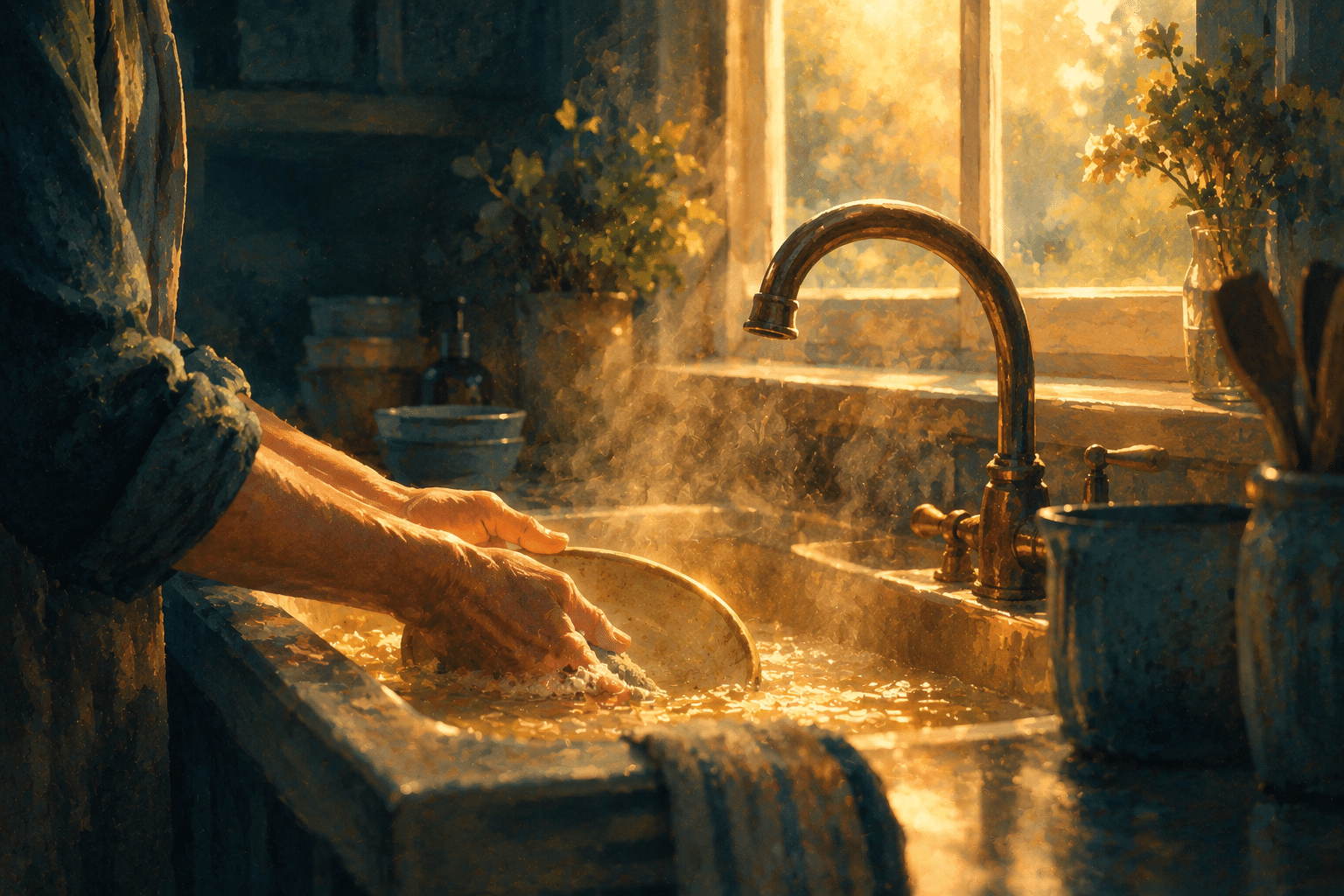
In the 1600s a Carmelite lay brother named Lawrence, whom I love, was assigned to the monastery kitchen, work he did not particularly want. He spent decades there among the pots and pans, and what he discovered became one of the most beloved little books in Christian spirituality. He said he felt as close to God with his hands in the dishwater as he did kneeling at the altar. He put it with a kind of homely joy that still disarms people four hundred years later: “I turn my little omelet in the pan for the love of God” (The Practice of the Presence of God).
Notice what he is not saying. He is not saying he thought holy thoughts while cooking, using the omelet as background noise for a more important interior event. He is saying the turning of the omelet was the prayer. The egg, the pan, the wrist, the attention — all of it, offered. Matter became prayer in his hands, and he did not have to leave the kitchen to find God, because God had not left the kitchen either.
The most material faith there is
There is real theology under all of this, not just a nice sentiment. Christianity makes an almost scandalous claim about matter, that God took a body. “The Word became flesh” (John 1:14) — not became an idea, or a feeling, or a philosophy. Flesh. And ever since, the central rites of the faith have been stubbornly physical: bread, wine, water, oil, hands laid on a head. A sacrament, as the old definition has it, is an outward and visible sign of an inward and invisible grace. Which is to say the material world is not a distraction from the spiritual one. It is the way the spiritual one reaches us.
Teilhard de Chardin, the Jesuit who spent his life with his hands in actual dirt as a paleontologist, said it as plainly as anyone has: “By virtue of Creation, and still more the Incarnation, nothing here below is profane for those who know how to see” (The Divine Milieu). Nothing here below. Not the sink, not the garage, not the body, not the work.
Running in the grey mist
I used to run marathons. Really — I did. I was never a world-class runner, not close, but I did all right.
I would lace up in the dark and get out on the road while the grey mist still hung over the street in the early twilight. And there were mornings when I stood there stretching and thought, I am not in a place mentally to run today. Some days I went anyway, for no better reason than that one foot could go in front of the other.
And then something would happen. A mile or two in, a rhythm would find me — breath and stride and pavement all arriving at the same time — and I would smooth out. The effort did not disappear. It changed, simple.
And then, in that rhythm, came the moment. I touched something. You know what I mean, don’t you? All was right with the world, and I was not running anymore. I was communing. I had no language for it then. I would call it prayer now.
How we learned to split them
If this is true, why does it feel so unfamiliar? Two reasons, and they come from opposite directions.
The first is old. There has always been an impulse in religion to treat spirit as high and matter as low — to assume the body is a problem to be managed and the material world a waiting room for something better. It is an ancient instinct and the church has flirted with it for centuries, but the Incarnation keeps embarrassing it. You cannot build a faith around God taking on flesh and then quietly teach that flesh does not matter.
The second reason is new, and it is the machine I have written about before. A culture organized around output does not want your attention on the onion. It wants the onion chopped fast so you can get to the next thing, ideally while listening to something that makes you more productive. Hurry makes matter mute. Not because the dishes stopped being holy, but because nobody is home while they are being washed.
Who sweeps a room
The practical tradition here is wonderfully unglamorous. George Herbert, who wrote in 1633, put it in two lines that have outlived nearly everything else he said: “Who sweeps a room, as for thy laws, makes that and th’ action fine.” The Hebridean households I wrote about in the last piece blessed the kindling of the fire and the milking of the cow. Jewish practice has a blessing for bread, for wine, for the body working as it should. None of these are poetic decoration laid over ordinary life. They are claims about what ordinary life already is.
The book on my father’s kitchen island
My father died. And when my brother and I went to clean out the house, we found the book he had been reading at the end: Chop Wood, Carry Water.
My father was not a religious man. He had no use for church and did not talk about his soul. So why was he reading that? I never found out. There was no one left to ask, and I have made a kind of peace with never having the answer.
But I read the book, it changed my life. Its whole argument is that the spiritual path is not somewhere else — it is in the chopping and the carrying, in the office and the kitchen and the ordinary hours. Living here, now, is what matters most. The end of my life will take care of itself, won’t it?
I still do not know what my father found in those pages. I know what I found. And I know he handed it to me without ever meaning to.
There is one more thing I only learned later. That book, published in 1984, is sometimes credited with almost single-handedly creating the modern literature on finding the sacred in ordinary work. My father — who had no use for organized religion — died with the founding text of the thing I would spend the rest of my life trying to understand sitting on the kitchen island. I have never known what to do with that, except be grateful.
When Matter Becomes Prayer Reflection Sheet
Matter does not become prayer. We do.
I titled this blog “When Matter Becomes Prayer,” and now I want to take part of it back. Matter does not actually become prayer at some point, as though a bowl of soup were inert until the right thoughts were applied to it. In the last piece I wondered whether the veil is thin everywhere and we are the thick ones. The same correction belongs here. The onion was always the handiwork of God. The water was always water of baptism, in its way. What changes is not the matter. What changes is whether anyone is present to it.
Attention, then, is the thing we actually bring. Not belief, not feeling, not the right words — attention. Simone Weil said that absolutely unmixed attention is prayer, and anyone who has ever lost themselves in making something with their hands knows the truth of it from the inside, whether or not they would have called it prayer at the time.
Practices for hands
Do one thing at a time, with your whole self, and let that be enough. Make something with your hands this week — bread, a repair, a meal, a line of paint — and do not listen to anything while you do it. Eat one meal slowly enough to taste it. Bless the thing in front of you, out loud if you can stand it. And when words will not come, which happens to all of us eventually, let the body pray instead: walk, dig, cook, hold a hand. The body has been praying since long before you had language, and it has not forgotten how.
Brother Lawrence stayed in that kitchen the rest of his life. He is not remembered for a system or a doctrine. He is remembered because he discovered that the distance between the sink and the sanctuary was a distance he had invented, and once he stopped defending it, God was simply there — in the pan, in the water, in the hands.
Your hands are already in the water. That was never the obstacle. It was the invitation.
Peace and every good.
About Jim & Lynette Vaive
Jim and Lynette Vaive are the co-founders of spirit of EQ and co-authors of The Mystical Seeker. They are Master Certified Coaches, certified Narrative Enneagram teachers, and Certified Spiritual Directors, and together they hold credentials in Spiritual Emotional Intelligence (SEQ) — a framework rooted in Lynette’s Doctor of Ministry research. Learn more at spiritofeq.com.
Sources
Brother Lawrence — The Practice of the Presence of God: overview
Pierre Teilhard de Chardin — The Divine Milieu, “nothing here below is profane”: Center for Action and Contemplation
Rick Fields et al. — Chop Wood, Carry Water (1984).
George Herbert, “The Elixir” (1633); John 1:14; Simone Weil on attention.


Leave a Reply
Want to join the discussion?Feel free to contribute!