
Are You Thirsty?
This is the last of three from Academy for Spiritual Formation #43, a program of The Upper Room. Our faculty presenter for session five of eight was Dr. Heidi A. Miller, associate professor of spirituality and Christian ministry at Mercer University’s McAfee School of Theology, teaching on prayer and the art of discernment. Part one was about the word just. Part two was about the body. This one is about standing up when the ground will not hold still.
Friday was the last morning, and she opened by telling us the ground was shaking.
“The very ground we stand on is shaking.” Then she said it again, the way she did with the lines that mattered.
She told us about a friend caught in an earthquake in another country, running out of a building. “We’d put our foot down, and then the ground would shift, and we’d put it down and be at another spot than where we aimed.” The most disorienting thing she had ever been through — and notice that the disorienting part was not the shaking. It was arriving somewhere you had not aimed.
I know that feeling. When I had my heart attack twelve years ago, there was a violent earthquake in what I thought was true, and putting my foot down did not change that.
Twelve years later, in a three-minute prayer on a Wednesday morning in that same room, the same body said the same thing to me much more quietly.
Then she had us do the simplest exercise of the week.
A blessing of the senses
Five things you can see. Take your time with them. Then touch your eyes, and let the Spirit tend your sight.
Four things you can touch. Open your hands, and let the Spirit tend your touch.
Three things you can hear. Touch your ears.
Two things you can smell. Touch your nostrils.
One thing you can taste — she had put things out on the tables beforehand so that everyone would have something. Touch your mouth.
Amen.
If you have done trauma work, or sat in a counselor’s office, you have met 5-4-3-2-1 before. What she had done was marry it to something much older: the blessing of the senses given to catechumens as they begin, formalized in the Rite of Christian Initiation of Adults after Vatican II. She called that kind of borrowing “a migration of meaning,” and her point was that all of us are catechumens — still being taught toward something, over and over.
“When nothing makes sense, grounding our discernment back into our senses helps. It also helps prevent longer trauma.”
Then she walked us through how much of the gospel runs on the senses. Jesus making spittle out of mud. Thomas, touch my side. Cooking fish over a fire for the disciples after the resurrection — and she noted that it was by a fire that Peter denied him, and by a fire that Jesus came back for him. The woman with the alabaster jar down at his feet, and the whole room filling with that perfume.
Soil kin
Then she gave us the wordplay I wrote down twice.
Adamah is the Hebrew word for soil. Adam is human. Same root. Humus. Human.
“We are soil kin,” she said. “Earthlings.”
Ashes to ashes and dust to dust comes straight out of that passage — which means it is not first a sentence about death. It is a sentence about where we are from.
And the day before, she had made the point that has stayed with me longest. When God creates in Genesis 2, God’s posture is down in the dirt. The serpent’s posture is up in a tree, looking down. One of those is a God who has made himself available to be wounded.
She looked up the etymology of vulnerable while she was preparing. It means the capacity to be wounded. “I fought that,” she admitted. “I just kept going — it’s got to be the vastness of God. Got to be. And I kept looking at it and it was like: that is not the God being presented here.”
Nephesh is a verb
Then she turned it into an obligation, which I did not see coming.
Nephesh — life, breath, fullness of being — is not only a noun. In Exodus it is a verb. God rested on the seventh day and was re-nefeshed.
And look at how the commandment extends it. Six days you shall do your work, but on the seventh you shall rest — so that your ox and your donkey may have relief, and your home-born slave and the resident alien may be refreshed. Re-nefeshed.
Rest is not a personal wellness item. In that text, rest is something you owe your neighbor, your worker, the stranger in your house, and your animals.
Which produces her question, and it is the one I carried home from the whole week: who is not allowed to rest in our culture?
She pointed at Isaiah confronting people who sat in worship while the people they had hired worked straight through with no re-nefeshing at all. “See — that jug of being just? It’s not for the other person. We’re not getting a just pour.”
And then she described, with uncomfortable accuracy, what every organization does when things get hard. “Just work harder. Staff gets cut in half. Now you do all the rest of the jobs the staff had before, on half the people, and do it all the same. More should, ought, must, quicker, more efficient. So we buy more planners that are kind of nice and pretty. And we work with them for three weeks and it doesn’t work. And we wonder what’s wrong with us — if I was only better.”
I ran a company with ninety trucks. The crews took them home overnight, which meant ninety driveways across central Ohio with a black-and-gold truck parked in them, which meant the work sat outside ninety houses every night. I called that efficiency. I built it. I am the one who decided who got to rest.
I have said things close to this in other pieces, so I will not pretend it is a new discovery. What started to change my perspective was learning what it means to be human. Yes, we have to work. Yes, we have to be productive. But pushing and pushing and pushing to get a ten or twelve percent growth, at the expense of health and happiness — I don’t know. I am still not sure I have the answer.
The prayer he got wrong
She told us about a large congregation in Harrisonburg, and a very seasoned leader near retirement who stood up in front of everyone and said: I used to pray that God would keep us from what threatens us around us.
She was careful here. Prayers of protection are real and good — traveling mercies, the breastplate prayers. But when protection becomes the primal prayer of a church, proximity turns into something to be defended against rather than entered.
And this man said, in front of that whole congregation: I got the prayer wrong.
The prayer he had come to instead was: God, what are you doing in this neighborhood that we need to join?
She gave us the other half of it from James Baldwin, whom she came back to more than once across the week — that for white people racism is “a corrosive spiritual bondage,” and that avoiding another person’s humanity erases neither the kinship nor the guilt of having violated it. Her own extension of it was blunt: no amount of claiming that someone else is not human makes the rest of us more human. “I too am an it that is expendable.”
Armor protects. That is what it is for. And then the question becomes the one she asked next: what happens when we become the armor?
Many to one
So what do you do, when the ground is moving and the warning lights are on everywhere at once and your brain wants to go in every direction? Her own impulse, she said, is either to curl up in sackcloth and ashes or go screaming through the streets like a prophet. “You really get a sense for prophets.”
Her practice for it is moving from the many to the one.
- Notice the many. She will sometimes have people write the crowding things on slips of paper and set them all around themselves on the floor, because the body understands a pile better than it understands a list. What is crowding me?
- Go to a window, or outside, and do a wide-lens scan of the horizon. Slowly. Distance, sky, trees. Wait, and notice the shift in your body.
- Choose one gift. A leaf. A blade of grass. An ant crossing a stone. One. Wait with it — “it tells you a different story.”
- Go back to the many, and ask to see it with a new lens.
She tied this to the woman with the hemorrhage, who came up behind Jesus in a crowd that was pressing on him from every side, and touched the edge of his cloak. Peter’s line is essentially that everyone is touching you. And in all that noise, Jesus stopped and asked: who touched me? Not who is shouting. Who touched me.
“It’s like the crowd’s there, and all of a sudden — something touched me here that I’m to pick up.”
Then honor the one.
Are you thirsty?
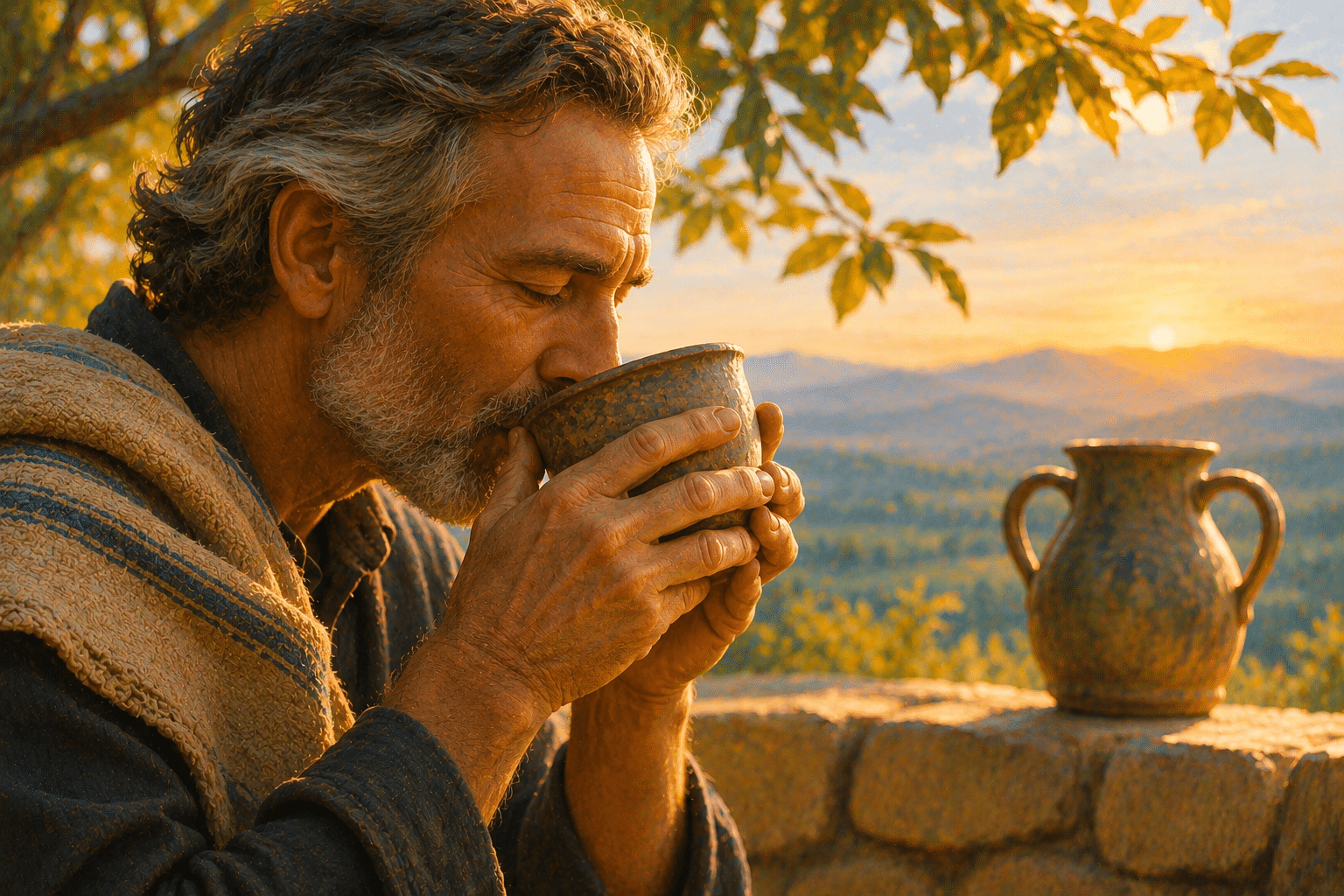
She closed the week with a small story, and I am closing with it too, because it is the whole week in a single question.
A librarian came through two years of spiritual direction training. Part of that training was about being a director in your own neighborhood — the informal version, a way of being rather than an appointment. She said that a lot of the people who come into her library are unhoused, and she was beginning to see them differently. She also volunteered at a farmers market, handing out water.
“I used to just say: do you want some water?”
After two years, she said, I ask a different question.
Are you thirsty?
That is it. One word different, and a transaction becomes a person.
Gerard Manley Hopkins has the line for it, and Dr. Heidi left it up on her last slide. What I do is me: for that I came. And then: the just man justices.
Just, as we learned on the first morning of the week, is a pitcher. The measure of the pour.
And by Friday it was a verb.
Take this further
Many to One is a free reflection sheet carrying the blessing of the senses and the many-to-one practice, with eight questions and an invitation for the week. Download the reflection sheet (PDF).
Part 3 of 3. Part 1: Just — the word, the pitcher, and where the story starts. Part 2: presence, the body, and why you cannot achieve it.
Peace and every good.
With gratitude to Dr. Heidi A. Miller
Everything of substance in this post is hers. The blessing of the senses and its adaptation from the Rite of Christian Initiation of Adults, the adamah and adam wordplay, the reading of nephesh as a verb and of rest as something owed to a neighbor, the question of who is not allowed to rest, the story of the leader who said he got the prayer wrong, the many-to-one practice, the Hopkins poem, and the librarian’s question — all of it came from her sessions at Academy #43, session five, October 2026. The quotations are drawn from recordings of those sessions. What is mine is only what it did to me.
Dr. Miller is associate professor of spirituality and Christian ministry at Mercer University’s McAfee School of Theology, where she directs the Doctor of Ministry program.
About Jim & Lynette Vaive
Jim and Lynette Vaive are the co-founders of spirit of EQ and co-authors of The Mystical Seeker. They are Master Certified Coaches, certified Narrative Enneagram teachers, and Certified Spiritual Directors. Together they hold credentials in Spiritual Emotional Intelligence (SEQ) — a framework rooted in Lynette’s Doctor of Ministry research — and serve individuals, small groups, and organizations across faith traditions. Learn more at spiritofeq.com.
Sources
Dr. Heidi A. Miller, “Prayer and the Art of Discernment,” The Academy for Spiritual Formation #43, session five, October 2026 (The Upper Room). Quotations drawn from session recordings.
Gerard Manley Hopkins, “As Kingfishers Catch Fire” (public domain). Dr. Miller noted that she had taken a small liberty with inclusive language in the closing lines as she read them.
James Baldwin — quoted by Dr. Miller across several sessions on racism as a corrosive spiritual bondage and on what dehumanizing does to the one who does it.
Jonathan Sacks on mishpat and tzedakah — retributive and distributive justice — referenced in her session on nuancing what justice means.
Resmaa Menakem, My Grandmother’s Hands (Central Recovery Press, 2017), and Martin Luther King Jr., Where Do We Go From Here: Chaos or Community? — both recommended from the front of the room.
