
Posts

Be the Light: Support Ser-Kallai, Heal Communities

There are moments when a single idea — compassion made practical — can change a life and, eventually, a community. That is the group I have worked alongside for the last few years. Lynette and I have served on the board and in the field, and from firsthand experience we know what this work means to people affected by poverty and trauma. That’s the promise at the heart of Ser‑Kallai. Founded in 2019 with a name that means “to be light,” Ser‑Kallai grew from the simple conviction that trauma healing, emotional intelligence, and community connection are not luxuries but essentials for thriving societies. Today, as our country faces growing emotional and social challenges, Ser‑Kallai’s programs are not only timely — they’re pivotal.

A personal beginning, a universal mission

Nathalie Caycedo’s story is the origin of Ser‑Kallai. Born in Colombia and shaped by early volunteering in neighborhoods scarred by poverty and violence, she learned that small acts of attention and care can create lasting opportunities. Years later, when she helped refugee families adjust to life in the U.S., she saw that healing comes from trust, from consistency, and from programs that teach emotional skills along with academic support.

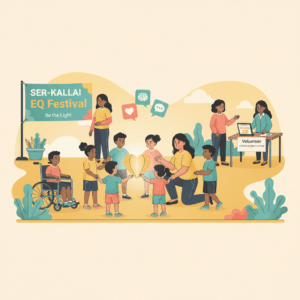
That experience seeded a nonprofit that centers emotional intelligence (EQ), trauma‑informed care, and community resilience. With help from her church, Living Word Christian Community, Nathalie and a committed team began offering after‑school programs, coaching, workshops and high‑impact EQ festivals that equip children, teens and adults to handle life’s stresses and build stronger relationships. Ser‑Kallai has already made a measurable difference across Arizona, California, Ohio and Florida, supporting foster and kinship families, federal‑custody teens, refugees and low‑income communities.

Why this work matters now

We live in turbulent times. Rates of anxiety, depression, and interpersonal conflict have surged across age groups. Children are navigating more complex emotional landscapes than prior generations. Communities dealing with the aftermath of displacement, economic strain and systemic trauma need resources that go beyond immediate aid — they need tools to rebuild capacity and hope.

Emotional intelligence is not just “soft” enrichment

It is the foundation for better decision‑making, improved school and work performance, and healthier families. When we teach children and adults how to recognize emotions, regulate responses, and build empathetic relationships, we invest in a future of lower violence, higher civic engagement, and stronger workforce readiness. Ser‑Kallai’s programs do exactly that — they transform vulnerability into resilience.

My personal perspective

Working with Ser‑Kallai has been one of the most meaningful commitments of my life. On the board and in program rooms, I’ve seen small, quiet breakthroughs that ripple outward: a teen who finds a new way to communicate with their caregiver, a parent who learns to manage their own stress so they can be present, a classroom that shifts from reactive to restorative. Those moments fill me with gratitude and hope. At the same time, I feel urgency — the need to scale what works so more families and neighborhoods can find stability and healing.
I’m proud of what Ser‑Kallai has accomplished, and I’m deeply moved by the people we serve. Every success is earned through the courage of participants, the dedication of volunteers and staff, and the generosity of supporters. Personally, I give my time and energy because I have seen the difference that consistent care and practical emotional skills make in a life. I believe that when a community learns to tend its emotional wounds, it becomes stronger and kinder.

Your gift creates tangible results

Donations to Ser‑Kallai go directly into programs that produce measurable outcomes:

• After‑school enrichment that combines academic support with EQ lessons, helping kids succeed in school while building emotional resilience.

• Trauma‑informed workshops and coaching for families affected by foster care, displacement, or systemic inequities.

• Community‑level events like EQ festivals that bring practical tools to large groups, fostering connection and collective healing.

• Virtual and in‑person training so local leaders, teachers and volunteers can replicate Ser‑Kallai’s model in more neighborhoods.

Each dollar multiplies: a workshop can reach dozens of children and their caregivers; a festival creates networks that last long after the lights go out.

How you can help?

If you’re moved by this work, there are several ways to be the light: donate, volunteer, share Ser‑Kallai’s story with friends and local organizations, or bring our training model to your school or faith community. Every action matters.

Give today: https://serkallai.org/get-involved

My closing,

I am convinced that healing and emotional education are essential building blocks for resilient communities. Ser‑Kallai is putting those ideas into practice, and it’s an honor to stand with them. Please join us — your support helps more people move from hurt to hope.
Lynette’s DMin: Deepening Spiritual-Emotional Care

There are moments in life when personal accomplishment and communal mission converge in a way that changes everything. Lynette’s completion of her Doctor of Ministry  in Spiritual Direction is precisely one of those moments. This degree represents years of disciplined study, late nights balancing family and ministry, deep reflection, and the courage to push into new theological and practical territory. But beyond the diploma lies the person I’ve always known, compassionate, inquisitive, disciplined, and humble—someone who models faithful service and thoughtful leadership. Her DMin is not merely a credential; it is a deepening of the wisdom and skill she brings to everything she touches. For our family, for me personally, and for everyone connected to Spirit of EQ, it is a cause for celebration and renewed purpose. I am profoundly proud of Lynette, and my admiration for her grows with every step she takes in service to others.

As we move forward at Spirit of EQ, Lynette’s scholarship and pastoral insight will shape how we support individuals, leaders, and communities in cultivating emotional and spiritual maturity. The Spiritual Emotional Intelligence Assessment (the SEQ) has long been our foundational tool—designed to help people name where they are spiritually and emotionally, and to chart a path toward greater resilience, clarity, and wholeness. With Lynette’s advanced training in integrating theology, emotional intelligence and practical ministry, the SEQ will become even more robust. Expect enhancements that will weave research with pastoral sensitivity: richer assessment items that capture relational patterns and spiritual practices, evidence-informed interpretation guides, and culturally attuned frameworks that honor diversity of belief, experience, and context. The goal is not simply to measure, but to illuminate—helping clients see the intersections of their inner life, relationships, and spiritual formation so they can move toward healing and flourishing.


Practically, the work we will do with clients will deepen across several dimensions. First, our assessment process will be more integrative. Rather than offering a static score, the SEQ will provide a narrative map that identifies strengths, vulnerabilities, and possibilities—linking emotional regulation and spiritual practices. This map will be used in collaborative coaching and spiritual direction contexts, helping clients translate insight into sustainable practices. Second, our interventions will be more evidenced-informed and pastorally sensitive. Using evidence-based modalities—such as emotion-focused techniques, narrative practices, and contemplative disciplines—paired with Lynette’s pastoral spiritual direction training, we will support people in learning practical tools for self-regulation, conflict navigation, and meaning-making. Third, we will expand our training offerings for leaders and teams. Churches, nonprofits, and organizations seeking emotionally intelligent spiritual leadership will find workshops, retreats, and certification tracks that marry theological depth with applied emotional skills: how to lead with empathy under pressure, how to sustain pastoral identity over a long ministry career, and how to cultivate staff and congregational wellbeing without sacrificing mission.

One of the most exciting changes is how we will incorporate qualitative, story-centered work alongside quantitative assessment. People are not numbers; their lives are narratives. Lynette’s project work emphasized case-based learning—listening deeply to life stories, isolating turning points, and carrying those insights into tailored growth plans. At Spirit of EQ, that means every person who comes to us will receive an assessment that honors their story: how they were formed, how they are coping now, and what practices or relational shifts can help them move forward. For couples and families, this approach will allow us to identify not only individual spiritual-emotional patterns but the relational rhythms that either support or undermine flourishing. For leaders, it will highlight vocational strengths, blind spots, and sustainable rhythms of work and rest that preserve long-term effectiveness.

We will also broaden our community offerings. Lynette’s work has deepened our capacity to design group experiences that cultivate corrective emotional and spiritual experiences—small groups, peer supervision cohorts for clergy, and community healing circles that use structured practices to promote trust and transformation. These community modalities are powerful because they provide both accountability and belonging. People practice new ways of relating in safe contexts and then carry those practices back into their families, workplaces, and congregations. The ripple effects are significant. When a leader learns to regulate under pressure, their staff experience decreases in burnout and increases in trust. When congregation members learn compassionate ways of speaking about pain, the entire community can become a cradle for healing rather than a site of hidden suffering.

We are also committed to elevating accessibility and cultural relevance in all our work. Lynette’s DMin emphasized contextual theology through spiritual direction application and culturally sensitive care, and that emphasis will shape how we adapt the SEQ for diverse populations. Assessments, coaching curricula, and training materials will be offered in ways that respect linguistic, cultural, and theological differences—so that people from all backgrounds can find the language and tools that resonate with their faith and experience. We will invest in partnerships with local congregations and community organizations to co-create programs that address specific needs: supporting immigrant communities, equipping inner-city pastors, or providing transitional support for people moving through major life changes.

Finally, this degree enhances our capacity to contribute to broader conversations about spiritual and emotional health. With Lynette’s research skills and pastoral credibility, Spirit of EQ will produce resources—white papers, training manuals, podcasts, and workshops—that synthesize best practices at the intersection of faith and emotional intelligence. We want to equip not only individual clients but also the wider fields of ministry, counseling, and organizational leadership with tools that are both theologically grounded and psychologically sound. Our aim is to be a resource hub: offering practical, scalable interventions that help people live not just coping lives, but flourishing lives.

None of this would be possible without the love, perseverance, and integrity Lynette has shown throughout her journey. Her achievement is both deeply personal and profoundly public—an example of how disciplined study and faithful service can amplify a mission. I am endlessly proud of her and grateful for how she continues to shape our shared work. As Spirit of EQ enters this new season, we do so with greater clarity, deeper resources, and renewed hope: to help people name their struggles, cultivate practices that sustain them, build relationships that heal, and live into the fullness of their spiritual and emotional calling. If you or someone you love is seeking a compassionate, rigorous, and practical pathway to greater wholeness, we are here to walk alongside you—now with even more training, heart, and skill than ever before.

Gentle Steps Through the Ache of Loneliness – Hope

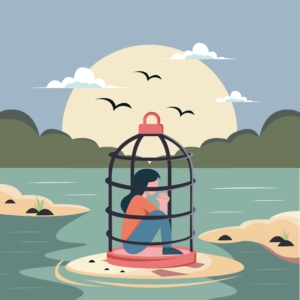
The ache of loneliness is deep and profound for some of us. It shows up in our posture, our energy and the way we relate to the world. I remember when I went through a painful divorce and the loneliness I felt. I did not have any self-esteem, or knowledge of what was next in my life. I traveled on autopilot, grunted responses to questions and went deep inside myself in a protective stance. My shoulders hunched as if trying to make myself smaller so I would take up less space — and maybe be less likely to be hurt again.

That posture mirrored how I felt inside: small, raw, and on guard. My days blurred together. I thought loneliness was something to be fixed quickly, as if I were just a machine with a loose bolt. But loneliness isn’t just a problem to be solved. It’s a human experience that asks for tenderness, time, and gradual re-learning about who we are when we are alone.

Loneliness wears many faces and loneliness can be noisy or silent. It can come after a breakup, a move, retirement, the loss of a loved one, or during seasons when you don’t fit into the surrounding culture. Sometimes it arrives without an obvious cause — you might be surrounded by people yet feel profoundly disconnected. It can color how you see yourself (when I felt unlovable) and others (nobody understands me). That lens is heavy and makes ordinary tasks feel larger.

When loneliness becomes long-term, it shapes habits. You might withdraw from invitations, avoid phone calls, or spend afternoons scrolling through images of other people living bright lives. Facebook is horrible for these times. You might develop defensive behaviors — sarcasm, irritability, or constant self-criticism — to keep others at a safe distance. These are understandable survival strategies, but they can keep us stuck.

A friend of mine, Marcus, is a gregarious person by nature, but after his father died, he sank into a quiet deep loneliness. He would show up to gatherings and laugh easily, but afterward he would go home and close the curtains. One night he told me he felt like a house with rooms no one ever walked into. Over the next few months, he knew something needed to change and he began meeting with a grief group and volunteered at a local community garden. The volunteers didn’t try to fix him; they simply shared tasks and stories. With time, his personal rooms were visited more often — not because he suddenly changed overnight, but because small, consistent human interactions built a sense of belonging again.

Another story: Ana, who moved to Italy for work, felt disconnected from the language and customs. Her loneliness was layered with isolation and cultural disorientation. She found solace by starting a weekly ritual — Tuesday potluck evenings with a few colleagues. No grand obligations, just a bowl of soup and one good question: “What was the best thing you did for yourself this week?” That question became a conduit for sharing and made her feel seen.

Gentle steps to comfort your own heart being lonely is not a personal failing! Responding to it with gentleness rather than self-blame transforms the experience. Here are four practical, compassionate ways to be gentle with yourself on this path:

  • Acknowledge the ache without rushing it. Sit with the feeling and name it: “This is loneliness.” Naming reduces the power of the sensation and helps you observe it instead of being swallowed by it. You might say this aloud when you’re alone or write it in a journal.
  • Normalize your experience. Remind yourself that many have felt this — it’s part of being human. Reading stories, memoirs, or essays about loneliness can make you feel less alone in your aloneness.
  • Create small rituals of care. When we’re lonely, big plans feel impossible. Start with tiny rituals: a cup of tea at the same time each afternoon, a ten-minute walk, lighting a candle before dinner. Rituals create structure and a sense of predictability, which is soothing when the world feels unstable.
  • Befriend your body. Loneliness often settles physically — tight shoulders, shallow breathing, a heavy chest. Use simple body-based practices: slow diaphragmatic breathing (inhale for 4, exhale for 6), progressive muscle relaxation, or a short yoga sequence that opens the chest. Even gentle movement can change your internal state and communicate kindness to yourself.

Even with the practical steps above there may be times when seeking therapeutic support is the most important thing you can do. A therapist, counselor or spiritual director can provide tools to navigate loneliness, help process past hurts, and gently challenge patterns that keep you isolated. Group therapy can be especially powerful because it combines professional help with human connection.

Comforting exercises you can try today

  • Write a letter to your future self. Describe what you are feeling right now and what you need. Seal it or save it to be opened in six months. This creates continuity and an ally you can visit later.
  • The “two-minute reach” practice. Each day, do one small, friendly thing for someone: send a message saying, “Thinking of you,” or thank the person who refilled the coffee. Small gestures often return warmth and remind you you’re part of a social web.
  • The self-compassion break. When you notice pain, put a hand on your heart and say: “This is a moment of suffering. Suffering is part of life. May I be kind to myself.” Pause and breathe for several rounds.
  • Make a list of “gentle yeses.” These are optional social activities that feel manageable — a short walk with a friend, an hour at the library, calling a sibling. Start with one gentle yes per week.

When loneliness persists

If loneliness feels chronic or is accompanied by hopelessness, persistent fatigue, or changes in appetite or sleep, reach out for professional support. Loneliness can be linked to mental health conditions like depression and can benefit from therapy, medication, or both. Asking for help is a courageous, practical step to comfort your heart.

A compassionate ending

Loneliness can be a fierce teacher. It can expose where we are tender, where we fear rejection, and where we have forgotten how to tend to ourselves. But it can also be a doorway to deeper self-knowledge. When we meet loneliness with small acts of kindness — tending our bodies, creating rituals, reaching out in tiny ways, and seeking community — we slowly reweave the threads of belonging.

Please hear me when I say, “you don’t need to hurry the healing”. On hard days, remember the posture you instinctively assume in pain: protective, small. Try instead to soften one muscle at a time. Breathe. Put a hand over your heart. Say one gentle thing to yourself. These are not grand solutions, but they are steady, and steadiness is what heals. Over time, small moments of tenderness add up, and the world starts to feel a little less cold.

A poem I wrote about loneliness….

Alone, I fold myself into small shapes, a quiet shell against the world’s bright wind.

Don’t see me

My shoulders learn to hide, my breath grows shallow, and I move through days on soft autopilot.

Don’t see me

Inside, a spark remembers how to rest and keeps a small light against the dark.

Don’t see me

I light a tiny ritual — tea, a song, a name — and let the ache be a visitor, not the whole house.

Maybe see me

Softly I unfold, muscle by muscle, word by word, until a single hand on my chest becomes a bridge.

See me