

The Running Wave: A Celtic Journey Into Deep Peace
Deep Peace: A Journey Home to Stillness
There is a moment, if you have ever stood at the edge of the ocean just before dawn, when the world holds its breath. The darkness is not yet gone. The light has not yet fully arrived. And in that thin, trembling space between the two, something ancient stirs. Something that cannot be named — only felt. A peace so deep it seems to rise from the earth itself, from the turning of the stars, from the breath of God moving over the waters.
This is where the story begins. Not on a stage or in a sanctuary, but on a shoreline, in the in-between.
The Ancient Roots of a Blessing
More than fifteen hundred years ago, on the wind-scraped islands off the western coast of Scotland and Ireland, a spiritual movement was quietly taking root. Celtic Christianity, as it would later be called, was unlike anything that had come before it. Where other traditions placed God at a remote and sovereign distance, the Celtic monks and hermits of the early medieval period felt the divine woven into everything — into the moss on stone, into the cry of the curlew, into the rhythm of the tide coming in and going out.
The monks of Iona, that small island off the coast of Mull where Saint Columba landed from Ireland in 563 AD, believed the world was thick with God. They called certain places thin places — locations where the veil between the human and the holy seemed almost transparent. Iona itself was such a place. Pilgrims have been walking its shores for over fourteen centuries, drawn by something they could not always explain.
It was from this tradition — earthy, luminous, deeply attentive to the natural world — that the great Celtic blessings emerged. They were not formal liturgies crafted in marble halls. They were prayers spoken over fishing boats, over sleeping children, over the dying. They were words meant to be carried in the body, not just the mind.
The blessing we now call Deep Peace grew from this soil.
A Pilgrim Sets Out
Let me tell you about a woman — call her by any name, because she is all of us at some point. She had spent years doing everything right. She had built her life with great care: the career, the relationships, the responsibilities. She was capable and admired and deeply, quietly exhausted.
One autumn she found herself standing in a field somewhere in the Scottish Highlands, watching the last light drain from the sky. She had not planned to be there. She had simply driven north when the noise inside her became too loud to bear. She had been looking, she realized, for a long time. Not for answers. Not for success or approval or resolution. She had been looking for peace. Real peace. The kind that doesn’t depend on circumstances being perfect.
That evening she stumbled upon a small stone church. Inside, a handful of people were gathered for an evening service. She sat in the back, unsure why she stayed. And then the minister began to speak words she had never heard before, but somehow already knew.
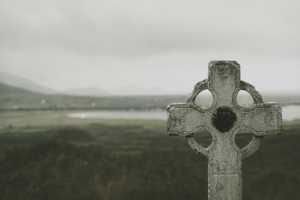
Deep peace of the running wave to you. Deep peace of the flowing air to you.
She felt something loosen in her chest.
Deep peace of the quiet earth to you. Deep peace of the shining stars to you.
Her eyes filled with tears, and she did not try to stop them.
Deep peace of the gentle night to you. Moon and stars pour their healing light on you.
What Peace Actually Is
We misunderstand peace, most of us. We think of it as the absence of trouble — as a kind of padded silence, a pause in the storm. But the peace described in this ancient Celtic blessing is something altogether different. It is not passive. It is alive.
Look at the images the blessing chooses: a running wave. Flowing air. The shining stars. These are not still images. They are images of constant, purposeful movement. The wave does not stop being peaceful because it is running. The air does not lose its gentleness because it is flowing. Peace, the blessing tells us, is not the absence of motion. It is motion in harmony with its own deepest nature.
The Celtic tradition understood this. To be at peace was not to be removed from the world, floating above its difficulties in some detached serenity. It was to be fully, rooted-ly present within it — moving like water moves, purposefully, without violence against itself.
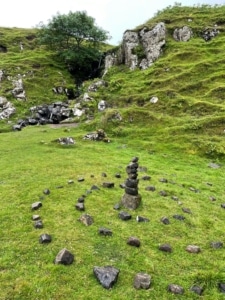
And then the blessing turns. Having drawn us through the natural world — the wave, the wind, the earth, the stars, the night — it arrives at its center:
Deep peace of Christ, of Christ, of Christ, the light of the world to you.
For the Celtic Christians, this was not a sudden turn away from nature. It was the completion of what the natural world had been pointing to all along. Every wave, every breath of wind, every star burning in the dark — they were all, in some way, expressions of the same light. The same source. The same love.
Christ was not separate from the running wave. Christ was the deep peace that the running wave carried.
Coming Home
The woman in the stone church sat for a long time after the service ended. The minister left. The candles burned down. And she sat in the dark and felt, for the first time in years, that she was not lost.
She had not solved anything. Her circumstances had not changed. The weight of her life was still her life. But something had shifted in the way she was holding it. She had been gripping so tightly, white-knuckled, afraid to let go even for a moment. Now, just briefly, she had opened her hands.
Peace does not arrive like a conquest. It arrives like dawn — gradually, gently, until you realize the darkness has been replaced not by force but by light.
This is the invitation the old blessing has always carried. Not a command to feel peaceful, as if peace were a performance. But a pronouncement. A declaration spoken over you, like water poured on a forehead, like a hand placed gently on a bowed head.
Deep peace to you.
It is being given. You do not have to earn it or construct it or protect it. You only have to receive it.
And so the journey comes full circle — back to the shoreline, back to the edge where darkness and light meet and hold each other without fear. The wave still runs. The air still flows. The stars still burn their quiet fire in the deep.
And somewhere, in a stone church on a windswept island, or in a field at dusk, or in the middle of an ordinary Tuesday when the world is too loud and you are too tired — the ancient words are still being spoken.
Deep peace of the running wave to you. Deep peace of the flowing air to you. Deep peace of the quiet earth to you. Deep peace of the shining stars to you. Deep peace of the gentle night to you. Moon and stars pour their healing light on you. Deep peace of Christ, of Christ, of Christ, the light of the world to you. Deep peace of Christ to you.
May you receive it. All of it. Down to your bones.
Peace and ever good.



Love this reflection. Had not heard it before but it spoke to need I had this night for peace, for quiet, for the soft sounds of small stream.