
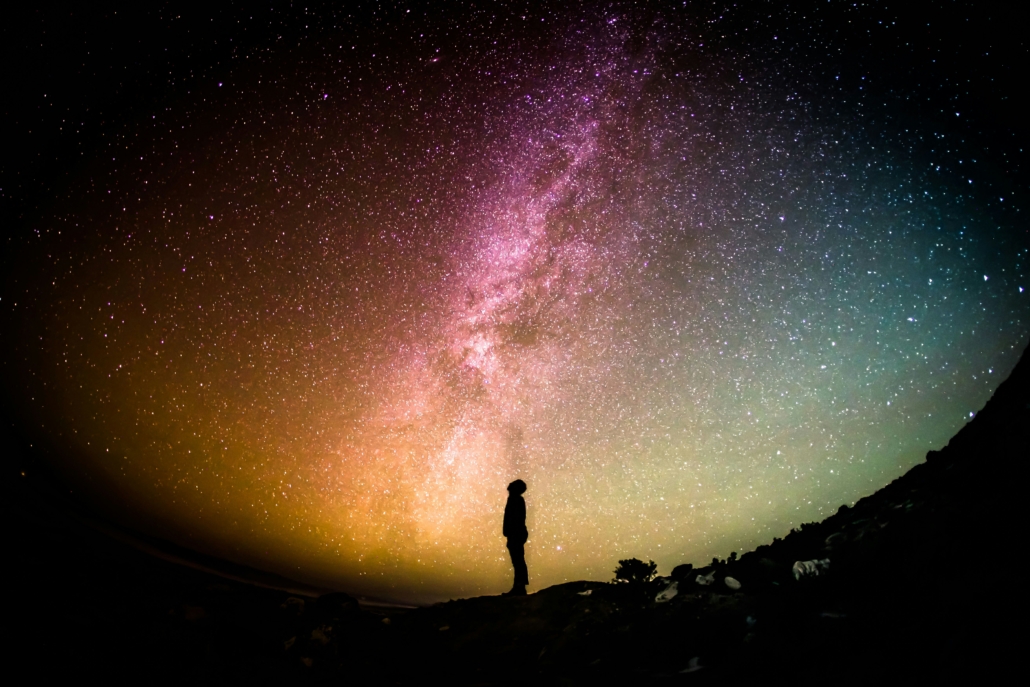
Beholding: Learning to See What’s Always There
The Art of Beholding: Learning to See What Has Always Been There
There is a particular quality of light that appears in the late afternoon of an Ohio April. It arrives low and amber, slanting through leaves that have already begun their eager growth to bright greens. If you are moving fast enough — hurrying to a car, glancing at a phone, managing the thousand small demands of a day — you will miss it entirely. Not because it isn’t there. Because you haven’t learned to behold it.
Beholding is an old word. It carries weight in it, a kind of gravity. We use “seeing” now, or “looking,” but beholding suggests something more — a sustained, willing act of attention that changes both the one who gazes and the thing being gazed upon. It is, in its truest form, a practice. And like all practices, it has a history.
An Ancient Hunger
Long before cell phones, before television, before the printing press turned information into a torrent, human beings struggled to pay attention. The desert fathers and mothers of fourth-century Egypt walked out into the Saharan silence precisely because the noise of Alexandria made attention impossible. They were not fleeing the world so much as trying to see it. To behold it, without the distortion of constant stimulation.
The medieval contemplatives — Hildegard of Bingen, Meister Eckhart, Julian of Norwich — built entire theologies around the act of sustained looking. Julian, sealed in a small room attached to a church in Norwich, spent decades beholding a series of visions she called her “showings.” She looked at them not once but repeatedly across a lifetime, returning, noticing new things, going deeper. Her great work, Revelations of Divine Love, is less a transcript of mystical experience than a record of what happens when someone refuses to look away.
What they all understood — and what we are slowly, painfully rediscovering — is that attention is not passive. It is not what happens when you have nothing else to do. It is, as spiritual writer Amy Frykholm describes it, a form of discipline every bit as demanding as any physical practice. “The practice of beholding,” she writes, “takes desire and discipline.” The desire is the easier part. We often want to see more deeply, feel more fully, live with more presence. The discipline is where most of us quietly give up.

A Story About a Garden
I remember when my grandmother kept a garden in the backyard of a house in a small Michigan town up in the thumb area. It was not a grand garden — a few beds, a few tomato stakes listing to one side, herbs growing in a few terra cotta pots along the fence. But she tended it with a quality of attention I didn’t understand as a child and have spent most of my adult life trying to remember these times of quiet and what they meant.
She would go out in the mornings, before it was fully light, and simply stand in it. Not weeding, not harvesting, not doing anything that could be explained by utility. Just standing. Sometimes she held a cup of coffee. Sometimes she didn’t. I asked her once what she was doing. She thought about it for a moment and said: I’m watching it wake up. WOW!
I thought she was being poetic. Now I think she was being precise.
She had learned, through years of practice, to behold. To give her full attention to something outside herself without immediately needing to act on it, explain it, or use it for something else. She was, in the language of the contemplatives, practicing presence. And the garden — the wet soil smell, the hum of early insects, the way light moved through bean leaves like green stained glass — the garden held her in return.
The Difficulty Is the Point
Frykholm names the struggle honestly: “Don’t underestimate the paradigm shift required for the act of beholding, just how different it is from our everyday lives and just how shiny and compelling our everyday life will seem when we propose pausing.”
This is not a problem technology created. Technology has sharpened it, given it new urgency, made distraction faster and more elegant. But the problem itself is ancient. The mind that wanders from prayer in a stone monastery cell and the mind that reaches for its phone in the middle of a sunset are doing the same thing: fleeing the discomfort of full presence.
Because presence is uncomfortable. To truly behold something — a person, a landscape, an idea, a grief — is to become vulnerable to it. You cannot behold something and remain entirely in control of what it means to you or what it does to you. This is why beholding is an act of courage as much as attention.
And then there is the second difficulty Frykholm names, the one that arrives even after we’ve managed to sit still. Our own thoughts. The internal narrator who cannot stop generating commentary, to-do lists, memories, anxieties. “Any act of attention is not a sustained experiencing,” she writes. “It’s a series of successive efforts to bring attention back to the same thing, considering it again and again.”
This reframe is quietly revolutionary for us. We tend to judge ourselves harshly for the mind that wanders — as though a wandering mind is evidence of failure. But Frykholm describes the return itself as the practice. Every time you bring your attention back, you are training something. You are doing the work. The wandering is not the obstacle. The returning is the path.
What Beholding Makes of Us
My grandmother died on a cold day in November. The garden had long gone to frost by then. But on the morning of her funeral, I went outside and stood in my own backyard — not her backyard, mine, a inner city lot quite different then hers — and tried to do what I had watched her do. I tried to behold. Her passing touched a part of me that needed to wake up.
The sky was the gray of Midwestern November, cold, stark, the kind that seems to press down gently on everything beneath it. A cardinal landed on the fence, bright as a wound, and regarded me with one black eye. I noticed my thoughts moving immediately toward meaning — a sign, she’s here, she’s saying goodbye — and I watched myself doing it, watched the mind rushing to make the moment useful, to metabolize it into narrative.
So, I came back. To the cardinal. To the gray sky. To the cold that was starting to find the gaps in my coat.
And for a few seconds — Frykholm says sometimes it is only a few seconds — something opened. The fence and the bird and the sky and my grief and the cold and the smell of dead leaves all existed together without needing to be explained or arranged. I was held by it.
“Whatever you behold,” Frykholm writes, “you eventually become beholden to. You enter into a love relation.”
This is the fruit of the practice: not escape from the world, not transcendence of the ordinary, but a deepening into it. A recognition of what has always been present, waiting for us to slow down long enough to receive it. The interconnected, openhearted world, as she puts it, welcomes us — not as strangers who finally arrived, but as the ones it has been waiting for all along.
My grandmother knew this. The desert fathers knew it. Julian knew it, sealed in her small stone room, looking and looking and looking.
The light is still there, amber and low, arriving every October afternoon.
We are still learning to see it.

Peace and every good
As cited by the Center for Action and Contemplation.
Chicago/Turabian: Frykholm, Amy. Journey to the Wild Heart. Maryknoll, NY: Orbis Books, 2025, pages 28–30.


