Posts

“The Work of Art at the Center of Every Person”

There were two easels in our house growing up, set at angles in the same room so neither parent blocked the other’s light. My mother worked in oils, slow and layered, sometimes returning to the same canvas for weeks until a shadow finally sat right. My father moved faster, looser, more willing to ruin a piece chasing something better. I grew up in the smell of turpentine and the quiet of two people absorbed in work that had no deadline attached to it, only a standard only they could see. I didn’t understand, as a kid, that I was watching two different theologies of creation. I just knew that in our house, “finished” was a word my parents used carefully, almost reluctantly, the way some families talk about money.


I tell you this because I’ve spent the better part of three decades since then assuming the lesson I took from that house was about art itself — about craft, attention, the discipline of starting over. It took my friend and colleague Jeff to show me I’d had it slightly wrong the whole time.

Jeff and I go back further than spirit of EQ. Long before either of us thought about emotional intelligence as a vocation, Jeff was part of the Varment Guard years — one of the people who helped build something out of almost nothing, back when “failure was not an option” was a motto we meant literally because the alternative wasn’t survivable. He’s the kind of person you want next to you in a startup’s early days: steady under pressure, unbothered by long hours, the sort of teammate who shows up and does the unglamorous work without needing credit for it. He was a member of New Albany UMC for years, and he still gives his weekends — actual weekends, the kind most people guard fiercely — to Kairos Prison Ministry, sitting in rooms with incarcerated men who have no platform, no audience, and in many cases no expectation that anyone outside those walls is thinking about them at all. Ask him about it and he doesn’t describe it as a sacrifice; he lights up. Being of service is, by his own account, what energizes him most.


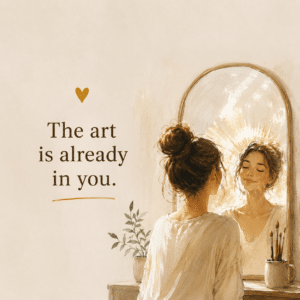
When Jeff talks about coaching now, he uses a phrase that stopped me the first time I heard it. His own way of putting it: “I believe that each person has a unique and amazing work of art at their core. Not art like painting, but their essence.” Not a metaphor for potential, exactly — closer to a literal claim. Somewhere underneath the job title, the defense mechanisms, the years of doing what was expected instead of what was true, there is something formed and specific and already complete, waiting less to be built than to be uncovered. His own Noble Goal, the thing he organizes his working life around, is to help people find that art in themselves.

I used to think that was a generous overstatement — the kind of thing you say to encourage someone, true in spirit more than in fact. Then I watched what Jeff does with men inside a prison who have nothing left to perform for, no résumé to protect, no boss to impress. There’s no career upside to a Kairos weekend. No referral pipeline, no testimonial, no audience beyond the man across the table. Jeff describes what he brings into that room plainly: “These men have been beaten down for so much of their life that no one has told them that they have worth or value. I believe that is the most important thing that I take into the prison.” That’s the same claim as the work of art, said in a different register — not a creative impulse waiting to be unlocked, but a worth that was never actually in question, only buried under years of being told otherwise. And it’s precisely there, where every external reason to fake it has been stripped away, that Jeff says he sees people most clearly — not the art they wish they’d made, but the art that was always there, scarred over, hidden, waiting on someone steady enough to notice it without flinching.

This reframes the question I’d been asking wrong for years. I’d absorbed from my parents’ easels that art was something you produced — a discipline you practiced, a skill you built, a thing that either existed on the canvas or didn’t exist at all. So, when people tell me, in coaching sessions or over coffee, that they don’t have a creative bone in their body, that the art conversation isn’t for them, I understand exactly what they mean, because I used to measure it the same way. But Jeff’s version of the Noble Goal isn’t asking anyone to make more. It’s suggesting that most of us are sitting on something we’ve already made — a way of loving people, a particular kind of patience, a capacity to stay present in rooms other people flee — and we’ve spent so long hiding it, smoothing it over, calling it ordinary, that we’ve forgotten it was art at all.

This is where emotional intelligence stops being a corporate competency and starts being something closer to excavation. The tools Jeff uses — the same EQ frameworks we teach leaders and teams — aren’t really about performance optimization when you trace them back far enough. They’re instruments for noticing: what someone feels underneath what they’re saying, what’s been buried so long it reads as personality rather than choice, what got hidden because revealing it once cost too much. Jeff’s years in prison ministry didn’t happen alongside his coaching work by coincidence. They’re the same practice in two different rooms — one with stakes most people will never know, one with a quarterly review attached, both asking the identical question: what is the work of art this person has been hiding, and what would it take for them to trust it back into the light.

The Art You’ve Been Hiding Reflection Sheet

I think about those two easels differently now. My parents weren’t only teaching me about craft. They were teaching me, without either of them saying it outright, that the thing worth making was never separate from the person making it — that the canvas was just where it became visible. Jeff would say the canvas isn’t required at all. The art is already there. The work, his work, our work, is helping people stop believing they have to make something new before they’re allowed to call what’s already inside them by its true name.

You don’t need to make more art. You need to stop hiding the one you already are.

Peace and Every Good

If this stirred something, you can find more reflections like it on The Mystical Seeker.

mysticalseeker.substack.com & spiritofeq.com/blog

About the Author

Jim Vaive is co-founder of spirit of EQ, where he and his wife Lynette help individuals, leaders, and teams grow through emotional intelligence, the Enneagram, and contemplative spiritual formation. He writes at The Mystical Seeker on the inward life that makes the outward work possible.


The Mug She Couldn’t Put Down

On the three lies we’re sold about work, and what’s true instead.

A woman sat across from me on a video call a few months ago, holding a coffee mug with her company’s logo on it up near her kitchen counter, turning it slowly between her palms the way you turn something you’re not sure you still want to hold. She had just been promoted into the title she had organized her twenties and thirties around — corner office, signing authority, her name under a slightly bigger headshot on the company website than the year before. She set the mug down on the counter next to her laptop and told me the day of her promotion had been the saddest day of her professional life. Not because anything had gone wrong. Because everything had gone exactly as promised, and she felt nothing.

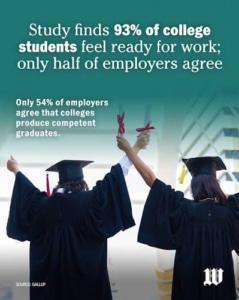
I have sat across from that kind of silence more times than I can count over the years — the silence that comes after someone gets the thing they were told to want and discovers the want was never really theirs. It usually arrives with a kind of quiet bewilderment, because nobody warned them this was a possible outcome. The story they were handed, somewhere around a commencement stage in a cap and gown, did not include a chapter where the dream job arrives on schedule and turns out to be the wrong dream.

This is, I suspect, a good part of what’s behind the wave of people quietly leaving or quietly checking out of corporate life right now, the wave that gets a new headline every few months — quiet quitting, quiet burnout, whatever comes next. It is tempting to read all of that concept as a generation gone soft, unwilling to put in the hours their parents did. I don’t think that’s it, or not mostly. I think a great many people are noticing, roughly around the same time, the same gap between a promise made to them early and a result delivered to them later, and discovering they were never told the promise came with an asterisk.

That story has a traceable origin. Standing at a Stanford commencement in 2005, Steve Jobs told the graduating class, “And the only way to do great work is to love what you do,” and the line has been framed on office walls and printed on coffee mugs ever since — including, probably, some very near where my directee set hers down. The writer Miya Tokumitsu, in her 2014 Jacobin essay “In the Name of Love,” traced exactly this lineage and pointed out something uncomfortable: the people most able to afford the leap into work they love are usually the people who already had the most cushion underneath them. For everyone else, the mantra quietly does something less generous than inspire. It turns a structural problem — not enough good jobs, not enough room to take risks — into a personal one. If you don’t love your work, the story implies, you simply haven’t looked hard enough, or wanted it badly enough, or been brave enough to go get it.

The second half of that same story usually arrives a little later in the curriculum — a guest entrepreneur clicking through a slide deck in a packed lecture hall, telling the room that with enough grit, any one of them could be the next name on a building. Anyone can build something of their own, the story goes, if they just work hard enough — and here I must be careful, because for a season of my life I was the proof people pointed to. My business partner Mike and I spent eight months preparing before we opened Varment Guard, the pest and wildlife management company we built from nothing into a business that eventually employed hundreds of people. We hung a sign over our own door — Failure was not an option — and meant it the way you mean something you have staked your mortgage on. It worked. I am not interested in pretending otherwise, or in false modesty about something I am genuinely proud of. But it worked because of a long list of things that had very little to do with how hard we wanted it: the specific economy of that particular year, a partner whose strengths were exactly the inverse of mine, a tolerance for risk that is not evenly distributed across human temperaments and never has been. I don’t want to make it sound costless, either. I had small children at home through those eight months and the years right after, and I missed real time with them I can’t get back — which is its own kind of bill, one that never shows up on anyone’s balance sheet but gets paid all the same. According to the Bureau of Labor Statistics, roughly half of new businesses don’t make it to their fifth year, and the ones that do are not simply the ones who wanted it most. Holding up survivors as proof that anyone can do this if they just try hard enough is a little like holding up a lottery winner as proof that anyone can get rich if they just buy a ticket.

What worries me more than the failure rate itself is what people do with it afterward. I have sat with more than one person who closed a business within those first hard years and absorbed it as a verdict on their character rather than what it mostly was — a coin flip with worse odds than anyone told them going in. The story promised something close to a meritocracy. The data describes something closer to weather.

Underneath both of those lies sits a third, quieter one: that money and position are the correct measure of a life well spent, and that everyone, deep down, wants more of both. Some people do, and there is nothing wrong with that — ambition is not a character flaw, and plenty of people are genuinely called toward building, leading, and accumulating in ways that serve others well. But plenty of other people are wired toward something else entirely: depth over breadth, the same craft practiced quietly for thirty years, a small life held close rather than a large one held loosely. I think of the kind of person who has spent three decades fixing pipe organs in the same three counties, with no interest in a bigger territory or a louder reputation, who is, by every measure I trust, thoroughly fulfilled. Emotional intelligence, at its most basic, includes the unglamorous skill of knowing accurately which one of those people you are, rather than which one you were told to become. The Enneagram, in its better uses, exists for exactly this kind of clarity — not to sort people into better and worse categories, but to help each of us recognize the shape of aliveness we were built for, which is rarely identical to our neighbor’s. Mistaking the second kind of person for a failed version of the first kind is not a small error. It is the engine behind an enormous amount of unnecessary suffering, including, I suspect, the kind my directee was sitting in when she set down her mug.

Was It Ever Yours To Want Reflection Sheet

I didn’t ask her what she wanted to do next. I asked her something slower: whether the job she’d just arrived at had ever been hers to want, or whether she had simply been collecting, for twenty years, on a promise someone else made on her behalf at a podium she barely remembers. She picked the mug back up while she thought about it, turned it over once more, and read her own company’s name on the side of it like she was seeing it for the first time. She didn’t have an answer that day. But she left the call holding the mug instead of setting it back down on the counter, which felt, to both of us, like the truer ending to that sentence.

If this stirred something up, I made a short reflection sheet to go with it — you can find it, along with more like it, at spiritofeq.com.

Peace and every good.

mysticalseeker.substack.com & spiritofeq.com/blog

Leaving the Family You Love: A Six Seconds Story

What Is Ours to Do: Six Years Inside the World’s EQ Family

We were sitting at Josh Freedman’s table in California, there to do actual work on an idea that had started with us and Josh after a night in Italy when everything was stolen.

That loss wasn’t metaphorical — it was the kind that strips a trip down to its studs and leaves you standing on a street in a foreign country with nothing but each other and whatever faith you came with. Sitting with that loss, Lynette and I began talking about something we couldn’t quite let go of afterward: a conviction that emotional intelligence, as powerful as it is, might be missing a layer. It could help you understand your feelings. It could not, on its own, help you understand your soul. We started calling that missing layer SQ, and while we were in Italy we told Josh we would like to be more involved with Six Seconds. He suggested an assessment built around spiritual intelligence, which eventually brought the concept to Josh’s table to evolve further, because Six Seconds had been the architecture of our own EQ formation for years, and he was the person we trusted most in that moment to talk it through with.

Josh listened the way he always does — fully, without performing his attention — and then he made suggestions that were smaller than what we’d imagined and, in their own way, wiser. Rather than reworking the SEI, the Six Seconds Emotional Intelligence Assessment that sat at the center of everything Six Seconds did, he proposed adding a spiritual assessment alongside it — one more tool in the library he’d already built, not a replacement for the organization’s core focus. Out of that suggestion came the SEQ — Spiritual Emotional Intelligence — a framework Lynette would spend years refining, eventually carrying it into her doctoral research with the Haden Institute. But that’s a different post. This one is about what happened next, at that same table.

While we were sitting there, we noticed Six Seconds was advertising for Regional Network Directors for North America. We asked Josh, somewhat sheepishly, if we should apply. “Sure,” he said. “Go ahead.” So we did, and the interview process began. Somewhere in the middle of it, we made an unusual request: we would take the role only if we could job-share it, together, at the salary of one person. It was a strange thing to ask for, and a stranger thing for an organization to say yes to. But Six Seconds said yes. And in one of those interviews, when they asked what we’d do with the region if we got it, Lynette and I gave an answer that had nothing to do with metrics or growth targets. We said we wanted to wrap North America in a warm blanket of love and understanding. That was the whole strategy. They hired us anyway.

The six years that followed were not what either of us expected, and they were more than either of us could have asked for.

We traveled to countries we’d never have reason to visit otherwise, and because we were there to work, not to vacation, we didn’t stay in hotels so much as we stayed in people’s lives. We sat at their tables. We learned their rhythms. We met people who would become genuinely dear to us, not contacts but family, and we got to see up close what it means for emotional intelligence to take root in a culture — not as a training module but as a way communities choose to treat each other. We came home from those trips different every time, fuller, more convinced that the work mattered.

We also got a front-row seat to something we hadn’t expected to witness so directly: the architecture of Josh’s mind. Calling him a genius might be generous or it might be exactly right — we’ve never been entirely sure which, and we suspect he isn’t either — but what we saw, year after year, was someone with an almost uncanny capacity to pull threads from neuroscience, education, business, and human development and weave them into something coherent enough to hand to a stranger and say, here, this will help you. None of that happened in isolation. Six Seconds is the work of many hands before us, beside us and ahead of us, people whose names don’t appear in the history pages, but whose fingerprints are all over the organization Six Seconds is today. We were grateful to be among them, even for a season.

Then the pandemic arrived, and everything we thought we knew about resilience got tested against something none of us had a training module for.

There were stretches of those years that asked more of our communication, our patience, and our nervous systems than almost anything we’d faced before — including the years building Varment Guard from nothing. There were moments of real friction inside the Six Seconds family, the kind that surfaces when an entire global community is trying to hold itself together through grief and uncertainty at the same time. We loved that family through all of it: the smiles, the frowns, the hard and honest conversations that emotional intelligence doesn’t exempt you from but requires of you. EQ was never a tool for avoiding conflict in that season. It was the only thing that made the conflict survivable, and occasionally, even generative. There were successes in the middle of it that made us cry — not from relief, but from something closer to awe, the sense of watching people choose connection when isolation would have been so much easier.

Through all six years, Lynette and I kept coming back to the same question, the one that has quietly governed most of the major decisions of our lives together: what is ours to do?

For that season, the answer was Six Seconds. We had a structure to help build for North America, and we built it — a structure that worked exactly as it needed to, for exactly as long as it needed to, until the world changed again and a different structure became necessary for an age of AI and rapidly shifting communities. We weren’t building something meant to outlast us unchanged. We were building something meant to serve, and then to be replaced by whatever served better. That’s not failure. That’s stewardship.

When the time came to leave, we left — not because the work stopped mattering, but because our hearts had never stopped belonging to the spiritual journey of the seekers in our own world, the ones who came looking for spirit of EQ specifically because they wanted the spiritual layer Six Seconds had helped us name but couldn’t, by its own scope and mission, fully carry. So, we said a true and grateful goodbye to a family we loved, and we came home to the work we were always going to return to.

What we keep coming back to, looking at those six years now, is this: none of it would have happened if we hadn’t been willing to ask an honest question out loud at someone else’s table, and none of it would have ended well if we hadn’t been willing to leave when leaving was the truer thing to do. Honoring the deepest truth in yourself sometimes looks like raising your hand for an opportunity you’re not sure you deserve. Sometimes it looks like walking away from a family you love because another part of your life is calling you home. Both are the same practice, really — the practice of taking your own soul seriously enough to follow it, even into the unknown, even when the unknown costs you something real.

Companion Work Book

We are endlessly thankful for Six Seconds, for Josh’s strange and generous brilliance, for the people who walked beside us before we arrived and the ones who are still walking that road now, building whatever comes next for a world that badly needs more emotional intelligence, not less. And we are thankful, too, for the courage it took to come home.

Peace and every good.


I Damaged Someone & The Truth It Taught Me

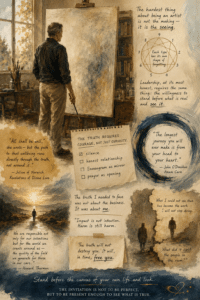
There is a picture my mother drew of my father in his studio. He is standing at the canvas with a brush in his hand, but he is not painting. He is looking. Just looking. My mother told me once that the hardest thing about being an artist is not the making — it is the seeing. Seeing what is there, not what you hoped would be there. Seeing clearly enough to know when something is wrong, even when the wrong thing is something you made.

I have thought about that picture a lot over the years. Especially in relation to leadership. Because leadership, at its most honest, requires the same thing my father was doing in that studio: the willingness to stand before what is real and see it — not manage it, not spin it, not quietly maneuver around it — but see it. And the hardest version of that seeing is always the one that turns inward.

When Lynette and I were building the spirit of EQ framework, we kept returning to a question that came up repeatedly in our coaching and spiritual direction work: why do so many gifted leaders struggle with self-awareness? Not because they lack intelligence. Not because they are unkind or unserious. But because the very qualities that made them effective — decisiveness, energy, forward momentum, the ability to hold a vision and drive toward it — can become the walls of a room they eventually cannot see out of.

The Enneagram has a word for this. It calls them fixations — the grooved, automatic patterns we operate from when we are running on autopilot rather than on presence. Each type has its own shape of forgetting. And the forgetting is not dramatic. It is quiet. It accumulates. It happens in the ordinary press of days, under the ordinary pressure of responsibility, until one morning you look up and realize the wake you have been leaving behind is wider and more damaging than you ever intended.

I know this from my own life. When I co-founded Varment Guard, my business partners were good people — steady, quiet, deeply competent in their domains. But one stands out for me, he did not move fast. He did not think fast. He processed carefully, methodically, and he was almost always right. I am a classic Enneagram Eight. I move fast. I decide fast. I push hard. I burned through rooms in those early years the way a locomotive burns through a tunnel — arriving on the other side with energy to spare, rarely pausing to consider what the air felt like for everyone else inside.

In the beginning, this particular partner and I worked well together. His steadiness balanced my fire. My drive opened doors his caution would have approached more slowly. But as the business grew and the pressure intensified, I lost access to that balance. I stopped seeing my partner clearly. I started seeing only the pace I needed us to keep, and I began — unconsciously, relentlessly — forcing this gentle soul into a shape that was not his. I pushed him beyond the edges of who he was. I did not mean to damage him. But I did. And eventually, he left. Not loudly. Not in conflict. He simply found a way out, and the relationship went with him. It was a wound I have carried for a long time.

What I could not see then — and what took years of coaching, spiritual direction, and a lot of sitting still to begin to understand — was that the truth I needed to face was not about the business. It was about me. The Eight’s deep gift is strength. The Eight’s deep shadow is the refusal to acknowledge the harm that strength can do. I had confused impact with intention. I believed that because I did not mean harm, I had not caused it. That is not how it works. That is not how it has ever worked.

The contemplative tradition is clear about this. Howard Thurman wrote that we are responsible not only for our intentions but for the world we create around us — the quality of the field we generate for those in our care. Julian of Norwich, writing from her anchorite cell in fourteenth-century Norwich, described the interior life as a dwelling place — something that requires tending, requires honest inspection, requires the willingness to see what is there rather than what we prefer to believe is there. “All shall be well,” she wrote — but the path to that wellbeing runs directly through the truth, not around it (Julian of Norwich, Revelations of Divine Love).

The research on emotional intelligence affirms what the mystics knew intuitively. Six Seconds, the global EQ nonprofit where Lynette and I served for many years, identifies self-awareness as foundational to every other capacity in the emotional intelligence model. You cannot regulate what you cannot see. You cannot choose your response when you are unconscious of your pattern. You cannot lead others toward wholeness from a place of unexamined wounding. The data bears this out across industries, cultures, and leadership contexts. Self-awareness is not a soft skill. It is the load-bearing wall.

But here is the thing about truth: it requires courage, not just curiosity. Many leaders are curious about themselves in a managed way — they take the assessments, they read the books, they sit in the leadership retreats. What is rarer is the willingness to let the truth land. To let it cost something. To sit with it long enough that it changes not just your language but your behavior, your relationships, the shape of the wake you leave. The contemplative teacher Thomas Keating called this the dismantling of the false self — the slow, sometimes painful process of releasing the persona we have constructed to protect ourselves and facing what is underneath (Thomas Keating, Open Mind, Open Heart). Most of us will do almost anything to avoid that process. Leaders perhaps most of all, because the stakes feel so high and the exposure feels so total.

John O’Donohue, the Irish poet and philosopher, wrote that “the longest journey you will ever make is from your head to your heart” (John O’Donohue, Anam Cara). I think of that line often when I am sitting with a leader in a coaching session, watching them circle a truth they cannot quite bring themselves to name. The truth is right there. They can feel it. But the distance between knowing it in the mind and letting it descend into the heart — into lived acknowledgment, into genuine accountability — can feel enormous. That journey is the work. And no amount of strategy, no quarterly planning cycle, no leadership competency framework can do it for you.

What helps? In our experience at spirit of EQ, several things. The practice of silence — not productivity, not journaling as output, but genuine quiet that creates the interior space for truth to surface. The practice of honest relationship — at least one person in your life who is not dependent on you, not intimidated by you, and will tell you what they see. The Enneagram, used not as a typology to explain yourself but as a mirror to face yourself. And prayer — whatever form that takes for you — as an act of opening, of consenting to be seen more fully than you can see yourself.

I did not get a chance to repair things with my partner. That is a grief I live with. But what his departure gave me — painfully, slowly, over years — was the beginning of something more honest in myself. A willingness to slow down long enough to feel the field I was generating. A willingness to ask not just “Did we hit the goal?” but “What did it cost the people in the room?” That shift did not diminish my leadership. It deepened it. It made me someone I am still, imperfectly, trying to become.

The Truth Leaders Don’t Want to Face

My father’s picture still lives in my mind. The brush in his hand. The stillness of his looking. The courage required to see clearly enough to know what is true and what is wish. That is the invitation for every leader who is willing — not to be perfect, not to have it all resolved, but to stand before the canvas of your own life and look.

The truth will not destroy you. It will, in time, free you.

If this reflection stirred something in you, we’d love to have you join us at mysticalseeker.substack.com — where we explore the inner journey of leadership, EQ, and spiritual formation.

Peace and every good.

mystical seeker.substack.com