
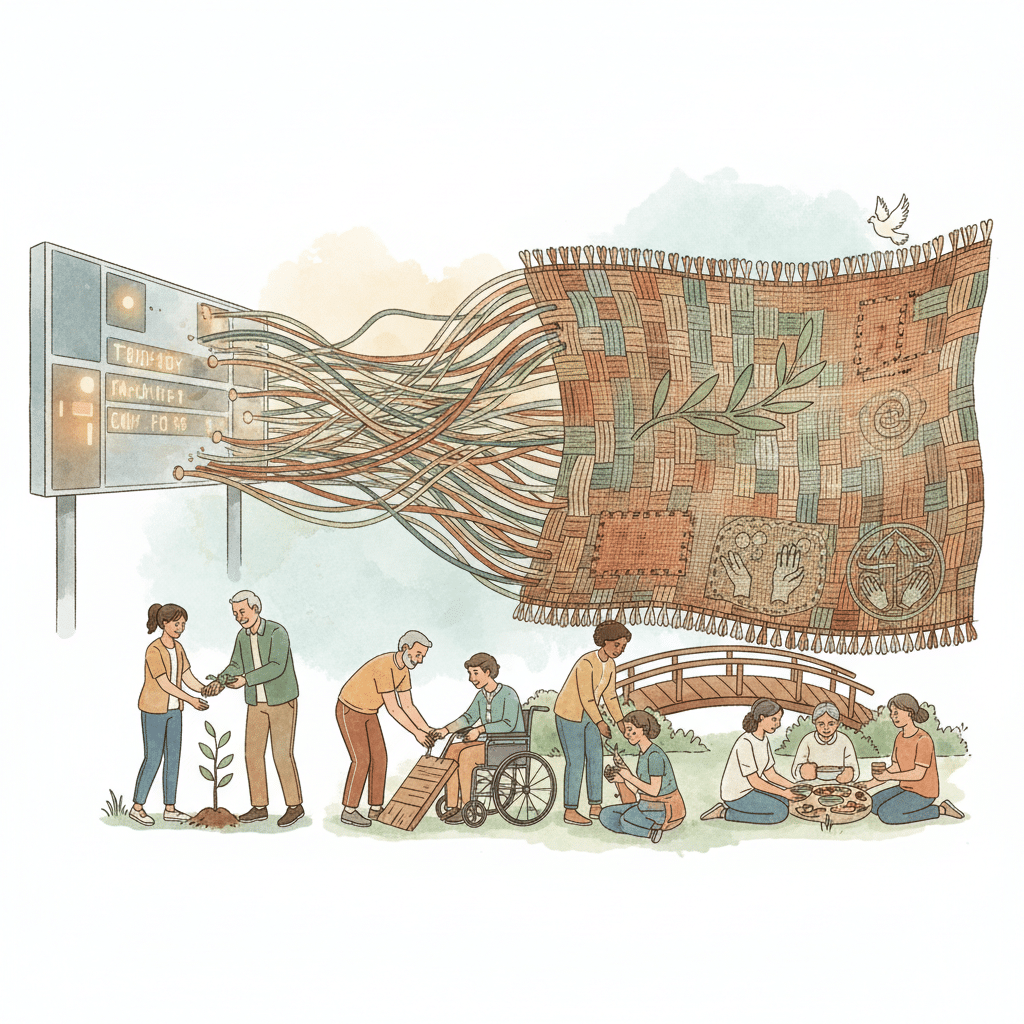
From Scoreboard to Tapestry: Embrace Nonviolence
My business partner’s offhand metaphor about the United States not engaging in a nationwide football game—where there are winners and losers—stayed with me. At first, it sounded like a crazy joke, the kind people make to underline how competitive and spectacle-driven our society has become. But on my reflection, that “football” image is more instructive than flippant. It captures a deep, pervasive fact: life as contest, the world as scoreboard. What if we loosened our grip on that metaphor? What if, instead of celebrating winners and humiliating losers, we reimagined success as a collective flourishing and centered a culture of nonviolence? It is a radical reframe, so bear with me and it is also one that deserves serious attention.
Competition has undeniable value. It spurs innovation, drives excellence, and gives shape to many of our institutions—from markets to sports, academic achievement to civic engagement. Yet when competition becomes the dominant frame for all human interaction, it blinds us to alternatives and normalizes collateral damage. A zero-sum mentality assumes that another’s gain is automatically our loss. It trains us to view relationships, resources, and even the planet as limited commodities to be conquered or defended. The result is not just interpersonal friction but systemic harm: escalating violence, widening inequality, environmental degradation, and eroded trust in institutions.
And…I remember times back home when I was just not up to the competition and I got my clock cleaned. The funny thing is, I was not small or weak or without merit, so I became angry, was belittled, and was told that I was less then. I wanted to quit, to run away, to hide and to lash out. Little good it did me with the overwhelming prevailing attitude of the coaches, players, cheerleaders and spectators. I didn’t stand a chance.
This is where the teachings of nonviolence offer a profound corrective. Nonviolence is often mistaken for passivity or simple conflict avoidance. But figures like Jesus and Mahatma Gandhi modeled a far more active ethic. These men and women who lived and walked on the earth had to find a courage that defied comprehension and for them nonviolence, in their practice and lifestyle, was a disciplined way of engaging the world—rooted in courage, principles, and creative action. It is not the absence of conflict; it is the commitment to resolve conflict without dehumanizing others. It asks us to cultivate empathy, to recognize the dignity of adversaries, and to seek solutions that heal rather than simply punish.
Reimagining “winning” through the lens of nonviolence means changing our metrics. Instead of tallying victories and defeats, we begin to ask different questions: Who is flourishing? Are communities strengthened or weakened? Is the planet being cared for or exploited? Do our policies and practices expand freedoms and opportunities for the many, or do they concentrate advantage among the few? Success, in this framework, is measured by collective well-being, resilience, and regenerative practice.
The stakes of this shift are extremely high. Imagine what people will say about you? Because we are living in a moment of converging crises. Climate change destabilizes ecosystems and economies; social and political polarization deepens mistrust and reduces the space for reasoned debate; economic systems often prioritize short-term profit over long-term sustainability. In such a context, a competitive, winner-take-all logic exacerbates harm. It encourages resource extraction without stewardship, political brinkmanship without compromise, and a politics of humiliation that breeds resentment and cycles of retaliation. Nonviolence, conversely, invites us to break those cycles. It reframes adversity as an opportunity for creativity and collective problem-solving.
What would living into this shift look like in practice? First, it requires cultivating inner practices that temper reactivity and encourage empathy. Mindfulness, contemplative traditions, and reflective dialogue help people recognize their fears and attachments. When we know our triggers, we can choose responses that align with shared human dignity rather than reflexively seeking to dominate. Education systems that prioritize social-emotional learning, critical thinking, and civic literacy prepare citizens to engage in public life as collaborators rather than combatants. How would that look?

Second, institutional redesign matters. Democracy works best when it incentivizes cooperation and reduces zero-sum incentives. Electoral systems, media ecosystems, and corporate governance structures can be retooled to reward long-term, inclusive solutions. Policies that incentivize sustainable production, equitable distribution, and restorative justice create feedback loops where nonviolent solutions are not merely moral but also pragmatic. Imagine electoral incentives that reward coalition-building, or corporate accountability systems that value community well-being as much as shareholder profit. These are not utopian fantasies; they are policy directions that have been piloted at local levels and can be scaled.
Third, we must honor the language and practice of restorative justice. Traditional punitive systems focus on retribution, often producing repeat harm. Restorative approaches center repair and the restoration of relationships. They ask victims, offenders, and communities to participate in making amends, offering a path toward reconciliation and reduced recidivism. When societies adopt restorative frameworks, they acknowledge human fallibility while working toward healing—transforming conflict into an opportunity to rebuild trust.

Fourth, environmental stewardship must be reframed as a nonviolent act. Exploiting nature as though it were inert inventory is a form of violence that kills biodiversity, undermines livelihoods, and creates crises that disproportionately burden the most vulnerable. Nonviolent stewardship means honoring ecological limits, investing in regenerative agriculture and clean energy, and ensuring access to resources for future generations. This is not a sacrifice so much as an investment in our common home and in the long-term survival of our species.

This vision of nonviolence is not naive. History is full of examples where nonviolent movements achieved change against overwhelming odds—India’s independence movement, the U.S. civil rights movement, and more recent peaceful uprisings that led to democratic opening in various parts of the world. These movements did not succeed solely because of moral superiority; they succeeded because they leveraged strategy, discipline, broad-based coalition, and the ability to expose the injustice of violent systems without mirroring their brutality.
Adopting a nonviolent orientation at scale will be messy. People will disagree about priorities and means. There will be moments when force is necessary to protect those who cannot protect themselves. The point is not to deny complexity but to insist that violence should not be the default logic for solving problems. Instead, we should design systems and cultures that exhaust nonviolent options first, that prioritize de-escalation and mutual uplift, and that recognize the moral and practical costs of violence.
If we commit to this path, the benefits are both moral and practical. Societies organized around nonviolence tend to be more stable, more prosperous, and more resilient. They foster innovation not by crushing competitors but by building networks of trust and shared purpose. They produce healthier citizens—physically, mentally, and socially—because communities that care for one another reduce the stressors that lead to harm. And they leave a legacy that matters most: a habitable planet and institutions capable of delivering justice and dignity for generations to come.
Returning to my partner’s football metaphor, I now hear it less as a quip and more as an alarm bell. AND you may not feel the way that I am writing this blog, lets have dialogue in the comments. The spectacle of competition can be exhilarating, but it can also normalize division and glorify winners at the expense of many. When we start measuring success by abundance—by how many people thrive, how well ecosystems recover, how justly opportunities are distributed—we remember that life is a tapestry, not a scoreboard. Each thread—human, animal, plant, waterway—contributes to the strength of the whole.
This transformation begins with personal commitments and ripples outward. It begins with conversations where we listen to learn, not to win. It begins with leaders who model humility and curiosity rather than invulnerability. It begins with institutions that reward cooperation and designers who build systems that align individual incentives with collective flourishing.
These Illustrations were built and drawn to portray a different way of being. What do you think?
FOR me to close here I must say that winning—if we must use that word—should mean creating conditions where everyone has the opportunity to flourish. It should mean a world where peace is not merely the absence of conflict but the presence of justice, equity, and compassion. It is a lofty aim, but not an impossible one. If even a small fraction of us commit to moving in that direction—toward nonviolence, toward stewardship, toward shared success—the change will be seismic. I promise you: start down that path even a little bit, and everything will begin to change. Hard as it will be.


