Posts on attention as a form of love — the noticing and presence it takes to actually see what’s in front of you, rather than what you expect to find. These reflections explore attention as practice.

Posts

When Matter Becomes Prayer

When Matter Becomes Prayer

A companion to Thin Places — because the holy ground may be in your hands.

Last time I said the thinnest ground you will ever stand on is probably within a mile of your bed. Here is the next turn of that same screw: it may be closer than that. It may be in your hands.

Most of us were handed a quiet assumption somewhere along the way — that the spiritual life is the part of life that is not physical. Prayer happens with eyes closed. Holiness happens in sanctuaries, or at least in silence. Everything else — the dishes, the commute, the sanding of a board, the chopping of an onion — is the ordinary stuff you get through in order to arrive at the real thing. It is the life we have, right? It is also, according to nearly every contemplative who ever lived, exactly backwards.
The monk in the kitchen

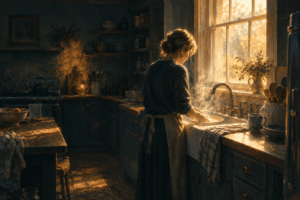
In the 1600s a Carmelite lay brother named Lawrence, whom I love, was assigned to the monastery kitchen, work he did not particularly want. He spent decades there among the pots and pans, and what he discovered became one of the most beloved little books in Christian spirituality. He said he felt as close to God with his hands in the dishwater as he did kneeling at the altar. He put it with a kind of homely joy that still disarms people four hundred years later: “I turn my little omelet in the pan for the love of God” (The Practice of the Presence of God).

Notice what he is not saying. He is not saying he thought holy thoughts while cooking, using the omelet as background noise for a more important interior event. He is saying the turning of the omelet was the prayer. The egg, the pan, the wrist, the attention — all of it, offered. Matter became prayer in his hands, and he did not have to leave the kitchen to find God, because God had not left the kitchen either.

The most material faith there is

There is real theology under all of this, not just a nice sentiment. Christianity makes an almost scandalous claim about matter, that God took a body. “The Word became flesh” (John 1:14) — not became an idea, or a feeling, or a philosophy. Flesh. And ever since, the central rites of the faith have been stubbornly physical: bread, wine, water, oil, hands laid on a head. A sacrament, as the old definition has it, is an outward and visible sign of an inward and invisible grace. Which is to say the material world is not a distraction from the spiritual one. It is the way the spiritual one reaches us.

Teilhard de Chardin, the Jesuit who spent his life with his hands in actual dirt as a paleontologist, said it as plainly as anyone has: “By virtue of Creation, and still more the Incarnation, nothing here below is profane for those who know how to see” (The Divine Milieu). Nothing here below. Not the sink, not the garage, not the body, not the work.

Running in the grey mist

I used to run marathons. Really — I did. I was never a world-class runner, not close, but I did all right.

I would lace up in the dark and get out on the road while the grey mist still hung over the street in the early twilight. And there were mornings when I stood there stretching and thought, I am not in a place mentally to run today. Some days I went anyway, for no better reason than that one foot could go in front of the other.

And then something would happen. A mile or two in, a rhythm would find me — breath and stride and pavement all arriving at the same time — and I would smooth out. The effort did not disappear. It changed, simple.

And then, in that rhythm, came the moment. I touched something. You know what I mean, don’t you? All was right with the world, and I was not running anymore. I was communing. I had no language for it then. I would call it prayer now.

How we learned to split them

If this is true, why does it feel so unfamiliar? Two reasons, and they come from opposite directions.

The first is old. There has always been an impulse in religion to treat spirit as high and matter as low — to assume the body is a problem to be managed and the material world a waiting room for something better. It is an ancient instinct and the church has flirted with it for centuries, but the Incarnation keeps embarrassing it. You cannot build a faith around God taking on flesh and then quietly teach that flesh does not matter.

The second reason is new, and it is the machine I have written about before. A culture organized around output does not want your attention on the onion. It wants the onion chopped fast so you can get to the next thing, ideally while listening to something that makes you more productive. Hurry makes matter mute. Not because the dishes stopped being holy, but because nobody is home while they are being washed.

Who sweeps a room

The practical tradition here is wonderfully unglamorous. George Herbert, who wrote in 1633, put it in two lines that have outlived nearly everything else he said: “Who sweeps a room, as for thy laws, makes that and th’ action fine.” The Hebridean households I wrote about in the last piece blessed the kindling of the fire and the milking of the cow. Jewish practice has a blessing for bread, for wine, for the body working as it should. None of these are poetic decoration laid over ordinary life. They are claims about what ordinary life already is.

The book on my father’s kitchen island

My father died. And when my brother and I went to clean out the house, we found the book he had been reading at the end: Chop Wood, Carry Water.

My father was not a religious man. He had no use for church and did not talk about his soul. So why was he reading that? I never found out. There was no one left to ask, and I have made a kind of peace with never having the answer.

But I read the book, it changed my life. Its whole argument is that the spiritual path is not somewhere else — it is in the chopping and the carrying, in the office and the kitchen and the ordinary hours. Living here, now, is what matters most. The end of my life will take care of itself, won’t it?

I still do not know what my father found in those pages. I know what I found. And I know he handed it to me without ever meaning to.

There is one more thing I only learned later. That book, published in 1984, is sometimes credited with almost single-handedly creating the modern literature on finding the sacred in ordinary work. My father — who had no use for organized religion — died with the founding text of the thing I would spend the rest of my life trying to understand sitting on the kitchen island. I have never known what to do with that, except be grateful.

When Matter Becomes Prayer Reflection Sheet

Matter does not become prayer. We do.

I titled this blog “When Matter Becomes Prayer,” and now I want to take part of it back. Matter does not actually become prayer at some point, as though a bowl of soup were inert until the right thoughts were applied to it. In the last piece I wondered whether the veil is thin everywhere and we are the thick ones. The same correction belongs here. The onion was always the handiwork of God. The water was always water of baptism, in its way. What changes is not the matter. What changes is whether anyone is present to it.

Attention, then, is the thing we actually bring. Not belief, not feeling, not the right words — attention. Simone Weil said that absolutely unmixed attention is prayer, and anyone who has ever lost themselves in making something with their hands knows the truth of it from the inside, whether or not they would have called it prayer at the time.

Practices for hands

Do one thing at a time, with your whole self, and let that be enough. Make something with your hands this week — bread, a repair, a meal, a line of paint — and do not listen to anything while you do it. Eat one meal slowly enough to taste it. Bless the thing in front of you, out loud if you can stand it. And when words will not come, which happens to all of us eventually, let the body pray instead: walk, dig, cook, hold a hand. The body has been praying since long before you had language, and it has not forgotten how.

Brother Lawrence stayed in that kitchen the rest of his life. He is not remembered for a system or a doctrine. He is remembered because he discovered that the distance between the sink and the sanctuary was a distance he had invented, and once he stopped defending it, God was simply there — in the pan, in the water, in the hands.

Your hands are already in the water. That was never the obstacle. It was the invitation.

Peace and every good.


About Jim & Lynette Vaive

Jim and Lynette Vaive are the co-founders of spirit of EQ and co-authors of The Mystical Seeker. They are Master Certified Coaches, certified Narrative Enneagram teachers, and Certified Spiritual Directors, and together they hold credentials in Spiritual Emotional Intelligence (SEQ) — a framework rooted in Lynette’s Doctor of Ministry research. Learn more at spiritofeq.com.

Sources

Brother Lawrence — The Practice of the Presence of God: overview

Pierre Teilhard de Chardin — The Divine Milieu, “nothing here below is profane”: Center for Action and Contemplation

Rick Fields et al. — Chop Wood, Carry Water (1984).

George Herbert, “The Elixir” (1633); John 1:14; Simone Weil on attention.

Thin Places That You Don’t Notice

Thin Places

The thinnest ground you will ever stand on is probably within a mile of your bed.

It is a Tuesday. You are standing at the kitchen sink with your hands in the warm water, or sitting on the back steps while the light goes long and gold, or in the chair where you always sit, and the house is quiet in a way it usually is not. Nothing happens. Nothing you could put in a report. And yet for a moment the ordinary goes quietly transparent, and you have the distinct sense that you are not alone in the room — that the world has worn thin right here, over the sink, on a Tuesday.

The Celtic Christians had a name for that: a thin place. The idea is that the usual distance between heaven and earth — between the material and the spiritual, the seen and the unseen — sometimes narrows almost to nothing. There is an old Celtic saying that heaven and earth are only three feet apart, but that in the thin places the distance is smaller still.

Yes, there are famous ones. That is not the point.

You may have heard the phrase attached to islands. George MacLeod, who refounded the Iona Community on that windswept Scottish island, is remembered for calling Iona “a thin place where only tissue paper separates the material from the spiritual” (The Living Church). Pilgrims say similar things about Lindisfarne, about Skellig Michael out in the Atlantic, about certain holy wells and standing stones. All of it is true, and if you ever get to stand on that kind of ground, go.

But if thin places are mostly islands off the coast of Scotland, then thin places are for people with money and vacation time, and that cannot be what the Celts meant. It is not, in fact, what they meant at all.

The Celts blessed the kitchen

Look at what they actually prayed. In the Carmina Gadelica — the great collection of Gaelic prayers and blessings that Alexander Carmichael gathered from Highland and Hebridean households in the 1800s — you find blessings for kindling the fire in the morning and for smooring it, banking the coals, at night. Blessings for milking the cow. For walking out. For making the bed and lying down in it (Carmina Gadelica). These were not pilgrims on a holy island. They were farmers and fishermen and tired women with cold hands, blessing the hearth in their own kitchens before dawn.

Which means the tradition we are borrowing from was never mainly about famous places. It was about the hearth. The doorway. The byre. The work of your own hands on an ordinary morning. They assumed the veil was thin right where they were standing, and they talked to God accordingly — not on retreat, but while lifting the peat.

The night on the back steps with Lincoln

One winter night I was sitting on the back porch steps with Lincoln. It was snowing. It was dark and cold and completely quiet.

Lincoln was a big golden retriever who almost never sat still — he loved everything and everybody, all the time, at full volume. But that night he sat. The two of us stared off into the dark together, our breath slowing until it seemed to wrap something gentle around us both.

And then everything stopped. The stars stopped moving across the sky. The sound around us stopped. Even the snow seemed to freeze mid-dance. We were still on the back steps, and we were somewhere else — a thin place. I did not decide that. It simply was.

And here is the part I still cannot explain: both of us knew. The dog knew. Something different was happening, right here and right now, and we were not observing it. We were being met. We felt seen.

Jacob was not on pilgrimage

Scripture backs this up in a way that should be a relief to all of us. Jacob was not on a spiritual retreat. He was running from his brother, sleeping rough in an unremarkable patch of wilderness with a stone for a pillow, and he dreamed of a ladder with angels going up and down between heaven and earth. He woke and said one of the most arresting lines in the whole Bible: “Surely the LORD is in this place, and I did not know it” (Genesis 28:16).

Read the second half slowly. The place did not change overnight. No one installed the holiness while Jacob slept. What changed was Jacob. The ground had been thin the entire time; he had simply been walking on it with his mind elsewhere, the way we all do — until a dream cracked him open enough to notice. He had been sleeping on the gate of heaven and calling it a rough night.

The ones near you

So look closer to home than you have been looking. A hospital corridor at three in the morning. A church basement with bad coffee and folding chairs, where somebody finally tells the truth. The cemetery you drive past on the way to work. The river in fog. The garage. The kitchen table after everyone else has gone to bed. The drive home from something hard, when you sit in the car in the driveway a minute longer before going in.

And the nearest one of all is about five and a half feet tall and goes everywhere you go. Your own body is a thin place — the breath that keeps arriving without your permission, the hands that know the work before you think it through, the gut that registers a room before your mind has words. If God is anywhere, God is at least as close as that.

Then there is this, which we have come to believe is the thinnest ground of all: sometimes the thin place is a person. The space between two people who are actually present to one another — in a direction session, in a marriage, at a bedside, in the silence after something true has finally been said — can be more transparent than any island. Ask anyone who has sat with the dying. They will tell you, often haltingly, that the room felt different. That they were standing somewhere they had not been before.

Sitting with Ernie

Ernie’s family asked me to sit with him. We do not know what to say, they told me. So I sat.

Ernie was coming to the end of his journey, and it had been a very good journey. There was nothing to fix and nothing to arrange. I did not have any words. Neither did Ernie. So we did not use any.

But I knew — the way the body knows things before the mind has language for them — that this was different. Important. Real in a way that most hours are not.

And when it was time, he left. I was holding his hand. In that moment I was standing against the other world. Not near it. Against it — close enough that I could almost have put my hand through and into it. I have never been able to describe it better than that, and I have stopped trying. Some things you do not explain. You carry them.

Why we walk past

So why do we miss so many of them, when they are this close? Consider Moses at the burning bush. The text says something easy to skip: he turned aside to see. Only then does the voice come, and the instruction — take off your sandals, the place where you are standing is holy ground (Exodus 3). The bush was burning before Moses noticed. What the moment asked of him was not belief but attention: the willingness to stop the errand he was on and go look at something that was not on his list.

We have built a world almost perfectly engineered against turning aside. Hurry is its native speed and distraction its default setting; there is always one more thing, one more scroll, one more errand. You cannot rush into a thin place. It does not open on demand and it will not compete for your attention. It simply waits, patient as a burning bush, for someone willing to be late for something else.

Or perhaps it is we who are thick

Here is where the mystics push us further, and we think they are right. If God is genuinely everywhere — if, as Isaiah heard the seraphim sing, the whole earth is full of the divine glory — then perhaps the veil is not thin only in a handful of blessed locations. Perhaps it is thin everywhere, and the variable is not the place at all. Perhaps it is us. Perhaps we are the thick ones.

That reframes the whole spiritual life. The goal is not to collect thin places, pilgrimage by pilgrimage, as though holiness were a destination with a gift shop. The goal is to become thin ourselves — porous, unhurried, awake — so that the ordinary Tuesday and the kitchen table and the person across from you begin to give off the light they have been giving off all along. The saints were not people who found more holy ground than the rest of us. They were people who had grown transparent enough to keep noticing it.

Thin Place Reflection Guide

How to grow thinner

None of this requires a plane ticket, though by all means go to Iona if you can. It requires smaller and harder things. Return to one ordinary place often enough that it stops being scenery. Keep silence long enough to get past the first wave of boredom. Go to the edges — dawn, water, doorways, the hours before the world has organized itself. Let grief and beauty do their slow work instead of managing them. Put your phone in another room and do one piece of work with your whole attention. And when something in you says stop, turn aside — do it, even if you are already late.

You might even do what those Hebridean women did, and simply bless the thing in front of you: the kindling of the fire, the making of the bed, the washing of the dishes, the hand you are holding. Not because the blessing makes the ground holy. Because it was holy, and the blessing is how you finally notice.

“Surely the LORD is in this place, and I did not know it.” That is not only Jacob’s line. It is the sentence waiting at the end of a great many of our days. The whole invitation of the mystical life is simply to shorten the distance between the presence and the noticing — until one day, God willing, there is no distance left at all.

Peace and every good.


About Jim & Lynette Vaive

Jim and Lynette Vaive are the co-founders of spirit of EQ and co-authors of The Mystical Seeker. They are Master Certified Coaches, certified Narrative Enneagram teachers, and Certified Spiritual Directors, and together they hold credentials in Spiritual Emotional Intelligence (SEQ) — a framework rooted in Lynette’s Doctor of Ministry research. Learn more at spiritofeq.com.

Sources

Carmina Gadelica — Alexander Carmichael’s collection of Gaelic household prayers and blessings: sacred-texts.com

The Living Church — “The Thin Place of Iona” (George MacLeod on Iona): livingchurch.org

Scripture: Genesis 28:16–17 (Jacob at Bethel); Exodus 3:1–5 (Moses turns aside); Isaiah 6:3.

Beholding: Learning to See What’s Always There

The Art of Beholding: Learning to See What Has Always Been There

There is a particular quality of light that appears in the late afternoon of an Ohio April. It arrives low and amber, slanting through leaves that have already begun their eager growth to bright greens. If you are moving fast enough — hurrying to a car, glancing at a phone, managing the thousand small demands of a day — you will miss it entirely. Not because it isn’t there. Because you haven’t learned to behold it.

Beholding is an old word. It carries weight in it, a kind of gravity. We use “seeing” now, or “looking,” but beholding suggests something more — a sustained, willing act of attention that changes both the one who gazes and the thing being gazed upon. It is, in its truest form, a practice. And like all practices, it has a history.

An Ancient Hunger

Long before cell phones, before television, before the printing press turned information into a torrent, human beings struggled to pay attention. The desert fathers and mothers of fourth-century Egypt walked out into the Saharan silence precisely because the noise of Alexandria made attention impossible. They were not fleeing the world so much as trying to see it. To behold it, without the distortion of constant stimulation.

The medieval contemplatives — Hildegard of Bingen, Meister Eckhart, Julian of Norwich — built entire theologies around the act of sustained looking. Julian, sealed in a small room attached to a church in Norwich, spent decades beholding a series of visions she called her “showings.” She looked at them not once but repeatedly across a lifetime, returning, noticing new things, going deeper. Her great work, Revelations of Divine Love, is less a transcript of mystical experience than a record of what happens when someone refuses to look away.

What they all understood — and what we are slowly, painfully rediscovering — is that attention is not passive. It is not what happens when you have nothing else to do. It is, as spiritual writer Amy Frykholm describes it, a form of discipline every bit as demanding as any physical practice. “The practice of beholding,” she writes, “takes desire and discipline.” The desire is the easier part. We often want to see more deeply, feel more fully, live with more presence. The discipline is where most of us quietly give up.

A Story About a Garden

I remember when my grandmother kept a garden in the backyard of a house in a small Michigan town up in the thumb area. It was not a grand garden — a few beds, a few tomato stakes listing to one side, herbs growing in a few terra cotta pots along the fence. But she tended it with a quality of attention I didn’t understand as a child and have spent most of my adult life trying to remember these times of quiet and what they meant.

She would go out in the mornings, before it was fully light, and simply stand in it. Not weeding, not harvesting, not doing anything that could be explained by utility. Just standing. Sometimes she held a cup of coffee. Sometimes she didn’t. I asked her once what she was doing. She thought about it for a moment and said: I’m watching it wake up. WOW!

I thought she was being poetic. Now I think she was being precise.

She had learned, through years of practice, to behold. To give her full attention to something outside herself without immediately needing to act on it, explain it, or use it for something else. She was, in the language of the contemplatives, practicing presence. And the garden — the wet soil smell, the hum of early insects, the way light moved through bean leaves like green stained glass — the garden held her in return.

The Difficulty Is the Point

Frykholm names the struggle honestly: “Don’t underestimate the paradigm shift required for the act of beholding, just how different it is from our everyday lives and just how shiny and compelling our everyday life will seem when we propose pausing.”

This is not a problem technology created. Technology has sharpened it, given it new urgency, made distraction faster and more elegant. But the problem itself is ancient. The mind that wanders from prayer in a stone monastery cell and the mind that reaches for its phone in the middle of a sunset are doing the same thing: fleeing the discomfort of full presence.

Because presence is uncomfortable. To truly behold something — a person, a landscape, an idea, a grief — is to become vulnerable to it. You cannot behold something and remain entirely in control of what it means to you or what it does to you. This is why beholding is an act of courage as much as attention.

And then there is the second difficulty Frykholm names, the one that arrives even after we’ve managed to sit still. Our own thoughts. The internal narrator who cannot stop generating commentary, to-do lists, memories, anxieties. “Any act of attention is not a sustained experiencing,” she writes. “It’s a series of successive efforts to bring attention back to the same thing, considering it again and again.”

This reframe is quietly revolutionary for us. We tend to judge ourselves harshly for the mind that wanders — as though a wandering mind is evidence of failure. But Frykholm describes the return itself as the practice. Every time you bring your attention back, you are training something. You are doing the work. The wandering is not the obstacle. The returning is the path.

What Beholding Makes of Us

My grandmother died on a cold day in November. The garden had long gone to frost by then. But on the morning of her funeral, I went outside and stood in my own backyard — not her backyard, mine, a inner city lot quite different then hers — and tried to do what I had watched her do. I tried to behold. Her passing touched a part of me that needed to wake up.

The sky was the gray of Midwestern November, cold, stark, the kind that seems to press down gently on everything beneath it. A cardinal landed on the fence, bright as a wound, and regarded me with one black eye. I noticed my thoughts moving immediately toward meaning — a sign, she’s here, she’s saying goodbye — and I watched myself doing it, watched the mind rushing to make the moment useful, to metabolize it into narrative.

So, I came back. To the cardinal. To the gray sky. To the cold that was starting to find the gaps in my coat.

And for a few seconds — Frykholm says sometimes it is only a few seconds — something opened. The fence and the bird and the sky and my grief and the cold and the smell of dead leaves all existed together without needing to be explained or arranged. I was held by it.

“Whatever you behold,” Frykholm writes, “you eventually become beholden to. You enter into a love relation.”

This is the fruit of the practice: not escape from the world, not transcendence of the ordinary, but a deepening into it. A recognition of what has always been present, waiting for us to slow down long enough to receive it. The interconnected, openhearted world, as she puts it, welcomes us — not as strangers who finally arrived, but as the ones it has been waiting for all along.

My grandmother knew this. The desert fathers knew it. Julian knew it, sealed in her small stone room, looking and looking and looking.

The light is still there, amber and low, arriving every October afternoon.

We are still learning to see it.

Peace and every good


As cited by the Center for Action and Contemplation.

Chicago/Turabian: Frykholm, Amy. Journey to the Wild Heart. Maryknoll, NY: Orbis Books, 2025, pages 28–30.