Posts

Being Cared For

Most writing about care comes from inside it, or after. From the person doing it, usually tired. From the person who came out the other side.

I am writing from before.

I have an aorta that is enlarged and could give way without warning. There is a cyst on my pancreas that gets watched. Neither is a crisis today. What they are is a standing appointment with a possibility. And the possibility is not mainly dying. It is needing to be looked after.

We have talked about it

I know who the caregiver would be. She is across the table most mornings.

So we have talked about this. A great deal, and for a while now.

What I did not expect is that the talking started as grief. Not planning. Not logistics. Grief — and nobody had died. We were grieving a future. The one where we are both fine. Where the next twenty years look like the last ten. Where who looks after whom stays theoretical.

That future went. It went well before anything happened to me. We sat in it together.

Nobody tells you the grief comes first. It does not wait for the illness. It arrives when the possibility becomes real, and then you go on having breakfast for years.

So I cannot claim the unasked question. We asked it.

Here is what I can tell you. Having talked about it is not the same as being ready for it. That gap is what this is about.

Helper and patient are roles

Connie Zweig treats this as one of the thresholds of later life. Becoming a caregiver, or requiring one. When it happens you are uprooted into foreign territory, and the territory comes with two roles already waiting. The helper. The patient.

Those roles work. They are also a way of not being in the room with each other. One person is competent. The other is a problem being managed. Both know their lines.

Her alternative is the move she makes everywhere. Role to soul. Not a helper and a patient. Two people, both of whom are going to die, one of whom needs something today.

That sounds soft until you look at what it costs each of them.

What it costs me

I am an Eight on the Enneagram. The disowned thing is need. Not weakness in the abstract — the specific state of requiring something from someone who might not give it.

I spent all of my life constructing something where that state was somebody else’s. Other people needed. I provided. I called the result strength.

Being cared for ends that. It is not a challenge to my capacity. It is the removal of capacity as the thing I am.

The good patient

I can see the move I would make, because I have made it my whole life.

I would be a good patient. Cheerful. Undemanding. Easy to look after. Apologising for the trouble. Managing her experience of my illness so she did not have to carry the weight of it.

That is not acceptance. That is the Hero in a bed.

Same performance, different room. Still the one who can. Still protecting. Still making sure nobody has to need anything from me, including my own need.

It would look like grace. It would be the final refusal.

What it costs her

A woman sits at a round table by lamplight in the evening, chin resting on her hand, looking toward a dark window, an untouched mug in front of her.

Zweig is honest about the part nobody says, and this would be a dishonest piece without it. Both sides of care carry shadow.

The person giving it has feelings she is ashamed of. Impatience. Resentment. Grief that arrived early and moved into the house. A flicker of wishing it were over, and then horror at having thought it.

None of that is a character flaw. It is what happens to a person asked to do an unbounded thing for an unknown length of time.

But it is unspeakable in most houses. The caregiver decides the feeling is a betrayal. So it goes underground and comes out as a tone of voice at nine at night.

Here is the thing I did not see until I wrote it down. If I perform ease, she cannot say any of it. My good patient act would seal her in.

The two shadows interlock. Mine makes hers unspeakable.

The messenger

Zweig calls caregiving a messenger of mortality awareness. She is right, but not for the obvious reason.

The obvious reason is that illness reminds you that you will die. Everyone knows that. Nobody believes it.

The real message is smaller. Being cared for is the daily, practical, unglamorous experience of not being self-sufficient. And self-sufficiency is the lie underneath most of what I built.

Not one revelation about death. A hundred small ones about dependence, arriving on ordinary afternoons, for as long as it takes.

A man could get an education out of that. Most of it against his will.

The four words, pointed the other way

I have told the story more than once now. A car park outside Florence. Everything we owned gone. Two colleagues arriving and asking what I needed first. That question, not the theft, is what undid me.

This year I have been learning to be the one who asks it. That is what an elder is, as near as I can tell. The person who asks what you need first instead of saying let me know if you need anything. And who can be asked back.

There is a version I have not faced.

Somebody is going to ask me what I need first and mean it operationally. Not as a kindness. As a question with a list behind it, waiting for the first item.

I do not know what I would say. I have no practice. A lifetime of making sure the question never came up is not preparation for answering it.

So I have started small, because small is what is available. Letting her carry something I could have carried. Answering the actual question when she asks how I am, instead of the version that keeps the morning smooth. Noticing the urge to reassure, and not doing it.

That is not being cared for. It is rehearsal, in a season when rehearsal is still possible. Which is a mercy I did not earn.

What I would want

A cottage at twilight seen from the garden, with one window warmly lit and a lamp burning inside.

If it comes, this is what I hope for. I am writing it down partly so it exists outside my head.

Not to be brave. Bravery in a patient is usually the management of other people’s discomfort.

Not to be easy. Easy is a performance, and it makes the other person lonely.

What I want is to say what I need first, out loud, to the person I have been saying things out loud with for a long time. And to let her say the unsayable half back to me.

Two people in a room. Neither one managing the other.

Which is what we have been practising for thirteen years, in two chairs, with a drink set down beside each of us.

That was not preparation for the spiritual life.

It was preparation for this.

A companion worksheet for this post: When the Need Comes Home (PDF).

About Jim & Dr. Lynette Vaive

Jim Vaive and Dr. Lynette Vaive are the co-founders of Spirit of EQ, where they work with leaders and seekers worldwide in coaching, training, and spiritual direction. Jim is a Master Certified Coach and Lynette a Professional Certified Coach; both are certified Narrative Enneagram teachers and Certified Spiritual Directors. Dr. Lynette Vaive’s doctoral research is the scholarly foundation of the Spiritual Emotional Intelligence (SEQ) framework. Together they write The Mystical Seeker on Substack and are co-authoring a book on SEQ. Reach them at jim@spiritofeq.com and lynette@spiritofeq.com.

Sources

Connie Zweig, The Inner Work of Age: Shifting from Role to Soul (Park Street Press, 2021). The framing of caregiving as a threshold of later life, the move from the roles of helper and patient to an inner orientation of two souls, and caregiving as a messenger of mortality awareness are hers.

© 2026 Spirit of EQ
The Elder Is the One Who Can Be Asked

For thirteen years Lynette and I have been going to the same spiritual director.

Two chairs. A drink set down beside each of us. That particular few seconds before anyone speaks, when you both know what you came to say and neither of you has started. We go there to say out loud the things that do not get said anywhere else — and I have noticed that nothing gets said out loud in that room until somebody asks.

It happened in that room. I could not tell you now what had just been said — only that somebody had said something true, and in the quiet afterwards the holy crap light came on.

Not a thought. A piece of information arriving from lower down than thinking: this has changed. You are not the one carrying it any more. You are the one it gets brought to.

And the part I did not expect, and still cannot entirely explain, is that it was all right.

Hero to Elder

Connie Zweig, a psychotherapist who spent a career in the work before writing The Inner Work of Age, has a name for this passage. She calls it the shift from role to soul, and underneath it the move from Hero to Elder. I reached for the words doing to being before I ever read her, which I take as evidence that the thing is real and she simply got there first with language.

The Hero’s unit of value is capacity — what he can carry, fix, build, protect. I ran on that for forty years, and I have written elsewhere about the bill. The drive was not fair to the people around me, and some are still paying for it. That is the Hero’s characteristic damage. Not malice. Force, applied to people who had not asked for it.

The Elder’s unit of value is availability. Not what he can carry. What he can be asked.

Why the Hero cannot answer the only question that matters

I have been circling one question: what is mine to do?

It took me an embarrassing while to see why it would not resolve. The question is unanswerable to a Hero, because the Hero’s answer is always all of it. I am an Eight on the Enneagram, and here is what an Eight does — sees something shiny in the sand, rushes over, picks it up, turns it into something. Each time the thing was real and worth doing. Each time the picking-up was automatic.

Discernment requires something to decline with. You cannot sort what is yours from what is merely available while your sense of yourself depends on being able to take all of it. The move from hero to elder is not a pleasant development in late life. It is the thing that makes the question answerable at all.

What stands in the way is not time

Zweig came to this from shadow work — she co-wrote Meeting the Shadow long before she wrote about age. What blocks the passage is not the calendar. It is unconscious material: the denial and resistance that erupt at the thresholds of later life, mostly out of sight of the person they are happening to.

Every type has a version. For an Eight the disowned thing is need — not weakness in general, but the state of requiring something from someone who might not give it. I spent decades building a life in which that state was impossible, and I called the result strength.

Which is why the afternoon in that car park outside Florence went the way it did. Our car had been emptied, my passport with it, and I had been competent at a robbery all day. Then two colleagues arrived and asked what I needed first, and the thing I had spent forty years keeping out of the room walked in, and I could not hold it.

That is shadow doing what shadow does, and it is why a Hero cannot decide to become an Elder on a Tuesday. The material has to be met, and it does not surface on request. It surfaces when something takes your passport.

Where I already made the move, and where I have not

Here is the part I did not expect to find when I started writing this.

I have been doing elderhood for twenty years, professionally, without noticing. In the chair with a client or a directee, the one thing I will not do is tell them what to do. The choice is theirs, the consequences are theirs, and the only thing I have worth anything is a question they had not thought to ask themselves. People tell me, in almost the same phrase, that I never tell them what to do. I used to hear that as a compliment about technique. I think now it is a description of the office.

So the transition is not ahead of me at work. It is unfinished everywhere else.

An Eight fights for the people he cares about. That is my line and I have said it proudly. But I can let a client have their own consequences all day long, and whether I can let the people I love have theirs is a different question. I do not like my answer. The Hero is still fully operational in exactly the places where I care most.

A word, not a plan

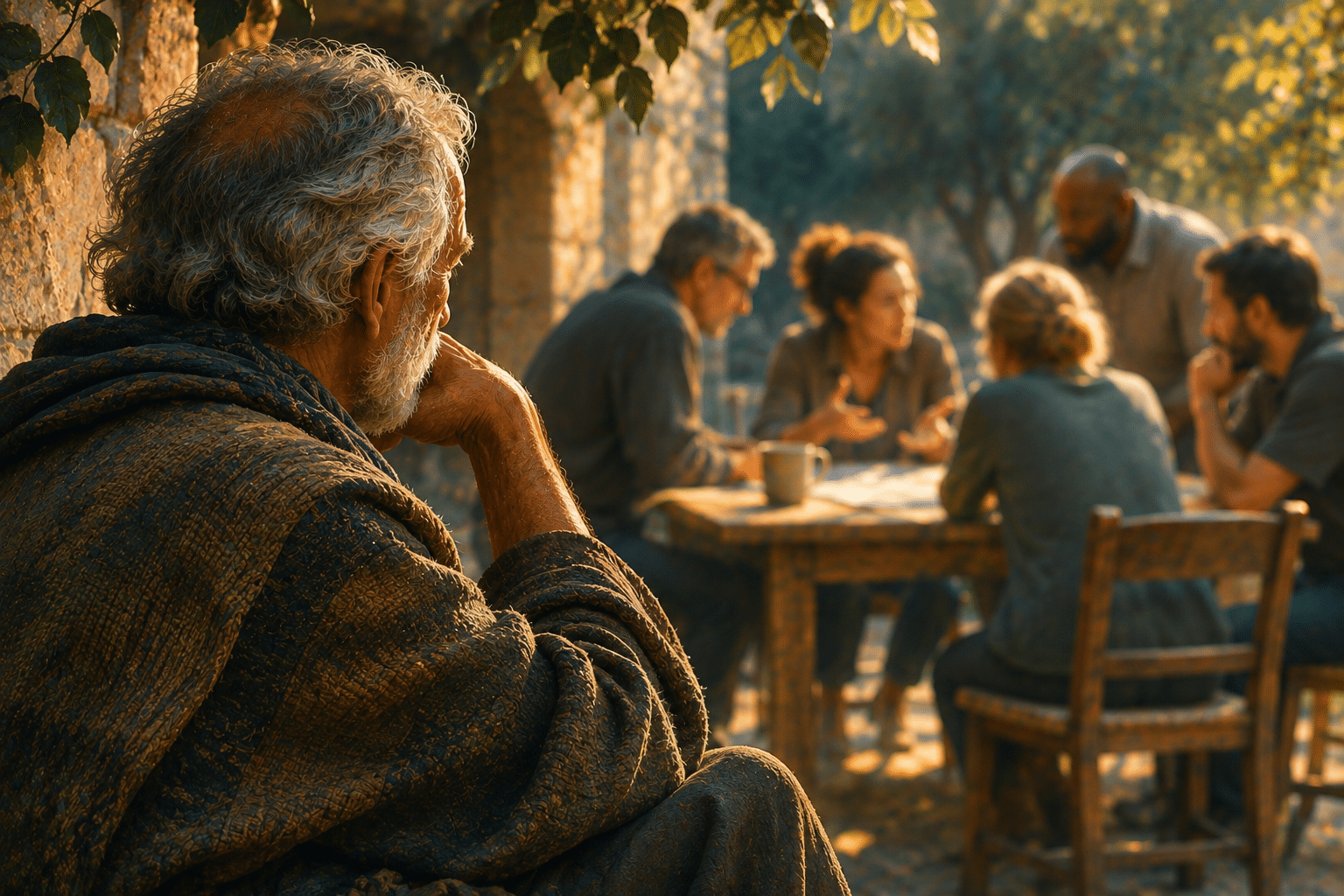
An older man in the foreground watches a group of people seated around a table in conversation outdoors in warm afternoon light.

The monastics who went out into the Egyptian desert in the fourth century had no credentialing body — no application, no committee, no letters after anyone’s name. People walked out to where somebody was living, sat down, and said: abba, give me a word. Amma, if it was a woman. That was the whole transaction. Not a program, not a strategy — a word, something short and often strange, which the asker carried around for a year.

Notice who made the elder. The askers did. The office existed because people kept coming, and it would have ended the day they stopped. Which is the same shape as the thing I learned in Italy: an identity handed to you by other people, with no document in the transaction.

It also explains why advice is the Hero’s instrument and a word is the Elder’s. The Hero knows, and the knowing is proof of capacity. A word is offered and let go of, and whether anything comes of it is none of the giver’s business. You cannot give a word while you are still using your answers to prove something.

You cannot claim it. You can only become askable.

So what do you do, if you want the office and nobody is handing it out? Nothing that looks like applying. An elder who announces himself is seniority with a grievance. The only move available is to become the kind of person it makes sense to ask — reachable, honest about what you got wrong, done performing wisdom, and willing to be asked at an inconvenient hour by someone whose problem is not interesting.

Then the other half. The elder is not only the one who can be asked. The elder is the one who asks. Not let me know if you need anything, which hands the work back to the person already underwater. The four words two Italians used on me in a car park: what do you need first?

Anyone who asks that is doing the office, whatever their age.

What it costs, and the word I used

I will not pretend this is painless. It means being consulted less than you are capable of advising, with your influence running entirely on other people choosing to ask. After forty years of needing nobody’s permission to act, that is a real loss and I feel it.

What you get is larger and harder to name. The Hero is exhausting to be and exhausting to be near. People brace around a Hero. Nobody braces around an elder, which is exactly why they come.

Zweig was initiated as an Elder in a formal ceremony by a community that still performs them, and I am glad such things exist. But the ceremony did not make her one — it recognised something already underway. The rite ratifies; it cannot manufacture.

Which settles the question I have been circling since the passport. Everything else that proves me was issued by somebody and can be taken back in an afternoon — the title, the credentials, the body, the document in the drawer. This one is different, and not because it is more secure. It is different because it was never issued at all.

It is not a rank. It is a practice. And when I understood that, the word that came was not finally, and it was not at last. It was all right — the weight off the back arriving not as triumph but as permission.

Two chairs. A drink beside each of us. Somebody older than me has been doing this so quietly, for thirteen years, that it took me most of that time to notice it was a job.

A companion reflection sheet for this post: Who Comes to You (PDF).

About Jim & Dr. Lynette Vaive

Jim Vaive and Dr. Lynette Vaive are the co-founders of Spirit of EQ, where they work with leaders and seekers worldwide in coaching, training, and spiritual direction. Jim is a Master Certified Coach and Lynette a Professional Certified Coach; both are certified Narrative Enneagram teachers and Certified Spiritual Directors. Dr. Lynette Vaive’s doctoral research is the scholarly foundation of the Spiritual Emotional Intelligence (SEQ) framework. Together they write The Mystical Seeker on Substack and are co-authoring a book on SEQ. Reach them at jim@spiritofeq.com and lynette@spiritofeq.com.

Sources

Connie Zweig, The Inner Work of Age: Shifting from Role to Soul (Park Street Press, 2021), foreword by Harry R. Moody. Zweig is also co-author of Meeting the Shadow.

The form “give me a word” is from the sayings of the Desert Fathers and Mothers (the Apophthegmata Patrum), fourth-century Egypt.

Richard Rohr, “Our Life’s Call,” Daily Meditations, Center for Action and Contemplation, 13 November 2026.

© 2026 Spirit of EQ

Detroit Eight: From Fury to Integrated Nonviolence

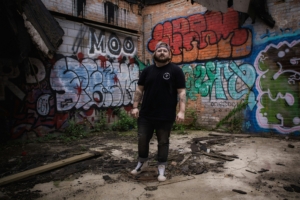
I grew up in Detroit, a city of factories and funeral parades, Motown records and mended fences. The streets I learned to walk on were loud with engines and louder still with ambition. In that city — in that era, especially — toughness was currency. I learned early to stand my ground, to protect my own, to make my small kingdom unassailable. I was quick to anger, 0 to 60 in a tenth of a second. I would ask myself, (because I did not like who I was) what’s wrong with me? No answer came that felt right, and the pattern repeated and repeated: I’d lash out, hurt people I loved, and then retreat into shame. For a long while that cycle defined me.

It took a long time — and a lot of embarrassing, painful failures — before I started to look for explanations that could become pathways instead of the same dead ends. That search, over the last 45 years, led me through countless trainings, retreats, and relationships. I studied plenty of systems and skills, but one of the most meaningful things I discovered was the Narrative Enneagram. Within that circle of nine, I found my number. I was an Eight! At first, being an Eight offered relief — finally a label that explained the force that drove me. But labels can also be prisons. I saw that I was not “integrated.” I was functioning at half speed, armed and dangerous, without most of the inward tools that make a life human.


When people talk about Detroit in the 1960s, they talk about dynamism and danger together. It was a place of industrial might — auto plants humming, assembly lines that made America mobile — and it was also a city simmering with social change, racial tension, and the scream of a neighborhood that felt squeezed. The Detroit of my youth carried the echoes of the Great Migration and the rising voice of civil rights. The city’s heartbeat was Motown: Berry Gordy’s miracle where Black voices found national airwaves and a kind of dignity that shimmered in lacquered records. Yet alongside that soundtrack was the sound of helicopters over riots, the crack of police batons, and the heavy grief of lives upended in streets that once felt safe.


In that environment, my Eight side learned to armor up fast. Eights, by temperament, protect themselves and others. We can be decisive, direct, and resolute. But when an Eight is not integrated — when the strength becomes defensiveness, when the will becomes domination — the results are destructive. I protected, but too often that protection translated into control. I could make things erupt and keep going long after the battle was over. Nonviolence? It felt distant, like a lighthouse across a foggy dreamscape — brilliant and unreachable.

The turning point was not a single dramatic event. It was a slow bringing together of consequences: the relationships I broke, the loneliness that followed victories, the growing realization that power without wisdom made me small, not big. I began to understand that being an Eight did not have to mean living in constant fight or flight. My work — a lifetime of practice — became a work of integration: bringing heart into will, softness into strength. Becoming a Narrative Enneagram Teacher was more than a credential; it was a map and a mirror. The map helped me see the directions toward healthier functioning. The mirror showed me what I had been avoiding: pain, vulnerability, and the need to learn how to love without expecting payment.


Part of what made this path possible was a latent contemplative streak. Even as a tough kid in Detroit, I had a part of myself drawn to silence, to long walks, to listening. But that contemplative part and my Eight-protector part were at war. It took years, and a lot of gentle but relentless practice, to let the contemplative side come in and lead sometimes. Nonviolence slowly revealed itself not as weakness, but as another kind of courage — a deeper, riskier courage that asks you to enter the world without armor and to offer dignity to people who may not deserve it by any conventional measure.


Nonviolence as an ethic is often mistaken for passivity. But the courage to be nonviolent is active; it is fiercely moral. It expects nothing in return. It sees others with dignity and honor. It listens more than it talks. It walks with, sits with, eats with, cries with, works with, and is present with. For me, this shift was seismic. I began practicing presence, sitting still with discomfort instead of scattering it with aggression. I learned restraint — not the brittle restraint of suppressing emotion so it later detonates, but the integrated restraint of feeling fully and choosing a wise response.

Detroit taught me a lot that helped on this path. In the 60s, the city showed both the worst and the best of human responses to pressure. It taught an appreciation for community — neighbors who checked on one another, churches that organized, and storefronts that doubled as meeting houses. It taught resilience. Coming out of factories and through hard winters taught people how to persevere; it taught me, too, that endurance can be tempered with tenderness. The music was a school of its own. Motown taught us how to turn sorrow into voice, outrage into rhythm, and marginalization into artistry. That artistry taught me how expression can be both a release and a bridge.


Becoming a healthy Eight required that I relearn power. True power, I discovered, is not about the loudest voice or the most forceful stance. True power is presence. It is the capacity to hold complexity without collapsing into defensiveness. It is the humility to ask for help. It is the willingness to risk being known as imperfect. I practiced sitting with people I feared, letting them see me, letting me see them. I practiced listening without planning my rebuttal. I practiced the kind of attentiveness that honors the other as worthy.


Was it easy? No. I would be lying if I claimed to have become saintly. Old habits die slowly and some are stubborn in their refusal to die. I am still not perfect. But the change has been profound. The storms have calmed. I have real peace now — a presence that feels more alive and less like a bluff. And that peace has given me the capacity to teach from a place of empathy rather than coercion. As a Narrative Enneagram Teacher, MCC (Master Certified Coach), and a Spiritual Director I don’t just help people identify their numbers; I help them see the paths toward integration: how to bring heart to will, how to temper justice with mercy, how to turn fierce protection into compassionate stewardship.


This journey taught me a lesson that reaches beyond personality systems: transformation is possible when courage is directed inward. The bravest thing I did was not a heroic outward act, but a quiet, repeated turning inward — to ask hard questions, to allow grief and shame to be felt, and to choose differently each time. From Detroit’s fists and furnace, I forged a softer kind of steel: resilient, flexible, and honest.


If you are an Eight reading this, or the loved one of an Eight, know this: your force can be your greatest gift when it is integrated with tenderness. Try to see the lighthouse of nonviolence not as a retreat but as a harbor. If you are someone who grew up in tough places — in cities of industry and unrest, where survival required a hard face — know you can let down that face without losing yourself. You can keep your dignity while showing vulnerability. You can hold others without crushing them.


If you are not an Eight, perhaps you recognize in this story a pattern you know well: a part of you that is reactive; a part that wants to protect at all costs. Our work is similar: to find the courage to be less sure, more present, more generous with silence and attention. To listen. To walk with. To sit with.


I won’t pretend the path is quick. It took me decades to move from a default of fury to a life where peace is possible. But the effort is worth it. The city taught me that too — to endure, to repair, to keep making music even when the world is cracked. There is a tenderness in Detroit that does not compromise grit. There is a sanctity in power when it is used to steward rather than dominate.


Try it. Sit in an uncomfortable silence, and don’t fill it with force. Walk toward someone you fear and stay long enough to see them. Speak quietly when the instinct is to roar. You might be surprised by how powerful you can be when you are softer. You might just like it.

Peace and every good.