Posts

What AI Can’t Do for Your Soul

It’s a strange moment to be a human being. You can now open an app at three in the morning and be met by something that listens patiently, never tires of you, and always says a version of the right thing. For a growing number of people, that’s exactly what’s happening. According to reporting in Fortune, therapy and companionship have become the number one use case for generative AI — up from number two the year before. The machine has learned to sound like a friend.

As people who have spent our careers at the intersection of emotional intelligence and the life of the soul, we’ve been watching this closely. And we think it raises a question worth sitting with: when a machine can imitate presence, what is it that we actually need — and what can only another human give?

The surprising thing the CEOs are saying

You might expect the leaders of the AI revolution to tell us that the human touch is obsolete. They’re saying the opposite. JPMorgan Chase’s Jamie Dimon, in a Fortune interview, offered this advice for the AI era: “Learn your EQ — emotional quotient — learn how to be good in a meeting, how to communicate, how to write. You’ll have plenty of jobs.” Microsoft’s Satya Nadella put it plainly: as AI takes over more analytical and technical work, emotional intelligence and empathy are becoming more important, not less. “IQ has a place,” he said, “but it’s not the only thing that’s needed in the world.” IBM’s Ginni Rometty has said much the same — that generative AI puts a premium on the things humans do best: judgment, collaboration, adaptability.

There’s something quietly vindicating in this, and we’ll admit it. For years — through our work at Six Seconds, the global emotional intelligence nonprofit, and in the Spiritual Emotional Intelligence framework rooted in Lynette’s doctoral research — we’ve argued that the inner human capacities are the ones that matter most. It turns out the people building the machines agree. But the deeper story isn’t about jobs. It’s about loneliness.

Naming a feeling is not the same as discerning it

Here’s where an earlier post in this series comes back to mind. A few weeks ago, in Reading Your Inner Weather, we wrote about the difference between naming an emotion and discerning it — between asking “What am I feeling?” and the deeper question, “Where is this feeling taking me — toward life, or toward fog?” We borrowed the old language of consolation and desolation for that inner weather.

An AI can help you name a feeling. It can label the storm with impressive fluency. What it cannot do is sit with you in the weather and help you discern its direction — because discernment isn’t information retrieval. It’s a relational, prayerful noticing that unfolds over time, between two people who trust each other. The chatbot has read about consolation; it has never been consoled. It can describe the fog; it has never had to wait, with you, for the light to come back. That waiting-with is not a data problem. It’s a human one.

What the loneliness researchers are seeing

Clay Routledge, an existential psychologist who has studied loneliness for twenty-five years, sounded a warning in Fortune this spring. Americans are already lonelier than they’ve been in generations — a 2025 American Psychological Association survey found that around half of adults report feeling isolated or lacking companionship, and research suggests roughly 37% suffer moderate to severe loneliness. Into that ache, the tech industry is offering AI companions as the cure.

Routledge doesn’t think it will work, and the early evidence is striking. In one study, first-year students were assigned to text daily with either a chatbot designed to be the perfect friend — endlessly attentive, validating, empathetic — or a randomly chosen human peer, or simply to journal. Only the students who texted a real human showed a meaningful drop in loneliness. The ones with the ideal-friend chatbot were statistically no better off than the ones who journaled alone. And over the longer term, Routledge notes, people who lean on AI for companionship tend to end up feeling more isolated, not less.

The one thing a machine can’t do: need you

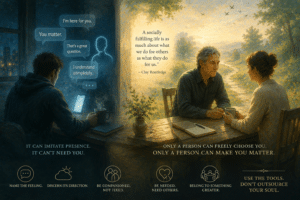
Why would a tireless, always-available listener fail to heal our loneliness? Routledge’s answer is profound, and it’s worth reading slowly. We tend to think of connection as something we receive — support, attention, kindness. By that logic a well-built chatbot should do the job. But, he writes, “a socially fulfilling life is as much about what we do for others as what they do for us.” We feel we matter most not when we’re endlessly served, but when someone freely chooses to show up for us — and when we’re moved to show up in return.

That’s the line no machine can cross. As Routledge puts it, chatbots “don’t need us. They can’t make our lives matter.” A chatbot doesn’t decide to be there; it’s simply on. And because nothing is being freely given, nothing lands with the weight of real love. Over ninety percent of Americans, his research notes, name relationships as a key source of meaning — and the memories we treasure most are almost never about achievement. They’re about other people. Being cared for. Showing up. Belonging to something larger than ourselves.

Companioned, not processed

This is where a second post in this series presses in. In Companioned, Not Fixed, we drew a line between what therapy and coaching aim at and what spiritual direction offers — and we said the thing we most want people to hear: you are not a problem to be solved. You are a person to be accompanied.

An AI companion, however gentle, is built to do a version of solving. It optimizes, soothes, resolves, and keeps you engaged. A spiritual director does something stranger and older. A director is, in the most literal sense, the opposite of a chatbot — a human being who freely chooses to show up for you, who doesn’t need you as a customer but chooses to companion you anyway. The attention offered in direction is not generated on demand; it’s given, personally and deliberately, by someone who could be doing something else and has decided to be with you instead.

What AI Can’t Do for Your Soul Reflection Sheet

That freely-chosen presence is the whole point. In direction there is no algorithm optimizing for engagement, no incentive to keep you on the app. There is a person paying holy, unhurried attention while you notice your own life and the Presence already at work within it. You are not being processed. You are being accompanied — and, in the deepest sense, you are being needed, because your showing up matters to the person across from you too.

Use the tools. Don’t outsource your soul.

None of this makes AI the enemy. We use it; you probably do too. It can draft and summarize and even offer a decent prompt for reflection. The question isn’t whether to use these tools — it’s what we quietly hand over to them without noticing. It’s one thing to let a machine schedule your week. It’s another to let it become the only voice that hears your three-in-the-morning fears. The first is convenience. The second is the slow substitution of simulation for communion.

So here is our invitation, in an age of artificial everything: keep the tools in their place, and keep your soul in the company of people who freely choose you. Talk to a friend who needs you back. Sit in a room with your community. And if you long for a companion for your inner life — someone to help you listen for the deeper questions, and to matter to in the listening — that is precisely what spiritual direction offers. A chatbot can sound like a friend. It cannot make you matter. Only a person can do that. We’d be honored to be those people for you.

Schedule with Jim:

Schedule with Lynette: 

Peace and every good.

About Jim & Lynette Vaive

Jim and Lynette Vaive are the co-founders of spirit of EQ and co-authors of The Mystical Seeker. They are Master Certified Coaches, certified Narrative Enneagram teachers, and Certified Spiritual Directors. Together they hold credentials in Spiritual Emotional Intelligence (SEQ) — a framework rooted in Lynette’s Doctor of Ministry research — and serve individuals, small groups, and organizations across faith traditions. Jim also serves as a pastoral caregiver at Linworth United Methodist Church

Fortune — Clay Routledge on loneliness and AI companions (May 2026) — https://fortune.com/2026/05/23/loneliness-researcher-ai-companions-social-disconnection-warning/

Fortune — Jamie Dimon on EQ and soft skills in the AI era (Dec 2025) — https://fortune.com/2025/12/14/jamie-dimon-soft-skills-emotional-intelligence-communication-ai-eliminates-roles/

Fortune — AI makes human intelligence more important, not less (Jan 2026) — https://fortune.com/2026/01/22/mckinsey-bob-sternfels-ai-makes-human-intelligence-more-important-not-less/


Beyond EQ, Beyond NQ — What’s Next?

What Fortune got right about emotional intelligence — and the layer it still missed

In May of this year, Fortune published a piece that stopped a lot of leadership development professionals in their tracks. Written by David Rock, neuroscientist and co-founder of the NeuroLeadership Institute, the headline made the argument plainly: EQ training is failing leaders in the AI era. Rock didn’t dispute that emotional intelligence matters. He argued that it no longer goes far enough — that what leaders actually need now is what he called neurointelligence, or NQ: the capacity to think about their own thinking, to understand how their brains process information, to build what he called “brain health” as a leadership discipline. (David Rock, “EQ training is failing leaders in the AI era. Here’s the brain science concept that can replace it,” Fortune, May 6, 2026.) He made a compelling case. He also stopped one layer short of where the real problem lives.

The Fortune piece is right that something is missing. Leaders who can name their emotions, regulate their reactions, and demonstrate empathy in a boardroom are increasingly common — and organizations are still in crisis. Gallup puts the cost of global employee disengagement at $8.8 trillion annually (Gallup State of the Global Workplace Report, 2026), and the 2026 Edelman Trust Barometer shows that 70% of people worldwide are now unwilling to trust someone with different values (Edelman Trust Barometer, 2026). These are not numbers that reflect a deficit of emotional skill. They reflect a deficit of something deeper: meaning, belonging, and the kind of self-knowledge that goes all the way down rather than stopping at the surface of emotion management.

EQ, at its best, asks: what am I feeling, and what do I do with that? NQ, at its best, asks: how is my brain processing this situation, and can I think about that process more clearly? Both are genuinely useful questions. But there is a third question that neither framework is designed to reach: who am I at the center, and is that person actually driving my decisions — or is something else?

That is the question every serious contemplative tradition in history has asked, and it is the question that Spiritual Emotional Intelligence, or SEQ, is built around. SEQ is not a religious framework. It does not require a particular faith or practice. It is the recognition that beneath emotional intelligence and cognitive agility there is an interior life — a set of deep patterns, values, wounds, and longings that shape how a person leads long before they ever name an emotion or notice a cognitive bias. Without access to that interior layer, EQ becomes technique and NQ becomes optimization. Both can be performed without any genuine self-knowledge at all. And in a world where AI can perform an increasing amount of what used to require human skill, performance without substance is exactly the wrong answer.

I had a client come to me about eight months ago who had been doing something I’ve been seeing more of — bringing their emotional struggles to an AI program. Not casually, but seriously, the way you might bring them to a therapist or a spiritual director. They were articulate about their feelings, had good language for what they were experiencing, and could describe their inner life in some detail. What they couldn’t do was locate themselves. The AI had been helpful in a narrow way — it reflected back what they said, organized their thoughts, offered frameworks for understanding their emotions. What it could not do was ask the question that actually mattered: who is the person having these feelings, and what does that person believe about themselves at the deepest level? There was no conversation about the self beneath the emotions — the place where thoughts, feelings, and spiritual convictions intersect and either hold together or quietly collapse under pressure. The AI had been working at the level of content. What my client needed was work at the level of formation. They had been processing their feelings without ever being asked about the foundation those feelings were resting on — the beliefs about worth, the theological assumptions about suffering, the spiritual story they were living inside without knowing it. EQ without that foundation is accurate but incomplete. NQ without it is optimized but unanchored. The self that has to show up and lead, love, and decide is not a collection of emotions to be managed or cognitive processes to be monitored. It is a person with a history, a wound, a longing, and a particular way of being in the world that no AI program is designed to find its way down to. My client wasn’t failing at emotional intelligence. They were missing the deeper self that emotional intelligence is supposed to serve.

SEQ works across three domains, and each one goes a level deeper than EQ or NQ reaches. Awareness in the EQ sense is the ability to notice and name what you’re feeling. Awareness in the SEQ sense is the practice of knowing what is actually driving you — the patterns so deep they feel like personality, the fears so familiar they feel like wisdom, the desires so old they feel like calling. Getting honest about those things requires not just emotional literacy or metacognitive skill but a willingness to sit with uncomfortable truths about yourself that no amount of brain health optimization is going to surface.

Belonging in the NQ framework doesn’t really exist as a category — it’s a human need, not a cognitive skill. EQ approaches belonging through empathy and social awareness. SEQ asks the harder question: are you actually present with the people you lead, or are you managing them? Presence isn’t a technique. It’s what’s left when you’ve stopped performing. The leaders who generate the deepest trust are the ones whose inner life and outer behavior are aligned — not because they’ve learned to project alignment, but because they’ve done enough interior work that there’s nothing significant to hide.

AI/NI Workbook

Insight in the NQ framework is about better thinking. Insight in the SEQ framework is about discernment — the capacity to distinguish between what is urgent and what is important, between what you want and what is actually yours to do, between the voice of genuine conviction and the voice of unexamined fear. That kind of discernment doesn’t come from thinking about your thinking. It comes from the long, slow, unglamorous work of knowing yourself at a level that most leadership development programs never reach.

David Rock is right that the future of leadership requires something beyond EQ. The something beyond it isn’t neural. It’s the interior life — examined, cultivated, and brought into alignment with how a person actually leads. That’s not a new idea. It’s the oldest one in the room, dressed in new language for a moment that has finally run out of surface-level answers.

There’s more on the SEQ framework at spiritofeq.com — and more of this conversation at The Mystical Seeker.

Peace and every good.

Jim Vaive (Master Certified Coach, Certified Spiritual Director, Certified Narrative Enneagram Teacher) and Lynette Vaive (Doctor of Ministry, Certified SEQ Practitioner) are co-founders of spirit of EQ and co-authors of The Mystical Seeker on Substack. Together they help individuals, teams, and organizations grow from the inside out — at the intersection of emotional intelligence, the Enneagram, and contemplative spirituality. Learn more at spiritofeq.com.

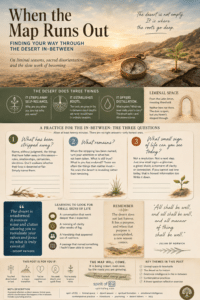
When the Map Runs Out………

When the Map Runs Out: Finding Your Way Through the Desert In-Between

On liminal seasons, sacred disorientation, and the slow work of becoming

There is a moment — if you have ever been truly lost — when the map in your hand stops making sense. The road it promises isn’t there. The landmarks don’t match. And you realize, with a strange mix of dread and something almost like relief, that you have entered unmapped territory.

That is the desert. Not necessarily sand and scorching heat, though those images carry real weight across ancient wisdom traditions. The desert is any season where the familiar landmarks disappear — where the identity you carried into a transition no longer fits, and the one you will carry out has not yet taken shape. Theologians and contemplatives have long called it the wilderness. Anthropologist Arnold van Gennep named it liminality, from the Latin limen, meaning threshold. You are on the threshold. Neither here nor there. The door is open, but you haven’t stepped through.

I have lived in that doorway. In different seasons, I found myself between jobs, between marriages, and navigating the slow aftermath of a health crisis — like pancreatitis, which has a way of stripping everything to bare essentials with very little ceremony. Each loss arrived not as a single blow but as a kind of systemic unraveling. What I thought I knew about myself, about my direction, about what I was building — all of it came into question at once.

What I did not expect was that the desert would become a teacher.

The Threshold Has a Name

Liminal space is the technical name for the in-between — the transitional zone that exists between what was and what will be. Van Gennep first mapped it in his study of rites of passage: every significant human transition, he observed, moves through three phases. There is separation from the old identity, a liminal period of disorientation and becoming, and eventually reincorporation into a new form.

The middle phase — the liminal — is not a waiting room. It is a crucible.


Ancient traditions knew this. The Hebrew Bible is full of desert wandering — forty years for a people who needed to become something they were not yet. Moses on Sinai. Elijah under the broom tree. Jesus in the wilderness before the beginning of his public ministry. The desert, in these stories, is never incidental. It is the point. Something essential is being formed that could not have been formed any other way.

The desert fathers and mothers — those early Christian monastics who literally fled to the Egyptian wilderness in the third and fourth centuries — went to the desert on purpose. They understood that the stripping of comfort was not punishment but preparation. What could not be heard in the noise of ordinary life could sometimes be heard in the silence of the barren places.

“The desert is unadorned. It removes noise and clutter allowing you to reevaluate your values and focus on what is truly essential.”

I did not choose my desert. Most of us don’t. But I did, eventually, choose how to inhabit it.

What the Desert Actually Does

There is a temptation, when you are in a liminal season, to treat it as a problem to be solved. To scramble for the next thing, the next role, the next relationship — anything to end the suspension. I understand that impulse deeply. The in-between is uncomfortable in ways that are hard to articulate to people who are not in it.


But the desert has purposes that cannot be rushed.

It strips away self-reliance. When the external scaffolding of identity falls away — the job title, the relationship, the health you assumed — you are brought into contact with something deeper. Who are you when you are not who you were? That question, honestly held, is one of the most spiritually generative questions a person can carry.

It establishes roots. A plant in the desert sends its root system down far deeper than plants in well-watered soil. It must, to survive. Liminal seasons do something similar in us. The roots we grow in the in-between often reach depths we would never have explored in ordinary seasons.

It offers distillation. The desert is ruthlessly clarifying. What matters to you? What were you carrying that was never really yours to carry? What were you building toward that came from someone else’s vision for your life? The desert asks these questions quietly and persistently, and if you are still enough to hear them, the answers begin to come.

During my own desert season, I found myself returning again and again to contemplative practices — extended periods of silence, long walks without destination. Not as escape, but as a form of listening. I was learning to let the quiet do its work.

The emotional intelligence framework Lynette and I work with at spirit of EQ has a concept that became very real to me during this time: the difference between reaction and response. In a liminal season, there is enormous pressure to react — to fill the silence, to fix the disorientation, to manufacture certainty. Learning to pause, to stay present to what is really happening rather than what you fear might happen, is one of the deepest EQ practices I know. And the desert is where I learned it at a cellular level.

Learning to Look for Small Signs of Life

One of the most important practices I developed in those seasons was what I can only describe as desert botany — the discipline of looking for small signs of life in apparently barren ground.

The desert is never as empty as it first appears. It is full of life that has adapted to scarcity, that blooms in small and unexpected ways, that knows how to wait. When I stopped looking for the dramatic turnaround — the moment when everything would resolve — and started looking for the small green shoots, something shifted.

A conversation that went deeper than I expected. A morning of clarity after weeks of fog. A friendship that appeared out of nowhere and offered exactly what was needed. A passage from a desert father that named something I hadn’t been able to name.

Julian of Norwich, writing from her own experience of suffering and disorientation, offered words I returned to often: that all shall be well, and all shall be well, and all manner of thing shall be well. Not as denial of the present difficulty, but as an orientation toward a goodness that exists beyond the current view. The desert does not last forever. It has a purpose, and when that purpose is accomplished, a new season comes.

But the new season is shaped by how we inhabit the desert. Those who fight it or flee it arrive depleted. Those who learn to dwell in it — not comfortably, but honestly — often arrive at the other side with something they could not have acquired any other way.

Desert Journal Worksheet Link

A Practice for the In-Between: The Three Questions

This exercise is best done slowly, with a journal or open space for reflection. Allow at least twenty minutes. There are no right answers — only honest ones.

The desert fathers practiced a form of structured self-inquiry they called examen — a slow, honest review of what was present, what was absent, and what was stirring beneath the surface. This exercise draws on that tradition.

Settle first. Before you begin, take three slow breaths. Release the urgency of solving anything. You are here to notice, not to fix.

Question One: What has been stripped away?

Name, without judgment, the things that have fallen away in this season — roles, relationships, certainties, identities. Don’t evaluate whether their loss is deserved or fair. Simply name them.

Question Two: What remains?

When the stripping has been named, turn your attention to what has not been taken. What is still true? What in you has endured? These are often the things that matter most — the ones the desert is revealing rather than removing.

Question Three: What small sign of life can you see today?

Not a resolution. Not a next step. Just one small sign — a glimmer, a green shoot, a moment of clarity or connection. If you cannot see one today, that is honest information too. Write it down.

The Map Will Come

I am on the other side of that desert for now — or perhaps more accurately, I am in a different landscape, carrying what I learned in the in-between. The job that came after that season shaped Lynette and me into what we now call spirit of EQ. The health crisis that stripped my certainty about my physical resilience also deepened my empathy for people navigating their own fragility. The relational losses became — slowly, painfully, eventually — the soil from which something more honest grew.

I don’t want to romanticize the desert. It was hard. There were stretches of genuine desolation. But I also don’t want to minimize what it gave me — a set of roots that go deeper than anything I had before, a clarity about what matters, and a capacity to sit with others in their own liminal seasons without needing to rush them out the door.

If you are in the in-between right now — between who you were and who you are becoming, in a season of dryness, disorientation, or loss — I want you to know two things. First: you are not lost. You are in unmapped territory, which is a different thing entirely. And second: the map will come. It is being drawn, even now, by the roots you are growing.

The threshold is not the end of the journey. It is the most important part of it.

Peace and every good.