Thin Places That You Don’t Notice
Thin Places
The thinnest ground you will ever stand on is probably within a mile of your bed.
It is a Tuesday. You are standing at the kitchen sink with your hands in the warm water, or sitting on the back steps while the light goes long and gold, or in the chair where you always sit, and the house is quiet in a way it usually is not. Nothing happens. Nothing you could put in a report. And yet for a moment the ordinary goes quietly transparent, and you have the distinct sense that you are not alone in the room — that the world has worn thin right here, over the sink, on a Tuesday.
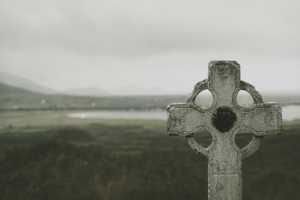
The Celtic Christians had a name for that: a thin place. The idea is that the usual distance between heaven and earth — between the material and the spiritual, the seen and the unseen — sometimes narrows almost to nothing. There is an old Celtic saying that heaven and earth are only three feet apart, but that in the thin places the distance is smaller still.

Yes, there are famous ones. That is not the point.
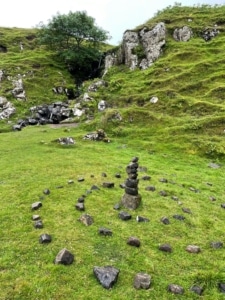
You may have heard the phrase attached to islands. George MacLeod, who refounded the Iona Community on that windswept Scottish island, is remembered for calling Iona “a thin place where only tissue paper separates the material from the spiritual” (The Living Church). Pilgrims say similar things about Lindisfarne, about Skellig Michael out in the Atlantic, about certain holy wells and standing stones. All of it is true, and if you ever get to stand on that kind of ground, go.
But if thin places are mostly islands off the coast of Scotland, then thin places are for people with money and vacation time, and that cannot be what the Celts meant. It is not, in fact, what they meant at all.
The Celts blessed the kitchen
Look at what they actually prayed. In the Carmina Gadelica — the great collection of Gaelic prayers and blessings that Alexander Carmichael gathered from Highland and Hebridean households in the 1800s — you find blessings for kindling the fire in the morning and for smooring it, banking the coals, at night. Blessings for milking the cow. For walking out. For making the bed and lying down in it (Carmina Gadelica). These were not pilgrims on a holy island. They were farmers and fishermen and tired women with cold hands, blessing the hearth in their own kitchens before dawn.
Which means the tradition we are borrowing from was never mainly about famous places. It was about the hearth. The doorway. The byre. The work of your own hands on an ordinary morning. They assumed the veil was thin right where they were standing, and they talked to God accordingly — not on retreat, but while lifting the peat.
The night on the back steps with Lincoln
One winter night I was sitting on the back porch steps with Lincoln. It was snowing. It was dark and cold and completely quiet.
Lincoln was a big golden retriever who almost never sat still — he loved everything and everybody, all the time, at full volume. But that night he sat. The two of us stared off into the dark together, our breath slowing until it seemed to wrap something gentle around us both.
And then everything stopped. The stars stopped moving across the sky. The sound around us stopped. Even the snow seemed to freeze mid-dance. We were still on the back steps, and we were somewhere else — a thin place. I did not decide that. It simply was.
And here is the part I still cannot explain: both of us knew. The dog knew. Something different was happening, right here and right now, and we were not observing it. We were being met. We felt seen.
Jacob was not on pilgrimage
Scripture backs this up in a way that should be a relief to all of us. Jacob was not on a spiritual retreat. He was running from his brother, sleeping rough in an unremarkable patch of wilderness with a stone for a pillow, and he dreamed of a ladder with angels going up and down between heaven and earth. He woke and said one of the most arresting lines in the whole Bible: “Surely the LORD is in this place, and I did not know it” (Genesis 28:16).
Read the second half slowly. The place did not change overnight. No one installed the holiness while Jacob slept. What changed was Jacob. The ground had been thin the entire time; he had simply been walking on it with his mind elsewhere, the way we all do — until a dream cracked him open enough to notice. He had been sleeping on the gate of heaven and calling it a rough night.
The ones near you
So look closer to home than you have been looking. A hospital corridor at three in the morning. A church basement with bad coffee and folding chairs, where somebody finally tells the truth. The cemetery you drive past on the way to work. The river in fog. The garage. The kitchen table after everyone else has gone to bed. The drive home from something hard, when you sit in the car in the driveway a minute longer before going in.
And the nearest one of all is about five and a half feet tall and goes everywhere you go. Your own body is a thin place — the breath that keeps arriving without your permission, the hands that know the work before you think it through, the gut that registers a room before your mind has words. If God is anywhere, God is at least as close as that.
Then there is this, which we have come to believe is the thinnest ground of all: sometimes the thin place is a person. The space between two people who are actually present to one another — in a direction session, in a marriage, at a bedside, in the silence after something true has finally been said — can be more transparent than any island. Ask anyone who has sat with the dying. They will tell you, often haltingly, that the room felt different. That they were standing somewhere they had not been before.
Sitting with Ernie
Ernie’s family asked me to sit with him. We do not know what to say, they told me. So I sat.
Ernie was coming to the end of his journey, and it had been a very good journey. There was nothing to fix and nothing to arrange. I did not have any words. Neither did Ernie. So we did not use any.
But I knew — the way the body knows things before the mind has language for them — that this was different. Important. Real in a way that most hours are not.
And when it was time, he left. I was holding his hand. In that moment I was standing against the other world. Not near it. Against it — close enough that I could almost have put my hand through and into it. I have never been able to describe it better than that, and I have stopped trying. Some things you do not explain. You carry them.
Why we walk past
So why do we miss so many of them, when they are this close? Consider Moses at the burning bush. The text says something easy to skip: he turned aside to see. Only then does the voice come, and the instruction — take off your sandals, the place where you are standing is holy ground (Exodus 3). The bush was burning before Moses noticed. What the moment asked of him was not belief but attention: the willingness to stop the errand he was on and go look at something that was not on his list.
We have built a world almost perfectly engineered against turning aside. Hurry is its native speed and distraction its default setting; there is always one more thing, one more scroll, one more errand. You cannot rush into a thin place. It does not open on demand and it will not compete for your attention. It simply waits, patient as a burning bush, for someone willing to be late for something else.
Or perhaps it is we who are thick
Here is where the mystics push us further, and we think they are right. If God is genuinely everywhere — if, as Isaiah heard the seraphim sing, the whole earth is full of the divine glory — then perhaps the veil is not thin only in a handful of blessed locations. Perhaps it is thin everywhere, and the variable is not the place at all. Perhaps it is us. Perhaps we are the thick ones.
That reframes the whole spiritual life. The goal is not to collect thin places, pilgrimage by pilgrimage, as though holiness were a destination with a gift shop. The goal is to become thin ourselves — porous, unhurried, awake — so that the ordinary Tuesday and the kitchen table and the person across from you begin to give off the light they have been giving off all along. The saints were not people who found more holy ground than the rest of us. They were people who had grown transparent enough to keep noticing it.
Thin Place Reflection Guide
How to grow thinner
None of this requires a plane ticket, though by all means go to Iona if you can. It requires smaller and harder things. Return to one ordinary place often enough that it stops being scenery. Keep silence long enough to get past the first wave of boredom. Go to the edges — dawn, water, doorways, the hours before the world has organized itself. Let grief and beauty do their slow work instead of managing them. Put your phone in another room and do one piece of work with your whole attention. And when something in you says stop, turn aside — do it, even if you are already late.
You might even do what those Hebridean women did, and simply bless the thing in front of you: the kindling of the fire, the making of the bed, the washing of the dishes, the hand you are holding. Not because the blessing makes the ground holy. Because it was holy, and the blessing is how you finally notice.
“Surely the LORD is in this place, and I did not know it.” That is not only Jacob’s line. It is the sentence waiting at the end of a great many of our days. The whole invitation of the mystical life is simply to shorten the distance between the presence and the noticing — until one day, God willing, there is no distance left at all.
Peace and every good.
About Jim & Lynette Vaive
Jim and Lynette Vaive are the co-founders of spirit of EQ and co-authors of The Mystical Seeker. They are Master Certified Coaches, certified Narrative Enneagram teachers, and Certified Spiritual Directors, and together they hold credentials in Spiritual Emotional Intelligence (SEQ) — a framework rooted in Lynette’s Doctor of Ministry research. Learn more at spiritofeq.com.
Sources
Carmina Gadelica — Alexander Carmichael’s collection of Gaelic household prayers and blessings: sacred-texts.com
The Living Church — “The Thin Place of Iona” (George MacLeod on Iona): livingchurch.org
Scripture: Genesis 28:16–17 (Jacob at Bethel); Exodus 3:1–5 (Moses turns aside); Isaiah 6:3.