
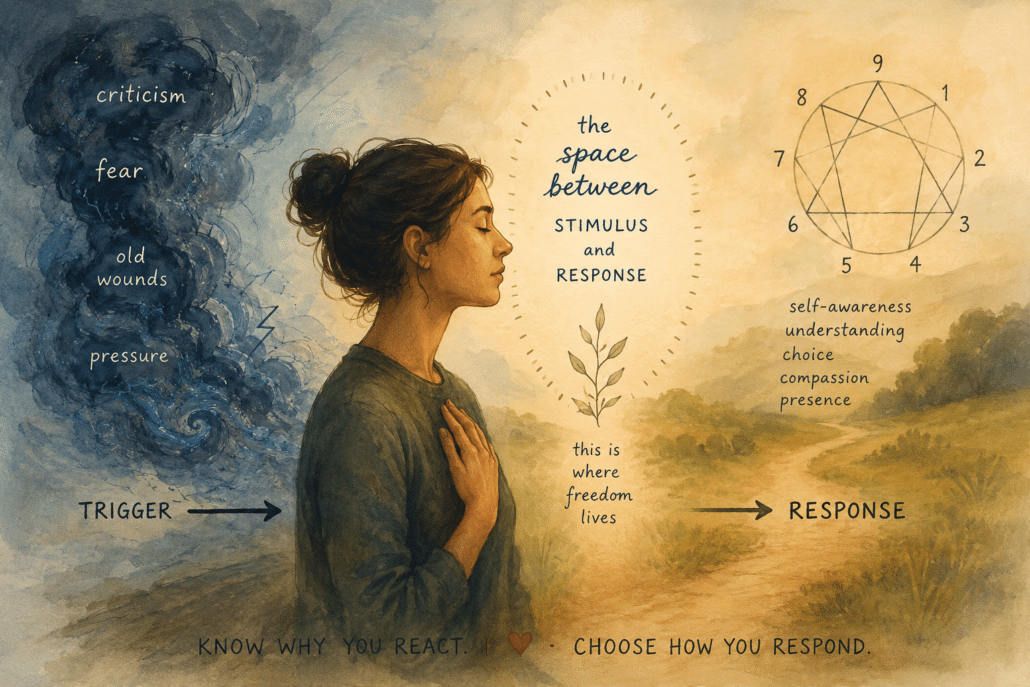
The Most Intelligent Thing You Can Do Is Slow Down
When You Know Why You React, You Can Choose How You Respond
What the Enneagram and emotional intelligence reveal about the space between trigger and response
There is a photograph I keep coming back to in my mind — not an actual photograph, but the kind that forms over years of sitting across from people in coaching conversations. It is the image of a person mid-sentence, eyes slightly wide, voice pitched a half-step higher than usual, saying something they will probably wish they hadn’t. And in the moment before the words arrive, there is this invisible space — a fraction of a second, maybe less — where everything that matters is happening.
Viktor Frankl called it the space between stimulus and response. He wrote about it from inside a concentration camp, which means he earned the right to talk about it. That space, he said, is where our freedom lives. It is also, I’ve come to believe, where emotional intelligence and the Enneagram converge into something genuinely transformative.
The Intelligence Beneath the Surface
Emotional intelligence, as Daniel Goleman mapped it, begins with self-awareness — the capacity to notice what’s happening inside you before it moves through you and into the world. Josh Freedman of Six Seconds distills it differently, into a sequence I return to often: Know Yourself, Choose Yourself, Give Yourself. The knowing comes first. Without it, we are largely reactive — moved by currents we can’t name.
Most of us have experienced this. A colleague’s offhand comment lands wrong and we feel our jaw tighten before we understand why. A family member raises a familiar complaint and we hear ourselves responding in the old way again — the way we promised ourselves we wouldn’t. The reaction isn’t irrational exactly. It’s just faster than our awareness.

This is where the Enneagram enters the room.
A Map of the Interior
The Enneagram is a nine-type system of personality that goes deeper than behavior into motivation — into the core fears and longings that drive us. It is not a label to be worn comfortably. At its best, it is an unsettling mirror, one that shows you not only what you do but why, and what you are protecting when you do it.
A Type Eight (the Challenger) doesn’t lead aggressively because they are cruel. They lead that way because somewhere underneath the forcefulness is a terror of being controlled or betrayed — and strength feels like the only reliable protection. A Type Two (the Helper) doesn’t overextend themselves because they are foolish. They do it because their worth, in some deep and often unconscious way, feels contingent on being needed.
When you understand this about yourself — really understand it, not just intellectually but in the body — something shifts. The reaction doesn’t disappear. But there is more space around it.
The Place Where They Meet
I’ve seen this play out in workshops and in one-on-one coaching more times than I can count. A leadership team I worked with had a Type Eight and a Type Nine in constant friction. The Eight moved fast, spoke bluntly, made decisions before the Nine felt heard. The Nine withdrew, agreed on the surface, and then quietly undermined the direction — not out of malice but out of a desperate need for harmony they didn’t know how to ask for. What made it harder was that both of them were genuinely trying. The Eight believed clarity and decisiveness were acts of respect — waste no one’s time, say what’s true, move forward. The Nine believed keeping the peace was its own form of care — absorb the friction, hold the group together, avoid the rupture. Neither of them was wrong exactly. They were just operating from entirely different interior maps, and no one had ever handed them the other person’s.
When we named what was happening through the lens of both the Enneagram and emotional intelligence, something loosened. The Eight didn’t need to become soft. The Nine didn’t need to become confrontational. They needed to understand each other’s interior logic — and then, from that understanding, choose something different than their default. What I watched happen in that room was not a personality makeover. It was something quieter and more durable: two people recognizing that the other person’s behavior had a reason, and that the reason wasn’t contempt or weakness. That recognition created enough safety for genuine conversation — maybe for the first time in years of working together.
That’s the intersection. The Enneagram names what’s underneath. Emotional intelligence gives you tools to work with it. Together, they create the conditions for what I’d call non-reactive presence — the ability to be fully in a difficult moment without being fully hijacked by it.
Some Places to Begin
If this is new territory for you, here are a few entry points worth sitting with:
- Get curious before you get defensive. The next time you feel a strong reaction — irritation, anxiety, the urge to withdraw or escalate — ask yourself what it’s protecting. Not in a clinical way, but genuinely. What’s at stake for me right now?
- Learn your Enneagram type as a spiritual practice, not a personality quiz. The Narrative Enneagram tradition invites you into the type through lived experience and community, not just a test score. There’s a difference.
- Practice the pause. Frankl’s space between stimulus and response can be cultivated. Centering Prayer, mindful breathing, simple body awareness — any practice that builds your capacity to notice before acting will serve you here.
- Make it relational. Understanding your own type is valuable. Understanding the types of the people you love and work with alongside yours is where transformation tends to happen. The framework becomes a bridge rather than a mirror.
I don’t think any of us become non-reactive all the way down. That would require not being human. But I do believe we can cultivate the capacity to meet our reactions with a little more light and a little less automatic machinery. The Enneagram helps us see ourselves clearly. Emotional intelligence gives us something to do with what we see.
That space between stimulus and response — Frankl was right. Something important lives there. And with practice, we can learn to inhabit it.
If you’re curious about exploring the Enneagram and EQ together — for yourself, your team, or your community — visit spiritofeq.com to learn more about our workshops and coaching.
Peace and every good.
— — —
Subscribe to The Mystical Seeker on Substack — in-depth posts on the contemplative life


