Reflections on self-discovery as an inward journey — the identity and awareness that emerge when you slow down enough to actually look. These posts explore where self-discovery and the contemplative life meet.

From the Frats to the Hippies: How Not Belonging Taught Me to See

Good Enough for This Life

Do you ever think about whether you are good enough for this life?

I ask it that way on purpose — not “good enough at your job” or “good enough for the relationship” but for this life, the whole thing, the fact of being a particular kind of person moving through a world that was mostly built for a different kind of person. It is a question I have carried for a long time. And I want to tell you where it came from, because the origin of this story matters.

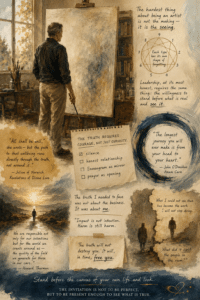
Picture a room full of people who seem to know where to stand. You are at the edge, not by design but because the middle arrived too fast and too loud, because you are already receiving the room — not just the nearest conversation but every conversation, the ambient emotional temperature, the undercurrent of music, the way the light is sitting differently on one side than the other. You are cataloging all of it without meaning to, because that is simply how your mind moves.

I know that room. I spent most of my adolescence looking for the group that would finally let me in — not merely tolerate me but receive what I was bringing. I tried the frats, with their crisp hierarchies and their belonging-by-exclusion, their handshakes and their unwritten ledgers of who counted. I tried the greasers, leather and bravado, a different code but a code all the same, enforced with the same quiet ferocity. I tried the soul brothers, drawn by the warmth and the music and the sense that community here might stretch wide enough to hold more kinds of people. And finally, tentatively, I found the hippies — loose-structured, philosophically suspicious of tight categories, practicing a kind of radical acceptance that was imperfect and sometimes chaotic but real. They were the closest thing to a fit I had found. And even there, I was only partly in.

What I didn’t understand then, standing at the edges of all those circles, was that the thing keeping me out was also the thing that made me able to see.

I have dyslexia and ADHD. Together. Which, if you’ve lived it, means the mind doesn’t run one stream of consciousness but several — simultaneous, layered, cross-referencing, sometimes chasing each other into corners before snapping back. The squirrel jokes are accurate. Mid-sentence, mid-thought, something peripheral catches your sight and suddenly you are somewhere else entirely, following a thread that no one else in the room can see.

What I couldn’t name as a teenager was the experience of receiving a conversation on six channels at once — the words someone was saying and the words they weren’t saying, the slight tension in their shoulders, the way their story didn’t quite line up with their eyes, the ambient emotional weather of the room, the connection to something said three exchanges ago that suddenly mattered now. All of it arriving at the same time. All of it real.

This was not comfortable. For years it was almost unbearable — the sensation of always arriving sideways to the conversation, unable to slow the intake down enough to meet people where they were. I tried to explain it, and it came out tangled. I tried to belong and it came out strange. Large parties still overwhelm me quickly; the signal-to-noise ratio collapses under too many inputs running at once, and I learned early to find the wall, the corner, the quieter edge where the room could be read rather than absorbed whole. And so, the question I carried — quietly, persistently, the way you carry things you cannot put down — was: Am I good enough for this?

Howard Gardner’s theory of multiple intelligences, developed in the early 1980s, named what many people had quietly suspected: that intelligence is not a single axis running from less to more, but a wide range of distinct capacities — linguistic, spatial, musical, interpersonal, intrapersonal, and more — that show up differently in different people, and are cultivated or suppressed depending on the environments those people move through. Ned Hallowell, who has written about ADHD from the inside for decades, describes it as a Ferrari engine with bicycle brakes: enormous processing power that simply needs a different kind of structure to channel it well. What both are pointing toward is this — the brain that struggles in one environment is often extraordinarily capable in another. Not as consolation. As fact.

The multiple streams I couldn’t turn off at parties became, in smaller rooms and deeper conversations, something closer to precision. I could hear what people meant underneath what they said. I could hold several threads at once and notice where they crossed without losing either. I could sit with someone in confusion and not rush them toward clarity, because I knew from the inside what it felt like to have the mind moving in many directions at once and not yet know which one was true. The gift and the difficulty were the same thing, running on the same hardware, expressed differently depending on context.

I think now about that teenager trying the frats and the greasers and the soul brothers and the hippies — not as someone who failed to find a home, but as someone learning, by accumulation and by refusal, what belonging required. It wasn’t a group that would tolerate him. It was a context in which his actual nature could be useful. The hippies came closest because they had, almost by philosophy, released the requirement to be one thing, to arrive in a straight line, to present a coherent and unified self at all times. They were practicing, imperfectly and sometimes chaotically, the idea that a loose structure could hold more kinds of people and more kinds of minds.

What I do now — working with people around emotional intelligence, around the interior life, around the persistent gap between who we are and who we think we should be — is built directly from those years of standing at the edges of rooms and learning to read them. The overwhelm at large gatherings is still real. The squirrels still appear. But I have learned to trust the multiple streams, to follow rather than fight them, to understand that the signal is often in the thing that looks like noise. Observation turns out to be one of the rarest things one person can offer another. And it was built, in me, precisely by not being comfortable in the middle.

So: do you ever think about whether you are good enough for this life?

Edge Of Room Workbook

Here is the reframe I want to offer — not a reassurance, not “of course you are, everyone is,” which is kind but lame and thin. Instead, the question assumes a standard that was probably never built for you. The thing you experience as a deficit — the way you process or move or think or feel that doesn’t match the room — may be exactly the mechanism by which you will eventually see most clearly.

I still sometimes find myself at the edge of a room, taking in more than I was asked to take in, following threads no one else is following. But I am no longer trying to get to the middle.

The edge, it turns out, is a very good place to observe from. And observation, it turns out, is exactly what most people are waiting for someone to offer them.

If this landed somewhere in you, the conversation continues at [Substack/Mighty Networks] — a community that keeps asking these same questions together.

Peace and every good.

Two Wounded Hands and the Gap We Still Must Close

The Divine Touch of Connection: How a Single Image Holds a History, a Story, and a Call

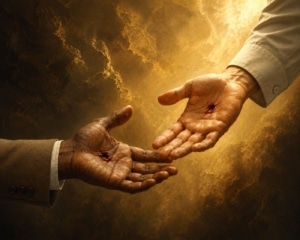
My father was an artist of some renown. He drew an image like this during the turmoil of the 1960s to tell us something — and it was lost to history. I have tried to recreate it for us today. Make no mistake: this is quite a bit more than a religious statement.

There are images that simply depict an idea — and then there are images that enter the viewer’s life, carrying history, memory, and longing inside their composition. This picture, which my father called the divine touch of connection, does the latter. It shows only what matters most: two reaching hands, marked by wounds, suspended in a beam of golden light. Between them is a gap — small, tense, and full of meaning — like the moment just before forgiveness becomes real.

What makes this image so powerful is that it doesn’t ask you to choose one interpretation. It layers spiritual symbolism, human vulnerability, and historical resonance into one quiet act of reaching. And by dressing the hands in 20th-century clothing, it refuses to stay in the past. It insists that what the wounds and the light signify is not only ancient scripture. It is also modern life.

A History Written into Hands

Hands are among the oldest symbols humans have used to communicate — offering help, taking responsibility, giving blessing, or showing harm. In the world of Christian art, wounded hands are deeply recognizable. Nail marks call to mind crucifixion imagery, but artists traditionally place those images in a broader scene: the whole body, the cross, the crowd, the sky.

This image reduces the scene to hands only. That reduction is not an artistic limitation — it is a deliberate spiritual strategy. By isolating the hands and making the wounds central, the image suggests that suffering and redemption are not peripheral details. They are the core language of connection itself. The wounds are displayed as proof that love can survive pain.

But the image doesn’t stop at religious history. The hands wear 20th-century clothing — not the robes of antiquity. That single choice pulls the meaning forward into the modern era. It tells us: this is not a distant story. The image becomes a mirror for contemporary wounds, whether those wounds are racial, social, political, or personal. The sacred is not only in ancient narratives. It shows up in modern suffering and in modern attempts to heal.

The Story Within the Gap

The heart of the image is its almost-touching moment. Neither hand grips the other. Neither dominates. Both reach. The open posture communicates invitation rather than force, reconciliation rather than conquest. That matters, because many of the world’s conflicts — religious, political, racial — begin when one side grips and the other recoils.

Here the hands approach each other in suspended space. The scene is not contact already achieved. It is connection about to happen but not yet completed. That tension is emotionally accurate. Healing rarely arrives all at once. Reconciliation is a series of near moments, the apology that is almost spoken, the conversation that almost happens, the decision to see someone fully that almost follows through.

The golden light makes this suspension feel sacred. Darkness surrounds the hands, but the light concentrates on the space where connection is possible — hope emerging not because suffering is good, but because something holy can be born from it. The light suggests that mercy is not only a feeling. It is an action. Something that can be reached for.

Shared Suffering, Shared Grace

The wounds are more than reminders of an old story. When both hands carry nail marks, the image conveys a radical idea: suffering is not isolated.

In many traditional depictions, the wounds belong to one figure — Christ alone. Here, the image implies shared vulnerability. The pain is carried on both sides, so the scene becomes less about hierarchy and more about solidarity,suffering is shared, therefore compassion is shared.

That shift changes everything. If suffering belonged only to one person, viewers might feel safe distance. But when wounds appear on both sides, the image draws us into mutual recognition: we are not as separate as we pretend. Redemption begins inside the act of reaching — not after pain is resolved, but inside the willingness to remain present with wounds without hiding them, denying them, or wielding them as weapons.

True connection happens through vulnerability, not perfection.

Unity Across the Lines History Built

One of the most striking layers is the contrast between darker and lighter skin tones. Because the hands are visibly different, the image refuses to keep its meaning safely vague. It insists on unity across difference — across racial boundaries, across histories of separation, across the long American wound that my father watched bleed openly in the 1960s and that has never fully closed.

The visual contrast says: shared humanity exists despite different bodies, stories, and experiences. The wounds look similar in their meaning — proof that everyone understands pain. The sacred is not reserved for one group. Mercy is offered across every line that society polices.

This is where the image becomes socially resonant. The nail wounds point toward biblical crucifixion. The racial contrast points toward reconciliation that is still unfinished. Even viewers who never connect the image to specific political events can feel its moral insistence: compassion must cross the lines that history creates.

Why the Clothes Matter

If the hands were dressed like ancient figures, viewers might treat this as museum spirituality — something reverent but unreachable. The 20th-century clothing changes that. It says the wounds belong to our world. The work of reconciliation is not reserved for saints or scripture. It happens through ordinary conversations and ordinary choices: whether to see another person as fully human, whether to hold accountability, whether to respond to harm with truth and mercy rather than retaliation.

The modern clothing also transforms the golden light. It can still be read as divine presence — but it can also be read as the clarity that sometimes arrives when someone chooses to break a cycle of hostility. It becomes conscience illuminated: the moment a person sees the other not as an enemy but as a neighbor.

What My Father Knew — and What We Must Face

My father was deeply troubled by what he saw around him. He watched a nation fracture along lines of race and power. He watched people choose sides over choosing each other. He made this image because he believed something: that the gap between human hands was closeable — but only if people were willing to reach, willing to be seen in their wounds, and willing to stay in the difficult suspended space where healing lives.

I look at our world today and I see the same fractures. The same refusals. The same turning away. The same wounds being hidden or weaponized instead of brought into the light. My father’s image is not nostalgic. It is prophetic.

The Call for Us Might Be………

So here is the invitation — and I mean this with everything I have: do not sleepwalk through this moment.

The gap in this image is not decorative. It is the gap you live in every day — between what you believe about human dignity and what you do to protect it. Between the reconciliation you say you want and the conversation you keep postponing. Between the world you inherited and the world you are choosing, right now, by what you do and what you refuse to do.

The divine touch of connection is not something we observe. It is something we perform — with our actual hands, our actual voices, our actual choices about who we see and who we ignore.

Reach. Even when it costs something. Especially then.

Because the light in this image does not belong to the past. It belongs to whoever is willing, today, to close the gap.

Peace and Every Good.

“The Gap Between Good Intentions and Real Justice”

Dr. King, “Sincere Ignorance,” and the Work of Becoming Intelligent

There’s a moment I keep returning to—quiet, ordinary, and surprisingly revealing. A conversation starts with goodwill. People want fairness. They want safety. They want to be decent. Then the same pattern appears facts arrive without their context, a few details get trimmed, and the outcome starts to feel inevitable. What stays with me afterward isn’t only the disagreement. It’s the question: Who is willing to look closer?

Growing up in Detroit in the ’60s, I learned early that social justice isn’t abstract—it’s something you watch unfold in real time. July 1967 lives in me like a knot that never fully unties. I was playing ball at Palmer Park when I looked east and saw smoke rising from the direction of my house. My body understood something was wrong before my mind could name it. I ran home through smoke and fire, searching for friends and neighbors—and finding some of them too late.

The unrest of not looking closer had finally exploded in riot.

I also lived next door to neighbors who looked different than me but carried the same human needs: fear when things worsened, hope when someone promised change, love for family, and a dignity they never asked anyone to grant—only to recognize.

That’s why Dr. King’s words land so gently and so powerfully—not as condemnation, but as an invitation to wake up.

“Nothing in the world is more dangerous than sincere ignorance and conscientious stupidity. We have a responsibility to be intelligent.”

Dr. King wasn’t only warning about cruelty. He was naming something subtler: sincerity that feels honest, and conscience that grows numb—not because people lack intelligence, but because they avoid the work required to use it. This isn’t merely about knowing. It’s about becoming the kind of person who refuses to let comfort masquerade as truth—even when the truth costs you something.

An Invitation into Three Kinds of Becoming

If we approach Dr. King with humility, his warning opens into an invitation:

  1. Becoming the kind of person who can learn without self-protection.
  2. Becoming the kind of person who can keep loving while seeking clarity.
  3. Becoming the kind of person who treats truth as a responsibility—not something to be avoided.

So, let’s take Dr. King’s phrase “sincere ignorance” seriously, not as a label to throw at others, but as a mirror—one that helps us notice where we may be missing something, and where we can grow.

Sincere Ignorance: When Not Knowing Feels Like Innocence

Sincere ignorance can happen even with the best intentions. It often begins quietly—with being handed only a portion of the story. We learn in fragments: family traditions, school lessons, community conversations, headlines. When that information is offered as complete, it can feel natural to accept it as reality. Over time, a partial account can solidify into a belief system—not because someone has thought deeply, but because they were never given a reason to question it.

“Ignorance” here doesn’t mean wrongdoing. It often means you simply didn’t have access to the full record—you weren’t trained to doubt yourself in healthy ways, and you weren’t offered the better questions.

And yet—here is the invitation—staying in that ignorance can still carry harm, even without intent.

Sincere ignorance disguises itself as innocence. Confirmation bias works quietly: we notice what aligns with our assumptions and overlook what doesn’t. We confuse “no doubt” with “truth.” In Detroit, I remember how hard it was to make meaning fast enough—how emotions demanded answers, but language didn’t arrive in time. I carried confusion that never became clarity. Dr. King’s phrase invites us to notice that gap: between what we feel, what we assume, and what we know.

Here’s the layer that makes this personal rather than merely intellectual: sometimes sincere ignorance causes harm through kindness. You respond with genuine empathy to someone who needs help—but the facts you’re relying on are trimmed. You’re responding to a portrayal rather than to the full context. Your compassion, guided by incomplete knowledge, may strengthen the very harm you hoped to prevent.

The invitation is not to shame people for what they didn’t know. It’s to learn how to stay compassionate without becoming careless. Becoming intelligent, in this sense, is how we protect love from becoming blind.

Conscientious Stupidity: When We Could Know and Choose Not To

Dr. King’s second phrase carries more weight, because it points to choice. Learning is possible. Clarity is available. Evidence exists. But discomfort protects comfort.

In daily life, this can look like postponing that never ends—asking for proof indefinitely while the pattern stays visible; insisting everything is too complicated until responsibility disappears; debating endlessly while inaction becomes normal.

Conscientious stupidity shifts the emphasis from not knowing to defending not knowing. It can look like demanding receipts while refusing to examine the receipts already within reach—or choosing abstraction over action, talking about nuance while ignoring what harm looks like on the ground.

It often sounds reasonable. It can wear the mask of “I’m just being cautious,” while quietly avoiding the steps that would test the belief.

But I want to keep this an invitation, not a threat. Dr. King isn’t asking, “Are you bad?” He’s asking, “Are you willing to wake up?”

A Spiritual Lens: What Fruit Are You Producing?

Howard Thurman’s approach to scripture offers a grounding question I find spiritually honest: What fruit is this teaching producing? Does it deepen love in action? Or does it produce obedience without transformation?

That question matters here because becoming intelligent is not only cognitive—it’s spiritual. Faith that cannot bear evidence will eventually become a shelter for denial. But faith that can bear evidence becomes a doorway to courage.

The invitation is to let your theology, your spiritual commitments, and your daily habits be tested by fruit. Are you becoming more loving and more accountable? Or more defended and less open?

What “Be Intelligent” Looks Like in Practice

Becoming intelligent isn’t cold or superior. It’s love with clarity.

  1. Pause before repeating a claim. Ask: Where did this come from? What context might be missing?
  2. Seek the full record. Look for credible evidence—not only persuasive stories. If a claim matters, the sources should matter too.
  3. Read teachings by their fruit. Ask: What does this lens train me to do? Compassion with courage, or comfort without accountability?
  4. Turn learning into one next right action. Share what you learn respectfully. Support local justice work. Join conversations that welcome both evidence and humanity.

Don’t Stop at Agreement

If this resonates with you, don’t stop there. Dr. King’s warning is an invitation to become awake—to let truth shape conscience, and to move from confusion to action, so love doesn’t stay trapped in good intentions but becomes something people can feel in the world.

Pick one claim you’ve heard often—something you’ve repeated without fully checking. Don’t choose something to debunk. Choose something to understand responsibly. Research it thoroughly, then name one specific change you will make: how you will speak, what you will support, what you will no longer excuse.

Then invite someone else—gently—into the same work. Not by humiliating them, but by modeling what humility looks like: the courage to say, “I might be missing something,” and the willingness to learn anyway.

Sincerity is not enough. Intelligence, in Dr. King’s sense, is responsibility: the courage to look again, to learn, and to act as though what’s true matters—and as though what happens next matters too.

Dr. King’s warning is not a verdict of you doing something wrong. It is a doorway for truth and love to abound.

Peace and every good.

Numbness, Discernment, and Voting with Care

Sometimes I am just plain numb.

Not in a dramatic, storybook way—no fireworks, no sudden collapse. It’s quieter than that. It feels like driving through fog for days: my hands still move, my calendar still gets filled, my words still come out in the right order. I can answer emails. I can make dinner. I can show up.

But something inside me turns down the brightness.

It’s as if my heart has decided, If I can’t carry all this, I’ll carry less. Do you know what I mean here? Not because I’ve stopped caring—at least not exactly—but because my body seems to be trying to protect me from the cost of caring all at once, for too long, in a world that never stops asking for attention. EVER!

Numbness doesn’t always announce itself. Sometimes it disguises itself as competence. Sometimes it sounds like, “It’s fine,” when what I mean is, “I can’t feel the full weight of this moment and still function.”

Then the information comes.

It doesn’t arrive all at once anymore—it arrives like weather. Right? Headlines. Updates. Breaking news. A constant parade of opinions wrapped in certainty, wrapped in urgency, wrapped like they’re personal medicine for whatever I’m currently hungry for. You don’t even have to choose it. It just finds you. It knows what makes you afraid. It knows what makes you feel righteous. It knows what you’re lonely for.

And somehow it keeps stacking until numbness looks less like rest and more like survival.

I used to think numbness was the opposite of hope. Lately I’m wondering if numbness can be a protective shutoff—not because we stopped caring, but because we’ve been overwhelmed with caring for too many things we can’t fix alone.

And that leads me to a question that keeps waking me up at night:

What can we believe? Anything?

Because belief—at least the kind that’s constantly being pushed at us—doesn’t always arrive through reflection. It arrives through pressure. Through targeting. Through personalization. Through a feed that seems to understand my nerves better than I do.

If everything is designed to convince you, then belief itself becomes slippery. I don’t just weigh information; I experience a kind of emotional tug-of-war. I borrow certainty for relief in the moment. I scroll until I find a voice that makes my feelings sound wise. I trade listening for winning. I trade the slow work of discernment for the quick thrill of being right.

Then the next wave arrives.

And I realize the certainty I leaned on wasn’t built to last inside me. It doesn’t grow roots in my values or my conscience. It just briefly covers the exposed parts of me. It soothes discomfort without earning trust. It can feel true because it feels stabilizing—but stability isn’t the same thing as truth.

What I didn’t fully understand until very recently is that the battle isn’t only “what people believe.” The battle is also the environment that trains my mind to adopt beliefs quickly, intensely, and defensively.

And I’ve felt what that training does to me—especially when I start getting stuck around elections.

I keep thinking about how I decide when everything feels like it’s trying to decide for me.

Not just who wins. Not just what side I’m on. But what I can responsibly believe long enough to vote. I was talking with one of my daughters the other day, and she is pretty dog gone smart, we got into this tug of war over voting, who’s right, who’s wrong. Because there are only two choices, correct? I mean we must stand on that statement, right?

Well, voting isn’t theoretical for me. It’s a real choice with real consequences. And I don’t want numbness to steal my discernment while I’m pretending, I’m just “being realistic.”

I’ve noticed a pattern in myself that I don’t like but can’t ignore when information gets relentless, I start chasing certainty. Then I start getting suspicious. Then I start getting overwhelmed. Then numbness shows up again—not calm, not peace, but a kind of emotional dimming so I don’t have to keep bracing.

It’s not that I can’t think. It’s that my thinking gets hijacked by urgency. Can you hear that? Urgency!

So, I’ve been trying to build a decision process that slows down instead of speeding up—one that treats belief like something I cultivate, not something I grab.

Here are a few shifts that have helped me, at least a little:

1) I check my nervous system before I check the headline.

When I’m tense, my brain reads like a courtroom. I look for evidence that will make me feel safe in my conclusion. If I notice my body is on alert, I don’t scroll as much. I pause long enough to ask: Am I trying to find truth—or trying to calm fear? Those are very different tasks.

2) I separate “credible” from “certain.”

A claim can sound confident and still be unreliable. A person can sound convincing and still be careless. When I’m tempted to treat certainty as proof, I try to look for things that last longer than a moment: consistency, willingness to update, clear sourcing, and an ability to hold up under questions.

3) I let my values be a filter, not a shortcut.

Values matter to me—compassion, justice, truth-seeking. But I’ve learned that values can accidentally become permission slips. So instead of asking, “Does this match my values?” I try to ask, “If this policy is applied in the world, who does it help, who does it harm, what tradeoffs are being ignored?”

4) I make decisions in steps, not in panic.

The election cycle tempts me to compress everything into one anxious sprint: gather all info, feel certain, choose immediately, feel morally resolved. But discernment doesn’t work well under time pressure that’s designed by other people. I’ve started asking myself what I can know enough to make the next small responsible decision—and what I need to postpone until I can look again with better clarity.

5) I treat belief like a draft.

If I notice my belief requires me to reject nuance completely—if it demands, I treat disagreement as stupidity or betrayal—that’s a sign. I want convictions that can survive complexity, not convictions that collapse the moment reality gets complicated.

Numbness and discernment both show up as signals, not enemies. Numbness can mean I’m overloaded. It can mean I need boundaries with my attention. It can mean I’ve absorbed too much conflict with no outlet except more information.

But numbness can also become its own trap: a quiet way of opting out. A way of “not feeling” that looks like neutrality while it quietly reshapes what I’m willing to care about.

I don’t want numbness to decide my vote by dulling my conscience. I don’t want exhaustion to turn into apathy dressed as wisdom.

And this is where my concern returns, again and again—back to elections.

I worry about how easily I can be pulled into certainty that doesn’t actually come from evidence. I worry about how easily my mind can be trained to treat emotion as proof. I worry about how the feed can make every issue feel like a personal referendum on whether I’m good, smart, safe, or right.

I worry that the louder the certainty gets, the more I may reach for it simply to stop the feeling of being unmoored.

When I think about voting, I try to come back to a simpler question than “Who is correct?”—a harder question that might protect my integrity:

What would I choose if I weren’t being rushed into belief?

Not what would feel best in the moment. Not what would win the argument. Not what would make me feel righteous fastest. What would I choose if I had time to look carefully, compare responsibly, and accept that I might need to revisit my understanding?

I’m still learning how to do that. I’m still prone to getting tugged into the certainty treadmill, still vulnerable to the fog.

But I’m trying to treat this moment—this election moment—as more than a headline cycle. As a chance to practice discernment instead of numbness. As a chance to believe with care, not with cravings for certainty.

Because at the end of all this, I want my vote to be an act of responsibility, not an act of shutdown. And I want my belief to be sturdy enough to survive contact with reality—especially when reality keeps changing.

Peace and every good!

The Light That Holds Back Darkness 2

First Comes Justice: The Light That Holds Back the Darkness

This is one story I feel strongly about.

I will not soon forget the first time I walked through the heavy steel doors of a state prison with Kairos Prison Ministries. The Sally port has a clang when it shuts behind you that feels final, like the world I knew had been sealed off, and what lay ahead of me in the eyes of forty plus men whose lives most of society had quietly written off was unknown. And what I did not know when I went in is that you cannot get out of the prison until they let you out, period. And I was dead tired that day. I had convinced myself on the drive over that nothing I said would matter. Surely there were better people, more eloquent people, more useful people for this work. I almost turned around in the parking lot. I never told anyone that feeling until today.

But something made me go in. And in the back row sat a man I will call Marcus (not his name) He had not spoken a word the entire first morning, his arms crossed, his eyes anywhere but on us. No trust, none, by the afternoon, he had shifted. By the second day, he raised his hand, and no one made fun of the question. And on the third day, with tears in his eyes, he told me, “Nobody has visited me in fourteen years. Nobody. Until you.” I cried.

That is when I understood something I had read a hundred times but never felt in my bones. Justice is not a verdict handed down from a bench. Justice is a face in a doorway. Justice is the willingness to walk through the gate when every instinct says RUN the other direction. Justice is showing up, especially for the people the world has decided do not count.

Marcus did not need me to fix his life; in fact, he would have run the other way if I had tried. He needed someone to say, by their presence, that his life still mattered. That is the smallest unit of justice, and it is also the largest. Every policy, every program, every reform is built on that single brick. Just a quick note here for those of you maybe thinking this, No I do not think he needed to be let of prison because we from Kairos came to visit. Some statistics put it this way, 10% are innocent, 80% are doing their time for things they have done, and 10% should never see the light of day.

A Little History for Background

The word justice is older than any nation that claims it. In ancient Hebrew, the concept came in two intertwined words. Mishpat described justice in its sharp, courtroom sense, the kind that punishes wrongdoing and protects the innocent. Tzedakah described justice as right relationship, the kind that restores what has been broken between people. The ancients understood that you cannot have one without the other. Punishment without restoration is cruelty. Restoration without accountability is sentimentality. We learned this in Kairos.

Greek philosophers gave us the idea of justice as a virtue, the fair distribution of what is owed. The Romans codified it into law. The framers of Magna Carta in 1215 forced a king to admit that even he stood under it. Centuries later, abolitionists like Frederick Douglass and Harriet Tubman risked their lives to insist that justice could not coexist with chains. Suffragists marched for it. Workers organized for it. Dr. King wrote about it from a Birmingham jail, reminding a comfortable nation that injustice anywhere is a threat to justice everywhere.

Every generation has had to learn the same lesson the hard way. Justice is not inherited. It is not automatic. It is not the natural state of human affairs. We live with it and it is built, defended, and rebuilt by ordinary people who decide that the world as it is cannot be the world as it should be. Again, Kairos helped me here.

Justice Today, Justice Here

We live, right now, in a moment that tests whether we have learned anything at all.

Roughly two million of our neighbors are behind bars in this country, more than in any other nation on earth. And truly if you added up the next few largest countries together, we still have more in our prisons then they in theirs. Tens of millions go to bed hungry in a land of plenty. Healthcare remains a privilege rather than a right for far too many families. When we had our mission, Everyday People Ministries, we gave out 30 tons of food a month. I saw veterans sleep on sidewalks within sight of the monuments built to honor them. Children grow up in zip codes that determine, with frightening accuracy, what their futures will hold. Like the one I grew up in, in Detroit.

These are not natural disasters. They are choices. Our choices. And choices can be unmade.

The good news is that justice still wears a human face. It looks like the nurse who stays an extra hour with the patient who has no visitors. It looks like the teacher who buys school supplies out of her own paycheck. It looks like the volunteer who delivers a meal, the lawyer who takes a case without payment, the neighbor who pays attention. It looks like Lynette and me sitting at tables in countries far from home, learning that loneliness and hunger speak every language. It looks like a Kairos weekend, where men who have done terrible things and men who have had terrible things done to them sit in the same circle and discover that grace is bigger than any of us deserve.

You do not have to fix the whole system to be part of the answer. You only have to refuse the lie that this is somebody else’s problem. Volunteer for one organization. Mentor one young person. Advocate for one policy. Write one letter. Sit with one person in the hospital. The work is never finished, but the work is never wasted either.

The darkness is loud right now. It tells us we are too small to matter, too tired to try, too divided to agree on anything. It wants us to scroll past, to look away, to whisper “not my problem.” Every time we refuse that whisper, we hold the line. Every time we show up, we push the darkness back by an inch. Inches add up.

Linking Arms

I think often about Marcus, and about the hundreds of others I have met inside those walls. They taught me that I nearly missed the gift by almost “not walking through the gate”. How many gates do the rest of us almost not walk through? How many people are waiting on the other side, not for our money or our expertise or our opinions, but simply for our presence?

We began with a question. What is justice in a world teetering on the edge of chaos? It is fairness, yes. It is accountability, yes. It is law, yes. But underneath all of that, justice is love with its sleeves rolled up. All the way up. It is compassion that has stopped talking and started walking. It is the moment when the comfortable decide that the comfort of the comfortable is not the point.

So here we are, you and I. The need has not gotten smaller since you started reading. Somewhere a child is going to bed afraid tonight. Somewhere a sick person is waiting for someone who will not come. Somewhere a person behind bars is wondering if anyone remembers their name. And somewhere, a gate is waiting for someone to walk through it.

Let us be the ones who walk through. Let us be the ones who link arms across our differences and hold back the darkness together. Let us be known not by what we accumulated or what we argued about, but by who we visited, who we lifted, and who we refused to forget. Let us be the fillers of the breach, the lighters of small candles, the keepers of one another.

The world is not going to save itself. Neither is the person across the street, the person across the country, or the person across the wall. They are waiting on us, and we are waiting on each other, and somewhere in the middle of all that waiting, justice is asking whether we will finally say yes.

First comes justice. Everything else, everything good, everything lasting, everything worth handing down, follows.

Peace and every good.

Sources

  1. Hugh Whelchel, “Understanding Tzedakah & Mishpat (Righteousness & Justice),” Institute for Faith, Work & Economics. https://tifwe.org/tzedakah-mishpat-righteousness-justice/ — for the paired meanings of mishpat(rectifying/retributive justice) and tzedakah (right relationship), and the way the two words function together in the Hebrew Scriptures.
  2. Martin Luther King Jr., Letter from Birmingham Jail, April 16, 1963. Full text hosted by the University of Pennsylvania African Studies Center: https://www.africa.upenn.edu/Articles_Gen/Letter_Birmingham.html — source of the line “Injustice anywhere is a threat to justice everywhere.”

The Tender Work of Healing Loneliness, Slowly.

The ache of loneliness is deep and profound for some of us. It shows up in our posture, our energy, and the way we relate to the world. I remember when I went through a painful divorce and the loneliness I felt. I didn’t have self-esteem, and I didn’t know what was next in my life. I traveled on autopilot, grunted responses to questions, and went deep inside myself in a protective stance.

My shoulders hunched as if trying to make myself smaller so I would take up less space—and maybe be less likely to be hurt again. That posture mirrored how I felt inside: small, raw, and on guard. My days blurred together. I thought loneliness was something to be fixed quickly, as if I were just a machine with a loose bolt. But loneliness isn’t just a problem to be solved. It’s a human experience that asks for tenderness, time, and gradual re-learning about who we are when we are alone.

Loneliness wears many faces. Sometimes it’s noisy—restless, consuming, hard to shake. Sometimes it’s silent. It can arrive after a breakup, a move, retirement, the loss of a loved one, or during seasons when you don’t fit into the surrounding culture. And sometimes it arrives without an obvious cause. You might be surrounded by people yet feel profoundly disconnected. Loneliness can color how you see yourself (when I felt unlovable) and how you see others (“nobody understands me”). That lens is heavy. It makes ordinary tasks feel larger, heavier, and harder to start.

When loneliness becomes long-term, it shapes habits. You might withdraw from invitations, avoid phone calls, or spend afternoons scrolling through images of other people living bright, full lives. Facebook (as an example) can be especially brutal in these seasons. You might develop defensive behaviors—sarcasm, irritability, or constant self-criticism—to keep others at a safe distance. These are understandable survival strategies. But they can keep us stuck, tightening the loop between pain and isolation.

A friend of mine, John, is a gregarious person by nature. But after his father died, he sank into a quiet, deep loneliness. He would show up to gatherings and laugh easily, but afterward he would go home and close the curtains. One night he told me he felt like a house with rooms no one ever walked into.

Over the next few months, he knew something needed to change. He began meeting with a grief group and volunteered at a local community garden. The volunteers didn’t try to fix him. They simply shared tasks and stories. With time, his personal rooms were visited more often—not because he suddenly changed overnight, but because small, consistent human interactions built a sense of belonging again. (True Story)

Another story: Ana moved to Italy for work and felt disconnected from the language and customs. Her loneliness was layered with isolation and cultural disorientation. She found solace by starting a weekly ritual—Tuesday potluck evenings with a few colleagues. No grand obligations, just a bowl of soup and one good question: “What was the best thing you did for yourself this week?” That question became a conduit for sharing. It helped her feel seen, not solved. (Example)

If you’re lonely right now, I want to say this clearly: being lonely is not a personal failing. Gentleness is not indulgence. Responding to loneliness with self-blame usually increases the pain, as if the heart needs to be punished before it can heal. Instead, try meeting yourself with care and clarity—like you would meet a friend who is hurting.

Here are four practical, compassionate ways to be gentle with yourself on this path:

  • Acknowledge the ache without rushing it.

Sit with the feeling and name it: “This is loneliness.” Naming reduces the power of the sensation and helps you observe it instead of being swallowed by it. You might say it aloud when you’re alone or write it in a journal.

  • Normalize your experience.

Many people have felt this—it’s part of being human. Reading stories, memoirs, or essays about loneliness can make you feel less alone in your aloneness. You’re not broken; you’re human.

  • Create small rituals of care.

When we’re lonely, big plans can feel impossible. Start with tiny rituals: a cup of tea at the same time each afternoon, a ten-minute walk, lighting a candle before dinner. Rituals create structure and a sense of predictability—soothing when the world feels unstable.

  • Befriend your body.

Loneliness often settles physically tight shoulders, shallow breathing, a heavy chest. Try simple body-based practices: slow diaphragmatic breathing (inhale for 4, exhale for 6), progressive muscle relaxation, or a short yoga sequence that opens the chest. Even gentle movement can change your internal state and communicate kindness to yourself.

Even with these practical steps, there may be times when seeking therapeutic support is the most important thing you can do. A therapist, counselor, or spiritual director can provide tools to navigate loneliness, process past hurts, and gently challenge patterns that keep you isolated. Group therapy can be especially powerful because it combines professional help with human connection.

Comforting exercises you can try today

  • Write a letter to your future self.

Describe what you are feeling right now and what you need. Seal it or save it to be opened in six months. This creates continuity and an ally you can visit later.

  • Try the “two-minute reach” practice.

Each day, do one small, friendly thing for someone: send a message saying, “Thinking of you,” or thank the person who refilled the coffee. Small gestures often return warmth and remind you you’re part of a social web.

  • Use the self-compassion break.

When you notice pain, put a hand on your heart and say: “This is a moment of suffering. Suffering is part of life. May I be kind to myself.” Pause and breathe for several rounds.

  • Make a list of “gentle yeses.”

These are optional social activities that feel manageable—a short walk with a friend, an hour at the library, calling a sibling. Start with one gentle yes per week.

When loneliness persists

If loneliness feels chronic—or if it’s accompanied by hopelessness, persistent fatigue, or changes in appetite or sleep—reach out for professional support. Loneliness can be connected to mental health conditions like depression, and it can benefit from therapy, medication, or both. Asking for help is a courageous, practical step. It can comfort your heart and change the trajectory of your days.

A compassionate ending

Loneliness can be a fierce teacher. It can expose where you’re tender, where you fear rejection, and where you’ve forgotten how to tend to yourself. But it can also be a doorway to deeper self-knowledge. When we meet loneliness with small acts of kindness—tending our bodies, creating rituals, reaching out in tiny ways, and seeking community—we slowly reweave the threads of belonging.

Please hear me when I say, “you don’t need to hurry the healing.” On hard days, remember the posture you instinctively assume in pain: protective, small. Try instead to soften one muscle at a time. Breathe. Put a hand over your heart. Say one gentle thing to yourself. These are not grand solutions, but they are steady—and steadiness is what heals. Over time, small moments of tenderness add up, and the world starts to feel a little less cold.

A poem I wrote about loneliness….

Alone, I fold myself into small shapes, a quiet shell against the world’s bright wind.

Don’t see me

My shoulders learn to hide, my breath grows shallow, and I move through days on soft autopilot.

Don’t see me

Inside, a spark remembers how to rest and keeps a small light against the dark.

Don’t see me

I light a tiny ritual — tea, a song, a name — and let the ache be a visitor, not the whole house.

Maybe see me

Softly I unfold, muscle by muscle, word by word, until a single hand on my chest becomes a bridge.

See me

Peace and every good.

From Scoreboard to Tapestry: Embrace Nonviolence

My business partner’s offhand metaphor about the United States not engaging in a nationwide football game—where there are winners and losers—stayed with me. At first, it sounded like a crazy joke, the kind people make to underline how competitive and spectacle-driven our society has become. But on my reflection, that “football” image is more instructive than flippant. It captures a deep, pervasive fact: life as contest, the world as scoreboard. What if we loosened our grip on that metaphor? What if, instead of celebrating winners and humiliating losers, we reimagined success as a collective flourishing and centered a culture of nonviolence? It is a radical reframe, so bear with me and it is also one that deserves serious attention.

Competition has undeniable value. It spurs innovation, drives excellence, and gives shape to many of our institutions—from markets to sports, academic achievement to civic engagement. Yet when competition becomes the dominant frame for all human interaction, it blinds us to alternatives and normalizes collateral damage. A zero-sum mentality assumes that another’s gain is automatically our loss. It trains us to view relationships, resources, and even the planet as limited commodities to be conquered or defended. The result is not just interpersonal friction but systemic harm: escalating violence, widening inequality, environmental degradation, and eroded trust in institutions.

And…I remember times back home when I was just not up to the competition and I got my clock cleaned. The funny thing is, I was not small or weak or without merit, so I became angry, was belittled, and was told that I was less then. I wanted to quit, to run away, to hide and to lash out. Little good it did me with the overwhelming prevailing attitude of the coaches, players, cheerleaders and spectators. I didn’t stand a chance.

This is where the teachings of nonviolence offer a profound corrective. Nonviolence is often mistaken for passivity or simple conflict avoidance. But figures like Jesus and Mahatma Gandhi modeled a far more active ethic. These men and women who lived and walked on the earth had to find a courage that defied comprehension and for them nonviolence, in their practice and lifestyle, was a disciplined way of engaging the world—rooted in courage, principles, and creative action. It is not the absence of conflict; it is the commitment to resolve conflict without dehumanizing others. It asks us to cultivate empathy, to recognize the dignity of adversaries, and to seek solutions that heal rather than simply punish.

Reimagining “winning” through the lens of nonviolence means changing our metrics. Instead of tallying victories and defeats, we begin to ask different questions: Who is flourishing? Are communities strengthened or weakened? Is the planet being cared for or exploited? Do our policies and practices expand freedoms and opportunities for the many, or do they concentrate advantage among the few? Success, in this framework, is measured by collective well-being, resilience, and regenerative practice.

The stakes of this shift are extremely high. Imagine what people will say about you? Because we are living in a moment of converging crises. Climate change destabilizes ecosystems and economies; social and political polarization deepens mistrust and reduces the space for reasoned debate; economic systems often prioritize short-term profit over long-term sustainability. In such a context, a competitive, winner-take-all logic exacerbates harm. It encourages resource extraction without stewardship, political brinkmanship without compromise, and a politics of humiliation that breeds resentment and cycles of retaliation. Nonviolence, conversely, invites us to break those cycles. It reframes adversity as an opportunity for creativity and collective problem-solving.

What would living into this shift look like in practice? First, it requires cultivating inner practices that temper reactivity and encourage empathy. Mindfulness, contemplative traditions, and reflective dialogue help people recognize their fears and attachments. When we know our triggers, we can choose responses that align with shared human dignity rather than reflexively seeking to dominate. Education systems that prioritize social-emotional learning, critical thinking, and civic literacy prepare citizens to engage in public life as collaborators rather than combatants. How would that look?


Second, institutional redesign matters. Democracy works best when it incentivizes cooperation and reduces zero-sum incentives. Electoral systems, media ecosystems, and corporate governance structures can be retooled to reward long-term, inclusive solutions. Policies that incentivize sustainable production, equitable distribution, and restorative justice create feedback loops where nonviolent solutions are not merely moral but also pragmatic. Imagine electoral incentives that reward coalition-building, or corporate accountability systems that value community well-being as much as shareholder profit. These are not utopian fantasies; they are policy directions that have been piloted at local levels and can be scaled.

Third, we must honor the language and practice of restorative justice. Traditional punitive systems focus on retribution, often producing repeat harm. Restorative approaches center repair and the restoration of relationships. They ask victims, offenders, and communities to participate in making amends, offering a path toward reconciliation and reduced recidivism. When societies adopt restorative frameworks, they acknowledge human fallibility while working toward healing—transforming conflict into an opportunity to rebuild trust.

Fourth, environmental stewardship must be reframed as a nonviolent act. Exploiting nature as though it were inert inventory is a form of violence that kills biodiversity, undermines livelihoods, and creates crises that disproportionately burden the most vulnerable. Nonviolent stewardship means honoring ecological limits, investing in regenerative agriculture and clean energy, and ensuring access to resources for future generations. This is not a sacrifice so much as an investment in our common home and in the long-term survival of our species.

This vision of nonviolence is not naive. History is full of examples where nonviolent movements achieved change against overwhelming odds—India’s independence movement, the U.S. civil rights movement, and more recent peaceful uprisings that led to democratic opening in various parts of the world. These movements did not succeed solely because of moral superiority; they succeeded because they leveraged strategy, discipline, broad-based coalition, and the ability to expose the injustice of violent systems without mirroring their brutality.

Adopting a nonviolent orientation at scale will be messy. People will disagree about priorities and means. There will be moments when force is necessary to protect those who cannot protect themselves. The point is not to deny complexity but to insist that violence should not be the default logic for solving problems. Instead, we should design systems and cultures that exhaust nonviolent options first, that prioritize de-escalation and mutual uplift, and that recognize the moral and practical costs of violence.

If we commit to this path, the benefits are both moral and practical. Societies organized around nonviolence tend to be more stable, more prosperous, and more resilient. They foster innovation not by crushing competitors but by building networks of trust and shared purpose. They produce healthier citizens—physically, mentally, and socially—because communities that care for one another reduce the stressors that lead to harm. And they leave a legacy that matters most: a habitable planet and institutions capable of delivering justice and dignity for generations to come.

Returning to my partner’s football metaphor, I now hear it less as a quip and more as an alarm bell. AND you may not feel the way that I am writing this blog, lets have dialogue in the comments. The spectacle of competition can be exhilarating, but it can also normalize division and glorify winners at the expense of many. When we start measuring success by abundance—by how many people thrive, how well ecosystems recover, how justly opportunities are distributed—we remember that life is a tapestry, not a scoreboard. Each thread—human, animal, plant, waterway—contributes to the strength of the whole.

This transformation begins with personal commitments and ripples outward. It begins with conversations where we listen to learn, not to win. It begins with leaders who model humility and curiosity rather than invulnerability. It begins with institutions that reward cooperation and designers who build systems that align individual incentives with collective flourishing.

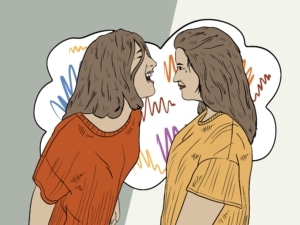
These Illustrations were built and drawn to portray a different way of being. What do you think?

FOR me to close here I must say that winning—if we must use that word—should mean creating conditions where everyone has the opportunity to flourish. It should mean a world where peace is not merely the absence of conflict but the presence of justice, equity, and compassion. It is a lofty aim, but not an impossible one. If even a small fraction of us commit to moving in that direction—toward nonviolence, toward stewardship, toward shared success—the change will be seismic. I promise you: start down that path even a little bit, and everything will begin to change. Hard as it will be.

Hide-and-Seek of the Soul: Learning to Be Found…

When I was a child, summer evenings meant the sweet, damp smell of grass and the soft thud of bare feet on the lawn as we played hide-and-seek until the light thinned to the color of my old side of our old house. I remember crouching behind brick walls in that ethnic area of Detroit called Hamtramck, my breath held, counting on my hands while my young friends scattered like leaves on the wind. The delight of being both pursued and hidden—of waiting in a secret pocket of the world until someone found me—stayed with me. That game was, in miniature, a schooling in the rhythms of life: the thrill of discovery, the quiet of waiting, the embarrassment and laughter when the hiding place failed. Beginning here, with that memory of hide-and-seek, helped me see how the hidden things of life are part of the same pattern we practiced as children.

One moment we are walking along, sure of our path, and the next moment something rises from below the surface—a memory, a grief, a joy so bright it takes our breath away. We jump, we scream, we wonder, we are grateful, sometimes all in the same moment. These small detonations and soft arrivals are reminders that we are alive. They are also invitations: invitations to pay attention, to name, to bear witness.

In spiritual direction, I have found that the time spent sitting with clients and listening to the story that unfolds usually brings about those hidden things that want to bubble to the surface. There is a kind of safety in the slow arc of attentive listening. As someone tells their story—staggering details together with ordinary moments, explanations scribbled in the margins—those tucked-away parts of experience begin to show themselves. A pause becomes pregnant with meaning. A stray tear draws out a knot of memory. An offhand joke reveals a wound. The directed space is not magic; it is relational and structured, and that structure matters. It offers permission to the hidden to be seen.

Why do hidden things remain hidden in the first place? Often because we have learned survival strategies that require us to ignore certain sensations or thoughts. We may have been taught that some feelings are inappropriate, unspiritual, or unwise to voice. We may fear the consequences of acknowledgement—shame, judgment, or a sense of being overwhelmed. Or we may be so immersed in the busyness of living—work, caretaking, the small daily duties—that we simply do not have the patience to notice the subtleties at work in our inner life. But life has a way of insisting. The hidden, like water, finds the path of least resistance. It leaks through in dreams, in somatic signals, in sudden irritations, in wonderings that won’t let us go.

When those pesky hidden things are asking to be seen, what do you normally do? Stuff them down, let them out, ignore them? That’s me, Ignore them! This simple question is an important litmus test for our way of managing interior life. Each of these options—suppressing, expressing, or ignoring—carries consequences.

Stuffing things down can be a short-term coping mechanism. It may allow us to function under pressure, to remain reliable for others, or to dodge the immediate pain of facing something difficult. But suppression is porous. Pain that is not metabolized finds another expression: chronic anxiety, irritability, sleep disturbances, or unexpected explosions of emotion. Over time, what we have buried can calcify, making it harder to access and integrate. Spiritually, suppression can feel like a closing off from the grace that often arrives when we name the truth of our condition. It can turn our inner landscape into a desert.

Letting things out—expressing raw emotion—can be liberating. A cry, a fierce conversation, an honest confession, a journal entry that spills secrets onto the page: these can unbind what was stuck. But unrestrained release without discernment can also cause harm. If the expression is directed at vulnerable others or enacted impulsively, it can fracture relationships and create new wounds. What helps is a tempered expression: naming what is present without launching it like a spear at someone else. Finding appropriate outlets—trusted friends, therapists, spiritual directors, creative acts—can channel release in healing ways.

Ignoring is its own form of avoidance, subtly different from stuffing. To ignore is too busy ourselves with neutral or distracting activities—scrolling, workaholism, noise—so that we do not have the space to meet whatever is asking for attention. Ignoring can feel safe because it delays the inevitable. Yet the hidden things have stamina. They may return more persistently or in altered forms. Ignoring is a passive collusion with fear.

So, what is the middle way? From the practice of spiritual direction and from the rhythms of contemplative life, a few patterns emerge that help make the hidden visible without being consumed by them.

  1. Cultivate a listening posture. Listening is not merely the absence of speaking; it is an orientation of attention. When you cultivate a listening posture toward yourself—pausing, closing the gap between stimulus and reaction—you give the hidden a chance to emerge. Practices that cultivate listening include silence, breath awareness, journaling, and prayerful attention. In a listening posture, you loosen the habit of immediate reactions and make space for discovery.
  1. Name gently. When something surfaces, name it as precisely as you can. “I am feeling afraid,” “I notice grief behind my anger,” “There is shame when I think about that conversation.” Naming is enacting a tiny liturgy of truth: you acknowledge a reality and thereby diminish its power to run you unconsciously. Naming need not be a full-blown analysis—often a brief, compassionate descriptor will do.
  1. Use trusted containers. Not every feeling needs to be told to everyone. Spiritual direction, therapy, close friendships, creative outlets, and ritual provide containers where the hidden can be explored safely. A good container holds both tenderness and truth. It helps you stay with a feeling long enough to learn from it without being overwhelmed.
  1. Practice curiosity, not judgment. Hidden things often come with a script—a voice that tells us we are broken, weak, or unworthy. Replace condemnation with curiosity. Ask, what is this wanting from me? How old is this pattern? Where did I first learn this response? Curiosity opens pathways of understanding that judgment seals shut.
  1. Attend to body and imagination. The hidden speaks not only through thought but through the body and imagination. An ache in the chest, a clenching in the jaw, a dream, an image that keeps returning—these are languages of the soul. Attend to them. They often carry the metaphorical shape of what’s needing attention. Let your imagination be a map, not a liar; test its images against gentle reality-checks. As an example, I tend to hold stress in my neck and at times becomes so painful that I cannot use one of my arms and when I check in with my body, I can usually find the reason.

When I think back to hide-and-seek on the lawn, I notice how the children’s version of the game allowed for a safe reveal. We knew, inherently, that being found wasn’t the end of the world—it was part of the play. That trust made hiding feel not like concealment but like a temporary, innocent withholding. In adult life we often forget that being found can be met with gentleness rather than punishment. Spiritual direction, friendships, and practices of presence restore that simple truth: the world, and the people we trust, can be safe places to be seen.

Reflections on life’s hiddenness inevitably led to paradox. The very things that surprise us—the sudden joy, the spontaneous grief—are both evidence of our vulnerability and of our depth. They remind us that life is not a list of accomplishments but a living relation. When we make room for these hidden things, they can become sacramental: ordinary moments that reveal deeper truth. A tear can be a doorway; an unexpected laugh can be grace.

In the end, how we respond to the hidden shapes the arc of our lives. Do we cultivate a posture of listening and curiosity, or do we keep building higher walls? Do we find companions who can sit with the messy reality of us, or do we continue a lonely performance? The invitation is simple and relentless: pay attention.

And so, I come back, as the sun sank on those summer evenings, to the hush of hiding and the laughter of being found. The child who crouched behind the hedge trusted that discovery would not be punishment but part of play; the adult who sits in a quiet room with a spiritual director or a friend can relearn that same trust. To let the hidden things surface is not to expose ourselves to harm but to return to a game we once knew well—the risky, delightful art of being seen. If we remember how play taught us that being found often brings relief, connection, and a burst of laughter, then perhaps we can meet our inner surprises with less dread and more curiosity. Hide-and-seek becomes a small theology: what is hidden will be found, and what is found can become fuel for deeper life. Trust the finding.

Presence Over Pressure: Rethinking Adulthood at 32

I have started todays blog with a paraphrased story to illustrate this important study for coaching and spiritual direction.

When my friend Lila brought her twenty-four–year–old nephew, Jonah, to the small group at our church last spring, I expected the usual restless energy of someone caught between college and a first job. Jonah sat quietly through the opening prayer, his hands folded, eyes darting now and then to his phone. Then he listened as a woman in her fifties talked about grief; he asked a thoughtful question about responsibility. By the time the meeting ended he admitted, with a nervous laugh, that he sometimes felt like he was “pretending to be an adult.” He wasn’t sure whether that was a confession or a relief.

This part is dense reading but worth the time if you are a coach or spiritual director. The conversation Jonah sparked has stayed with me, (Jim) because it maps a striking piece of science that demands we rethink how we guide young people in coaching and spiritual formation. IN the latest issue of “Presence” a Spiritual Directors International publication it states this study from 2025 that neuroscientists from Cambridge University published in Nature Communications (Mousley et al.) that compared diffusion MRI scans from nearly four thousand human brains ranging from infancy to ninety years old. Rather than finding a smooth, linear path of maturation, they reported discrete shifts at roughly ages nine, thirty-two, sixty-six, and eighty-three. One of the most provocative takeaways: adolescence, in neurological terms, appears to stretch well beyond what most social norms call “adulthood” — actual adulthood, the study suggests, may not begin until around age thirty-two.

This finding upends a lot of assumptions we make in churches, coaching programs, and spiritual direction. If brains remain in a significant developmental flux into the late twenties and early thirties, how should mentors, pastors, and spiritual directors show up for people like Jonah — or for us — in ways that match their neurodevelopment reality?

What the study suggests….

Mousley and colleagues used diffusion MRI to map patterns of white matter — the brain’s communication highways — across the lifespan. Prior to age thirty-two, the brain is still reorganizing: white matter is growing, neural pathways are becoming more efficient, and connectivity patterns are shifting. After roughly thirty-two, the researchers found a more stabilized architecture that often persists for about three decades, followed by later-life shifts around sixty-six and eighty-three. These aren’t just trivia about neurons; they have implications for how people form identity, sustain relationships, and engage with meaning and purpose.

A short story: the mentor, the millennial, the map When I met Jonah months later for coffee, he’d switched jobs twice and was enrolled in a night course on ethics. He confessed he dreaded the “adult checkboxes” — house, marriage, stable job — yet felt impatient with peers who seemed to have them. We talked about mentors: he wanted guidance but bristled at being told what to do. I told him about the Cambridge study — he laughed, then listened.

“Maybe being older isn’t the only way to be wise,” he said. “Maybe people can help me without trying to make me into something I’m not yet.”

That line captures the pastoral (presence) pivot we need: to offer presence without premature pressure, to accompany without imposing finished forms. The neuroscientific finding invites humility and patience. It asks us to honor the ongoing developmental work young adults are doing — neurologically, emotionally, spiritually — while providing steady practices and relational spaces that support maturation without rushing it.

Two ways for us to be present

  1. Practice steady attunement through embodied listening What it is: Embodied listening means attending to the whole person — voice, posture, affect, silence — and not just the words. It requires slowing down, modulating one’s own responses, and noticing shifts in emotion and cognitive framing without immediately correcting or advising.

How to do it:

  • Create predictable space and rhythm: offer recurring meetings that give the person time to try on insights between sessions. Stability matters to a brain still organizing its networks.
  • Use nonverbal check-ins: begin with a single question — “Where is your attention?” — allow a minute of silence, then reflect what you notice about tone and posture before asking probing questions.
  • Resist the fix: when you sense the urge to “solve” identity questions, mirror instead. “I hear uncertainty about responsibility and a desire for meaning.” This models a mind that can hold complexity without collapsing into premade answers.

Why it helps:

For a brain in flux, steady attunement supports the integration of new patterns. It offers a relational scaffold where the young adult can test emerging values and neural pathways safely.

  1. Offer scaffolded practices that combine exploration with ritual What it is: Scaffolded practices are simple, repeatable spiritual exercises that invite both experimentation and the formation of habit. They recognize that neurodevelopment thrives on both novelty (to build new connections) and repetition (to consolidate them).

How to do it:

  • Introduce three-month “experiment” cycles: choose one spiritual practice (e.g., contemplative journaling, short daily silence, or service with reflection) to try for 90 days. Check in weekly for the first month, then biweekly.
  • Combine short, diverse practices with a consistent ritual frame: begin and end with a five-minute centering practice (breath or scripture reading), then introduce a varied middle (creative reflection, dialogue, or action).
  • Encourage meta-reflection: every month, ask: “What patterns do you notice in your responses? What feels alive? What drains you?” This helps the maturing brain integrate experience into identity.

Why it helps: This approach respects the brain’s dual needs: novelty for growth and repetition for stability. Ritual gives a predictable platform for experimentation, reducing anxiety while encouraging exploration.

Why this matters to coaching and spiritual direction

  1. Developmentally informed accompaniment improves outcomes coaching and spiritual direction aim to catalyze growth: in habits, vocation, moral discernment, and interior integration. If the brain continues to rewire well into the late twenties and early thirties, then coaching strategies that treat early adulthood as a finished stage may be ineffective or even harmful. A developmental lens encourages coaches and directors to calibrate expectations, scaffold change plans over longer timelines, and attend to the neurobiological rhythms of consolidation and plasticity.
  2. It reframes maturity as a process, not a milestone spiritual direction, at its best, is about guiding people into deeper coherence — integrating emotions, beliefs, and actions. The Cambridge study reminds us that coherence can be emergent and slow. Rather than treating a thirty-year-old’s doubts as failures, we can see them as part of ongoing integration. This reduces shame and normalizes the nonlinear trajectory of faith and identity formation.
  3. It demands relational humility and patience Both coaching and spiritual direction rely on relationship. Neuroscience underscores that relationship is not merely a context but a mechanism for change: safe, attuned relationships shape neural development. Coaches and directors who cultivate attunement, ritual, and scaffolded experimentation are not just providing tools — they are offering the relational conditions in which the brain can reconfigure toward more adaptive patterns.
  4. It broadens the role of community If individual neurodevelopment unfolds across decades, community becomes a crucial resource — not merely a backdrop. Churches, peer groups, mentorship networks, and coaching cohorts can offer the recurring, low-stakes opportunities to practice new moral habits, relationships, and vocational identities. Programs that build long-term relational continuity will likely be more aligned with how brains mature.

A closing note to mentors and leaders:

When you sit across from someone like Jonah, remember you are not simply transferring information. You’re participating in a slow, relational craft of formation. The Cambridge findings do not strip away responsibility; they expand it. We must give space for the messy apprenticeship of being an adult, provide practices that balance novelty with ritual, and be present in ways that allow the nervous system and the soul to settle into new patterns of coherence.

Jonah eventually stopped checking his phone during our meetings. He still questions, still wanders in and out of certainty. But he’s started keeping a short weekly journal and meets once a month with an older mentor who listens without solving. Watching him, I’m learning to be less anxious about boxes checked and more attentive to the small, steady shifts that mark maturation. That’s the work neuroscience is asking us to honor: presence over pressure, accompaniment over answers, and the patient trust that growing up is a journey that may take longer — and be more sacred — than we thought.

Thank you for reading this study and helpful guide for professionals who coach and do spiritual direction.

Mousley, A., et al. (2025). (2025). Nature Communications. [Mousley et al., 2025, Nature Communications — diffusion MRI lifespan study]

https://pubmed.ncbi.nlm.nih.gov/41290675/

Gentle Steps Through the Ache of Loneliness – Hope

The ache of loneliness is deep and profound for some of us. It shows up in our posture, our energy and the way we relate to the world. I remember when I went through a painful divorce and the loneliness I felt. I did not have any self-esteem, or knowledge of what was next in my life. I traveled on autopilot, grunted responses to questions and went deep inside myself in a protective stance. My shoulders hunched as if trying to make myself smaller so I would take up less space — and maybe be less likely to be hurt again.

That posture mirrored how I felt inside: small, raw, and on guard. My days blurred together. I thought loneliness was something to be fixed quickly, as if I were just a machine with a loose bolt. But loneliness isn’t just a problem to be solved. It’s a human experience that asks for tenderness, time, and gradual re-learning about who we are when we are alone.

Loneliness wears many faces and loneliness can be noisy or silent. It can come after a breakup, a move, retirement, the loss of a loved one, or during seasons when you don’t fit into the surrounding culture. Sometimes it arrives without an obvious cause — you might be surrounded by people yet feel profoundly disconnected. It can color how you see yourself (when I felt unlovable) and others (nobody understands me). That lens is heavy and makes ordinary tasks feel larger.

When loneliness becomes long-term, it shapes habits. You might withdraw from invitations, avoid phone calls, or spend afternoons scrolling through images of other people living bright lives. Facebook is horrible for these times. You might develop defensive behaviors — sarcasm, irritability, or constant self-criticism — to keep others at a safe distance. These are understandable survival strategies, but they can keep us stuck.

A friend of mine, Marcus, is a gregarious person by nature, but after his father died, he sank into a quiet deep loneliness. He would show up to gatherings and laugh easily, but afterward he would go home and close the curtains. One night he told me he felt like a house with rooms no one ever walked into. Over the next few months, he knew something needed to change and he began meeting with a grief group and volunteered at a local community garden. The volunteers didn’t try to fix him; they simply shared tasks and stories. With time, his personal rooms were visited more often — not because he suddenly changed overnight, but because small, consistent human interactions built a sense of belonging again.

Another story: Ana, who moved to Italy for work, felt disconnected from the language and customs. Her loneliness was layered with isolation and cultural disorientation. She found solace by starting a weekly ritual — Tuesday potluck evenings with a few colleagues. No grand obligations, just a bowl of soup and one good question: “What was the best thing you did for yourself this week?” That question became a conduit for sharing and made her feel seen.

Gentle steps to comfort your own heart being lonely is not a personal failing! Responding to it with gentleness rather than self-blame transforms the experience. Here are four practical, compassionate ways to be gentle with yourself on this path:

  • Acknowledge the ache without rushing it. Sit with the feeling and name it: “This is loneliness.” Naming reduces the power of the sensation and helps you observe it instead of being swallowed by it. You might say this aloud when you’re alone or write it in a journal.
  • Normalize your experience. Remind yourself that many have felt this — it’s part of being human. Reading stories, memoirs, or essays about loneliness can make you feel less alone in your aloneness.
  • Create small rituals of care. When we’re lonely, big plans feel impossible. Start with tiny rituals: a cup of tea at the same time each afternoon, a ten-minute walk, lighting a candle before dinner. Rituals create structure and a sense of predictability, which is soothing when the world feels unstable.
  • Befriend your body. Loneliness often settles physically — tight shoulders, shallow breathing, a heavy chest. Use simple body-based practices: slow diaphragmatic breathing (inhale for 4, exhale for 6), progressive muscle relaxation, or a short yoga sequence that opens the chest. Even gentle movement can change your internal state and communicate kindness to yourself.

Even with the practical steps above there may be times when seeking therapeutic support is the most important thing you can do. A therapist, counselor or spiritual director can provide tools to navigate loneliness, help process past hurts, and gently challenge patterns that keep you isolated. Group therapy can be especially powerful because it combines professional help with human connection.

Comforting exercises you can try today

  • Write a letter to your future self. Describe what you are feeling right now and what you need. Seal it or save it to be opened in six months. This creates continuity and an ally you can visit later.
  • The “two-minute reach” practice. Each day, do one small, friendly thing for someone: send a message saying, “Thinking of you,” or thank the person who refilled the coffee. Small gestures often return warmth and remind you you’re part of a social web.
  • The self-compassion break. When you notice pain, put a hand on your heart and say: “This is a moment of suffering. Suffering is part of life. May I be kind to myself.” Pause and breathe for several rounds.
  • Make a list of “gentle yeses.” These are optional social activities that feel manageable — a short walk with a friend, an hour at the library, calling a sibling. Start with one gentle yes per week.

When loneliness persists

If loneliness feels chronic or is accompanied by hopelessness, persistent fatigue, or changes in appetite or sleep, reach out for professional support. Loneliness can be linked to mental health conditions like depression and can benefit from therapy, medication, or both. Asking for help is a courageous, practical step to comfort your heart.

A compassionate ending

Loneliness can be a fierce teacher. It can expose where we are tender, where we fear rejection, and where we have forgotten how to tend to ourselves. But it can also be a doorway to deeper self-knowledge. When we meet loneliness with small acts of kindness — tending our bodies, creating rituals, reaching out in tiny ways, and seeking community — we slowly reweave the threads of belonging.

Please hear me when I say, “you don’t need to hurry the healing”. On hard days, remember the posture you instinctively assume in pain: protective, small. Try instead to soften one muscle at a time. Breathe. Put a hand over your heart. Say one gentle thing to yourself. These are not grand solutions, but they are steady, and steadiness is what heals. Over time, small moments of tenderness add up, and the world starts to feel a little less cold.

A poem I wrote about loneliness….

Alone, I fold myself into small shapes, a quiet shell against the world’s bright wind.

Don’t see me

My shoulders learn to hide, my breath grows shallow, and I move through days on soft autopilot.

Don’t see me

Inside, a spark remembers how to rest and keeps a small light against the dark.

Don’t see me

I light a tiny ritual — tea, a song, a name — and let the ache be a visitor, not the whole house.

Maybe see me

Softly I unfold, muscle by muscle, word by word, until a single hand on my chest becomes a bridge.

See me