Reflections on spiritual direction as sacred companionship — the discernment and attentive listening that help someone notice where the sacred is already at work in their life. These posts explore where spiritual direction and the contemplative life meet.

When Matter Becomes Prayer

When Matter Becomes Prayer

A companion to Thin Places — because the holy ground may be in your hands.

Last time I said the thinnest ground you will ever stand on is probably within a mile of your bed. Here is the next turn of that same screw: it may be closer than that. It may be in your hands.

Most of us were handed a quiet assumption somewhere along the way — that the spiritual life is the part of life that is not physical. Prayer happens with eyes closed. Holiness happens in sanctuaries, or at least in silence. Everything else — the dishes, the commute, the sanding of a board, the chopping of an onion — is the ordinary stuff you get through in order to arrive at the real thing. It is the life we have, right? It is also, according to nearly every contemplative who ever lived, exactly backwards.

The monk in the kitchen

In the 1600s a Carmelite lay brother named Lawrence, whom I love, was assigned to the monastery kitchen, work he did not particularly want. He spent decades there among the pots and pans, and what he discovered became one of the most beloved little books in Christian spirituality. He said he felt as close to God with his hands in the dishwater as he did kneeling at the altar. He put it with a kind of homely joy that still disarms people four hundred years later: “I turn my little omelet in the pan for the love of God” (The Practice of the Presence of God).

Notice what he is not saying. He is not saying he thought holy thoughts while cooking, using the omelet as background noise for a more important interior event. He is saying the turning of the omelet was the prayer. The egg, the pan, the wrist, the attention — all of it, offered. Matter became prayer in his hands, and he did not have to leave the kitchen to find God, because God had not left the kitchen either.

The most material faith there is

There is real theology under all of this, not just a nice sentiment. Christianity makes an almost scandalous claim about matter, that God took a body. “The Word became flesh” (John 1:14) — not became an idea, or a feeling, or a philosophy. Flesh. And ever since, the central rites of the faith have been stubbornly physical: bread, wine, water, oil, hands laid on a head. A sacrament, as the old definition has it, is an outward and visible sign of an inward and invisible grace. Which is to say the material world is not a distraction from the spiritual one. It is the way the spiritual one reaches us.

Teilhard de Chardin, the Jesuit who spent his life with his hands in actual dirt as a paleontologist, said it as plainly as anyone has: “By virtue of Creation, and still more the Incarnation, nothing here below is profane for those who know how to see” (The Divine Milieu). Nothing here below. Not the sink, not the garage, not the body, not the work.

Running in the grey mist

I used to run marathons. Really — I did. I was never a world-class runner, not close, but I did all right.

I would lace up in the dark and get out on the road while the grey mist still hung over the street in the early twilight. And there were mornings when I stood there stretching and thought, I am not in a place mentally to run today. Some days I went anyway, for no better reason than that one foot could go in front of the other.

And then something would happen. A mile or two in, a rhythm would find me — breath and stride and pavement all arriving at the same time — and I would smooth out. The effort did not disappear. It changed, simple.

And then, in that rhythm, came the moment. I touched something. You know what I mean, don’t you? All was right with the world, and I was not running anymore. I was communing. I had no language for it then. I would call it prayer now.

How we learned to split them

If this is true, why does it feel so unfamiliar? Two reasons, and they come from opposite directions.

The first is old. There has always been an impulse in religion to treat spirit as high and matter as low — to assume the body is a problem to be managed and the material world a waiting room for something better. It is an ancient instinct and the church has flirted with it for centuries, but the Incarnation keeps embarrassing it. You cannot build a faith around God taking on flesh and then quietly teach that flesh does not matter.

The second reason is new, and it is the machine I have written about before. A culture organized around output does not want your attention on the onion. It wants the onion chopped fast so you can get to the next thing, ideally while listening to something that makes you more productive. Hurry makes matter mute. Not because the dishes stopped being holy, but because nobody is home while they are being washed.

Who sweeps a room

The practical tradition here is wonderfully unglamorous. George Herbert, who wrote in 1633, put it in two lines that have outlived nearly everything else he said: “Who sweeps a room, as for thy laws, makes that and th’ action fine.” The Hebridean households I wrote about in the last piece blessed the kindling of the fire and the milking of the cow. Jewish practice has a blessing for bread, for wine, for the body working as it should. None of these are poetic decoration laid over ordinary life. They are claims about what ordinary life already is.

The book on my father’s kitchen island

My father died. And when my brother and I went to clean out the house, we found the book he had been reading at the end: Chop Wood, Carry Water.

My father was not a religious man. He had no use for church and did not talk about his soul. So why was he reading that? I never found out. There was no one left to ask, and I have made a kind of peace with never having the answer.

But I read the book, it changed my life. Its whole argument is that the spiritual path is not somewhere else — it is in the chopping and the carrying, in the office and the kitchen and the ordinary hours. Living here, now, is what matters most. The end of my life will take care of itself, won’t it?

I still do not know what my father found in those pages. I know what I found. And I know he handed it to me without ever meaning to.

There is one more thing I only learned later. That book, published in 1984, is sometimes credited with almost single-handedly creating the modern literature on finding the sacred in ordinary work. My father — who had no use for organized religion — died with the founding text of the thing I would spend the rest of my life trying to understand sitting on the kitchen island. I have never known what to do with that, except be grateful.

When Matter Becomes Prayer Reflection Sheet

Matter does not become prayer. We do.

I titled this blog “When Matter Becomes Prayer,” and now I want to take part of it back. Matter does not actually become prayer at some point, as though a bowl of soup were inert until the right thoughts were applied to it. In the last piece I wondered whether the veil is thin everywhere and we are the thick ones. The same correction belongs here. The onion was always the handiwork of God. The water was always water of baptism, in its way. What changes is not the matter. What changes is whether anyone is present to it.

Attention, then, is the thing we actually bring. Not belief, not feeling, not the right words — attention. Simone Weil said that absolutely unmixed attention is prayer, and anyone who has ever lost themselves in making something with their hands knows the truth of it from the inside, whether or not they would have called it prayer at the time.

Practices for hands

Do one thing at a time, with your whole self, and let that be enough. Make something with your hands this week — bread, a repair, a meal, a line of paint — and do not listen to anything while you do it. Eat one meal slowly enough to taste it. Bless the thing in front of you, out loud if you can stand it. And when words will not come, which happens to all of us eventually, let the body pray instead: walk, dig, cook, hold a hand. The body has been praying since long before you had language, and it has not forgotten how.

Brother Lawrence stayed in that kitchen the rest of his life. He is not remembered for a system or a doctrine. He is remembered because he discovered that the distance between the sink and the sanctuary was a distance he had invented, and once he stopped defending it, God was simply there — in the pan, in the water, in the hands.

Your hands are already in the water. That was never the obstacle. It was the invitation.

Peace and every good.


About Jim & Dr. Lynette Vaive

Jim and Dr. Lynette Vaive are the co-founders of spirit of EQ and co-authors of The Mystical Seeker. Jim is a Master Certified Coach and Lynette a Professional Certified Coach; both are certified Narrative Enneagram teachers and Certified Spiritual Directors, and together they hold credentials in Spiritual Emotional Intelligence (SEQ) — a framework rooted in Lynette’s Doctor of Ministry research. Learn more at spiritofeq.com.

Sources

Brother Lawrence — The Practice of the Presence of God: overview

Pierre Teilhard de Chardin — The Divine Milieu, “nothing here below is profane”: Center for Action and Contemplation

Rick Fields et al. — Chop Wood, Carry Water (1984).

George Herbert, “The Elixir” (1633); John 1:14; Simone Weil on attention.

Thin Places That You Don’t Notice

Thin Places

The thinnest ground you will ever stand on is probably within a mile of your bed.

It is a Tuesday. You are standing at the kitchen sink with your hands in the warm water, or sitting on the back steps while the light goes long and gold, or in the chair where you always sit, and the house is quiet in a way it usually is not. Nothing happens. Nothing you could put in a report. And yet for a moment the ordinary goes quietly transparent, and you have the distinct sense that you are not alone in the room — that the world has worn thin right here, over the sink, on a Tuesday.

The Celtic Christians had a name for that: a thin place. The idea is that the usual distance between heaven and earth — between the material and the spiritual, the seen and the unseen — sometimes narrows almost to nothing. There is an old Celtic saying that heaven and earth are only three feet apart, but that in the thin places the distance is smaller still.

Yes, there are famous ones. That is not the point.

You may have heard the phrase attached to islands. George MacLeod, who refounded the Iona Community on that windswept Scottish island, is remembered for calling Iona “a thin place where only tissue paper separates the material from the spiritual” (The Living Church). Pilgrims say similar things about Lindisfarne, about Skellig Michael out in the Atlantic, about certain holy wells and standing stones. All of it is true, and if you ever get to stand on that kind of ground, go.

But if thin places are mostly islands off the coast of Scotland, then thin places are for people with money and vacation time, and that cannot be what the Celts meant. It is not, in fact, what they meant at all.

The Celts blessed the kitchen

Look at what they actually prayed. In the Carmina Gadelica — the great collection of Gaelic prayers and blessings that Alexander Carmichael gathered from Highland and Hebridean households in the 1800s — you find blessings for kindling the fire in the morning and for smooring it, banking the coals, at night. Blessings for milking the cow. For walking out. For making the bed and lying down in it (Carmina Gadelica). These were not pilgrims on a holy island. They were farmers and fishermen and tired women with cold hands, blessing the hearth in their own kitchens before dawn.

Which means the tradition we are borrowing from was never mainly about famous places. It was about the hearth. The doorway. The byre. The work of your own hands on an ordinary morning. They assumed the veil was thin right where they were standing, and they talked to God accordingly — not on retreat, but while lifting the peat.

The night on the back steps with Lincoln

One winter night I was sitting on the back porch steps with Lincoln. It was snowing. It was dark and cold and completely quiet.

Lincoln was a big golden retriever who almost never sat still — he loved everything and everybody, all the time, at full volume. But that night he sat. The two of us stared off into the dark together, our breath slowing until it seemed to wrap something gentle around us both.

And then everything stopped. The stars stopped moving across the sky. The sound around us stopped. Even the snow seemed to freeze mid-dance. We were still on the back steps, and we were somewhere else — a thin place. I did not decide that. It simply was.

And here is the part I still cannot explain: both of us knew. The dog knew. Something different was happening, right here and right now, and we were not observing it. We were being met. We felt seen.

Jacob was not on pilgrimage

Scripture backs this up in a way that should be a relief to all of us. Jacob was not on a spiritual retreat. He was running from his brother, sleeping rough in an unremarkable patch of wilderness with a stone for a pillow, and he dreamed of a ladder with angels going up and down between heaven and earth. He woke and said one of the most arresting lines in the whole Bible: “Surely the LORD is in this place, and I did not know it” (Genesis 28:16).

Read the second half slowly. The place did not change overnight. No one installed the holiness while Jacob slept. What changed was Jacob. The ground had been thin the entire time; he had simply been walking on it with his mind elsewhere, the way we all do — until a dream cracked him open enough to notice. He had been sleeping on the gate of heaven and calling it a rough night.

The ones near you

So look closer to home than you have been looking. A hospital corridor at three in the morning. A church basement with bad coffee and folding chairs, where somebody finally tells the truth. The cemetery you drive past on the way to work. The river in fog. The garage. The kitchen table after everyone else has gone to bed. The drive home from something hard, when you sit in the car in the driveway a minute longer before going in.

And the nearest one of all is about five and a half feet tall and goes everywhere you go. Your own body is a thin place — the breath that keeps arriving without your permission, the hands that know the work before you think it through, the gut that registers a room before your mind has words. If God is anywhere, God is at least as close as that.

Then there is this, which we have come to believe is the thinnest ground of all: sometimes the thin place is a person. The space between two people who are actually present to one another — in a direction session, in a marriage, at a bedside, in the silence after something true has finally been said — can be more transparent than any island. Ask anyone who has sat with the dying. They will tell you, often haltingly, that the room felt different. That they were standing somewhere they had not been before.

Sitting with Ernie

Ernie’s family asked me to sit with him. We do not know what to say, they told me. So I sat.

Ernie was coming to the end of his journey, and it had been a very good journey. There was nothing to fix and nothing to arrange. I did not have any words. Neither did Ernie. So we did not use any.

But I knew — the way the body knows things before the mind has language for them — that this was different. Important. Real in a way that most hours are not.

And when it was time, he left. I was holding his hand. In that moment I was standing against the other world. Not near it. Against it — close enough that I could almost have put my hand through and into it. I have never been able to describe it better than that, and I have stopped trying. Some things you do not explain. You carry them.

Why we walk past

So why do we miss so many of them, when they are this close? Consider Moses at the burning bush. The text says something easy to skip: he turned aside to see. Only then does the voice come, and the instruction — take off your sandals, the place where you are standing is holy ground (Exodus 3). The bush was burning before Moses noticed. What the moment asked of him was not belief but attention: the willingness to stop the errand he was on and go look at something that was not on his list.

We have built a world almost perfectly engineered against turning aside. Hurry is its native speed and distraction its default setting; there is always one more thing, one more scroll, one more errand. You cannot rush into a thin place. It does not open on demand and it will not compete for your attention. It simply waits, patient as a burning bush, for someone willing to be late for something else.

Or perhaps it is we who are thick

Here is where the mystics push us further, and we think they are right. If God is genuinely everywhere — if, as Isaiah heard the seraphim sing, the whole earth is full of the divine glory — then perhaps the veil is not thin only in a handful of blessed locations. Perhaps it is thin everywhere, and the variable is not the place at all. Perhaps it is us. Perhaps we are the thick ones.

That reframes the whole spiritual life. The goal is not to collect thin places, pilgrimage by pilgrimage, as though holiness were a destination with a gift shop. The goal is to become thin ourselves — porous, unhurried, awake — so that the ordinary Tuesday and the kitchen table and the person across from you begin to give off the light they have been giving off all along. The saints were not people who found more holy ground than the rest of us. They were people who had grown transparent enough to keep noticing it.

Thin Place Reflection Guide

How to grow thinner

None of this requires a plane ticket, though by all means go to Iona if you can. It requires smaller and harder things. Return to one ordinary place often enough that it stops being scenery. Keep silence long enough to get past the first wave of boredom. Go to the edges — dawn, water, doorways, the hours before the world has organized itself. Let grief and beauty do their slow work instead of managing them. Put your phone in another room and do one piece of work with your whole attention. And when something in you says stop, turn aside — do it, even if you are already late.

You might even do what those Hebridean women did, and simply bless the thing in front of you: the kindling of the fire, the making of the bed, the washing of the dishes, the hand you are holding. Not because the blessing makes the ground holy. Because it was holy, and the blessing is how you finally notice.

“Surely the LORD is in this place, and I did not know it.” That is not only Jacob’s line. It is the sentence waiting at the end of a great many of our days. The whole invitation of the mystical life is simply to shorten the distance between the presence and the noticing — until one day, God willing, there is no distance left at all.

Peace and every good.


About Jim & Dr. Lynette Vaive

Jim and Dr. Lynette Vaive are the co-founders of spirit of EQ and co-authors of The Mystical Seeker. Jim is a Master Certified Coach and Lynette a Professional Certified Coach; both are certified Narrative Enneagram teachers and Certified Spiritual Directors, and together they hold credentials in Spiritual Emotional Intelligence (SEQ) — a framework rooted in Lynette’s Doctor of Ministry research. Learn more at spiritofeq.com.

Sources

Carmina Gadelica — Alexander Carmichael’s collection of Gaelic household prayers and blessings: sacred-texts.com

The Living Church — “The Thin Place of Iona” (George MacLeod on Iona): livingchurch.org

Scripture: Genesis 28:16–17 (Jacob at Bethel); Exodus 3:1–5 (Moses turns aside); Isaiah 6:3.

What Happens in a Spiritual Direction Session?

If you’ve never experienced spiritual direction, it can be hard to picture. Not because it’s complicated, but because it’s quiet in a way that’s unusual — and quiet is hard to describe.

Jim remembers the first time he sat with a spiritual director, years before he trained to offer it himself. He walked in with something vague and heavy that he’d been carrying for weeks — not a crisis, just a weight he couldn’t name. He left an hour later without a single answer. And yet something had shifted. The weight was still there, but it had a shape now. He could see it, which meant he could begin to understand it.

That’s as close as he can get to describing what happens in a session. Let’s try to go a little deeper.

Before you arrive

Most spiritual directors suggest arriving with a loose sense of what you’d like to bring — not an agenda, exactly, but an openness to whatever feels most alive or most heavy in your life right now. You don’t need to have figured anything out in advance. The session itself will help you locate what’s most important.

Some people journal briefly beforehand. Others arrive mid-conversation with themselves and discover the thread once they sit down. All of this is fine. The preparation, to the extent it’s needed at all, is simply an intention to be present.

How it opens

Sessions typically begin with a moment of centering — a brief silence, a short prayer, a breath. Lynette and Jim both open their sessions this way, and not as formality. It’s a genuine attempt to shift the register of the conversation from the ordinary pace of a day into something slower and more attentive. Even a few seconds of silence at the opening does something. It marks this time as different.

From there, the director will typically offer a simple, open invitation: What would you like to bring today? And the conversation begins.

What the director does — and doesn’t do

This is where spiritual direction tends to surprise people most. Jim often says that his job in a session is to get out of the way — not of the person sitting across from him, but of whatever is already moving in them that hasn’t quite surfaced yet. A director doesn’t lead. Doesn’t teach. Doesn’t offer advice or suggest solutions or move the conversation toward a predetermined destination.

They listen — with a quality of attention that most of us rarely receive in ordinary life. What they’re listening for isn’t only the surface content of what you’re saying. They’re listening beneath it: for what seems to carry energy or weight, for what you keep circling back to without quite landing on, for what might be stirring in you that you haven’t yet given voice to.

Silence is part of the work. Neither Jim nor Lynette is uncomfortable with it. When you trail off, or pause, or lose the thread, they don’t rush in to fill the gap. They let it sit. Because sometimes the most important thing is just underneath the silence, and it surfaces when given room.

What you might talk about

Anything that belongs to your inner life. Grief. A recurring dream. A relationship that’s shifted in ways you can’t name. A decision you can’t make. A joy so unexpectedly large it frightened you a little. A long stretch of spiritual dryness. A sense of call toward something you’re not sure you’re equipped for.

Jim’s work — including his accompaniment of individuals and small groups across faith traditions like at Linworth United Methodist Church — has taught him that the thing people think they’re bringing into a session is rarely the only thing. Often it’s the doorway. What’s really there tends to show up once the room gets quiet enough.

Toward the close

Sessions typically run 50 to 60 minutes. As the end approaches, a director might gently offer a reflection — not a conclusion, but an observation about what seemed most alive in the conversation. Or they might invite you to name what you’re taking with you.

You won’t always leave with clarity. Sometimes you leave with a question that feels sharper than when you arrived, which is its own kind of progress. And sometimes a session is simply a session — a quiet hour of attentive presence that doesn’t produce a dramatic insight but is nonetheless doing something, slowly, over time.

Between sessions

Spiritual direction and spiritual formation tend to work best as an ongoing practice, meeting roughly monthly. Between sessions, many people find that the conversation continues internally — that the questions raised in a session keep surfacing in ordinary life, in unexpected moments, in the margins of ordinary days. That continuation is part of the work too. The director doesn’t go home when the session ends.

If you’ve been wondering what it would actually feel like, a free 15-minute conversation with Jim or Lynette is an easy way to find out — not a commitment, just a first conversation to see if this is the right kind of companionship for where you are.

Schedule with Jim: 

Schedule with Lynette:

Peace and every good.


About Jim & Dr. Lynette Vaive

Jim and Dr. Lynette Vaive are the co-founders of spirit of EQ and co-authors of The Mystical Seeker. Jim is a Master Certified Coach and Lynette a Professional Certified Coach; both are certified Narrative Enneagram teachers and Certified Spiritual Directors. Together they hold credentials in Spiritual Emotional Intelligence (SEQ) — a framework rooted in Lynette’s Doctor of Ministry research — and serve individuals, small groups, and organizations across faith traditions. Jim and Lynette also serve at Linworth United Methodist Church.


When Is the Right Time for Spiritual Direction?

There’s a question that comes up almost every time someone expresses interest in spiritual direction, and it usually sounds something like this: Am I ready for something like that?

Jim has heard this question more times than he can count — in pastoral care conversations, in introductory sessions, in the quiet pause before someone finally picks up the phone to schedule. And his honest answer, every time, is some version of this: there is no ideal moment. But there are seasons that tend to open people to it. Recognizing yours might be the most useful thing this post can offer.

When something is ending or beginning

In 2008, Varment Guard — the pest control and wildlife management company Jim co-founded after eight months of preparation, the one with “Failure was not an option” painted above the door — hit the full force of the financial crisis. The company survived. But the season of navigating that uncertainty, of trying to discern what was worth holding and what needed releasing, was one of the most clarifying of Jim’s life. Not because it was easy — it wasn’t — but because it forced a quality of attention that ordinary times don’t require.

Transitions do that. A job ending. A relationship shifting. Children leaving home. A diagnosis. Even positive transitions carry loss inside them, and most of us don’t have a space specifically designed to hold that complexity. Spiritual direction and spiritual formation make room for the full texture of transitions — the grief and the hope, the relief and the fear — without trying to flatten any of it. If you’re in a between-space right now, that’s not a reason to wait. It’s often exactly the right time.

When you’re trying to discern something

Discernment — the practice of understanding what is truly yours to do, to choose, to release — is one of the oldest reasons people have sought spiritual companionship. Jim and Lynette’s years at Six Seconds, the global emotional intelligence nonprofit, were rich with this kind of work: helping leaders and organizations understand not just what they wanted to accomplish, but what was worth wanting in the first place. That distinction is at the heart of discernment. And it’s one of the things spiritual direction is extraordinarily well-suited to hold.

It doesn’t have to be a dramatic crossroads. Sometimes discernment looks like trying to understand why a particular relationship keeps surfacing in your thoughts. Why a certain path feels both right and frightening. Why you can’t shake a sense of call toward something you don’t have language for yet.

When your inner life feels flat or distant

This one surprises people. They assume spiritual direction is for moments of intensity — crisis, grief, breakthrough. But some of the most significant formation happens in the seasons that feel quiet to the point of emptiness. The plateau. The long stretch of ordinary days when nothing seems to be happening spiritually, and you’re not sure whether that’s rest or loss.

Howard Thurman — one of the contemplative voices that has most shaped Jim’s own formation — wrote about the soul’s need for intervals of quiet that aren’t actually empty, even when they feel that way. A skilled director knows how to be present with you in those stretches without rushing you out of them. Which is often exactly what they need.

When you’ve had an experience you don’t have words for

Sometimes something happens — in prayer, in nature, in a moment of unexpected stillness — and you find yourself thinking: what was that? Not with alarm, but with a kind of alert attention. Something shifted. Something landed.

Jim grew up in Detroit with two professional artist parents who taught him, without using these words, that what’s beneath the surface of things is worth your most careful attention. That instinct has shaped everything he does as a coach, a spiritual director, and a person of faith. Spiritual direction is one of the few spaces in most people’s lives where that kind of experience is taken seriously on its own terms — not explained away, not spiritualized into a tidy category, but listened to with genuine care.

When you’ve been carrying something alone for too long

This may be the simplest of all. Some things aren’t appropriate for therapy. Some things aren’t quite what a friend or spouse is equipped to hold. Some things belong to the inner life in a way that doesn’t translate easily into the ordinary rhythms of conversation.

Lynette and Jim have both sat with people carrying things for years that had never quite had a container — not because they lacked good relationships, but because what they were carrying required a particular kind of listening. The kind that doesn’t rush, doesn’t fix, doesn’t need you to arrive at a conclusion by the end of the hour.

You don’t need to be in crisis. You don’t need to be spiritually advanced. What you need is a sense that your inner life is worth this kind of attention — and the willingness to find out what it might surface if given the space.

If any of these seasons sound familiar, a free, no-obligation 15-minute conversation with Jim or Lynette is a gentle next step. Just a chance to talk about where you are and whether this is the right kind of company for the road.

Peace and every good.

Schedule with Jim: 

Schedule with Lynette: 


About Jim & Dr. Lynette Vaive

Jim and Dr. Lynette Vaive are the co-founders of spirit of EQ and co-authors of The Mystical Seeker. Jim is a Master Certified Coach and Lynette a Professional Certified Coach; both are certified Narrative Enneagram teachers and Certified Spiritual Directors. Together they hold credentials in Spiritual Emotional Intelligence (SEQ) — a framework rooted in Lynette’s Doctor of Ministry research — and serve individuals, small groups, and organizations across faith traditions. Jim & Lynette also serves as a pastoral caregivers in the United Methodist Church.

Jesus and the Gift of Music

Part One of a Three-Part Conversation with Eric Pennington

There’s a particular kind of loneliness in watching your own life happen to you. Eric Pennington knows it from the inside. As a boy, he remembers feeling almost outside himself — like he could watch young Eric move through his days, present in his own body but somehow also a few feet to the side of it, observing. Not constantly. Not dramatically. Just enough, and just often enough, that he noticed.

He doesn’t call it an out-of-body experience, exactly, though he understands why that’s the word people reach for. It’s closer to a kind of early vigilance — the watchfulness of a kid trying to make sense of a house that didn’t explain itself.


His parents, he suspects — though neither ever sat for a formal assessment — were both Nines on the Enneagram. The Peacemakers. Which meant, in practice, a house full of quiet. Not unkind quiet. Just unexplained quiet. “They’re just not talking,” he told me, “and you’re kind of left with — as a kid, I felt like I was left with question marks.” There was dysfunction underneath that silence, but a child doesn’t have the architecture yet to name it. He just keeps moving. Survives the day. Doesn’t ask why.

Then he turned twelve, then thirteen, and the questions he didn’t have language for started arriving anyway. Something cracked open in his family that year — the kind of rupture that becomes public in a way a kid never asked for, the kind that follows you into a new school year whether you’re ready or not. What matters for where we’re going today is what happened underneath it, at the same time, almost on top of it.

Eric gave his life to Christ in that window.

And within the same season — maybe eight months, maybe a year on either side — music became something more than background noise. “Jesus and the music was like a lifeline,” he told me. “The hope. The belief that I could navigate life in a way where I wouldn’t necessarily fall into the traps of a lot of my family — drugs, alcohol, prison. That’s kind of how I anchored myself. In those two things.”

Not one. Two. Faith and music, arriving together, doing something neither could have done alone.

I asked him about an archetype he’s mentioned to me more than once — Miles Davis. Not as a musician he simply admired, but as something closer to a mirror. His answer surprised me a little. “I really found Miles Davis’s music to be rather boring,” he said. It wasn’t the sound that hooked him. It was the shape of the career underneath it. Davis spent years doing it one way, then reinvented the whole thing and spent the next stretch doing it completely differently. A chameleon. Restless. Unwilling to stay put in a style just because it had worked.

“I think my attractiveness to that was just my hyper-creativity,” Eric said. “My desire to find things that were unique and different.” But there was something more functional happening too, something that only makes sense once you know what twelve-and-thirteen-year-old Eric was living through. “I think some of that connected to the trauma that was happening — like protection. If I could find something that set me apart, that would be sort of a protective barrier from just going along with the herd.” Because the herd, as he put it, was the thing pointing. Whispering. Making him the kid everyone already had a story about.

Difference, for Eric, wasn’t a personality trait he discovered later in a workshop. It was armor he built at thirteen, tuned to the rhythm of a man who refused to keep playing the same five years on repeat.

“Jesus and the Gift of Music”Reflection Sheet

I think about that often — how the things that save us early rarely look like salvation at the time. Music didn’t feel like a rescue plan to a thirteen-year-old. It felt like the only thing that made sense to do with his hands and his attention while everything else in his house was unreadable. Faith didn’t feel like doctrine. It felt like the only voice in the room that wasn’t asking him to pretend he understood something he didn’t.

What I find myself sitting with now, decades later, talking to the man that boy became, is how much of Eric’s whole posture toward emotional intelligence — the listening, the curiosity, the refusal to let people stay invisible to him — traces back to a kid who learned to watch closely because nobody was explaining anything out loud. He learned to read a room before he could read a textbook. He learned that silence isn’t the absence of information; it’s information you have to go looking for. And he learned, at thirteen, that you can be carried by two things showing up at once that have no business needing each other — a hope you can’t see and a sound you can hold in your hands.

He doesn’t watch himself from the outside anymore. Not the way he used to. But I’d guess some of that boy is still in there, still paying close attention, still listening for the note that doesn’t sound like everyone else’s.

Where this meets you: somewhere in your own story, two unlikely things probably arrived together and held you up when you couldn’t yet name what either one was doing.

Next time: how a bored afternoon in a corporate conference room turned into a company called Epic Living — and how emotional intelligence found Eric before he ever went looking for it.

Peace and every good.

About the Author

Jim Vaive is co-founder of spirit of EQ, where he and his wife Lynette help individuals, leaders, and teams grow through emotional intelligence, the Enneagram, and contemplative spiritual formation. He writes at The Mystical Seeker on the inward life that makes the outward work possible.

What People Get Wrong About Spiritual Direction


There’s a particular kind of confusion that comes up almost every time spiritual direction is mentioned. People hear “spiritual” and think church. They hear “direction” and think someone’s about to tell them what to do. Neither is quite right, and the confusion is understandable — it’s an old practice with a name that doesn’t translate easily into how we talk now.

So let’s start with what it actually is.

Spiritual direction is a confidential, one-on-one companionship that creates space to notice where the sacred is already present in your everyday life — your joys, struggles, questions, and transitions. Not where it should be, or where you wish it were. Where it already is, whether or not you’ve had language for it yet.

That noticing happens through deep listening. A director isn’t formulating a response while you talk; they’re paying attention — to your words, to what’s underneath them, to the silences. Conversation, prayer, silence, reflection — these are the tools, but the posture underneath all of them is the same: compassion without judgment, curiosity without an agenda.

It’s also, importantly, not a single appointment that wraps something up. Spiritual direction tends to unfold as an ongoing relationship, typically meeting monthly, because the things worth paying attention to in a life rarely show themselves all at once. They surface slowly, in fragments, across seasons. A director who’s been walking with you for a year can hear an echo in this month’s session that connects to something you said eight months ago — and that kind of continuity is part of what makes the practice work.

And it’s open to anyone. You don’t need a particular faith tradition, or any tradition at all, to do this work. The starting point is always your own lived experience, not a doctrine you’re being measured against.

Is This What I’m Looking For? Reflection Sheet

Now, what it isn’t — because this matters just as much.

It isn’t therapy or counseling. A spiritual director isn’t trained to diagnose or treat mental health conditions, and a good one will know that boundary well and respect it. Plenty of people find real value in having both a therapist and a spiritual director at the same time — one tending to the mind, one tending to the soul, each doing its own work without trying to be the other.

It isn’t religious instruction. Nobody hands you a doctrine to follow or grades how faithfully you’re practicing. If you came expecting a syllabus, you’d be disappointed — and that’s by design. The conversation starts with you, not a curriculum.

It isn’t advice-giving or problem-solving. This might be the hardest one for people used to efficiency. A director isn’t going to hand you a three-step plan. Instead, they ask the kind of questions that help you find your own clarity — slower, yes, but often truer, because it’s clarity you arrived at rather than clarity you were handed.

And it isn’t a quick fix. Like most things worth doing, it unfolds gradually, session by session. If you’re looking for a fast resolution to something, this isn’t that. If you’re looking for a steady companion while you sit with something that doesn’t resolve quickly — grief, a discernment, a season of change — this might be exactly that.

So who is this actually for?

Anyone in a season of discernment. Anyone carrying grief that hasn’t found its shape yet. Anyone who senses there’s more going on beneath the surface of their days but hasn’t had a space — or a companion — to slow down enough to notice it.

If that’s resonating, here’s an easy next step: a free, no-obligation 15-minute conversation with either of us, just to talk it through. No pressure, no commitment — just a chance to see if this is the right fit for where you are right now. 

Schedule with Jim:

Schedule with Lynette: 

Peace and every good.


“The Work of Art at the Center of Every Person”

There were two easels in our house growing up, set at angles in the same room so neither parent blocked the other’s light. My mother worked in oils, slow and layered, sometimes returning to the same canvas for weeks until a shadow finally sat right. My father moved faster, looser, more willing to ruin a piece chasing something better. I grew up in the smell of turpentine and the quiet of two people absorbed in work that had no deadline attached to it, only a standard only they could see. I didn’t understand, as a kid, that I was watching two different theologies of creation. I just knew that in our house, “finished” was a word my parents used carefully, almost reluctantly, the way some families talk about money.


I tell you this because I’ve spent the better part of three decades since then assuming the lesson I took from that house was about art itself — about craft, attention, the discipline of starting over. It took my friend and colleague Jeff to show me I’d had it slightly wrong the whole time.

Jeff and I go back further than spirit of EQ. Long before either of us thought about emotional intelligence as a vocation, Jeff was part of the Varment Guard years — one of the people who helped build something out of almost nothing, back when “failure was not an option” was a motto we meant literally because the alternative wasn’t survivable. He’s the kind of person you want next to you in a startup’s early days: steady under pressure, unbothered by long hours, the sort of teammate who shows up and does the unglamorous work without needing credit for it. He was a member of New Albany UMC for years, and he still gives his weekends — actual weekends, the kind most people guard fiercely — to Kairos Prison Ministry, sitting in rooms with incarcerated men who have no platform, no audience, and in many cases no expectation that anyone outside those walls is thinking about them at all. Ask him about it and he doesn’t describe it as a sacrifice; he lights up. Being of service is, by his own account, what energizes him most.


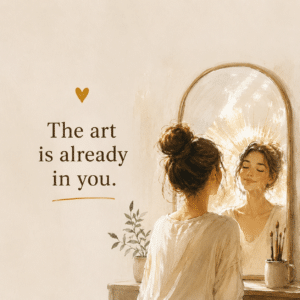
When Jeff talks about coaching now, he uses a phrase that stopped me the first time I heard it. His own way of putting it: “I believe that each person has a unique and amazing work of art at their core. Not art like painting, but their essence.” Not a metaphor for potential, exactly — closer to a literal claim. Somewhere underneath the job title, the defense mechanisms, the years of doing what was expected instead of what was true, there is something formed and specific and already complete, waiting less to be built than to be uncovered. His own Noble Goal, the thing he organizes his working life around, is to help people find that art in themselves.

I used to think that was a generous overstatement — the kind of thing you say to encourage someone, true in spirit more than in fact. Then I watched what Jeff does with men inside a prison who have nothing left to perform for, no résumé to protect, no boss to impress. There’s no career upside to a Kairos weekend. No referral pipeline, no testimonial, no audience beyond the man across the table. Jeff describes what he brings into that room plainly: “These men have been beaten down for so much of their life that no one has told them that they have worth or value. I believe that is the most important thing that I take into the prison.” That’s the same claim as the work of art, said in a different register — not a creative impulse waiting to be unlocked, but a worth that was never actually in question, only buried under years of being told otherwise. And it’s precisely there, where every external reason to fake it has been stripped away, that Jeff says he sees people most clearly — not the art they wish they’d made, but the art that was always there, scarred over, hidden, waiting on someone steady enough to notice it without flinching.

This reframes the question I’d been asking wrong for years. I’d absorbed from my parents’ easels that art was something you produced — a discipline you practiced, a skill you built, a thing that either existed on the canvas or didn’t exist at all. So, when people tell me, in coaching sessions or over coffee, that they don’t have a creative bone in their body, that the art conversation isn’t for them, I understand exactly what they mean, because I used to measure it the same way. But Jeff’s version of the Noble Goal isn’t asking anyone to make more. It’s suggesting that most of us are sitting on something we’ve already made — a way of loving people, a particular kind of patience, a capacity to stay present in rooms other people flee — and we’ve spent so long hiding it, smoothing it over, calling it ordinary, that we’ve forgotten it was art at all.

This is where emotional intelligence stops being a corporate competency and starts being something closer to excavation. The tools Jeff uses — the same EQ frameworks we teach leaders and teams — aren’t really about performance optimization when you trace them back far enough. They’re instruments for noticing: what someone feels underneath what they’re saying, what’s been buried so long it reads as personality rather than choice, what got hidden because revealing it once cost too much. Jeff’s years in prison ministry didn’t happen alongside his coaching work by coincidence. They’re the same practice in two different rooms — one with stakes most people will never know, one with a quarterly review attached, both asking the identical question: what is the work of art this person has been hiding, and what would it take for them to trust it back into the light.

The Art You’ve Been Hiding Reflection Sheet

I think about those two easels differently now. My parents weren’t only teaching me about craft. They were teaching me, without either of them saying it outright, that the thing worth making was never separate from the person making it — that the canvas was just where it became visible. Jeff would say the canvas isn’t required at all. The art is already there. The work, his work, our work, is helping people stop believing they have to make something new before they’re allowed to call what’s already inside them by its true name.

You don’t need to make more art. You need to stop hiding the one you already are.

Peace and Every Good

If this stirred something, you can find more reflections like it on The Mystical Seeker.

mysticalseeker.substack.com & spiritofeq.com/blog

About the Author

Jim Vaive is co-founder of spirit of EQ, where he and his wife Lynette help individuals, leaders, and teams grow through emotional intelligence, the Enneagram, and contemplative spiritual formation. He writes at The Mystical Seeker on the inward life that makes the outward work possible.


The Exquisite Risk of Letting the Dark Do Its Work

There is a photograph I have carried in my memory for decades — not one taken on film, but one pressed into the body the way cold presses into bone. It is a winter morning in Detroit, still dark at six a.m., and I am standing at the kitchen window watching my mother mix paint in the silence before the house woke up. She wasn’t sad. She wasn’t lost. She was in that rare place artists sometimes go — a place that looks like emptiness from the outside but is, from the inside, a particular kind of waiting. A necessary hollow. I didn’t have words for it then. I do now.

The mystics called it la noche oscura — the dark night of the soul.

When the Ground Falls Away

Most of us arrive at the dark night not by choice but by collapse. Something that once held meaning — a career, a faith practice, a sense of self, a relationship — gives way beneath us. The fall is disorienting precisely because we didn’t see it coming, and because the things we reach for on the way down don’t hold.

This is not ordinary sadness. It is not burnout, though it can look like it. It is not clinical depression, though it can travel alongside it, and if it is significantly impairing your daily life or generating thoughts of self-harm, please reach out to a licensed professional — that is not weakness, it is wisdom.

What distinguishes the dark night is its spiritual texture: the loss isn’t just of energy or motivation but of meaning itself. Things that once lit you up feel hollow. Your spiritual practices go silent. You withdraw. You wonder, quietly or loudly, whether you have lost God, or whether God was ever there at all.

St. John of the Cross — a sixteenth-century Spanish mystic who wrote from inside a prison cell no larger than a closet, where he had been confined by the very religious order he was trying to reform — would say: you are exactly where you need to be.

That is hard to hear in the dark. It was for me.


The Poem That Knows the Way

What John wrote in that cell was not a lament. It was, against all reason, a love poem.

“Dark Night of the Soul” — in Mirabai Starr’s luminous translation opens not in despair but in secret motion. The soul slips out of the house while everything is still. She travels in darkness, not despite the darkness but through it, guided not by any external lamp but by something burning in her own chest.

No other light, no other guide Than the one burning in my heart. — St. John of the Cross, trans. Mirabai Starr

This is the paradox the dark night holds: what feels like abandonment is, in John’s vision, a form of being led. The stripping away of every consolation — every spiritual feeling, every certainty, every framework that once made sense — is not punishment. It is preparation. The soul is being emptied so that something truer can fill it.

The poem ends not in the darkness but in a garden. In rest. In transformation. Lover transformed in Beloved.

John doesn’t promise the journey will be short. He doesn’t promise it won’t hurt. He promises it goes somewhere.

What Emotional Intelligence Has to Do with It

Here is where the contemplative tradition and emotional intelligence meet in a way I find profound: both ask us to stay present with what is, rather than immediately managing it away.

One of the core competencies in the Six Seconds model of EQ is what we call Feel Your Feelings — the capacity to move toward your inner experience rather than away from it. Not to be consumed by it. Not to perform it. But to let it be what it is, without premature resolution.

The dark night, spiritually understood, asks for the same posture. It resists the fixes we reach for — the productivity systems, the five-step frameworks, the urgent need to locate the lesson and extract it. Those impulses are understandable. They are also, in the dark night, exactly what is being dismantled.

What the dark night wants from you is not your solutions. It wants your surrender.

And surrender — in the contemplative sense — is not passivity. It is a particular kind of courage: the willingness to stop managing the mystery and begin inhabiting it.


Five Things to Do When You Are in the Dark

I want to offer not a ladder out but a way of being in. These are not performance targets. They are invitations.

Stay close to your body.  The dark night is disorienting in the mind, but the body often knows more than we credit it with. Walk. Sit with your back against something solid. Pay attention to what you can smell, hear, feel. The Incarnation — God taking on a body — is itself a theological argument that matter matters. You are allowed to be a creature.

Release the spiritual performance.  If your prayer feels empty, don’t force it into the shape it used to have. John wrote from inside a prison cell with nothing but scraps of cloth and the words forming in him in the dark. The form of devotion may need to change entirely. Let it.

Find one trustworthy companion.  Not someone who will rush you to resolution, but someone who can sit in the not-knowing with you. A spiritual director. A therapist. A friend formed in contemplative patience. The dark night is not meant to be survived alone, even when it demands solitude.

Practice lectio divina with the darkness itself.  What if you read the darkness the way monastics read scripture — slowly, with openness, asking not what does this mean but what is this forming in me? The dark night, John insists, is doing something. You may not be able to name it yet. That is alright.

Trust the heart that burns inside.  Even when you cannot feel it. Even when the candle seems to have gone out. John’s soul travels the whole dark journey guided by what is burning inside her chest — not what she can see, not what makes rational sense, but what is alive in her. There is something in you that has not gone out. It may be very quiet. Tend it like an ember.

What the Darkness Already Knows Reflection Guide


What the Darkness Already Knows

My mother would finish her mixing before the sun came up, and then she would begin. I used to think the dark hours were the waiting. I understand now they were the work.

The dark night of the soul is not a detour from the spiritual life. For John of the Cross, for Meister Eckhart, for Howard Thurman writing from the underside of suffering, for Julian of Norwich holding her visions in the midst of plague — the darkness has always been the passage. Not the destination. But not the obstacle either.

It is, to borrow Mirabai Starr’s phrase, an exquisite risk.

And if you are in it right now — if the house has gone still and everything you reached for is no longer where you left it — you are not broken. You are, perhaps, being made.

The night that joins the lover with the Beloved does not announce itself. It simply comes. And it leads.

St. John of the Cross, Dark Night of the Soul, translated by Mirabai Starr, Riverhead Books, 2002 —

If this found you in a threshold season, we’d be honored to walk alongside you — explore spirit of EQ’s community on Substack or join us in our Mighty Networks space for ongoing conversation.

Peace and every good.

The Running Wave: A Celtic Journey Into Deep Peace

Deep Peace: A Journey Home to Stillness

There is a moment, if you have ever stood at the edge of the ocean just before dawn, when the world holds its breath. The darkness is not yet gone. The light has not yet fully arrived. And in that thin, trembling space between the two, something ancient stirs. Something that cannot be named — only felt. A peace so deep it seems to rise from the earth itself, from the turning of the stars, from the breath of God moving over the waters.

This is where the story begins. Not on a stage or in a sanctuary, but on a shoreline, in the in-between.

The Ancient Roots of a Blessing

More than fifteen hundred years ago, on the wind-scraped islands off the western coast of Scotland and Ireland, a spiritual movement was quietly taking root. Celtic Christianity, as it would later be called, was unlike anything that had come before it. Where other traditions placed God at a remote and sovereign distance, the Celtic monks and hermits of the early medieval period felt the divine woven into everything — into the moss on stone, into the cry of the curlew, into the rhythm of the tide coming in and going out.

The monks of Iona, that small island off the coast of Mull where Saint Columba landed from Ireland in 563 AD, believed the world was thick with God. They called certain places thin places — locations where the veil between the human and the holy seemed almost transparent. Iona itself was such a place. Pilgrims have been walking its shores for over fourteen centuries, drawn by something they could not always explain.

It was from this tradition — earthy, luminous, deeply attentive to the natural world — that the great Celtic blessings emerged. They were not formal liturgies crafted in marble halls. They were prayers spoken over fishing boats, over sleeping children, over the dying. They were words meant to be carried in the body, not just the mind.

The blessing we now call Deep Peace grew from this soil.

A Pilgrim Sets Out

Let me tell you about a woman — call her by any name, because she is all of us at some point. She had spent years doing everything right. She had built her life with great care: the career, the relationships, the responsibilities. She was capable and admired and deeply, quietly exhausted.

One autumn she found herself standing in a field somewhere in the Scottish Highlands, watching the last light drain from the sky. She had not planned to be there. She had simply driven north when the noise inside her became too loud to bear. She had been looking, she realized, for a long time. Not for answers. Not for success or approval or resolution. She had been looking for peace. Real peace. The kind that doesn’t depend on circumstances being perfect.

That evening she stumbled upon a small stone church. Inside, a handful of people were gathered for an evening service. She sat in the back, unsure why she stayed. And then the minister began to speak words she had never heard before, but somehow already knew.

Deep peace of the running wave to you. Deep peace of the flowing air to you.

She felt something loosen in her chest.

Deep peace of the quiet earth to you. Deep peace of the shining stars to you.

Her eyes filled with tears, and she did not try to stop them.

Deep peace of the gentle night to you. Moon and stars pour their healing light on you.

What Peace Actually Is

We misunderstand peace, most of us. We think of it as the absence of trouble — as a kind of padded silence, a pause in the storm. But the peace described in this ancient Celtic blessing is something altogether different. It is not passive. It is alive.

Look at the images the blessing chooses: a running wave. Flowing air. The shining stars. These are not still images. They are images of constant, purposeful movement. The wave does not stop being peaceful because it is running. The air does not lose its gentleness because it is flowing. Peace, the blessing tells us, is not the absence of motion. It is motion in harmony with its own deepest nature.

The Celtic tradition understood this. To be at peace was not to be removed from the world, floating above its difficulties in some detached serenity. It was to be fully, rooted-ly present within it — moving like water moves, purposefully, without violence against itself.

And then the blessing turns. Having drawn us through the natural world — the wave, the wind, the earth, the stars, the night — it arrives at its center:

Deep peace of Christ, of Christ, of Christ, the light of the world to you.

For the Celtic Christians, this was not a sudden turn away from nature. It was the completion of what the natural world had been pointing to all along. Every wave, every breath of wind, every star burning in the dark — they were all, in some way, expressions of the same light. The same source. The same love.

Christ was not separate from the running wave. Christ was the deep peace that the running wave carried.

Coming Home

The woman in the stone church sat for a long time after the service ended. The minister left. The candles burned down. And she sat in the dark and felt, for the first time in years, that she was not lost.

She had not solved anything. Her circumstances had not changed. The weight of her life was still her life. But something had shifted in the way she was holding it. She had been gripping so tightly, white-knuckled, afraid to let go even for a moment. Now, just briefly, she had opened her hands.

Peace does not arrive like a conquest. It arrives like dawn — gradually, gently, until you realize the darkness has been replaced not by force but by light.

This is the invitation the old blessing has always carried. Not a command to feel peaceful, as if peace were a performance. But a pronouncement. A declaration spoken over you, like water poured on a forehead, like a hand placed gently on a bowed head.

Deep peace to you.

It is being given. You do not have to earn it or construct it or protect it. You only have to receive it.

And so the journey comes full circle — back to the shoreline, back to the edge where darkness and light meet and hold each other without fear. The wave still runs. The air still flows. The stars still burn their quiet fire in the deep.

And somewhere, in a stone church on a windswept island, or in a field at dusk, or in the middle of an ordinary Tuesday when the world is too loud and you are too tired — the ancient words are still being spoken.

Deep peace of the running wave to you. Deep peace of the flowing air to you. Deep peace of the quiet earth to you. Deep peace of the shining stars to you. Deep peace of the gentle night to you. Moon and stars pour their healing light on you. Deep peace of Christ, of Christ, of Christ, the light of the world to you. Deep peace of Christ to you.

May you receive it. All of it. Down to your bones.

Peace and ever good.

Lynette’s DMin: Deepening Spiritual-Emotional Care

There are moments in life when personal accomplishment and communal mission converge in a way that changes everything. Lynette’s completion of her Doctor of Ministry  in Spiritual Direction is precisely one of those moments. This degree represents years of disciplined study, late nights balancing family and ministry, deep reflection, and the courage to push into new theological and practical territory. But beyond the diploma lies the person I’ve always known, compassionate, inquisitive, disciplined, and humble—someone who models faithful service and thoughtful leadership. Her DMin is not merely a credential; it is a deepening of the wisdom and skill she brings to everything she touches. For our family, for me personally, and for everyone connected to Spirit of EQ, it is a cause for celebration and renewed purpose. I am profoundly proud of Lynette, and my admiration for her grows with every step she takes in service to others.

As we move forward at Spirit of EQ, Lynette’s scholarship and pastoral insight will shape how we support individuals, leaders, and communities in cultivating emotional and spiritual maturity. The Spiritual Emotional Intelligence Assessment (the SEQ) has long been our foundational tool—designed to help people name where they are spiritually and emotionally, and to chart a path toward greater resilience, clarity, and wholeness. With Lynette’s advanced training in integrating theology, emotional intelligence and practical ministry, the SEQ will become even more robust. Expect enhancements that will weave research with pastoral sensitivity: richer assessment items that capture relational patterns and spiritual practices, evidence-informed interpretation guides, and culturally attuned frameworks that honor diversity of belief, experience, and context. The goal is not simply to measure, but to illuminate—helping clients see the intersections of their inner life, relationships, and spiritual formation so they can move toward healing and flourishing.


Practically, the work we will do with clients will deepen across several dimensions. First, our assessment process will be more integrative. Rather than offering a static score, the SEQ will provide a narrative map that identifies strengths, vulnerabilities, and possibilities—linking emotional regulation and spiritual practices. This map will be used in collaborative coaching and spiritual direction contexts, helping clients translate insight into sustainable practices. Second, our interventions will be more evidenced-informed and pastorally sensitive. Using evidence-based modalities—such as emotion-focused techniques, narrative practices, and contemplative disciplines—paired with Lynette’s pastoral spiritual direction training, we will support people in learning practical tools for self-regulation, conflict navigation, and meaning-making. Third, we will expand our training offerings for leaders and teams. Churches, nonprofits, and organizations seeking emotionally intelligent spiritual leadership will find workshops, retreats, and certification tracks that marry theological depth with applied emotional skills: how to lead with empathy under pressure, how to sustain pastoral identity over a long ministry career, and how to cultivate staff and congregational wellbeing without sacrificing mission.

One of the most exciting changes is how we will incorporate qualitative, story-centered work alongside quantitative assessment. People are not numbers; their lives are narratives. Lynette’s project work emphasized case-based learning—listening deeply to life stories, isolating turning points, and carrying those insights into tailored growth plans. At Spirit of EQ, that means every person who comes to us will receive an assessment that honors their story: how they were formed, how they are coping now, and what practices or relational shifts can help them move forward. For couples and families, this approach will allow us to identify not only individual spiritual-emotional patterns but the relational rhythms that either support or undermine flourishing. For leaders, it will highlight vocational strengths, blind spots, and sustainable rhythms of work and rest that preserve long-term effectiveness.

We will also broaden our community offerings. Lynette’s work has deepened our capacity to design group experiences that cultivate corrective emotional and spiritual experiences—small groups, peer supervision cohorts for clergy, and community healing circles that use structured practices to promote trust and transformation. These community modalities are powerful because they provide both accountability and belonging. People practice new ways of relating in safe contexts and then carry those practices back into their families, workplaces, and congregations. The ripple effects are significant. When a leader learns to regulate under pressure, their staff experience decreases in burnout and increases in trust. When congregation members learn compassionate ways of speaking about pain, the entire community can become a cradle for healing rather than a site of hidden suffering.

We are also committed to elevating accessibility and cultural relevance in all our work. Lynette’s DMin emphasized contextual theology through spiritual direction application and culturally sensitive care, and that emphasis will shape how we adapt the SEQ for diverse populations. Assessments, coaching curricula, and training materials will be offered in ways that respect linguistic, cultural, and theological differences—so that people from all backgrounds can find the language and tools that resonate with their faith and experience. We will invest in partnerships with local congregations and community organizations to co-create programs that address specific needs: supporting immigrant communities, equipping inner-city pastors, or providing transitional support for people moving through major life changes.

Finally, this degree enhances our capacity to contribute to broader conversations about spiritual and emotional health. With Lynette’s research skills and pastoral credibility, Spirit of EQ will produce resources—white papers, training manuals, podcasts, and workshops—that synthesize best practices at the intersection of faith and emotional intelligence. We want to equip not only individual clients but also the wider fields of ministry, counseling, and organizational leadership with tools that are both theologically grounded and psychologically sound. Our aim is to be a resource hub: offering practical, scalable interventions that help people live not just coping lives, but flourishing lives.

None of this would be possible without the love, perseverance, and integrity Lynette has shown throughout her journey. Her achievement is both deeply personal and profoundly public—an example of how disciplined study and faithful service can amplify a mission. I am endlessly proud of her and grateful for how she continues to shape our shared work. As Spirit of EQ enters this new season, we do so with greater clarity, deeper resources, and renewed hope: to help people name their struggles, cultivate practices that sustain them, build relationships that heal, and live into the fullness of their spiritual and emotional calling. If you or someone you love is seeking a compassionate, rigorous, and practical pathway to greater wholeness, we are here to walk alongside you—now with even more training, heart, and skill than ever before.