
The Work That Holds Everything Together
A CONVERSATION WITH DR. DON AJENÉ WILCOXSON · PART TWO OF THREE
A Man Who Stands in the Room
On teaching, spiritual direction, and what it means to carry many callings at once
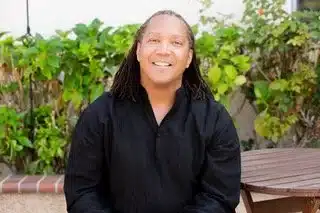
There is a question I have wanted to ask Ajené for years, and as we continue our 3 part conversation I finally asked it when we sat down together: what is the connective tissue across everything you do? Because from where I sit, the list is remarkable. Distinguished Professor at Riverside City College — recently elevated to Professor Emeritus after more than three decades. Spiritual director. Six Seconds EQ faculty. Enneagram teacher. Minister. Business consultant. Dream worker trained in the Jungian mystical tradition at the Haden Institute. Scuba diver, salsa dancer, Lego builder, student of classical guitar.
He smiled at the question. Then he said something I have been turning over ever since.
“Emotional intelligence is intertwined with who I am at a soul level. One moves the other. From this perspective, I am passionate about living and teaching how to experience a soul-centered emotionally intelligent life.”
That is the connective tissue. Not a set of skills or roles, but a way of being — the conviction that what we feel and what we believe and how we treat the people in front of us are not separate compartments but a single integrated life. Everything Ajené does flows from that integration.
The classroom is where I have seen him described most often by others, and the descriptions are strikingly consistent. His dean at RCC said he has a natural ability to connect with his students — that he “allows students to find solace in his presence when they are struggling.” The Accreditation Council for Business Schools and Programs recognized him with their Teaching Excellence Award; he was one of only twenty faculty nationwide to receive it that year. But when you ask Ajené what he is doing in the classroom, he does not talk about pedagogy. He talks about presence.
“The classroom is the students’ space, not mine,” he told me. “I enter their space with respect. I leave my own baggage outside the door so I can meet them where they are.” His approach is rooted in listening rather than answers — in the recognition that every person arriving in that room is carrying something, and that learning cannot happen until the person feels held.
This is, at its core, an emotional intelligence practice. In the Six Seconds model, the capacity to “increase empathy” — to genuinely enter another person’s experience before responding to it — is one of the deepest and most difficult competencies to develop. Ajené has built a classroom around it. And notably, he has done this in a business and entrepreneurship department, which is not the first place most people would look for this kind of formation work. That gap between where it is expected and where he practices it is, I think, part of the point.
The spiritual direction practice carries the same posture into a different room. Ajené works with people across Buddhist, Christian, Hindu, Islamic, Jewish, and no-tradition backgrounds — a range that reflects his own formation. He grew up with a mother who was Jehovah’s Witness, a father who was Buddhist, a grandmother who was Baptist, an uncle who was Muslim, and a Catholic school. His doctorate from New York Theological Seminary was in interfaith, inter-spiritual, and intercultural theology — not because he chose a specialty, but because he was already living at that intersection and needed language for it.
He describes his approach to spiritual diversity through a Baha’i image: the most beautiful garden is a mixture of flowers. He is not interested in resolving difference into uniformity. He is interested in what each tradition offers to the whole — and in holding space wide enough that a person from any background can find their own ground.
“The most beautiful gardens are a mixture of flowers. I see my own spiritual life that way — enriched by every stream, not threatened by any of them.”
His work as a Enneagram coach sits at the center of all of this. The Enneagram tradition is distinctive in that it asks real people to speak from their own lived experience of a type — not to have a type explained to them, but to hear from those who inhabit it. Ajené is a Nine, the Peacemaker, and he brings to that work a rare self-awareness about both the gift and the cost of his type. Nines tend to minimize their own needs and giftedness in service of harmony. They absorb the priorities of others. They can mistake self-erasure for humility.
When I asked him where his Nine-ness serves him most and where it costs him most, he was characteristically honest. The gift: the capacity to enter any room and genuinely see every person in it, to hold multiple realities at once without needing to collapse them into a winner. The cost: the temptation to smooth over things that need to be said, to defer his own voice when it is exactly his voice that is required. He is aware of both. That awareness is itself the work.
He describes his current life season as winter — and he is careful to define what he means. Not decline. Not retreat. Spaciousness. The steadiness that comes from having built something over decades and knowing now what matters. He hopes, he told me, for more presence over productivity, more wisdom than certainty, more accompaniment over expertise. And the phrase that has stayed with me: not trying to become more but learning to become enough.
That phrase does a particular kind of work on me, because it runs counter to almost everything our culture tells us about professional life. Enough is not a word our productivity-saturated age handles well. But for a man who has earned Distinguished Professor status and a national teaching award and a doctorate and a spiritual direction practice and three decades of student relationships — for that man to say he is learning to become enough — that is not resignation. That is a different kind of ambition entirely.
There is a thread in the contemplative tradition — I am thinking of Thomas Merton, of Howard Thurman, of the desert fathers and mothers — about the movement from doing to being, from accumulation to presence. Ajené is living that transition with his eyes open. He knows what season he is in. And he is choosing to inhabit it rather than fight it.
In our next conversation, we will go to the harder places. The grief he carries about racial injustice. The threats he faced in high school for speaking up. The discrimination he encountered at the institution where he would go on to build one of the most distinguished careers in its history. And his word — direct and unhurried — to the people standing at the edge of the room, wondering whether there is a place for them.
But here, in this middle movement, I want to simply name what I see when I look at his life whole: a man who has refused, across decades and contexts, to let his work be less than his faith. That refusal is its own kind of witness.
To get in touch with Ajene use this link. mailto:ajene@donajene.com
If you are curious about how emotional intelligence and the Enneagram can deepen your own integration of work, faith, and presence, we would love to continue the conversation at spiritofeq.com.
Peace and every good.


