Seven Pillars: Practical Skills for Soul & Emotion

I’m starting today with a simple promise: to take the ancient tools people have used for millennia and translate them into everyday skills—what I call the seven pillars of spiritual emotional intelligence. This isn’t theory; it’s a practical way to blend inner awareness and soulful purpose with the concrete abilities we use to navigate relationships and stress. Think of it as learning a craft: quiet attention, clear intention, and steady practice that change how you move through life.

A quick map before the walk:

These pillars are Presence, Compassion, Boundary Wisdom, Shadow Integration, Purpose Alignment, Emotional Literacy, and Ritualization. They come from many lineages—Buddhist attention training, Stoic pauses, Sufi heart-work, Vedantic inquiry, Christian examen, and Indigenous rites. Those traditions taught two consistent things: growth is embodied (it needs habits, witness, and teachers) and real spirituality meets suffering with tenderness, not avoidance. Below I tell their story as a single journey and then give two short examples of how people actually use these pillars in life.

A journey through the pillars

You begin with presence. Presence is the steady place you return to—simple breath, noticing, naming—so you aren’t carried by reactivity. Try this as a starting ritual: three minutes sitting with the breath twice a day, or a quick one-question check-in before a meeting (“What do I most need to bring right now?”). These tiny acts expand your capacity to choose how you respond.

Once you can show up, compassion becomes practical. Compassion is not fixing; it’s holding—your own pain and another’s—without collapsing. In practice it looks like RAIN for yourself (Recognize, Allow, Investigate, Nurture), or one conversation a day where you listen for three minutes before offering advice. Compassion softens the edges so honesty can land.

Honest relating requires boundary wisdom. Boundaries are not walls but wise edges: clear scripts you’ve rehearsed, gentle no’s in low-stakes scenarios, and an end-of-day energy audit to notice where you gave too much. Boundaries preserve the space you need to practice the rest of the work.

When you notice repeated reactivity—jealousy, sudden anger, compulsive pleasing—you’re at the door of shadow integration. This is an area where I needed to do the most work. Shadow work is not easy folks and is naming what you hide, writing (or speaking) the truth into light, and making one small corrective action each month (an apology, a request, a boundary) to integrate that energy instead of letting it run you.

Purpose alignment pulls those pieces together. It’s the ongoing question: “Who do I want to be in three years?” and then testing one weekly action that aligns with that answer. Keep your top three values where you can see them and make a tiny wager—a public commitment—to move closer to that north star.

Emotional literacy supplies the vocabulary for the inner weather. Move from “I’m upset” to a more exact word—wistful, resentful, anxious—and map where it lives in the body. Naming reduces escalation and creates choice: label it, breathe into it, let it pass.

Finally, ritualization anchors everything. Rituals mark transitions and make meaning—lighting a candle when you come home, three breaths before you answer email, a brief weekly review of one lesson learned. Rituals transform intention into habit.

Two brief examples

Example 1

Maya, (name changed) the elementary school teacher was near burnout: long days, little margin, and a constant pull to fix everyone’s problems. She started with presence—three minutes sitting twice daily and the one-question check-in before parent meetings. That small habit made it possible to notice when she was reacting from anxiety and to do RAIN for herself in the staff bathroom before a hard conversation.

She added two boundary practices: she wrote three short scripts (“I can’t take that on right now,” “I need 24 hours to think about this”) and used them aloud in low-stakes situations once a day. By tracking how often she used scripts each week (target: three difficult interactions), she noticed her energy improved. For shadow work, she journaled once a week about what she judged in others and recognized it in herself—this led to a single integration action: she asked for help setting limits on committee work.

Maya’s result after four weeks: fewer evenings spent feeling depleted, clearer conversations with colleagues, and a small weekly ritual (lighting a candle when she arrives home) that signaled real rest. Her metric: practiced presence 12+ times weekly and used boundary scripts in three tough moments.

Example 2 —

 Alex, a startup founder operated from urgency and a heroic “do it all” posture. He used purpose alignment first: he wrote a 2–3 sentence vision of who he wanted to be in three years and committed publicly to one weekly action that honored that vision (mentoring a junior colleague). That tiny wager nudged decisions toward long-term value.

Because he’d learned to name his emotions more precisely, Alex replaced “stressed” with “overwhelmed and disappointed,” this is called also “reframing” and helped to map the feelings in his chest and used a two-minute loving-kindness micro-meditation to steady himself before tough meetings. When anger arose around an investor conversation, he paused and asked, “What need is unmet?”—an emotional-literacy move that revealed a need for respect and led to a clear boundary script: “I want to continue, but we need reciprocity in feedback.”

Alex’s shadow work, remember above, this work is hard, looked like safe disclosure: he told a trusted friend about his fear of failure and noticed relief rather than collapse. He tracked value-aligned actions per week (3–5 target) and used a weekly meaning review on Sundays to adjust the next week’s intention. Over a month he reported better team trust, fewer blowups, and decisions that matched his long-term goals. It was not easy but worth the effort.

How to begin (simple and honest)

  • Pick two pillars to start this week—one inward (Presence, Emotional Literacy, or Shadow) and one outward (Compassion, Boundary Wisdom, or Ritualization).
  • Use one simple practice for each pillar and set a small tracking metric (e.g., 10 three-minute anchors per week; use boundary scripts in 3 difficult interactions).
  • After four weeks, review what changed and choose the next two pillars.

A short safety note: some practices, especially shadow work and grief processing, can surface intense material. If you or someone you care for experiences persistent distress or decline in functioning, seek professional support.

FREE WORKBOOK DOWNLOAD

Safety one-page: quick steps if deep work brings intense material

Immediate crisis steps

  • If someone is in immediate danger or there is a risk of suicide or violence, call emergency services now (e.g., 911 in the U.S.) or go to the nearest ER.
  • U.S. crisis lines: call or text 988 (Suicide & Crisis Lifeline); text HOME to 741741 (Crisis Text Line). Outside the U.S., look up your country’s crisis line via local health services or the WHO directory.
  • If not immediately dangerous but overwhelmed: use grounding (5–4–3–2–1 senses), slow box-breathing, splash cold water on your face, hold an ice cube, and contact a trusted person to stay connected.

Finding professional help

  • Primary care: start here for medical assessment and referrals.
  • Therapist directories: Psychology Today, Zencare, Open Path Collective, or local professional boards—filter by specialty (trauma, grief) and telehealth availability.
  • Low-cost options: community mental health centers, university or training clinics, sliding-scale services.
  • Workplace resources: Employee Assistance Programs (EAPs) often provide short-term counseling and referrals.
  • Spiritual/community supports trusted clergy, elders, or peer groups can help bridge to clinical care—use them for support, not as the sole resource if risk is present.

What to ask a therapist

  • Credentials and license (LPC, LCSW, PsyD, PhD, MD)
  • Experience with grief, trauma, or the issue you’re facing.
  • Therapeutic approaches used and crisis policy between sessions.
  • Telehealth options, fees, sliding-scale availability, and cancellation policies.
  • Can we try a brief initial session to assess fit?

Create a simple safety plan (keep it visible)

  • Warning signs: list thoughts, feelings, or behaviors that show worsening.
  • Coping strategies: 3–5 things you can try alone (grounding, walk, phone a friend).
  • Contacts: 3 people you can call/text (include one who can be present).
  • Professional contacts: therapist, doctor, crisis line, emergency number.
  • Means reduction: plan to secure or remove anything that could be used for self-harm.

For friends and caregivers

  • Listen nonjudgmentally and validate feelings. Ask directly about suicidal thoughts if concerned.
  • Offer practical help—stay with them, help call a provider, remove access to means if safe.
  • Encourage professional evaluation and call emergency services if danger is imminent.
  • Seek support for yourself; helping someone in crisis is demanding.

Follow-up and documentation

  • Keep a short resource list in the workbook: numbers, clinics, referrals.
  • Note provider name, contact, appointment date, and safety instructions.
  • Revisit and update your safety plan weekly while doing deep inner work.

Final note

 This post supports practice but is not a substitute for clinical care. If distress increases or functioning declines, seek professional help now. Reaching out is a strong and necessary step.

Peace and Everygood

Choose Your Altars: Context Before Commitment Now!

Can I be heretical for a moment? I want to talk about worship—not as doctrine but as human behavior. When we use words like “worship,” “blessed,” or “devotion,” we often assume everyone shares the same map for those terms. But what if we treated those words as claims that require context and interrogation the way we would any major life commitment—like marriage, career choice, or a mortgage? Do we know why we are doing the deeply important things in our lives, and what it really means to be doing them?

Let’s start with a simple observation: language is slippery. “I worship God” can be a conscious, reflective claim about meaning and purpose, or it can be shorthand for a family habit, a cultural identity, or a weekly routine. The same goes for secular “objects” of devotion—money, status, sex, drugs, career. People often enact profound loyalties without pausing to ask whether those loyalties are chosen or inherited, adaptive or harmful.

I talked about context a few posts ago and I want to dive into it a little bit differently.

Examples make this more concrete.

  • The executive.

Consider Linda, a chief operations officer who describes herself as “dedicated” to her company. She works 70-hour weeks, vacations with her laptop, and measures self-worth by quarterly results. Her friends joke that she “worships the bottom line.” Is that hyperbole? For Linda it’s not; her weekends are filled with email, she’s missed births and birthdays, and financial metrics shape her identity. The question is: did she choose this life because it aligns with an examined set of values, or because the expectations and incentives around her nudged her into a default devotion? If she says she “devotes her life to work,” what does “devotion” actually mean for Linda—satisfaction, security, avoidance of other pains? What is the context that made work the main altar of her life? (I changed content of each of these examples because I was not given permission to use the people’s identities)


  • The influencer.

Jamal, a 23-year-old social media creator, measures success in likes, followers, and brand deals. His waking plan is content production optimized for engagement. That rhythm organizes his social circle, daily habits, and self-esteem. When his follower count stalls, he becomes anxious and makes riskier content decisions to chase virality. Is he worshipping audience approval? Again, the symbol matters: the behaviors are indistinguishable from religious devotion—rituals (posting), community reinforcement (comments), moral accounting (metrics). But does he understand why he chases those metrics? Is it autonomy, recognition, or fear of obscurity?

  • The habitual churchgoer.

Sara attends Sunday services every week, has for decades, and calls herself a person of faith. But she admits she often sits in the pew on autopilot—singing the songs, nodding at the sermon, rarely thinking about the theological claims. For her, worship is a social ritual that binds her to family and community. That’s meaningful in certain ways, but if someone asks whether she “devotes her life” to the principles taught there, she struggles to articulate specifics. Is her participation a moral compass, a habit, or a defense against loneliness? Without context, the claim “I worship” can mask a lack of considered commitment.

  • The non-believer.

Tom, an engineer, publicly states he does not believe in God or organized religion. What does that mean for him? Is he rejecting the metaphysical claims, the social practices, the institutional authority, or all of the above? For some people, atheism is an intellectual conclusion; for others it’s a cultural stance or even a reaction against abusive institutions. Context matters: a blanket “I don’t believe” can be an invitation to conversation, but it can also be shorthand for “I was hurt,” “I never saw the need,” or “I never had a framework to meaningfully engage.”

  • The addict.

Marcus struggled with substance dependence for years. He would prioritize the next fix over relationships, work, and health. In a clinical sense, addiction can look like a form of worship: consistent rituals, surrender of agency, and a value hierarchy in which the substance ranks above all else. When he entered recovery and asked why he had chased substances so relentlessly, he uncovered fears, trauma, and a hunger for acceptance. Recognizing the context changed his approach to life and meaning.

These vignettes point to a few recurring patterns.

First, devotion and habit are not the same. Something you do every week can be either a carefully chosen expression of core values or a default behavior sustained by habit and social reinforcement. We routinely confuse frequency with meaningfulness. The critical move is to ask: does repetition reflect reflective commitment or mere inertia?

Second, context transforms words into claims that can be evaluated. To say “I worship X” without specifying what X is, what X gives you, and what X costs you, is to make an ambiguous claim. Is the worship chosen freely? Is it compensatory (filling a void)? Is it communal or isolating? What happens if X is removed—does the person reorganize their life or collapse?

Third, many social institutions encourage uptake of labels without fostering critical thought. My pastor friend who worries about biblical text being used without context has a secular analogue: workplaces, subcultures, and social media ecosystems often pass down language and practices that people adopt without understanding origins or alternatives. Some call that “faith” or “loyalty”; others call it suspension of inquiry. Either way, it’s worth asking whether your assent is informed.

So, what do practical steps look like if we decide to insist on context before committing to the things that claim our lives?

  • Ask the “why” questions: Why this devotion? What needs does it serve? Whose approval or reward structures support it? Try to make a list—psychological, social, economic—that explains the attraction.
  • Consider the long-term ledger: How will this devotion look in five, ten, thirty years? What will be served, and what will be sacrificed? Try to envision the trade-offs honestly.
  • Test alternatives: Could you allocate attention differently? If your life’s axis shifted even slightly, what would change? Small experiments reveal if a devotion is truly intrinsic or simply convenient.
  • Seek external perspectives: Talk to friends, mentors, or a therapist about what they see. People immersed in a system often miss its blind spots.
  • Demand specificity from claims: When someone asserts “this is what we do” or “this is who we are,” ask follow-up questions. What do you mean by “this”? What metrics or stories support that definition?

Click Here For Free Workbook Link.

Language matters because it shapes identity. “Worship” is a provocative term because it exposes the sacrificial structure of devotion. You don’t have to use religious vocabulary to admit you are giving your life to something. You can be as devoted to a career, a relationship, a cause, or a compound as anyone kneeling in a chapel. The crucial question is whether that devotion is the result of an informed, reflective choice or an accident of context.

I can’t accept words without context. Can you? If you want to live honestly and with purpose, start asking context questions about the things that claim you. It doesn’t require rejection or conversion—only clarity. And when we have clarity, we gain power: the power to recommit intentionally, to redirect energy where it matters, and to stop pretending that habits equal meaning..

Be the Light: Support Ser-Kallai, Heal Communities

There are moments when a single idea — compassion made practical — can change a life and, eventually, a community. That is the group I have worked alongside for the last few years. Lynette and I have served on the board and in the field, and from firsthand experience we know what this work means to people affected by poverty and trauma. That’s the promise at the heart of Ser‑Kallai. Founded in 2019 with a name that means “to be light,” Ser‑Kallai grew from the simple conviction that trauma healing, emotional intelligence, and community connection are not luxuries but essentials for thriving societies. Today, as our country faces growing emotional and social challenges, Ser‑Kallai’s programs are not only timely — they’re pivotal.

A personal beginning, a universal mission

Nathalie Caycedo’s story is the origin of Ser‑Kallai. Born in Colombia and shaped by early volunteering in neighborhoods scarred by poverty and violence, she learned that small acts of attention and care can create lasting opportunities. Years later, when she helped refugee families adjust to life in the U.S., she saw that healing comes from trust, from consistency, and from programs that teach emotional skills along with academic support.

That experience seeded a nonprofit that centers emotional intelligence (EQ), trauma‑informed care, and community resilience. With help from her church, Living Word Christian Community, Nathalie and a committed team began offering after‑school programs, coaching, workshops and high‑impact EQ festivals that equip children, teens and adults to handle life’s stresses and build stronger relationships. Ser‑Kallai has already made a measurable difference across Arizona, California, Ohio and Florida, supporting foster and kinship families, federal‑custody teens, refugees and low‑income communities.

Why this work matters now

We live in turbulent times. Rates of anxiety, depression, and interpersonal conflict have surged across age groups. Children are navigating more complex emotional landscapes than prior generations. Communities dealing with the aftermath of displacement, economic strain and systemic trauma need resources that go beyond immediate aid — they need tools to rebuild capacity and hope.

Emotional intelligence is not just “soft” enrichment

It is the foundation for better decision‑making, improved school and work performance, and healthier families. When we teach children and adults how to recognize emotions, regulate responses, and build empathetic relationships, we invest in a future of lower violence, higher civic engagement, and stronger workforce readiness. Ser‑Kallai’s programs do exactly that — they transform vulnerability into resilience.

My personal perspective

Working with Ser‑Kallai has been one of the most meaningful commitments of my life. On the board and in program rooms, I’ve seen small, quiet breakthroughs that ripple outward: a teen who finds a new way to communicate with their caregiver, a parent who learns to manage their own stress so they can be present, a classroom that shifts from reactive to restorative. Those moments fill me with gratitude and hope. At the same time, I feel urgency — the need to scale what works so more families and neighborhoods can find stability and healing.

I’m proud of what Ser‑Kallai has accomplished, and I’m deeply moved by the people we serve. Every success is earned through the courage of participants, the dedication of volunteers and staff, and the generosity of supporters. Personally, I give my time and energy because I have seen the difference that consistent care and practical emotional skills make in a life. I believe that when a community learns to tend its emotional wounds, it becomes stronger and kinder.

Your gift creates tangible results

Donations to Ser‑Kallai go directly into programs that produce measurable outcomes:

• After‑school enrichment that combines academic support with EQ lessons, helping kids succeed in school while building emotional resilience.

• Trauma‑informed workshops and coaching for families affected by foster care, displacement, or systemic inequities.

• Community‑level events like EQ festivals that bring practical tools to large groups, fostering connection and collective healing.

• Virtual and in‑person training so local leaders, teachers and volunteers can replicate Ser‑Kallai’s model in more neighborhoods.

Each dollar multiplies: a workshop can reach dozens of children and their caregivers; a festival creates networks that last long after the lights go out.

How you can help?

If you’re moved by this work, there are several ways to be the light: donate, volunteer, share Ser‑Kallai’s story with friends and local organizations, or bring our training model to your school or faith community. Every action matters.

Give today: https://serkallai.org/get-involved

My closing,

I am convinced that healing and emotional education are essential building blocks for resilient communities. Ser‑Kallai is putting those ideas into practice, and it’s an honor to stand with them. Please join us — your support helps more people move from hurt to hope.

From Scoreboard to Tapestry: Embrace Nonviolence

My business partner’s offhand metaphor about the United States not engaging in a nationwide football game—where there are winners and losers—stayed with me. At first, it sounded like a crazy joke, the kind people make to underline how competitive and spectacle-driven our society has become. But on my reflection, that “football” image is more instructive than flippant. It captures a deep, pervasive fact: life as contest, the world as scoreboard. What if we loosened our grip on that metaphor? What if, instead of celebrating winners and humiliating losers, we reimagined success as a collective flourishing and centered a culture of nonviolence? It is a radical reframe, so bear with me and it is also one that deserves serious attention.

Competition has undeniable value. It spurs innovation, drives excellence, and gives shape to many of our institutions—from markets to sports, academic achievement to civic engagement. Yet when competition becomes the dominant frame for all human interaction, it blinds us to alternatives and normalizes collateral damage. A zero-sum mentality assumes that another’s gain is automatically our loss. It trains us to view relationships, resources, and even the planet as limited commodities to be conquered or defended. The result is not just interpersonal friction but systemic harm: escalating violence, widening inequality, environmental degradation, and eroded trust in institutions.

And…I remember times back home when I was just not up to the competition and I got my clock cleaned. The funny thing is, I was not small or weak or without merit, so I became angry, was belittled, and was told that I was less then. I wanted to quit, to run away, to hide and to lash out. Little good it did me with the overwhelming prevailing attitude of the coaches, players, cheerleaders and spectators. I didn’t stand a chance.

This is where the teachings of nonviolence offer a profound corrective. Nonviolence is often mistaken for passivity or simple conflict avoidance. But figures like Jesus and Mahatma Gandhi modeled a far more active ethic. These men and women who lived and walked on the earth had to find a courage that defied comprehension and for them nonviolence, in their practice and lifestyle, was a disciplined way of engaging the world—rooted in courage, principles, and creative action. It is not the absence of conflict; it is the commitment to resolve conflict without dehumanizing others. It asks us to cultivate empathy, to recognize the dignity of adversaries, and to seek solutions that heal rather than simply punish.

Reimagining “winning” through the lens of nonviolence means changing our metrics. Instead of tallying victories and defeats, we begin to ask different questions: Who is flourishing? Are communities strengthened or weakened? Is the planet being cared for or exploited? Do our policies and practices expand freedoms and opportunities for the many, or do they concentrate advantage among the few? Success, in this framework, is measured by collective well-being, resilience, and regenerative practice.

The stakes of this shift are extremely high. Imagine what people will say about you? Because we are living in a moment of converging crises. Climate change destabilizes ecosystems and economies; social and political polarization deepens mistrust and reduces the space for reasoned debate; economic systems often prioritize short-term profit over long-term sustainability. In such a context, a competitive, winner-take-all logic exacerbates harm. It encourages resource extraction without stewardship, political brinkmanship without compromise, and a politics of humiliation that breeds resentment and cycles of retaliation. Nonviolence, conversely, invites us to break those cycles. It reframes adversity as an opportunity for creativity and collective problem-solving.

What would living into this shift look like in practice? First, it requires cultivating inner practices that temper reactivity and encourage empathy. Mindfulness, contemplative traditions, and reflective dialogue help people recognize their fears and attachments. When we know our triggers, we can choose responses that align with shared human dignity rather than reflexively seeking to dominate. Education systems that prioritize social-emotional learning, critical thinking, and civic literacy prepare citizens to engage in public life as collaborators rather than combatants. How would that look?


Second, institutional redesign matters. Democracy works best when it incentivizes cooperation and reduces zero-sum incentives. Electoral systems, media ecosystems, and corporate governance structures can be retooled to reward long-term, inclusive solutions. Policies that incentivize sustainable production, equitable distribution, and restorative justice create feedback loops where nonviolent solutions are not merely moral but also pragmatic. Imagine electoral incentives that reward coalition-building, or corporate accountability systems that value community well-being as much as shareholder profit. These are not utopian fantasies; they are policy directions that have been piloted at local levels and can be scaled.

Third, we must honor the language and practice of restorative justice. Traditional punitive systems focus on retribution, often producing repeat harm. Restorative approaches center repair and the restoration of relationships. They ask victims, offenders, and communities to participate in making amends, offering a path toward reconciliation and reduced recidivism. When societies adopt restorative frameworks, they acknowledge human fallibility while working toward healing—transforming conflict into an opportunity to rebuild trust.

Fourth, environmental stewardship must be reframed as a nonviolent act. Exploiting nature as though it were inert inventory is a form of violence that kills biodiversity, undermines livelihoods, and creates crises that disproportionately burden the most vulnerable. Nonviolent stewardship means honoring ecological limits, investing in regenerative agriculture and clean energy, and ensuring access to resources for future generations. This is not a sacrifice so much as an investment in our common home and in the long-term survival of our species.

This vision of nonviolence is not naive. History is full of examples where nonviolent movements achieved change against overwhelming odds—India’s independence movement, the U.S. civil rights movement, and more recent peaceful uprisings that led to democratic opening in various parts of the world. These movements did not succeed solely because of moral superiority; they succeeded because they leveraged strategy, discipline, broad-based coalition, and the ability to expose the injustice of violent systems without mirroring their brutality.

Adopting a nonviolent orientation at scale will be messy. People will disagree about priorities and means. There will be moments when force is necessary to protect those who cannot protect themselves. The point is not to deny complexity but to insist that violence should not be the default logic for solving problems. Instead, we should design systems and cultures that exhaust nonviolent options first, that prioritize de-escalation and mutual uplift, and that recognize the moral and practical costs of violence.

If we commit to this path, the benefits are both moral and practical. Societies organized around nonviolence tend to be more stable, more prosperous, and more resilient. They foster innovation not by crushing competitors but by building networks of trust and shared purpose. They produce healthier citizens—physically, mentally, and socially—because communities that care for one another reduce the stressors that lead to harm. And they leave a legacy that matters most: a habitable planet and institutions capable of delivering justice and dignity for generations to come.

Returning to my partner’s football metaphor, I now hear it less as a quip and more as an alarm bell. AND you may not feel the way that I am writing this blog, lets have dialogue in the comments. The spectacle of competition can be exhilarating, but it can also normalize division and glorify winners at the expense of many. When we start measuring success by abundance—by how many people thrive, how well ecosystems recover, how justly opportunities are distributed—we remember that life is a tapestry, not a scoreboard. Each thread—human, animal, plant, waterway—contributes to the strength of the whole.

This transformation begins with personal commitments and ripples outward. It begins with conversations where we listen to learn, not to win. It begins with leaders who model humility and curiosity rather than invulnerability. It begins with institutions that reward cooperation and designers who build systems that align individual incentives with collective flourishing.

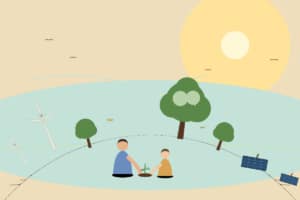
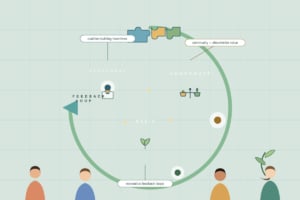
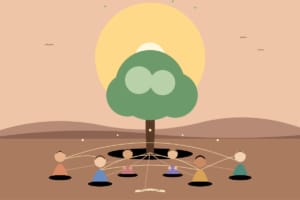
These Illustrations were built and drawn to portray a different way of being. What do you think?

FOR me to close here I must say that winning—if we must use that word—should mean creating conditions where everyone has the opportunity to flourish. It should mean a world where peace is not merely the absence of conflict but the presence of justice, equity, and compassion. It is a lofty aim, but not an impossible one. If even a small fraction of us commit to moving in that direction—toward nonviolence, toward stewardship, toward shared success—the change will be seismic. I promise you: start down that path even a little bit, and everything will begin to change. Hard as it will be.

Understand your growing edge

“Look well to the growing edge. All around us worlds are dying and new worlds are being born; all around us life is dying and life is being born. The fruit ripens on the tree, the roots are silently at work in the darkness of the earth against a time when there shall be new leaves, fresh blossoms, green fruit. Such is the growing edge. Look well to the growing edge.”

Howard Thurman

There are moments when the world around us feels raw and divided, when headlines and conversations seem to pull us apart rather than bring us together. In those moments I return to Howard Thurman’s words and find an invitation: to look for the small, persistent beginnings — the growing edge — where life quietly insists on renewal. Thurman’s lines are not a denial of loss; they are a map of hope. They remind us that endings and births travel side by side, that even in the shadow of decay there is an unseen labor preparing the next season.

Think of the growing edge as the slender green that appears on a branch after winter, or the first breath that follows exhaustion. As Thurman says, it is “the extra breath from the exhausted lung, the one more thing to try when all else has failed.” It is the steady, stubborn impulse that keeps us trying, learning, and reaching for what is better. This impulse is not grandiose or flashy; often it is quiet and humble — a neighbor listening, a teacher staying late, a community garden taking root in a vacant lot. Those acts, multiplied, become the scaffolding for something new.


Our world today bears many fractures — political rancor, social pain, environmental strain. Yet if we look only at what is breaking, we miss the synchronous birth of possibility. “All around us life is dying and life is being born.” If we pay attention to the growing edge, we can choose to live in alignment with that emergence. That doesn’t mean ignoring difficulty. It means placing our energy where life is being renewed: toward understanding, toward repair, toward building structures that invite flourishing rather than entrenching harm.

How do we tend the growing edge in the life we live? First, by embracing change instead of fearing it. Change is the canvas where new worlds are painted. Thurman’s vision encourages us to accept transformation as natural and necessary — to learn, adapt, and be curious about new perspectives. This openness creates the possibility of connection where division once stood.

Second, by intentionally looking for the positive developments that flicker into being. When we “look well to the growing edge,” we train our attention on those emerging efforts that point toward life: grassroots movements organizing for justice, teachers designing classrooms that foster belonging, neighbors organizing to protect a local river. These are the places where hope is not theoretical but practical. Thurman calls this “the upward reach of life when weariness closes in upon all endeavor.” Even a single upward reach can change the direction of a weary heart.

Third, by cultivating resilience. The growing edge is “the basis of hope” because it gives us evidence that renewal is possible. When we recognize obstacles as opportunities to grow, we reclaim agency. Speaking truth, showing up for others, and insisting on dignity in daily choices are acts that compound. They make us stronger and they signal to others that building anew is worth the struggle.

Fourth, by engaging in meaningful dialogue. When “times are out of joint and men have lost their reason,” Thurman suggests the incentive to carry on lives in relation, in listening and in sharing. Conversation done with patience and empathy can soften hardened positions and reveal common aims. It’s not always easy; it requires humility and courage to speak and to listen. But such exchanges often become the quiet work of the roots, preparing fertile ground for new leaves and blossoms.

I have to say without a shadow of a doubt there have been times in my life where I did not want to “engage in meaningful dialogue”. I even went so far as to decry the impulse to do so. How can you expect me to talk with “this person” for what they are doing around them?

It is HARD. It is WORTH IT!

Finally, by nurturing new leaders and ideas. “The birth of a child — life’s most dramatic answer to death” points to the profound power of beginnings. Supporting those who are starting — young people, marginalized voices, community organizers — replenishes our collective capacity to imagine and build alternatives. Their insights are often fresh because they are less encumbered by the constraints of what has always been.

History and daily life offer countless examples of the growing edge in motion: movements that transformed societies, technologies that reconnected people across distances, community responses to climate crises that turned despair into action. These all began as something small and persistent — a few people refusing to accept the finality of the old story.

There are challenges. Cynicism can blunt our sight; uncertainty can make us cling to familiar pain; idealism without grounding can falter. Thurman’s call — “Look well to the growing edge” — is precisely a remedy for these trials. It trains attention toward the life that insists on being born even in difficult soil.

So, when the world feels fractured, remember to look for the new leaves, the fresh blossoms, the quiet roots working underground. Tend to them when you find them. Join them when you can. In that practice, one extra breath at a time, we become participants in a larger turning — from fragmentation toward a renewed and shared life. Look well to the growing edge.

Folks, reading Howard Thurman is a life changing experience for those with eyes to see and ears to hear.

Peace and every good.

Detroit Eight: From Fury to Integrated Nonviolence

I grew up in Detroit, a city of factories and funeral parades, Motown records and mended fences. The streets I learned to walk on were loud with engines and louder still with ambition. In that city — in that era, especially — toughness was currency. I learned early to stand my ground, to protect my own, to make my small kingdom unassailable. I was quick to anger, 0 to 60 in a tenth of a second. I would ask myself, (because I did not like who I was) what’s wrong with me? No answer came that felt right, and the pattern repeated and repeated: I’d lash out, hurt people I loved, and then retreat into shame. For a long while that cycle defined me.

It took a long time — and a lot of embarrassing, painful failures — before I started to look for explanations that could become pathways instead of the same dead ends. That search, over the last 45 years, led me through countless trainings, retreats, and relationships. I studied plenty of systems and skills, but one of the most meaningful things I discovered was the Narrative Enneagram. Within that circle of nine, I found my number. I was an Eight! At first, being an Eight offered relief — finally a label that explained the force that drove me. But labels can also be prisons. I saw that I was not “integrated.” I was functioning at half speed, armed and dangerous, without most of the inward tools that make a life human.


When people talk about Detroit in the 1960s, they talk about dynamism and danger together. It was a place of industrial might — auto plants humming, assembly lines that made America mobile — and it was also a city simmering with social change, racial tension, and the scream of a neighborhood that felt squeezed. The Detroit of my youth carried the echoes of the Great Migration and the rising voice of civil rights. The city’s heartbeat was Motown: Berry Gordy’s miracle where Black voices found national airwaves and a kind of dignity that shimmered in lacquered records. Yet alongside that soundtrack was the sound of helicopters over riots, the crack of police batons, and the heavy grief of lives upended in streets that once felt safe.


In that environment, my Eight side learned to armor up fast. Eights, by temperament, protect themselves and others. We can be decisive, direct, and resolute. But when an Eight is not integrated — when the strength becomes defensiveness, when the will becomes domination — the results are destructive. I protected, but too often that protection translated into control. I could make things erupt and keep going long after the battle was over. Nonviolence? It felt distant, like a lighthouse across a foggy dreamscape — brilliant and unreachable.

The turning point was not a single dramatic event. It was a slow bringing together of consequences: the relationships I broke, the loneliness that followed victories, the growing realization that power without wisdom made me small, not big. I began to understand that being an Eight did not have to mean living in constant fight or flight. My work — a lifetime of practice — became a work of integration: bringing heart into will, softness into strength. Becoming a Narrative Enneagram Teacher was more than a credential; it was a map and a mirror. The map helped me see the directions toward healthier functioning. The mirror showed me what I had been avoiding: pain, vulnerability, and the need to learn how to love without expecting payment.


Part of what made this path possible was a latent contemplative streak. Even as a tough kid in Detroit, I had a part of myself drawn to silence, to long walks, to listening. But that contemplative part and my Eight-protector part were at war. It took years, and a lot of gentle but relentless practice, to let the contemplative side come in and lead sometimes. Nonviolence slowly revealed itself not as weakness, but as another kind of courage — a deeper, riskier courage that asks you to enter the world without armor and to offer dignity to people who may not deserve it by any conventional measure.


Nonviolence as an ethic is often mistaken for passivity. But the courage to be nonviolent is active; it is fiercely moral. It expects nothing in return. It sees others with dignity and honor. It listens more than it talks. It walks with, sits with, eats with, cries with, works with, and is present with. For me, this shift was seismic. I began practicing presence, sitting still with discomfort instead of scattering it with aggression. I learned restraint — not the brittle restraint of suppressing emotion so it later detonates, but the integrated restraint of feeling fully and choosing a wise response.

Detroit taught me a lot that helped on this path. In the 60s, the city showed both the worst and the best of human responses to pressure. It taught an appreciation for community — neighbors who checked on one another, churches that organized, and storefronts that doubled as meeting houses. It taught resilience. Coming out of factories and through hard winters taught people how to persevere; it taught me, too, that endurance can be tempered with tenderness. The music was a school of its own. Motown taught us how to turn sorrow into voice, outrage into rhythm, and marginalization into artistry. That artistry taught me how expression can be both a release and a bridge.


Becoming a healthy Eight required that I relearn power. True power, I discovered, is not about the loudest voice or the most forceful stance. True power is presence. It is the capacity to hold complexity without collapsing into defensiveness. It is the humility to ask for help. It is the willingness to risk being known as imperfect. I practiced sitting with people I feared, letting them see me, letting me see them. I practiced listening without planning my rebuttal. I practiced the kind of attentiveness that honors the other as worthy.


Was it easy? No. I would be lying if I claimed to have become saintly. Old habits die slowly and some are stubborn in their refusal to die. I am still not perfect. But the change has been profound. The storms have calmed. I have real peace now — a presence that feels more alive and less like a bluff. And that peace has given me the capacity to teach from a place of empathy rather than coercion. As a Narrative Enneagram Teacher, MCC (Master Certified Coach), and a Spiritual Director I don’t just help people identify their numbers; I help them see the paths toward integration: how to bring heart to will, how to temper justice with mercy, how to turn fierce protection into compassionate stewardship.


This journey taught me a lesson that reaches beyond personality systems: transformation is possible when courage is directed inward. The bravest thing I did was not a heroic outward act, but a quiet, repeated turning inward — to ask hard questions, to allow grief and shame to be felt, and to choose differently each time. From Detroit’s fists and furnace, I forged a softer kind of steel: resilient, flexible, and honest.


If you are an Eight reading this, or the loved one of an Eight, know this: your force can be your greatest gift when it is integrated with tenderness. Try to see the lighthouse of nonviolence not as a retreat but as a harbor. If you are someone who grew up in tough places — in cities of industry and unrest, where survival required a hard face — know you can let down that face without losing yourself. You can keep your dignity while showing vulnerability. You can hold others without crushing them.


If you are not an Eight, perhaps you recognize in this story a pattern you know well: a part of you that is reactive; a part that wants to protect at all costs. Our work is similar: to find the courage to be less sure, more present, more generous with silence and attention. To listen. To walk with. To sit with.


I won’t pretend the path is quick. It took me decades to move from a default of fury to a life where peace is possible. But the effort is worth it. The city taught me that too — to endure, to repair, to keep making music even when the world is cracked. There is a tenderness in Detroit that does not compromise grit. There is a sanctity in power when it is used to steward rather than dominate.


Try it. Sit in an uncomfortable silence, and don’t fill it with force. Walk toward someone you fear and stay long enough to see them. Speak quietly when the instinct is to roar. You might be surprised by how powerful you can be when you are softer. You might just like it.

Peace and every good.

Lynette’s DMin: Deepening Spiritual-Emotional Care

There are moments in life when personal accomplishment and communal mission converge in a way that changes everything. Lynette’s completion of her Doctor of Ministry  in Spiritual Direction is precisely one of those moments. This degree represents years of disciplined study, late nights balancing family and ministry, deep reflection, and the courage to push into new theological and practical territory. But beyond the diploma lies the person I’ve always known, compassionate, inquisitive, disciplined, and humble—someone who models faithful service and thoughtful leadership. Her DMin is not merely a credential; it is a deepening of the wisdom and skill she brings to everything she touches. For our family, for me personally, and for everyone connected to Spirit of EQ, it is a cause for celebration and renewed purpose. I am profoundly proud of Lynette, and my admiration for her grows with every step she takes in service to others.

As we move forward at Spirit of EQ, Lynette’s scholarship and pastoral insight will shape how we support individuals, leaders, and communities in cultivating emotional and spiritual maturity. The Spiritual Emotional Intelligence Assessment (the SEQ) has long been our foundational tool—designed to help people name where they are spiritually and emotionally, and to chart a path toward greater resilience, clarity, and wholeness. With Lynette’s advanced training in integrating theology, emotional intelligence and practical ministry, the SEQ will become even more robust. Expect enhancements that will weave research with pastoral sensitivity: richer assessment items that capture relational patterns and spiritual practices, evidence-informed interpretation guides, and culturally attuned frameworks that honor diversity of belief, experience, and context. The goal is not simply to measure, but to illuminate—helping clients see the intersections of their inner life, relationships, and spiritual formation so they can move toward healing and flourishing.


Practically, the work we will do with clients will deepen across several dimensions. First, our assessment process will be more integrative. Rather than offering a static score, the SEQ will provide a narrative map that identifies strengths, vulnerabilities, and possibilities—linking emotional regulation and spiritual practices. This map will be used in collaborative coaching and spiritual direction contexts, helping clients translate insight into sustainable practices. Second, our interventions will be more evidenced-informed and pastorally sensitive. Using evidence-based modalities—such as emotion-focused techniques, narrative practices, and contemplative disciplines—paired with Lynette’s pastoral spiritual direction training, we will support people in learning practical tools for self-regulation, conflict navigation, and meaning-making. Third, we will expand our training offerings for leaders and teams. Churches, nonprofits, and organizations seeking emotionally intelligent spiritual leadership will find workshops, retreats, and certification tracks that marry theological depth with applied emotional skills: how to lead with empathy under pressure, how to sustain pastoral identity over a long ministry career, and how to cultivate staff and congregational wellbeing without sacrificing mission.

One of the most exciting changes is how we will incorporate qualitative, story-centered work alongside quantitative assessment. People are not numbers; their lives are narratives. Lynette’s project work emphasized case-based learning—listening deeply to life stories, isolating turning points, and carrying those insights into tailored growth plans. At Spirit of EQ, that means every person who comes to us will receive an assessment that honors their story: how they were formed, how they are coping now, and what practices or relational shifts can help them move forward. For couples and families, this approach will allow us to identify not only individual spiritual-emotional patterns but the relational rhythms that either support or undermine flourishing. For leaders, it will highlight vocational strengths, blind spots, and sustainable rhythms of work and rest that preserve long-term effectiveness.

We will also broaden our community offerings. Lynette’s work has deepened our capacity to design group experiences that cultivate corrective emotional and spiritual experiences—small groups, peer supervision cohorts for clergy, and community healing circles that use structured practices to promote trust and transformation. These community modalities are powerful because they provide both accountability and belonging. People practice new ways of relating in safe contexts and then carry those practices back into their families, workplaces, and congregations. The ripple effects are significant. When a leader learns to regulate under pressure, their staff experience decreases in burnout and increases in trust. When congregation members learn compassionate ways of speaking about pain, the entire community can become a cradle for healing rather than a site of hidden suffering.

We are also committed to elevating accessibility and cultural relevance in all our work. Lynette’s DMin emphasized contextual theology through spiritual direction application and culturally sensitive care, and that emphasis will shape how we adapt the SEQ for diverse populations. Assessments, coaching curricula, and training materials will be offered in ways that respect linguistic, cultural, and theological differences—so that people from all backgrounds can find the language and tools that resonate with their faith and experience. We will invest in partnerships with local congregations and community organizations to co-create programs that address specific needs: supporting immigrant communities, equipping inner-city pastors, or providing transitional support for people moving through major life changes.

Finally, this degree enhances our capacity to contribute to broader conversations about spiritual and emotional health. With Lynette’s research skills and pastoral credibility, Spirit of EQ will produce resources—white papers, training manuals, podcasts, and workshops—that synthesize best practices at the intersection of faith and emotional intelligence. We want to equip not only individual clients but also the wider fields of ministry, counseling, and organizational leadership with tools that are both theologically grounded and psychologically sound. Our aim is to be a resource hub: offering practical, scalable interventions that help people live not just coping lives, but flourishing lives.

None of this would be possible without the love, perseverance, and integrity Lynette has shown throughout her journey. Her achievement is both deeply personal and profoundly public—an example of how disciplined study and faithful service can amplify a mission. I am endlessly proud of her and grateful for how she continues to shape our shared work. As Spirit of EQ enters this new season, we do so with greater clarity, deeper resources, and renewed hope: to help people name their struggles, cultivate practices that sustain them, build relationships that heal, and live into the fullness of their spiritual and emotional calling. If you or someone you love is seeking a compassionate, rigorous, and practical pathway to greater wholeness, we are here to walk alongside you—now with even more training, heart, and skill than ever before.

Desert Wisdom: Context is Everything

Reflecting on where we stand in life and the decisions, we make is not a luxury reserved for philosophers or the privileged; it is a practical necessity for anyone who shoulders responsibility—whether as a leader, a parent, a partner, or a friend. Every choice we make ripples outward: policies we endorse shape communities, the tone we set in our family’s shapes children’s emotional landscapes, and the way we respond to friends in crisis models what compassion looks like. When the pace of life accelerates and the noise of competing opinions grows louder, pausing to reflect helps us separate what is urgent from what is important. Reflection is the practice of stepping back long enough to see patterns, notice motivations, and weigh consequences. It gives us the mental and moral space to act with intention rather than reactivity, to lead with clarity rather than impulse, and to love with presence rather than distraction.

This capacity for reflective life is under strain in times of social, political, or spiritual disruption. Anxiety narrows our attention; polarization simplifies complex choices into binary demands; and scarcity—of resources, attention, or trust—pushes us toward short-term fixes instead of sustainable care. Yet precisely in such moments, reflection becomes more valuable. Leaders who cultivate a reflective habit are less prone to adopt popular but harmful policies; parents who slow down can respond rather than punish; friends who listen deeply become anchors when networks fray. Reflection is not passivity; it is a form of preparedness: an inner readiness that allows us to respond to external turbulence with steadiness, wisdom, and, crucially, hope.

There is deep, practical help available if we look to the contemplative practices of earlier generations. The desert mothers and fathers—Christian ascetics who retreated into the deserts of fourth- and fifth-century Egypt, Palestine, and Syria—faced their own forms of upheaval. Their world was marked by the collapse of old political certainties, shifting religious allegiances, economic insecurity, and the daily challenge of survival in a harsh landscape. Communities and institutions that once felt permanently secure were in flux. In that context, these seekers turned inward, developing practices designed to anchor the heart and clarify the mind: silence, disciplined prayer or attention, fasting, communal counsel, and a rigorous form of discernment aimed at identifying the motives behind action.

It’s easy to caricature the desert fathers and mothers as isolated oddities, but their practices emerged from and responded to real social stress. Solitude was a tool to remove the cacophony of public life and to make the inner life audible; silence and repetitive prayer shaped attention and broke cycles of reactivity; accountability to a spiritual community protected against spiritual pride and isolation. Their teachings were practical: notice the impulse before you act, name the fear or desire energizing you, seek counsel, and cultivate a steady interior ground that is not won by control but by clarity. In other words, their wisdom was not about withdrawing from the world out of despair but about preparing oneself to engage the world more faithfully.

Why should these ancient practices matter to us now? Because the human heart and the social dynamics that shape it have not changed as much as our technologies have. Fear, greed, ambition, envy, compassion, and love still govern behavior. Practices that train attention and regulate emotion speak to perennial human conditions. Integrating contemplative habits into modern life can provide two immediate benefits: First, they reduce reactivity and promote clearer decision-making. When leaders or family members cultivate habits of silence and discernment—simple practices such as pausing before responding, taking structured times for quiet reflection, or keeping a short journal of motivations—their choices are more likely to reflect long-term values than immediate pressure. This leads to steadier policies, more thoughtful parenting, and deeper friendships.

Second, these practices cultivate an inner reservoir of hope. Hope is not the same as optimism; it is a stable belief in the possibility of good action and transformation even when outcomes are uncertain. The desert wisdom teaches that hope is best sustained not by constant positive thinking but by disciplined attention to what is true and actionable in the present moment. Regular practices that calm the nervous system and sharpen moral perception—breath-focused attention, brief daily silence, or communal sharing of struggles—create psychological space where hope can grow. When we know how to listen to ourselves and to each other, despair loses its hold and the imagination for constructive possibility widens.

Translating these practices into contemporary contexts does not require cloistering oneself in a cave. Two specific, accessible ways to integrate ancient practices into modern life are particularly practical. First, establish micro-practices of silence and reflection embedded in daily routines. This could be a three- to five-minute pause at the start or end of the day, a brief breath-counting exercise before meetings, or a ritual of asking two questions before important decisions: “What am I afraid of right now?” and “What good do I most want to preserve or bring about?” These small practices act like cognitive reset buttons, allowing emotions to settle and values to guide choices.

Second, create structures of communal discernment. The desert tradition emphasized accountability and counsel: individuals would bring their struggles to experienced guides and to a community for testing and correction. In the modern setting, this might look like regular peer check-ins among leaders, family councils where major decisions are discussed slowly and with listening rules, or small groups of friends committed to honest feedback. Such structures slow decision-making constructively, expose hidden biases or blind spots, and distribute responsibility in ways that reduce burnout and improve wisdom. They also restore a sense of shared purpose and mutual support that counters the isolating effects of crisis.

Context matters: the desert mothers and fathers were responding to a world in transition—political empires shifting, communities redefining themselves, and everyday life marked by scarcity and vulnerability. Their practices were adaptive responses to conditions of uncertainty. They learned to live with less reliance on external securities and more on cultivated internal resources: discernment that distinguished helpful counsel from harmful flattery, silence that tempered projection and rumor, and community that corrected extremes of pride or despair. In short, their practices were designed to produce people who could act faithfully and resiliently when the external world was unreliable.

When we tie that ancient context to our own, the hopefulness becomes practical rather than sentimental. The same practices that helped people withstand the dislocations of their time can be adapted to ours, not by mimicking every ancient behavior but by translating the underlying principles: create space for reflection, practice disciplined attention, seek accountable community, and orient actions toward the common good rather than narrow expediency. By doing so we develop inner resources that make us less dependent on the immediate approval of the crowd and more able to pursue long-term flourishing.

If you are reading this and feeling the strain of present uncertainties, know that hope can be cultivated. Start small: choose one micro-practice of silence or reflection to try daily for two weeks. Invite one or two trusted people into a monthly conversation where you ask each other honest questions and hold one another accountable for decisions. Notice how these practices change not only your inner tone but the quality of your actions—decisions made with care, responses delivered with compassion, and leadership grounded in discernment rather than fear. Over time, these habits compound. They rebuild trust inwardly and outwardly, making it possible to navigate disruption with steadiness rather than fracture.

Ancient wisdom and present-day insight are not opposed; they are complementary. The desert mothers and fathers offer tested methods for cultivating inner freedom and clarity; contemporary psychology and organizational practices provide ways to embed those methods in modern life effectively. Together they offer a path not of retreat from the world, but of preparation for loving and courageous engagement with it. In a time that tempts us toward panic or paralysis, disciplined reflection, communal discernment, and small faithful practices can sustain hope and enable action that lasts.

Small Habits That Turn Self-Knowledge to Practice!

There were times when I felt utterly out of control, a realization that didn’t come with a map—only the uneasy knowledge that thinking harder wouldn’t change how I reacted. What helped was an ongoing practice of curiosity and embodiment: tiny experiments like three daily check-ins, a weekly trigger log, or a 30-day journal that forced me out of intellectual comfort and into the messy, tender territory of felt experience. Anchoring these practices in relationships—people who could notice with me, hold me accountable, or simply listen—turned isolated attempts into lasting habits. Those small, repeated actions gradually closed the gap between knowing and being, softening reactions and aligning choices so emotional intelligence shifted from a trendy idea to the steady, humane way I move through life—exactly the gentle, persistent work this blog’s conclusion urges you to begin.

Why “know yourself” matters Without a clear sense of what’s inside you—your triggers, values, habitual reactions, energy patterns, and underlying stories—you can’t intentionally choose how to respond. You’re more likely to react on autopilot: snap when stressed, avoid hard conversations, or keep burning the candle for approval. Knowing yourself gives you options. It gives you the ability to pause in that gap between stimulus and response and choose rather than default.

Instead of just writing narrative today I wanted to give you some tips and practice.

This post has 9 or 10 things you can do to improve knowing yourself. Lynette and I taught this when we were with Six Seconds and use it now in our coaching. We have seen results from these practices because it is not merely a cognitive exercise.

True self-knowledge is embodied. It combines accurate assessment with felt reflection and repeated practice. Here are practical ways to deepen the practice, plus examples you can start using today.

Let’s start with three daily check-ins and practice one:

One of the simplest, most powerful habits is to pause and name what you feel three times a day. Stop, breathe, and say aloud or in a journal: “I feel anxious,” “I feel tired,” “I feel excited.” Use plain language. Don’t argue with the emotion; label it.

Why it works:

Naming an emotion moves it from automatic reactivity into conscious awareness. Once named, it’s easier to examine the cause, notice bodily sensations, and choose an appropriate response.

Practice one:

  • Morning: Right after waking, notice and name one feeling (e.g., “I feel hopeful”).
  • Midday: Pause after lunch; name what’s present (e.g., “I feel irritated”).
  • Evening: Before bed, note the headline emotion of your day and one bodily sensation that accompanied it.

Use a body scan to root awareness Intellectual awareness without bodily feeling tends to stay theoretical. A short body scan links mind and body. Sit quietly for two minutes and scan from head to toe. Notice tightness, temperature, weight, or movement without judgment.

Why it works:

 Emotions show up in the body—tight chest, clenched jaw, shallow breath. Bringing attention to those sensations grounds your experience and makes emotional information actionable.

Practice two:

  • When you notice a strong emotion, pause and ask: Where do I feel this in my body? Describe it (e.g., “a knot in my stomach,” “heat in my face”). Breathe into that area for three breaths and note any change.

Run a 30-day reflection journal. Short daily entries over a month reveal patterns that a single insight won’t show. Spend 10–15 minutes each day with a prompt and at the end of each week, scan for themes.

Why it works:

Repetition uncovers recurring triggers, times of day when you’re drained or energized, and stories you tell yourself.

Prompts to use across 30 days:

  • What felt most alive for me today? What drained me?
  • When did I feel proud or competent? When did I feel ashamed or small?
  • What did I avoid and why? Whose approval did I seek today? At the end of each week, summarize the top three themes you see. Over four weeks, patterns start to feel like a map you can navigate rather than random events.

Map your triggers. Trigger mapping makes visible the situations that reliably produce strong reactions. For one week, log moments when you feel a spike of emotion: the situation, what was said or done, your immediate thought, and your bodily reaction.

Why it works:

You’re often reacting to old narratives or unmet needs, not the present reality. Mapping reveals those hidden drivers and creates space for choice.

Practice three:

  • At the first sign of irritation or panic, jot down: setting, other person’s words, your first thought (“I’m not good enough”), and the physical sensations. After a week, look for clusters—maybe criticism activates shame, or ambiguity triggers control anxiety.

Clarify values with trade-offs. Values become meaningful when placed in tension. Choose five candidate values (e.g., autonomy, family, security, creativity, community) then simulate scenarios that force trade-offs.

Why it works:

It exposes the values you will prioritize under pressure—not the ones you’d like to have.

Practice 4:

  • Scenario A: A secure well-paid job with predictable hours but limited creative freedom.
  • Scenario B: A lower-paid, uncertain job that gives time to create. Which do you choose and why? Try multiple trade-offs (family time vs. career advancement; stability vs. adventure) and notice where your real priorities lie.

Design tiny experiments:

The brain changes when it collects evidence that a new response works. Design small, low-risk experiments to test alternatives to habitual reactions.

Why it works:

Small wins build expectancy that you can act differently, and expectancy shifts behavior.

Practices:

  • If you snap when stressed, commit to a 30-second breath before responding to criticism for one week.
  • If you avoid difficult conversations, set a goal to raise one small concern in the next team meeting, keeping it under two minutes.

Practice with others—anchor learning in relationships Emotional intelligence is relational. Practice intentions with a trusted colleague, friend, or partner. Share a commitment (“I’m practicing listening without giving advice”) and ask for gentle feedback.

Why it works: \

Real relationships give safety, accountability, and real-time coaching. They also mirror blind spots in ways solitary practice can’t.

Practice five:

  • Pair up with someone for a weekly check-in. One person practices a chosen skill during the week and then debriefs—what happened, what felt hard, what changed.

Move from insight to embodied practice. Use role-plays, walking meetings, or breathwork to translate cognitive insight into felt experience. Embodiment helps the heart remember what the mind discovers.

Why it works:

The body stores patterns. Repeating new behaviors in a sensory-rich way helps make them automatic.

Practice six:

  • In a role-play, rehearse a difficult conversation multiple times, noticing voice tone, posture, and breath. After a few tries, the physical cues make the new behavior feel more natural.

Cultivate self-compassion rituals

 Knowing yourself also means treating yourself kindly when you fail to live up to your intentions. Create a short self-forgiveness script to use after missteps.

Why it works:

Compassion keeps you experimenting; shame makes you retreat. Self-kindness sustains practice.

Practice seven:

  • After a misstep, say: “I’m learning. What can I try differently next time?” Repeat a two-minute compassion practice in the morning—wish someone well, then extend the same wish to yourself.

Tell a new story about who you are Identity matters. Shift the story from “I get triggered” to “I notice when I’m triggered and pause.” Act in ways that confirm the new story; identity and behavior reinforce each other.

Why it works:

When action aligns with a coherent identity, change is easier and more sustainable.

Practice eight:

  • Write and repeat one identity sentence each morning for two weeks: “I am someone who pauses before responding when I feel triggered.” Notice situations where the sentence helps you choose differently.

Measure wisely. Measurement can support growth when used for learning rather than judgment. Track only whether you did the practice—did you pause, name, or experiment? Celebrate the attempts.

Why it works:

Simple metrics build momentum without turning practice into a performance.

Practice nine:

  • Keep a checklist of the week’s small practices (three check-ins, one breath-before-response experiment, one compassionate reflection). Note completion, not perfection.

 Knowing yourself is not the endpoint.

Begin with gentleness: change rarely arrives in a single, dramatic moment but in the small, deliberate acts that teach your body and heart new habits. By practicing curiosity, checking in with yourself a few times a day, keeping a trigger log, or committing to a short daily journal, you move from intellectual understanding to lived experience. Those tiny experiments—grounded in relationships that hold you accountable and compassionate—shrink the gap between knowing and being. Over time your reactions soften, your choices align with your values, and emotional intelligence becomes less a buzzword and more the quietly steady pulse that guides how you show up for yourself and others.

Presence as Witness: The Quiet Power of Showing Up

I remember the day my youngest child was born like a photograph in slow motion. It was 43 years ago, in a delivery room that smelled of antiseptic and hope. I promised myself I would be there — not because I thought I could do anything technical, but because something inside me insisted I needed to witness this threshold. What unfolded in those hours was not ordinary. It was raw, loud, fragile, triumphant. It was a miracle. And watching it changed me.

The delivery room was a small ecosystem of attention: my wife in the epicenter, midwives and doctors orbiting with focused calm, nurses moving with quiet purpose, machines humming like low prayers. My daughter arrived with a cry that sounded both new and ancient. As I watched, I wasn’t merely observing a birth. I was bearing witness — and that act of presence reshaped how I understood life, love, and what it means to simply be there for another human being.

What does it mean to “bear witness”? For me it meant surrendering the impulse to fix, comment, or perform. It meant holding a space with no agenda other than to attend. I saw my wife in ways I’d never seen before: fierce, vulnerable, triumphant. I saw my newborn, blinking and bewildered, entering a world I had only ever imagined for her. I saw the team at work, each person contributing a small essential piece to a profound whole. In the silence between contractions, in the quick exchanges of hands and glances, I learned something about the power of presence that has stayed with me for decades.

Bearing witness is not limited to dramatic life events like childbirth. It’s the practice of showing up when it matters: in grief, in joy, in mundane moments where another person might otherwise be alone in their experience. And you don’t need words to do it. Sometimes the most powerful language is the sturdy quiet of your attention. When you stand there and truly see what someone else is going through — without interrupting, diagnosing, or diverting — you give them something priceless: validation. You acknowledge their reality as worthy of being seen.

Why this matters now,

We live in a world of interruptions. Notifications, opinions, and obligations make us spectators to our own lives and to the lives of people around us. Bearing witness is an act of resistance against this fragmentation. It restores human connection. It heals small wounds before they become deep scars. It fosters trust and invites vulnerability. And it’s accessible: anyone can do it with a little intention and practice.

So instead of just talking at you I wanted to share two practical steps to start bearing witness today. They’re intentionally minimal so you can repeat them in any context — at home, at work, in a hospital waiting room, or on the street.

  1. The Two-Minute Presence Ritual
  • What to do: When someone begins to share something — good or bad — stop. Put down your phone, close your laptop, and face them. Take two full minutes of uninterrupted presence. Don’t plan a response; don’t analyze or advise. Let your eyes meet theirs, and if it feels natural, offer a soft touch: a hand on the shoulder or a brief squeeze of the hand.
  • Why it works: Two minutes is short enough to be manageable and long enough to break the loop of reactive listening. In those two minutes, you communicate that the person is important, that their experience matters. The ritual trains your nervous system to slow down, reducing the urge to interject or fix.
  • Where to use it: With a partner during a tough conversation, with a friend telling a story, with a colleague after a hard meeting, or even with a stranger who’s visibly distressed.
  1. The Question of Seeing
  • What to do: When someone describes an experience, ask one simple question: “What was that like for you?” Then pause and wait. Resist the urge to paraphrase right away. Allow silence to do some of the work. If the other person hesitates, follow up with: “I want to understand more. I’m here.”
  • Why it works: This question moves the focus away from facts and toward feeling. It invites deeper sharing and avoids the common trap of turning the conversation into a comparison or a problem-solving session. The follow-up line reaffirms your intent to be there for them without imposing your viewpoint.
  • Where to use it: In conversations about loss, transitions, parenting struggles, mental health, or moments of celebration where the other person wants to be witnessed rather than analyzed.

Stories that teach:

In that delivery room, I could have tried to make light of the pain to ease my wife’s tension, or I might have sought to take charge of logistics. Instead, I learned to breathe with her breath, to let my attention rest on the reality before me. Later, when friends and family told me about their own losses or breakthroughs, I found myself showing up differently — less eager to problem-solve and more willing to simply be present. Over time, the small acts of bearing witness built up a quiet network of care around the people I love.

People sometimes worry that bearing witness will overwhelm them, as though absorbing another person’s reality means carrying their whole burden. That’s not true. Bearing witness does not require you to fix anything. It asks only that you offer a portion of your attention and your heart. If emotions become too intense, honest boundaries are part of good witnessing: “I want to be here with you, and I also need a short break so I can come back present.” You can hold both care and self-preservation.

Who benefits? Everyone. The person being witnessed receives validation, validation that can transform isolation into connection. You, the witness, gain emotional fluency and deeper relationships. Communities become more resilient when people practice simple acts of presence. Teams at work perform better when members feel genuinely seen. Families heal faster when they adopt listening as an act of love.

A small practice, a big ripple:

The birth of my daughter taught me a simple truth: sometimes the most revolutionary act is to show up and stay present. You don’t need a certificate or training. You only need the willingness to slow down and give someone else a piece of your attention.

Call to action Try it this week. Choose one person — a partner, friend, coworker, or family member — and practice the Two-Minute Presence Ritual. Then, later in the week, use the question of seeing in a conversation where you usually would have jumped in to advise. Notice what changes: in the other person’s expression, in the flow of conversation, and in how you feel afterward. Share your experience with someone else or post a short note on social media about what you learned using #IWasThere. Invite a friend to try it with you.

If you want, tell me about your moment of bearing witness — what you saw, how it felt, and what changed. I’ll listen. No advice, no judgment. Just presence.

We don’t need words when bearing witness. We just need to be present. And in that simple presence, we can witness miracles — big and small — and be transformed by them.

Looking back on the birth of my daughter in that delivery room 43 years ago, everything contracted and expanded around a single point of arrival. My wife labored with a fierce determination I had never seen; her face was a map of pain and purpose. The medical team moved with practiced urgency, voices calm, hands steady. I stood at her side, breath matching hers, palms clammy but steady on her knee. There were moments of quiet concentration and moments of bright, startling noise — a mix of instructions, encouragement, and the rhythm of machines. Then the cry: a raw, immediate announcement that life had crossed the threshold. They placed my daughter on my wife’s chest and for a second the world narrowed to three breaths and the soft, wet weight of newness. Tears blurred everything; laughter and prayer braided together. In that instant I knew I had witnessed something holy — not because of drama, but because of the raw, shared humanness in that room. That witnessing changed me: it taught me the language of presence in a way no book ever could.